Healthcare Marketplace Startups and Regulatory Constraints
HIPAA breaches and fragmented state rules make compliance the real moat for health startups.

HIPAA: a Rule Governing Markets, Not Just Data
In its Cost of a Data Breach study, IBM found healthcare breaches cost a substantial multi-million-dollar sum on average, topping every other sector for the fourteenth straight year. A massive number of patient files, well into the hundreds of millions, were exposed during 2024. Those figures make HIPAA more than a compliance checkbox, creating real risk that shows up on investor documents.
See where marketplace-style firms break beneath that rule. Mental health telehealth provider Cerebral reportedly handed patient data to TikTok, Snapchat, and LinkedIn through ordinary pixels, the kind every growth marketer installs on autopilot. A tracking pixel, not a break-in, leaked Protected health details for 3.2 million people. Medusind, the medical billing vendor, suffered a breach reported in January 2025 which exposed data for hundreds of thousands of individuals, yet the covered entity wasn't where things went wrong. It was tied to the third-party vendor downstream for billing.
Change Healthcare is a systemic one. Ransomware disrupted pharmacy orders at tens upon tens of pharmacies, exposed data tied to 192.7 million patients, costing UnitedHealth Group several billion dollars. Afterward, OCR zeroed its focus on gaps spotted during risk analysis, old computers lacking multi-factor authentication, and taking too long to handle the breach. The Risk Analysis Initiative at OCR, starting October 2024, led to enforcement against multiple organizations that had skipped conducting a risk analysis.
For any marketplace, the point goes beyond one breach. A platform that gets data from providers, payers, or members takes on the compliance obligations of each node it touches. Any pixel, analytics script, or API link brings compliance risk automatically, so business contracts require frequent auditing reviews, and oversight must last far beyond signup. Investors already account for this. Poor HIPAA posture in diligence lowers valuations or stops transactions outright, so compliance matters just as much for valuation as it does for the law. HHS's draft changes to the Security Rule, pending finalization since 2024, are set to mandate encryption covering PHI while moving or stored, insist on MFA, call for risk assessments each year, and remove the safeguards tier marked "addressable". Even unfinished, it's already resetting the standards investors demand in a data room.
State Regulator Territory Beyond HIPAA and FTC
Direct-to-consumer health tools and most wellness products stay clear of HIPAA altogether, which founders tend to mistake for lighter regulation. Not true. Another regulator moves in to fill the gap, and it isn't toothless either.
Non-HIPAA vendors with private health files and outside providers fall under FTC's Health Breach Notification Rule, sweeping in health tools, smart devices, plus APIs joining them. The rule says companies must notify people whose data was exposed, must inform the FTC unless the breach hit under 500 users, may need to alert the press as well, and must usually wrap it all up in 60 days after discovering a disclosure. Firms in the digital health space regularly face FTC action over deceptive marketing and bad data handling, ending up with decrees requiring long-term protection plans plus outside assessments afterward.
State AGs now fill HIPAA's gap, and with more force, especially around private health data outside any covered entity.
For any marketplace including covered entities alongside buyers, it brings HIPAA enforcement for one group plus FTC enforcement for others, all at once, through that platform. Going national requires working through state-level compliance instead of using a single federal plan. Firms trapped within that gap, facing regulators from both sides, neither fully covered by health-privacy rules nor free from what that consumer-protection agency's authority can touch, usually face higher compliance cost burdens than those operating squarely under one framework. In that gap, founders suffer most, since it resembles a loophole yet behaves as a penalty.
How quickly AI or software can get to buyers depends on FDA oversight
Digital health startups are putting out AI tools faster than FDA's framework once did, but the gap is quickly getting smaller. From building to upkeep and documentation, the FDA's draft guidance sets rules for teams making AI-enabled medical devices throughout the product lifecycle.
The guidance requires explainability in real-world use. Regulators emphasize the need for explainability in AI-driven medical devices. Fairness validation and cutting bias are explicit requirements, not nice-to-haves, and continuous-learning models require regulatory oversight for revisions, which FDA's draft guidance on AI lifecycle aims to handle. Firms must maintain comprehensive documentation for AI-driven medical devices.
Startups selling worldwide deal with another layer beyond this. Under the EU AI Act, which became law during August 2024, transparency rules take effect ahead of August 2026, and enforcement of high-risk obligations lands somewhere from December 2027 to August 2028. That framework means AI-driven devices built for high-risk medical work get heavier scrutiny, so any business serving the US and EU must satisfy those regimes together rather than one by one.
A surprise wrinkle emerged in 2025. FDA layoffs kicked in April 1, 2025, after HHS said on March 27 they would slash policy and admin jobs. Most of FDA's policy team was folded under HHS for centralize policy, meaning FDA may issue a smaller number of guidances and rules. With no new leader yet, pending rules sit paused, making things less clear. Analysts suggest early-stage startups may face regulatory uncertainty in the near term.
But one date won't change. Matched to ISO 13485, the FDA's move off the Quality System Regulation onto the Quality Management System Regulation is due February 2026. Medtech startups still not ISO 13485 compliant should begin their gap analysis today, not after the break. Cybersecurity now serves as the cornerstone of submissions too. Medical devices require proof showing proactive risk management plus encryption alongside ongoing oversight baked within the regulatory submission rather than bolted on afterward.
Founders able to handle it get a clear edge. A business beating everyone through an untested new FDA pathway route or fresh category earns lead time rivals can never shortcut, regardless of their funding. Regulatory sign-off, in that way, acts like a moat rather than merely one milestone along the roadmap.
Healthcare Startups get pulled in Opposite Directions by the Federal Deregulatory Shift and State AI Rules.
Federal policy swung sharply deregulatory as 2025 and 2026 approach. A prior White House AI order was scrapped, a proposed rule would gut disclosure rules, and the administration has tried to block state AI statutes. State governments have taken an opposite course, assuming the ground federal policy vacated.
Most state AI laws aimed at healthcare come back to the same few ideas. Any choice about treatment or payment must rest with a qualified person, so AI may help but can't act alone. Many states now require disclosure when AI is used in healthcare decisions. AI tools engaging with protected groups must stay validated and monitored over time. Federal rules like HIPAA and the FTC Act govern AI in healthcare, with no clear exemption for automated decision-making. Some states have implemented restrictions on AI use in mental health treatment.
Compare federal deregulation with that same state work and the point is plain: the compliance load won't shrink much, but is redistributed widely among 50 separate state regimes. Founders betting that federal deregulation will ease things are betting on the incorrect layer of authority. A marketplace that serves nationally can hit conflicting AI disclosure rules, conflicting mental health delivery barriers, and standards on conflicting data simultaneously, based on the state where any customer lives. Today, Compliance lawyers must plan multi-state from the start instead of federal-first.
This change in core systems won’t hang around while all this gets decided. Anthropic's Claude for Healthcare and OpenAI's ChatGPT Health both launched days apart at the start of 2026. Big AI firms jumping straight to healthcare prove that layer is growing quickly, no matter what the regulatory rules say. Startups betting federal deregulation clears the way could see state enforcement closing it quicker than their roadmap allows.
Structurally Viable Business Models Shaped by Reimbursement Rules and Licensing
A healthcare marketplace that links people with providers, or handles bundling clinical care, inherits licensing requirements tied to what it's facilitating. Building it with software won't excuse a platform layer.
Telemedicine licensing shows this most clearly. Practicing beyond one state requires handling every licensing agency alone, so any marketplace built around telehealth delivery must track licensure requirements area by area rather than only locally.
Reimbursement brings another, bigger constraint. Fee-for-service remains what dominates the way healthcare gets money, so any marketplace built around value-based care, or bundled care, must negotiate those terms one by one with every payer it seeks. Compliance and malpractice protection are prerequisites for touching clinical delivery, not paperwork to file afterward. These are prerequisites for touching clinical delivery at all. Payer deals also take drawn-out buying cycles; startups often underestimate that and have a complete product left idle before money shows up.
Getting pills and tools cleared is the far side of that range. For Biotech companies plus medtech marketplaces, timelines run in annual terms, not shorter cycles, and it's built into the sector, not a problem a creator can work around.
Interest in AI-enabled tools across healthcare runs high. In the Purchasing Forecast on health IT from Sage Growth Partners, 57 percent of health leaders name AI as their top technology investment priority. But that interest becomes the scalable, billable business only if rules for licensing and payment through reimbursement support it. Founders who push the rapid-iteration, ship-first startup playbook into healthcare often waste twelve months discovering it won't work. Healthcare gives an edge to firms that weave compliance into their architecture from the start, since adding it afterward can force rebuilding the core product.
Compliance Architecture: Not Just a Cost Center but a Real Competitive Moat
Each regulatory rule that hinders a startup hinders its competitors too. It comes down to which startup first absorbs the cost, and with a stronger deal than the rest chasing it.
To navigate a new FDA pathway or new state AI disclosure framework ahead of rivals buys lead time, structurally protected. Rivals don’t get to shortcut that same approval path, however much money they spend. Being compliant also acts as a credential by itself. Health plans, payers, and big buyers see vendor compliance as needed for buying, while any startup HIPAA-compliant, holding SOC 2 Type II, and aligned to ISO 13485 can enter procurement pipelines blocked off to competitors that skipped it.
In diligence, Investors spot the same thing. A solid compliance posture lifts valuation, clears early blockers before they become killers. Poor posture has the opposite effect, discounting the term sheet or sinking a deal. Adding permission checks, logging plus data segmentation and PHI management to the architecture early saves money compared to retrofitting later, since doing so at volume usually requires rebuilding core product pieces while using up runway meant toward growth. Startups which pass on this work get shut out of corporate or health-system sales just when that income matters most.
These outside experts function as core support here. Strong healthcare startups hire healthcare attorneys plus regulatory specialists along with medical consultants from the start, then use them for real decision-making that stops pricey missteps in advance. Few groups are navigating several regulators together, so growing capability in-house gives a lead that compounds while regulatory rules get harder.
Concentration: Where Regulatory-Capable Startups Take the Lead
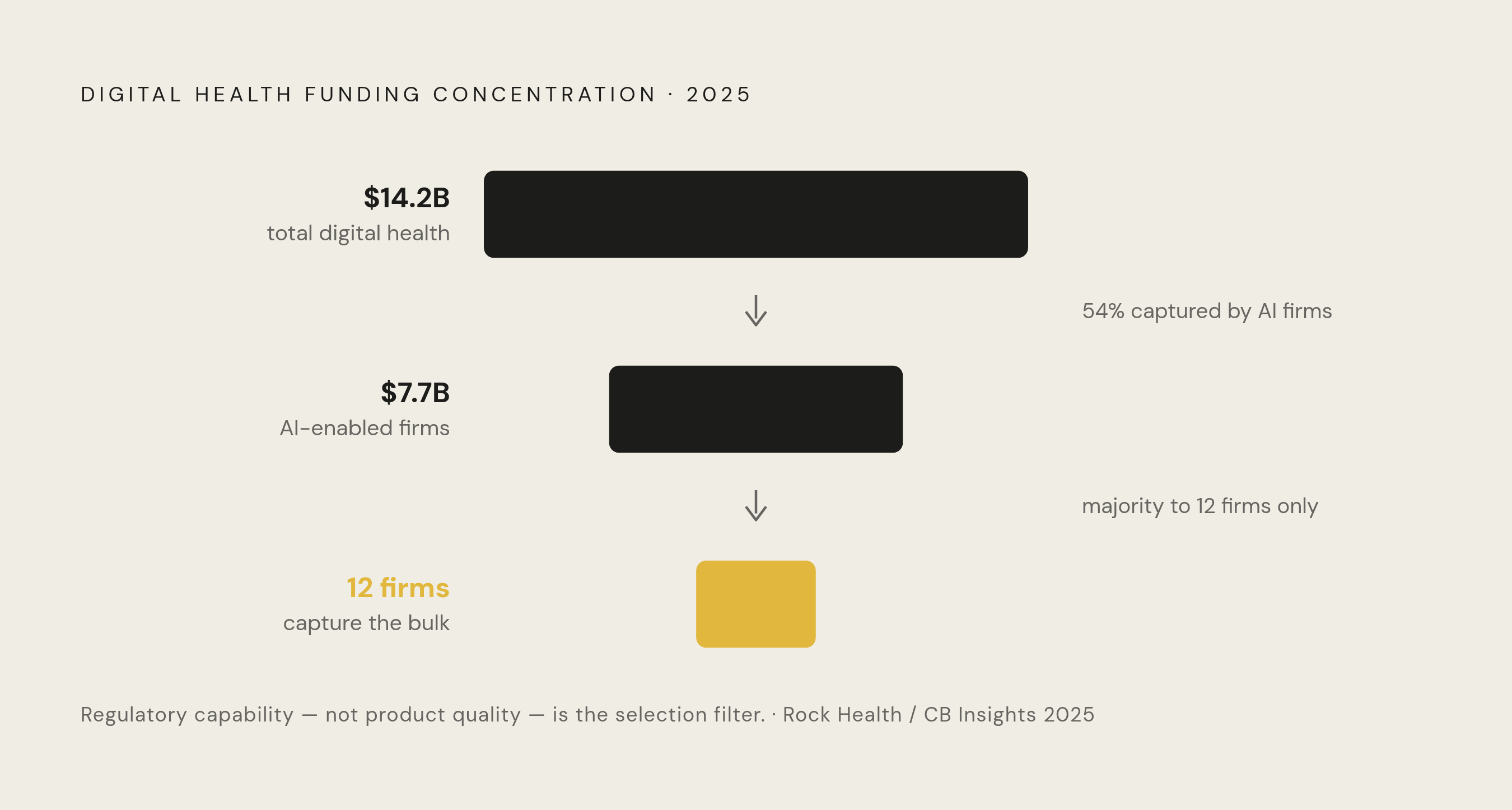
During 2025, Digital health investment reached $14.2 billion, climbing 35 percent over the previous twelve months to its biggest sum after 2022, while AI-enabled firms were pulling down 54 percent of it. Money is moving into this space's AI layer faster than nearly every software type today.
But how it splits up is where the sharper picture sits. During Q1 2026 only 12 firms took in most AI-driven funding. Instead of many firms hunting the same prize, this concentration shows backers rewarding a handful of startups able to work under HIPAA plus FDA and FTC alongside state AI rules all at once. For most founders, regulatory capability remains a secondary chore their counsel handles as the product gets built. That view is wrong. The product today is regulatory capability, picking a small handful of firms to win funding while a much larger crowd of others sit hoping a term sheet won't arrive.
Every new piece from marketplace crunch, as it's published.
Follow