Vertical SaaS Plus Marketplace Business Models
Vertical SaaS platforms multiply revenue by layering payments, marketplaces.

By stacking AI, finance that's embedded, plus marketplace revenue over a subscription foundation, Vertical SaaS companies transform a product that's sticky into something compounding. Owning a single industry's full workflow, not shipping some generic tool to many, leaves the platforms with an edge pure horizontal software will never match. Penetration rates in most vertical markets remain below 15%, meaning the bulk of digitization is still ahead. The facts show companies backing horizontal tools now are fighting the workflow. Most of those calls miss, and the retention figures below show why.
How workflow ownership translates into retention advantages pure SaaS cannot match
The lock-in idea becomes real on a balance ledger once you look at Retention numbers. ServiceTitan's S-1 disclosed gross retention over 95% across ten straight quarters, with net dollar retention over 110%, inside its customer base made up of plumbers plus electricians and trade service technicians, hardly exactly software's usual first adopters. Stickiness holds even when the customer has zero technical experience, no IT team vetting the deal, no CFO doing build-versus-buy math before they commit.
A caveat deserves attention: the platform's advantage holds only when it serves as the industry's source of truth. A scheduling widget on the edge of a plumber's busy day won't be handled this way, or be priced as if it will. Veeva Systems proves what total workflow ownership looks like when it gets big. Serving mostly life sciences companies, with a smaller footprint in adjacent regulated industries like consumer goods and cosmetics, Veeva reported $2.75 billion in revenue for fiscal 2025, subscription services growing 20%, operating income up 61% to $691 million, and a market cap above $42 billion. That kind of Retention becomes the precondition behind what comes next: the argument fails if the company keeps leaking customers each period.
The revenue layer architecture: what gets stacked on top of the subscription
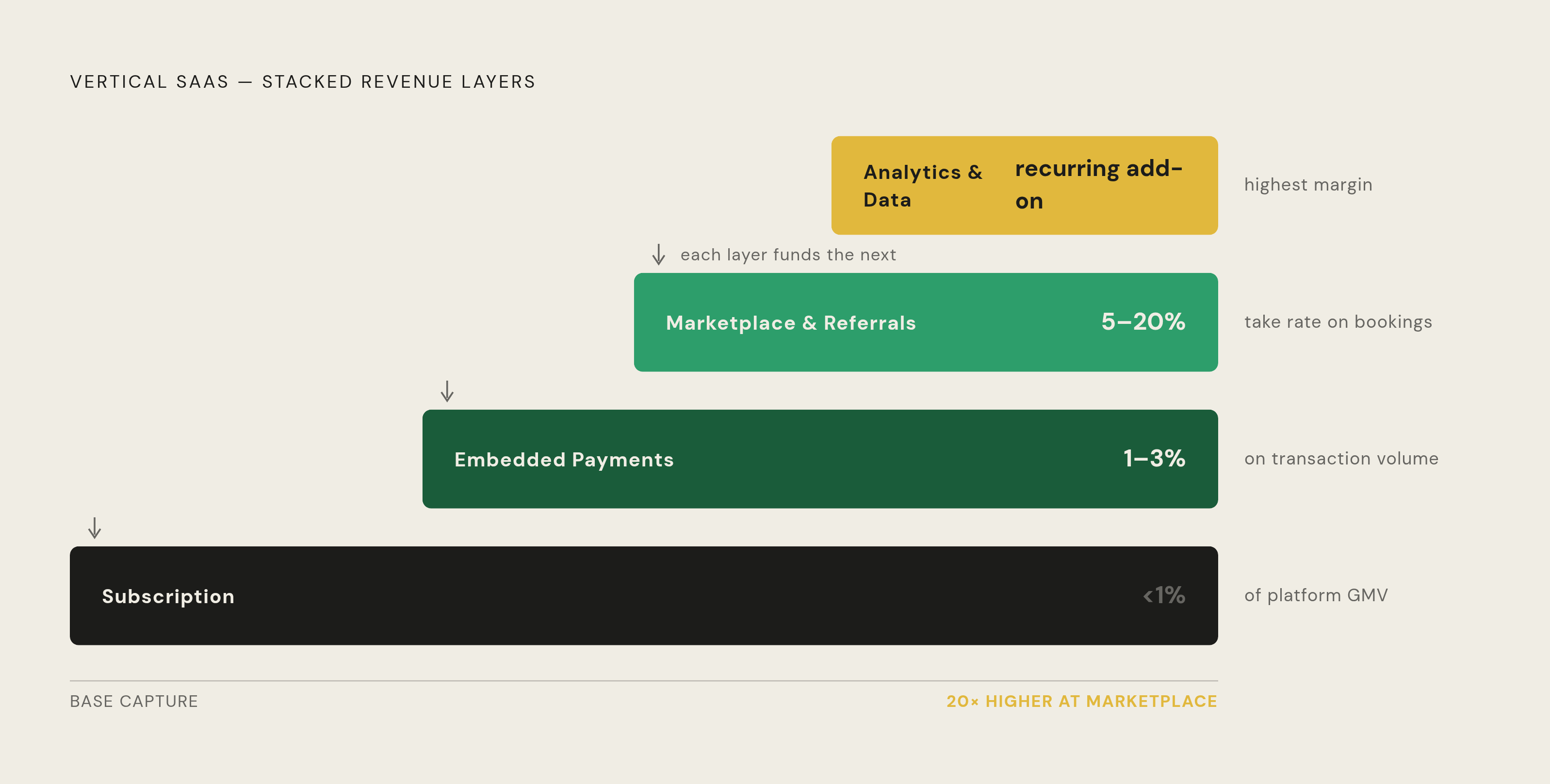
By itself, Subscription revenue monetizes at less than 1 percent of everything moving across the platform. Marketplace transactions monetize at 5 to 20% of bookings, orders, or referrals. This gap, from what a SaaS fee captures to what transaction fee captures, explains why vertical platforms pursue multi-product plans, not single-product ones.
Once a vertical platform builds real workflow depth, Four layers usually appear. Embedded payments plus fintech cover lending, invoicing, and risk protection woven through the workflow, usually taking 1 to 3% on transaction volume. Marketplace and transaction costs, taken as suppliers and practitioners meet customers through the platform, are 5 to 20%. For sectors like healthcare, law, plus finance, rules aren't optional, so add-ons that handle them drive real retention. Analytics and data tools, drawn from anonymized, aggregated customer information, are then offered industry-wide for benchmarking, forecasting, and similar uses.
According to Tidemark's 2025 Vertical, SMB, SaaS Benchmark Report, 59% of all companies offer multiple items, while 41% remain single-product. Those numbers show there’s still room for multi-product growth, not taken. Per Andreessen Horowitz, fintech by itself can boost revenue for each customer 2 to 5-fold, and adding more products, fintech among them, can push the platform's addressable market past twice its size.
The four layers all work through one flywheel, but at separate rates. The product gets better as workflow data grows. With a stronger product, lock-in deepens. That volume funds the following layer, and stronger lock-in pushes more transaction activity across the platform.
Embedded finance as the revenue multiplier that reshapes the P&L
Embedded finance revenue is projected to reach $51 billion by 2026, up from $22 billion in 2021. That's no longer a niche line item tucked under "other revenue" on a slide. Frequently, that figure tops the whole slide.
Toast shows best in public what this turns into once it grows up: $5 billion drawn from money products versus $936 million generated by subscriptions to software. At that scale, Payments is no longer a SaaS complement. It’s swallowed all of it. ServiceTitan's IPO filing showed a revenue split of 71% subscription, 25% usage-based fintech, and 4% services, a fintech wedge absent half a decade ago. Shopify's Merchant Solutions segment, covering Payments, Capital, and Balance, made up 73% of total revenue in 2025 and was on track for roughly 79% by the first quarter of 2026, arguably the clearest blueprint anywhere for what full monetization of a workflow eventually looks like. Gusto brought in $975 million of revenue during 2025, a 30% jump from twelve months earlier, as money tools layered onto its core payroll software drove more of the total.
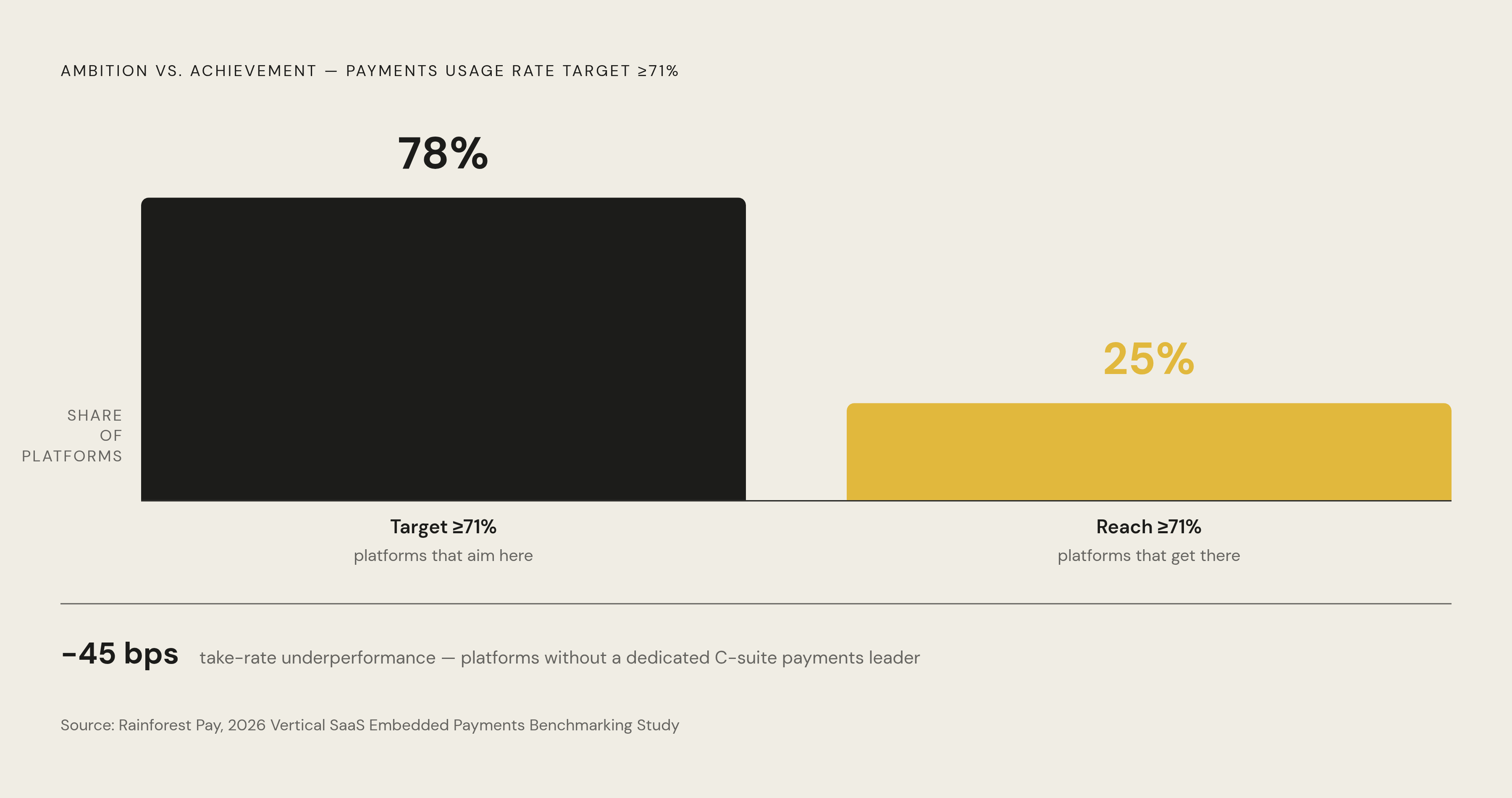
Lots of platforms miss this. Rainforest Pay's 2026 Vertical SaaS Embedded Payments Benchmarking Study found that 78% of platforms aim for a 71% or greater usage rate, yet just 25% managed to get there. That same gap holds across vertical, ARR range, or time with payments, showing a delivery issue rather than any market-readiness matter. That study found you gain 45 basis points on the median take rate by putting a dedicated payments leader in the C-Suite instead of leaving the role empty. It comes down to staffing, not some big-picture question. Firms that bolt payments onto the group handling core subscriptions end up in that 25%.
The marketplace layer: connecting buyers and sellers inside the workflow
Industry-specific buyers, sellers, suppliers, practitioners, customers, and subcontractors get linked by a vertical marketplace within the workflow itself, without routing anyone to an outside shopping platform. This platform already sees what each customer buys and from whom, so the supplier fit sits in the software, not some bolted-on product in a marketplace.
A subscription by itself never comes near that 5 to 20% take rate for referrals, bookings, and orders, which this positioning makes happen. Plus this marketplace layer yields an outcome pure SaaS structurally can't: a network. As more suppliers come in, buyers get more from that platform. When buyers transact more, that platform becomes worth more for suppliers. That cycle keeps building in a way no subscription fee can touch, no matter how solid the software runs.
Combine network effects alongside workflow switching costs, plus transaction data piling beneath both, and you build a protective moat standing qualitatively apart from every single layer operating by itself. One industry proves the point: Procore's recurring revenue topped $1 billion in 2023, and it ended 2024 expecting $1.14 billion for the full-year. The same holds for Healthcare and on-site operations, where buyers and sellers transact nonstop and the platform runs between them. One sprint is enough for a competitor to match what a product does. To copy a supplier network, with transaction records embedded in the workflow, is much harder, which protects the company.
AI as the next control point that deepens the flywheel
Since they collect domain-specific data with volume and a specificity that no generic tool could equal, Vertical platforms keep their edge against horizontal tools in AI. AI performs at its peak when domain-specific data makes sharply tailored training possible, so vertical SaaS companies are well placed to capture more of that edge compared with horizontal rivals.
The gap becomes clear quickly. Any horizontal CRM applies generic prospect ranking identically for one dentist or one trucking firm. A given vertical platform for one field or single specialty can tell which current customers might soon churn, which work may go over costs, which outside suppliers often arrive behind schedule, and its specificity grows sharper with time. The platform stops being a place where past events sit and starts doing the work: scheduling gets automated, regulatory requirements confirmed, overdue payments collected, suppliers assigned to the right tasks.
Switching costs deepen as a result. When a customer uses the platform for more time, AI knows more about that customer's operating habits, making it more difficult to leave and begin teaching it again in another place. Venture capital invested heavily in vertical SaaS in 2025, backers favoring companies that control end-to-end workflows across an industry, with AI a leading driver. Hyperspecialization sharpens this further: AI lift is largest for very narrowest platforms, with sub-verticals in healthcare, like dermatology, or trades like lawn work plus roofing, plumbing too, each training AI using data sets narrower but far richer than what any horizontal competitor might assemble.
What the compounding model looks like when all layers are operating together
From start to finish, the flywheel operates like this. Subscription revenue funds building the product and finding customers. Depth of Workflow generates volume of transactions. That volume powers embedded finance earnings and produces data alongside it. That data helps AI systems improve the workflow product, and when the product gets better, it deepens ownership, bringing in suppliers plus buyers across the marketplace. Once the Marketplace gets thicker, transaction volume climbs again and compounds onward.
ServiceTitan shows the idea firing on every cylinder at once, with scheduling, dispatching, invoicing, payroll, plus embedded payments, each shaped to fit how a shop really works. Its IPO valued the business at $9.6 billion, with retention over 95% gross and over 110% net dollar retention, numbers that seem reasonable only when each layer does its part.
Another variant is out there too: a business builds its horizontal base as a platform, then layers vertical tools over it. ServiceNow's industry workflows and Salesforce Industry Cloud both fit this model, capturing that wide addressable market which horizontal reach provides while still holding onto their retention with win-rate gains thanks to vertical depth. Veeva's numbers reveal the valuation impact: a $42 billion market cap built on revenue of $2.75 billion means investors value embedded items, workflow ownership, plus that data moat as one package, rather than subscription income alone. A single layer alone gives no unbreakable moat, yet every layer cuts the cost of adding another and is one a competitor would struggle to displace. The cumulative result, not a single layer, explains the defensibility.
Where the model is hardest to execute and what separates platforms that compound from those that stall
If the platform never really owns its core workflow, that retention advantage evaporates. No tool placed at an operations edge for a customer's team gains lock-in, however well built, since their company never depends on it. Confusing solid capabilities with workflow ownership is the trap to avoid. Those two differ, and just one retains customers above 110% for ten consecutive quarters.
Payments adoption is the place where ambition and the ability to deliver part ways most obviously. Rainforest Pay's 2026 study shows 78% of platforms target adoption past 71%, yet just 25% reach it, a gap that holds in every vertical and ARR tier. One reason is clear: platforms lacking one dedicated C-Suite payments leader underperform 45 basis points below median take rate, so organizational readiness must come before monetized embedded finance, not later.
A cold-start issue comes with Marketplace layers. Network effects come from hitting liquidity rather than being something a business can flip on, and pulling in buyers as well as suppliers toward a place where each finds real worth in the marketplace typically demands long-horizon capital plus, in many cases, explicit subsidies for one cohort while the other catches and closes the gap. AI has the same precondition: its advantage appears only after one platform has gathered the domain-specific data needed to teach a system that can beat any generic one. Even with great developers, Early-stage platforms working with small data sets lack it for now.
But the most obvious danger of all comes next. Tidemark's benchmark found in 2025 that 41% of SaaS vertical companies remain single-product, with subscription revenue alone and no extra layer added. This doesn't automatically mean failure, yet those companies won't be generating any flywheel effects shown earlier. Sequencing drives results: payments ahead of marketplace, then marketplace before data tools, with AI stacked over the data itself, and you build each new layer only after workflow ownership below can hold it up. Break the order and your flywheel spins too slowly to count for anything.
Notes
- Vertical SaaS market size: Growth, niches, and key players
Provided the penetration rate figure, Veeva's fiscal 2025 revenue and financial metrics, and market cap figures cited throughout the article.
- 2025 Vertical & SMB SaaS Benchmark Report | Tidemark
Provided the benchmark data showing 59% of vertical SaaS companies offer multiple products versus 41% remaining single-product.
- https://hgcapital.com/insights/orbit-podcast/ai-control-points-and-the-next-wave-of-vertical-saas-with-tidemark-capital
Informed the discussion of AI as a control point in vertical SaaS and the argument that vertical platforms accumulate domain-specific data advantages over horizontal competitors.
- https://www.signalfire.com/blog/frameworks-for-ai-vertical-saas
Informed the framework discussion of how vertical AI platforms deepen workflow ownership and switching costs over time.
Every new piece from marketplace crunch, as it's published.
Follow