Seller Onboarding and Activation in Product Marketplaces
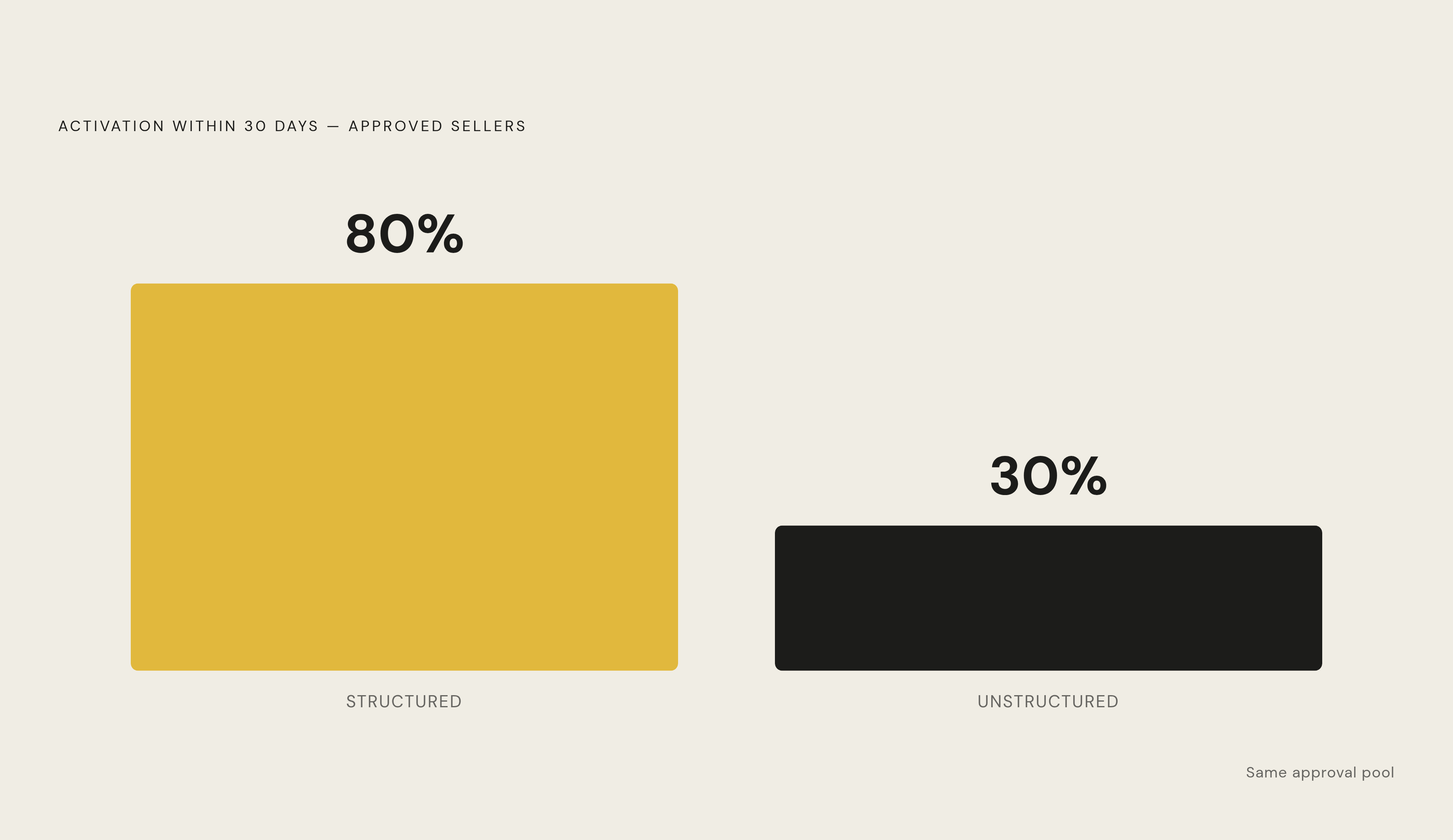
Structured onboarding converts four times more sellers into active transactors within thirty days.

Product Marketplaces: Activation and Seller Onboarding.
The gap between approved and active sellers, a marketplace's most expensive problem
Seller onboarding in a product marketplace acts as a conversion funnel, and whether it produces a high activation rate or not depends on how intentionally each step from identity verification to the first completed sale gets built. It's a conversion funnel: whether sellers reach a high activation rate depends on how intentionally every part, from identity verification to first completed sale, is built and automated. That difference feels pedantic until you see the volume moving through these platforms. Marketplaces drive roughly 67% of global ecommerce activity, with worldwide marketplace GMV expected to hit $3.8 trillion by 2026, and the supply side feeding this volume faces growing strain.
This shows up clearest at Amazon. The platform added just 165,000 sellers in 2025, down 44% from 2024, and its active seller count slid from 2.4 million in 2021 to 1.65 million by late 2025. Marketplace Pulse calls it the Great Compression. With fewer new sellers joining the pool, a platform's approved sellers are no longer a rounding error but its whole growth strategy.
And here's where the data turns rough. Structured onboarding converts 80% or more approved sellers into transacting ones in 30 days. Without a structured setup, pulling from that same approval pool, turns only about 30%, well under the rate a structured approach gets. This isn't a marginal improvement. An organic supply side grower looks nothing like a marketplace forced to keep pouring new approvals into a hole it can't keep plugging.
Approved sellers that don't activate aren't a neutral expense. They inflate a funnel that looks strong on a dashboard without adding liquidity, consume time on questions that produce no listing, and keep the marketplace's real assortment thinner than the seller count says. Buyers sense that thinness even without naming it: fewer options, stale stock, categories that seem full until you actually search.
Onboarding, and where most platforms draw the line too early
Registration and activation often get used as synonyms, but they are not. Registration is just an account being created. Activation happens when a seller lists goods and has completed their first transaction. Treating them as the same is the single most frequent operational mistake in marketplace design, and a costly one, since any metric relying on registration numbers will overstate how healthy the supply side really is.
Full onboarding includes identity verification, compliance, signing agreements, setting up the storefront, configuring logistics, and activating payment or payout. It is far more than a simple signup page followed by a verification message. The only metric that matters tracks time-to-first-sale rather than time-to-account-creation, since a signup without a sale earns zero for both sides of the marketplace.
Onboarding's priorities vary with the point a marketplace sits at in its lifecycle. At launch, the focus is pulling together a starting cohort sized to reach a viable assortment before buyers can access the platform. During expansion, onboarding turns into a constant process: vetting, recruiting, and activating sellers to broaden category coverage and widen geographic presence. At a mature stage, the focus shifts: making activation faster, cleaning up catalog standards, tightening compliance, and letting sellers get onboarded without the platform's own team running the process.
The recurring misconception is treating onboarding as a one-time admin step, not a planned path with explicit milestones and drop-off that is measurable. Nearly 75% of users ditch a product entirely after the first several days if onboarding trips them up, and a marketplace cranks up that danger because buyers and sellers have to come online at roughly the same pace. When a seller adds no product, they're functionally like a buyer who can't buy anything.
The seven-stage funnel from application to first sale
Registration is where sellers quit first, so get them signed in and pointed in the right direction instead of extracting everything the platform will ask for later. The best-performing flows keep registration to 4 fields or fewer, usually identity, email, shop title, and password, with the rest handled afterward. Showing a visible progress indicator such as "Step 1 of 5," reframes things into a countdown, not an open-ended task. Auto-populating fields the platform already gathered at signup dodges the insult of forcing a user to retype identical details.
At the funnel, what matters is keeping sellers informed. Sellers should understand what verification is for, which documents count, the typical timeline, and what to expect after a rejection. A verification checklist given to a seller before they begin uploading anything cuts abandonment caused solely by uncertainty about the process ahead.
Step 3 is where sellers accept terms: fees, payout timing, prohibited items, refunds, and dispute rules. Use scannable bullets for "Key Rules," paired with explicit accept clicks. Sellers who fail to absorb the rules now will learn them via cancellations, complaints from buyers, and dispute claims, draining the platform far more than a five-minute glance.
At this point comes storefront setup: logo, description, banner, seller details, and rules for refunds, the fields buyers find populated. Aiming for 70% or higher on completeness keeps the process measurable without requiring perfection from a seller before launch. Sellers skipping branding for their storefront tend to stall at the step of product listing, because having an online profile feels different from creating a page that looks like a shop.
Product listing and catalog setup at stage five demands the closest attention to sequencing: a progress indicator showing "Step 1 of 5" gives sellers forward momentum, and for sellers of physical products with many SKUs, a CSV template with pre-mapped fields matters because most CSV imports fail at the field-mapping step. For a seller, the real "aha moment" is seeing their first product appear and get its first click, with the goal of compressing the wait for that moment to ideally under 48 hours after approval. Bad or unevenly formatted product data tops the list of why listings get rejected, and every resubmission adds days to a go-live that was already behind.
Payout setup comes next, feeling more like proof of confidence than a technical step, covered in full below. The final step covers operational readiness: shipping rules, how to handle disputes, cancellation rules, and the targets set for each seller. Digital-goods sellers usually complete a full onboarding flow within one to three days; high-volume physical-product sellers might require up to two weeks, and platforms communicating this upfront spare the frustration of sellers assuming there's a problem. In Mirakl ecosystem data, time-to-activation has a median of 28 days, the fastest sellers activating within two weeks, while onboarding that stretches beyond fourteen-day materially increases churn.
Seller drop-off points and what the completion data reveals
Only 19.2% of sellers hit full onboarding checklist completion, so the typical one who enters an onboarding flow drops out. Most sellers, not only a tail-end few, never complete onboarding, and that figure should reframe platforms' approach to their funnels.
Most platforms compared against those standards miss both. Compounding this, 74% of sellers say marketplace onboarding is unnecessarily hard, and that frustration clusters at compliance and verification, matching where the funnel data reveals steepest drop-offs.
Most of it comes down to 3 structural issues. Front-loading demands too many details from sellers before they've seen anything resembling benefit from the platform. Ambiguity keeps sellers guessing about which paperwork to submit, each step’s timing, and what to do after a rejection. Momentum gaps hit hardest through silence: nothing nudges the seller toward a next step, nothing shows real progress, and no follow-up fires when they've sat inactive for days.
It doesn’t stop with the sellers who go through it. Sellers who hit a rough signup share it with others, and that chatter spreads across the marketplace quicker than most teams think. How well a marketplace onboards sellers usually decides whether its seller pool fills on time or late. Completion rate, put simply, is one sign of activation, and both measures are the product of choices, not a fixed trait in sellers who arrive. FinTech platforms finish at 24.5% completion, while businesses doing $1–5M revenue hit 27.1% completion: neither comes close to the 75%+ completion rate that drives activation. Vendor onboarding completion has a benchmark of 70% completion rate and an 80% target, while first listing averages 4 days versus a target under 48 hours, so most platforms miss both goals.
Compliance verification without killing momentum (KYC, KYB, and risk-tiering in practice)
Compliance isn't negotiable. Badly implemented compliance kills momentum, and proportionate verification is the fix, not the strictest verification applied uniformly to every new user. KYC is for sellers; KYB is for companies, with business verification heavier on purpose through entity verification, ownership checks, sanctions review, and paperwork before funds can be sent.
The work doesn't stop after a seller clears sign-up. Anti-money-laundering checks continue continuously, and the duty is visible in the filings: in fiscal 2024 alone, institutions submitted 4.7 million SARs.
Risk-tiering resolves the conflict between rigor and moving fast. Verification should adapt to the seller, transaction history, geography, and product category, since not every applicant requires the same scrutiny, and putting heavy friction on any low-risk seller just leads to abandonment without adding protection. Category triggers are now routine: branded electronics, jewelry, cosmetics, and similar luxury items usually need stronger evidence plus approval that is category-specific; age-restricted or restricted things call for business verification and the right licensing paperwork; and a sudden spike in orders, an unexpected payout shift, or a climbing dispute rate can force fresh re-verification before money goes out.
Compliance mistakes carry serious costs. Temu handed the DOJ and FTC $2 million in September 2025, marking the first time that provision was enforced. That consequence makes "proportionate but real" verification the only defensible design choice, rather than a nice-to-have. Practically, the fix is about talking to people: give a verification checklist to sellers before they begin uploading anything, share progress so no one sits wondering if their form vanished, and say why each requirement exists, since a seller who gets the point of a document request will usually send it.
Payment and payout setup as the final activation gate
Sellers who struggle to connect a payout method fast, or who have no idea when their payment will show up, delay activation nearly every time. This is about confidence, not motivation, and it should be handled that way.
Before the onboarding flow, a marketplace must resolve the Merchant of Record issue, as it shapes downstream. Neither setup is universally best; the decision determines who takes the hit when things break.
A costly infrastructure-layer trap looks like this: one provider runs customer-facing payments, another covers seller payouts, each carrying separate contracts, integrations, and reconciliation flows designed without any way to share data. It means fragmentation slows onboarding and increases error rates, causing reconciliation headaches over time. Sellers also want more now. Approaches like TikTok Shop compressed the once-normal weeks-long onboarding cycle to only two business days, so sellers compare every other platform with that benchmark.
A handful of infrastructure providers illustrate the variety available. Stripe Connect is API-first and customizable, so most vendors clear KYC fast while slower ones finish resolving in one to 3 business days because its verification flows adapt by region and business. Tipalti centers on high-volume payouts plus payables automation, while this category's leading payment automation can shrink payout processing by up to 50%. Adyen for Platforms handles enterprise-scale payment work across the globe. Each works for a different situation, and the best fit depends on transaction volume, geographic coverage, and how much compliance work a platform will take on itself.
Localization compounds these problems. Tailoring Onboarding flows to each region has boosted payout completion by up to 16%, and certain countries now approach a 50% approval rate. The simplest fix for nearly any platform is free to build: warn sellers upfront that verification may require a few days. Sellers who read a routine processing delay as a sign it's broken are the ones most likely to drop off.
Catalog setup and product data as the underestimated onboarding bottleneck
Brands bringing incomplete, inconsistent, badly formatted product data face the worst onboarding delays, since platform queues toss out non-compliant listings immediately, and each resubmission cycle costs the seller extra days. This is where well-meant plans from higher in the funnel quietly fall apart.
Sellers' actual aha moment is that first product pulling its first click, so catalog setup should focus entirely on shrinking the path to reach it. Sequencing matters enormously: sellers starting with bulk or CSV upload first tend to feel overwhelmed by too many fields and abandon before they finish, while sellers guided through a single manual listing first tend to take that momentum into bulk tasks next. Physical-product sellers juggling many SKUs need a CSV template where fields are pre-mapped, because field-mapping mistakes cause most CSV imports to fail, and fixing that removes the single biggest hurdle.
Catalog quality still matters after a seller is up and running. Marketplace algorithms judge post-launch results to set what a seller earns: doing well expands allocation plus visibility, doing poorly shrinks both and limits how big that seller can get. Early catalog choices have lasting effects.
Over time, the stakes for good product data are growing. AI-driven discovery depends entirely on product details that are structured, complete, and machine-readable, while Gartner's projection of a 50% or greater drop in organic traffic by 2028 from generative AI means sellers with tidy catalog data today get picked up by shopping agents.
AI compressing weeks of catalog work into hours
With many SKUs, physical-product sellers can receive a CSV template with fields pre-mapped, as most CSV imports fail during the field-mapping step.
The process is straightforward, even when the tech behind it isn't. A CSV template whose fields pre-mapped matters helps physical-product sellers handling many SKUs, since most CSV imports fail during the field-mapping step, and AI-driven discovery depends on structured, complete, machine-readable product data, leaving sellers with high-quality data positioned for AI discovery. That collapses the space between "seller approved" and a seller having a live, clickable listing, and if a marketplace's activation rate looks like 80% or like 30% depends on closing that gap.
This doesn't replace the funnel's earlier stages. Verification must still run, agreements require signatures, and payout details must be linked. But by removing the single labor-intensive step that keeps a verified seller from a first sale, catalog automation removes the gap where activation-rate gains are clearest, since incomplete or badly formatted data already drives listing rejection and resubmission delay. Marketplaces that treat onboarding like a funnel to design, not a page to fill, will stay good at converting approvals into working merchants even while the applicant pool shrinks.
Notes
- Onboarding Vendors: How To Onboard Marketplace Sellers
Provided the 80% and 30% activation rate figures for structured versus unstructured onboarding.
- The marketplace revolution: Key insights from our 2026 Seller Report – Mirakl
Provided the median 28-day time-to-activation figure from Mirakl ecosystem data.
- Marketplace Seller Onboarding: Process & Automation
Provided the 19.2%, 24.5%, and 27.1% onboarding completion rate figures by seller segment.
- The Impact of User Onboarding on Marketplace Activation and Long-Term Success
Provided the statistic that nearly 75% of users abandon a product after the first few days if onboarding is difficult.
- https://stripe.com/resources/more/merchant-onboarding
Provided the figure of 4.7 million SARs filed by institutions in fiscal 2024 as context for ongoing AML obligations.
- https://tipalti.com/blog/online-marketplace-payments/
Provided the figure that payment automation can reduce payout processing time by up to 50%.
- https://www.payoneer.com/resources/business/marketplace-payout-infrastructure/
Provided the figure that localizing onboarding flows has boosted payout completion by up to 16%.
- https://www.wcvendors.com/marketplace-conversion-rate-optimization/
Provided the 70% storefront completeness benchmark and the 48-hour target for first product listing.
Every new piece from marketplace crunch, as it's published.
Follow