Cold-Start Problem Solutions in Emerging Marketplace Startups
Marketplace survival depends on solving the coordination problem before chasing growth metrics.

CB Insights has published startup post-mortem analyses identifying "no market need" among the top reasons startups fail. For general startups, that label often fits. For marketplaces specifically, it is almost always wrong, or at least imprecise enough to be useless.
The companies in those analyses had capital. They had founders who convinced investors that market need existed. What they didn't have was liquidity, and that distinction matters more than most post-mortems acknowledge.
Liquidity is not the same thing as user count. A marketplace can have thousands of registered users and still be functionally dead if buyers can't reliably find relevant sellers when they show up. Liquidity means matches happen. It means when someone arrives looking for something, they find it quickly, the transaction completes, and they come back. Without that, you don't have a marketplace. You have a directory.
The actual mechanism of marketplace death is the unfavorable-expectations trap. Buyers don't join because they doubt sellers are there. Sellers don't join because they doubt buyers are coming. Each side's skepticism makes the other side's skepticism rational. It's like two people standing outside a restaurant, each waiting for the other to open the door first, until both leave hungry. And it has nothing to do with whether the underlying market opportunity is real. The opportunity can be enormous and the marketplace still dies, because the coordination problem baked into the business model was never resolved.
Andrew Chen's 2021 book "The Cold Start Problem" gives this dynamic its canonical vocabulary: atomic networks, tipping points, escape velocity. An atomic network is the smallest possible group of users, on both sides, where real value gets exchanged. A tipping point is the threshold at which the network begins growing itself rather than requiring heroic external effort. The reason this vocabulary matters is that it reframes the challenge from "get more users" to "achieve the minimum conditions for value exchange, then replicate."
Critical mass is not a number. It's a threshold: the point at which platform value per user accelerates rather than declines. Below it, every user who joins has a disappointingly thin experience. Above it, every new user makes the platform marginally better for everyone already there. A marketplace below critical mass is like a party where everyone keeps checking their phone — technically attended, but not actually working.
The timeline is not forgiving. OpenTable took approximately seven years to build enough supply-side density before demand showed up at scale. Any marketplace founder expecting to escape the cold-start phase in six months either hasn't understood what they're building, or is operating in an unusually thin niche where different rules apply.
The Sequencing Insight: Why Trying to Grow Both Sides at Once Is the Most Common and Costly Mistake
The intuitive approach to a two-sided marketplace is to treat both sides symmetrically: parallel acquisition campaigns, split budget, message both sides at once and let network effects do the rest. It sounds reasonable. It reliably destroys early capital.
When you divide effort across both sides before either has reached density, you produce a thin, disappointing experience everywhere. Buyers arrive and find sparse supply. Sellers show up and find no buyers. Both sides leave. Because each person's departure is invisible to the other, nobody knows whether they were the only one who showed up or one of hundreds who had the same underwhelming experience and quietly walked away. The failure is silent, which makes it particularly hard to diagnose in the moment.
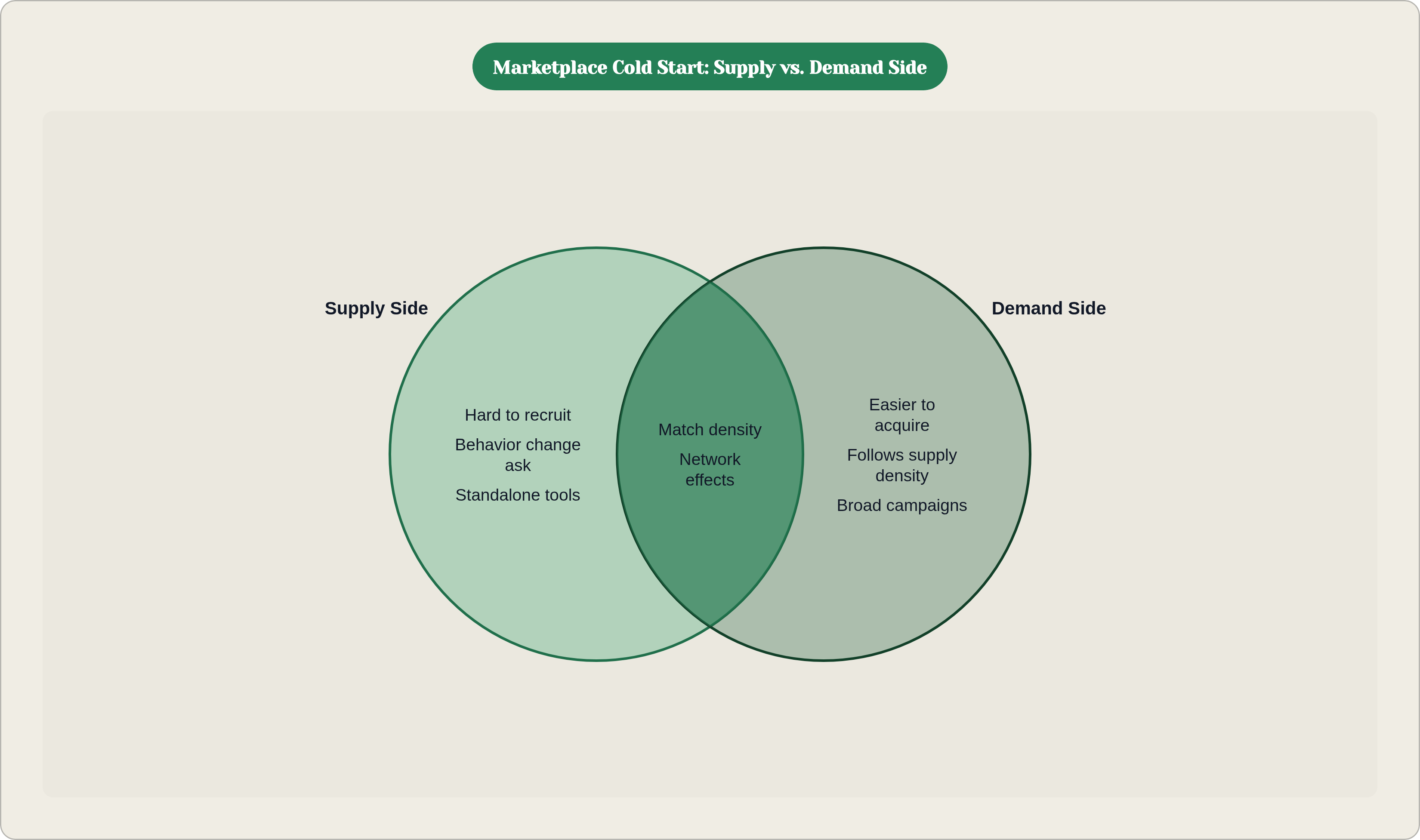
The structural reality underneath this is the hard side / easy side asymmetry. In every marketplace, one side is substantially harder to recruit than the other, and substantially more valuable once present. This is almost always the supply side: the drivers, the hosts, the sellers, the service providers. These are people being asked to change their behavior, often significantly, in exchange for a promise about future demand that doesn't yet exist. That ask is genuinely hard. It requires a different kind of persuasion than signing up a buyer who just wants to find something.
James Currier at NFX has observed, drawing on work with early-stage marketplace companies, that once the hard side is sufficiently present, the easy side follows at a fraction of the effort. If you spend the same energy on demand acquisition as on supply acquisition, you are misallocating, and the asymmetry will punish you for it.
The goal in the cold-start phase is not to build the full marketplace. It's to build the smallest possible functioning network where real transactions can happen, where match density is high enough that users have a good experience, and then replicate that unit. Aggregate metrics like total registered users or overall GMV are actively misleading at this stage. What matters is whether individual sub-networks — a single city, a single product category, a single professional niche — are achieving match density that makes the experience worth returning to.
The tactics available to marketplace founders are not interchangeable. They belong to different phases of the growth arc. Applying escape-velocity tactics during the cold-start phase doesn't just waste money; it creates the false impression that you've built something bigger than you have, which produces worse sequencing decisions downstream.
How Successful Marketplaces Manufactured Supply Before Demand Existed
Look at any marketplace that survived its cold-start phase, and you'll find the same pattern underneath different surface details: supply was acquired first, often by hand, before any automated system existed to facilitate matching.
Etsy's founders attended craft fairs physically. They walked up to artisans, explained the concept, and recruited them one by one. There's nothing romantic about that. It was a deliberate recognition that the supply side would not show up on its own, that the coordination problem required a human intermediary to bootstrap, and that no marketing budget could substitute for personal contact with the people whose presence would make the platform real. It was just the necessary work.
Airbnb's approach was similar in spirit, different in execution. They hired professional photographers to shoot hosts' apartments, which sounds like a product decision. It was actually a trust-manufacturing decision. Early demand-side users couldn't evaluate whether a listing was legitimate, safe, or accurately described. Professional photos reduced perceived risk before real trust signals — things like reviews and repeat bookings — had accumulated. The supply side responded, too: hosts who received professional photography felt the platform was investing in them, not merely extracting from them.
Uber guaranteed minimum driver earnings before rider volume could justify those guarantees. Supply subsidization in its most direct form. In accounting terms, it looked like a cost. In strategic terms, it was the price of solving the coordination problem.
The unifying principle is what's often called the concierge MVP: real transactions happening through unscalable, human-mediated processes, before any automation makes sense. The value of the concierge phase isn't operational. It's evidential. It proves the match is possible. That proof, when visible to both sides, breaks the unfavorable-expectations trap.
The diagnostic question is: which side, if absent, makes the platform worthless to the other? That's your hard side. Recruit it first. Do it manually if you have to. Subsidize its engagement, financially or through service, for as long as the gap between supply and demand requires it. This is not waste. It is the cost of manufacturing the conditions under which your marketplace can actually function.
Geographic and Niche Constraint as a Way to Reach Critical Mass Faster
There is a particular kind of ambition that kills marketplaces before they have a chance to live. It looks like vision. It presents as boldness. What it actually is: launching in many markets or categories simultaneously, which means you never reach match density anywhere. You end up perpetually thin everywhere instead of meaningfully thick somewhere. Trying to be everywhere at once is like spreading butter across an entire loaf of bread before you've confirmed the bread is edible — you've used everything up and satisfied no one.
Uber's expansion discipline is instructive here. Early operations followed a rule of not entering a new market until the existing market had sufficient driver density and estimated arrival times were consistently short enough to produce a reliable rider experience. Stay in a market, deepen supply, refuse to expand until the unit clears a defined threshold. That discipline required genuine nerve, especially when competitors were entering new cities and the pressure to match their footprint was real and visible. Expansion for its own sake is a trap, and Uber's early leadership understood that in a way many of their competitors didn't.
OpenTable concentrated on building meaningful restaurant density per city before attempting adjacency, because dining is inherently local. A consumer with only a handful of restaurant options in their neighborhood won't experience the platform as useful enough to return to. The category logic dictated the constraint.
The strategic concept here is the wedge: the smallest possible geographic, demographic, or category slice where supply and demand can concentrate fast enough to produce real matches. Once that wedge works, the playbook becomes replicable. What Chen calls the tipping point in a given atomic network is exactly this moment, when you can hand the wedge playbook to someone who wasn't there for the founding phase and have them execute it successfully in a new market.
There's also a defensibility argument for constraint that gets underappreciated. Interaction density and trust in a tight market create switching costs a broad-launch competitor simply cannot replicate quickly. A new entrant who launches in 20 cities on day one is thin everywhere. You, having spent two years building a dense, trusted community in one city, have something that can't be bought: genuine network depth. Expansion from that position is expansion from strength.
Single-Player Mode and Standalone Value as a Way to Recruit the Hard Side Without Needing the Other Side First
The coordination problem in a two-sided marketplace has an elegant partial solution most founders underutilize: make the platform worth joining for the hard side even when the other side isn't there yet.
The pitch shift is subtle but important. "Join my marketplace" is an ask that only makes sense if the buyer side already exists. "Use this tool to run your business better" stands on its own. Design genuine standalone utility into the supply-side experience and you remove the chicken-and-egg objection from initial recruitment entirely.
This takes different forms in different categories. Inventory management. Scheduling tools. Listing pages that double as a public portfolio or professional profile. Analytics on customer behavior. The common thread is supply-side utility that exists independent of whether any transactions happen through your platform. Suppliers who are already using the tools, already logging in, already deriving value, are infinitely easier to activate as marketplace participants when demand eventually arrives. They've already made the platform part of their workflow. That's a habit, and habits are hard to displace.
There's a trust-building side effect here worth naming. Suppliers who've been using the platform's tools for months have formed a relationship with the product before their first transaction. When demand arrives and a competitor shows up trying to poach them, the switching cost is real, not just contractual.
The risk, and this is a genuine one, is that standalone value becomes a trap. If suppliers are content using your scheduling tool and never feel compelled to transact, you've built a SaaS business that doesn't monetize like a marketplace. The design implication is that standalone features should create natural on-ramps toward transacting, not comfortable dead ends. Every tool should surface a moment where the supplier sees the value of the marketplace layer sitting on top of the utility layer and chooses to activate it. If you're not designing for that moment deliberately, you won't stumble into it.
Platform Aggregation and Borrowing Existing Supply from Adjacent Networks
Sometimes the most efficient path to supply is not recruitment from scratch but redistribution from somewhere supply already congregates. This is platform aggregation, sometimes called piggybacking, and it is one of the more tactically clever moves available during the cold-start phase.
Airbnb's Craigslist integration is the canonical example. Airbnb built tools that allowed hosts to cross-post their listings to Craigslist, tapping an existing pool of short-term rental seekers without those users needing to know what Airbnb was or having any reason to trust a brand-new platform. The supply side got incremental distribution. Airbnb got real listings visible to a real audience. Neither side had to take a leap of faith.
This works during cold start because it bypasses the bootstrapping timeline. Instead of recruiting supply from zero and waiting for it to accumulate, you import supply that already exists in a context where it was already participating in transactions. The compression of time-to-first-viable-atomic-network is significant. Treat it as a useful tool, not a reliable shortcut. It works until it doesn't.
The tradeoffs are real. You are dependent on an incumbent platform whose terms you don't control and whose tolerance for your behavior is limited. The supply that migrates from another context will carry different quality characteristics or expectations than supply you recruited intentionally. And when the incumbent notices what you've done and closes that door, the aggregation channel disappears, sometimes overnight.
NFX places platform aggregation firmly in the cold-start toolkit, not the scale toolkit. At scale, it becomes less necessary and sometimes counterproductive, because you're no longer trying to borrow supply; you're trying to own the category. The strategic question is time-sensitive: which adjacent platform holds the supply you need, what would make that supply willing to cross-list or migrate, and how long before the window closes?
What the Tipping Point Looks Like in Practice, and How Founders Know They've Crossed It
The tipping point is not a feeling. It is not a press mention, a waitlist milestone, or a successful fundraise. It is an operational condition: the moment when launching new atomic networks becomes replicable rather than heroic, when the playbook works without the founders personally executing it.
The operational signals are specific. Match rate rising without additional manual effort. Supply-side churn falling as suppliers see consistent transaction volume rather than erratic activity. Inbound supply applications arriving without outbound recruiting. These signals, taken together, indicate that the network is self-sustaining enough in this wedge that it can be expanded without collapsing.
A quantified expansion threshold is useful precisely because it gives a team something to evaluate against rather than a vibe to debate. Uber's documented rule around driver density and arrival-time targets before entering a new market is the clearest public example. Every marketplace needs its own version of that rule, calibrated to what makes an experience in that category feel full enough to retain users. The specific metric will differ between a professional services marketplace and a same-day delivery platform, but the discipline of defining a number and holding to it is transferable.
The danger in this phase is premature scaling, and it is extraordinarily common. Early buzz, press coverage, waitlist signups: these are leading indicators of interest, not lagging indicators of liquidity. Founders mistake the former for the latter, expand before real match density exists in the original wedge, and end up with a diluted experience in every new market and a retreat back to basics that costs months and capital. I've seen it happen to smart teams who understood the theory and still fell into it, usually because investor pressure and competitive anxiety arrived at the same moment and something gave way.
The metrics that actually matter here are liquidity metrics: match success rate, time-to-first-transaction for new supply, repeat transaction rate. These are direct measures of whether the network is functioning, not of whether people have heard of it.
Once genuine tipping-point signals appear, the founder's job changes in character. The transition is from manufacturing liquidity manually to building systems that replicate the atomic network model in new geographies or categories. That is different work, requiring different skills and different organizational focus. Founders who don't recognize the transition often keep doing the heroic early work long after it stops being the constraint, which is its own kind of waste.
A Staged Decision Framework for Marketplace Founders Navigating Their Own Cold-Start Phase
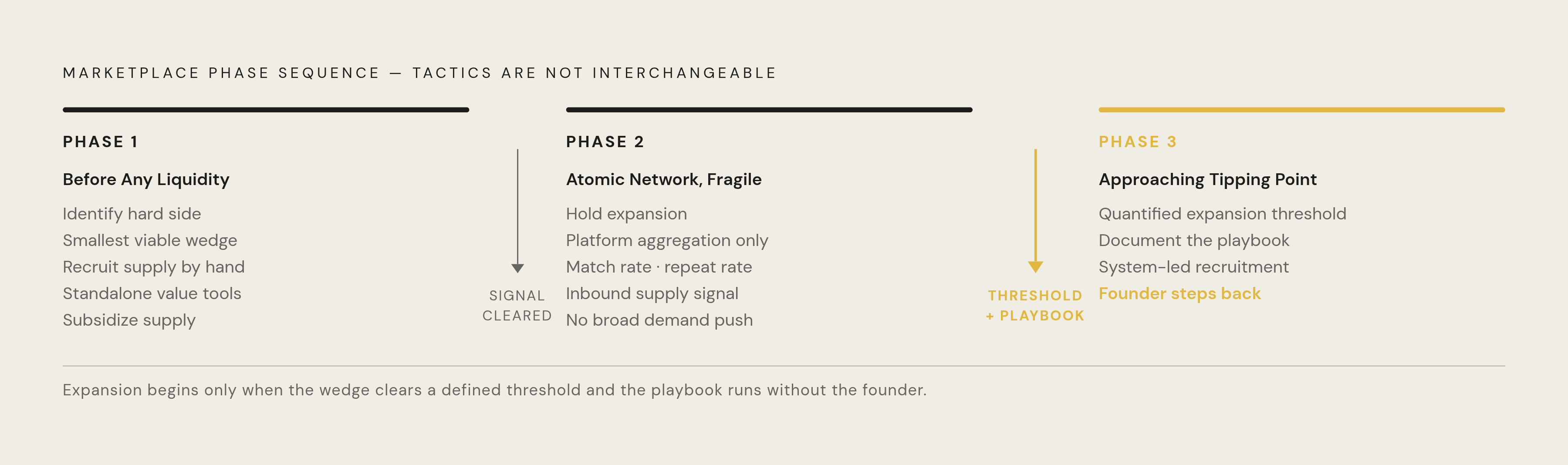
This is a sequence, not a menu. The tactics belong to phases, and using Phase 3 tactics during Phase 1 is one of the most reliable ways to burn early capital without building anything durable.
Phase 1: Before Any Liquidity Exists
Identify the hard side with precision. Ask which side's absence makes the platform worthless to the other. That side is your first priority, without qualification.
Choose the smallest viable wedge: one city, one category, one professional niche. The temptation to launch broadly is almost always a disguised form of avoiding the difficult work of achieving density somewhere specific.
Recruit hard-side supply by hand. Attend the physical venues where your supply congregates. Send personal outreach. Do the work that doesn't scale, because scaling is not yet the problem. Producing one real match is the problem.
If the chicken-and-egg objection is blocking recruitment, consider whether standalone value tools can remove it. Give the supply side a reason to be present before demand justifies their presence.
Subsidize supply engagement if dropout is occurring before demand arrives. Frame this as the cost of solving the coordination problem, not as broken unit economics.
Phase 2: First Atomic Network Is Functioning but Fragile
Do not expand yet. This is the hardest discipline of the cold-start phase, especially when investors are asking about the growth roadmap. Deepening density in the wedge you have is more valuable than thinning it by expanding too early.
Use platform aggregation tactically if an adjacent network holds supply that can accelerate density in your existing wedge. Know that the window will close, and don't structure your supply strategy around it.
Measure liquidity signals exclusively: match rate, repeat transactions, inbound supply applications. Resist the pull of vanity metrics that make the dashboard look better than the network actually is.
Hold off on broad demand-side campaigns. If supply density can't absorb incoming demand, you are paying to disappoint people who would have become loyal users under better conditions.
Phase 3: Approaching the Tipping Point
Define your quantified threshold. What is your version of a minimum-density expansion rule? This requires knowing your category well enough to define what sufficient match density feels like from the user's perspective, then working backward to a measurable operational proxy.
Expand to a new wedge only when the existing wedge clears that threshold and the playbook is documented well enough to be executed by someone who wasn't part of the founding phase. If it only works when you personally run it, the tipping point hasn't arrived.
Begin transitioning from founder-led supply recruitment to system-led: referral programs, algorithmic matching improvements, supply-side community building, incentive structures that make existing supply the primary recruitment channel for new supply.
The cold-start problem is not solved by finding the single right tactic. It's solved by applying the right tactic at the right phase, in a tight enough geography or niche that density can actually accumulate, in the correct sequence. Founders who internalize that this is a sequencing challenge spend their early capital manufacturing the conditions for liquidity. The ones who don't spend it trying to scale before liquidity exists, and the two outcomes are not comparable.