Geographic Expansion Sequencing for Vertical Marketplaces
Expand only when local density proves out, and pick adjacent markets.

Vertical marketplaces face a liquidity challenge when expanding geographically before they can capitalize on revenue potential. Each new market either fortifies the network or thins it beyond reliable transaction capacity, contingent on entry sequence. Growth must be guided by demonstrated local density and operational capabilities that transfer.
Why vertical marketplaces face a fundamentally different expansion problem than horizontal ones
Founders usually size up expansion by asking how big the market is and what sales it could yield. But capturing that opportunity requires local match density to be high enough. Liquidity means a geography holds enough live supply and demand that buyers reliably get what they seek and sellers reliably complete transactions. Horizontal platforms are different: they can pool demand worldwide and ship from anywhere, whereas home repair work, neighborhood meal delivery, and area-specific B2B supply need sellers close enough to reach the buyer's location.
Each new market thus presents a cold-start dilemma. Both parties require sufficient local concentration before transactions can be dependable, regardless of the platform's total user count. Scattering a limited user base across numerous cities creates fragmented markets that lack the density needed to function as a network. For vertical SaaS marketplaces, the challenge runs deeper: local brand familiarity and trust shape both network effects and the economics of customer acquisition. This geographic spread undermines both dependable transactions and participant acquisition costs.
How liquidity collapse happens and why it is hard to reverse once it starts
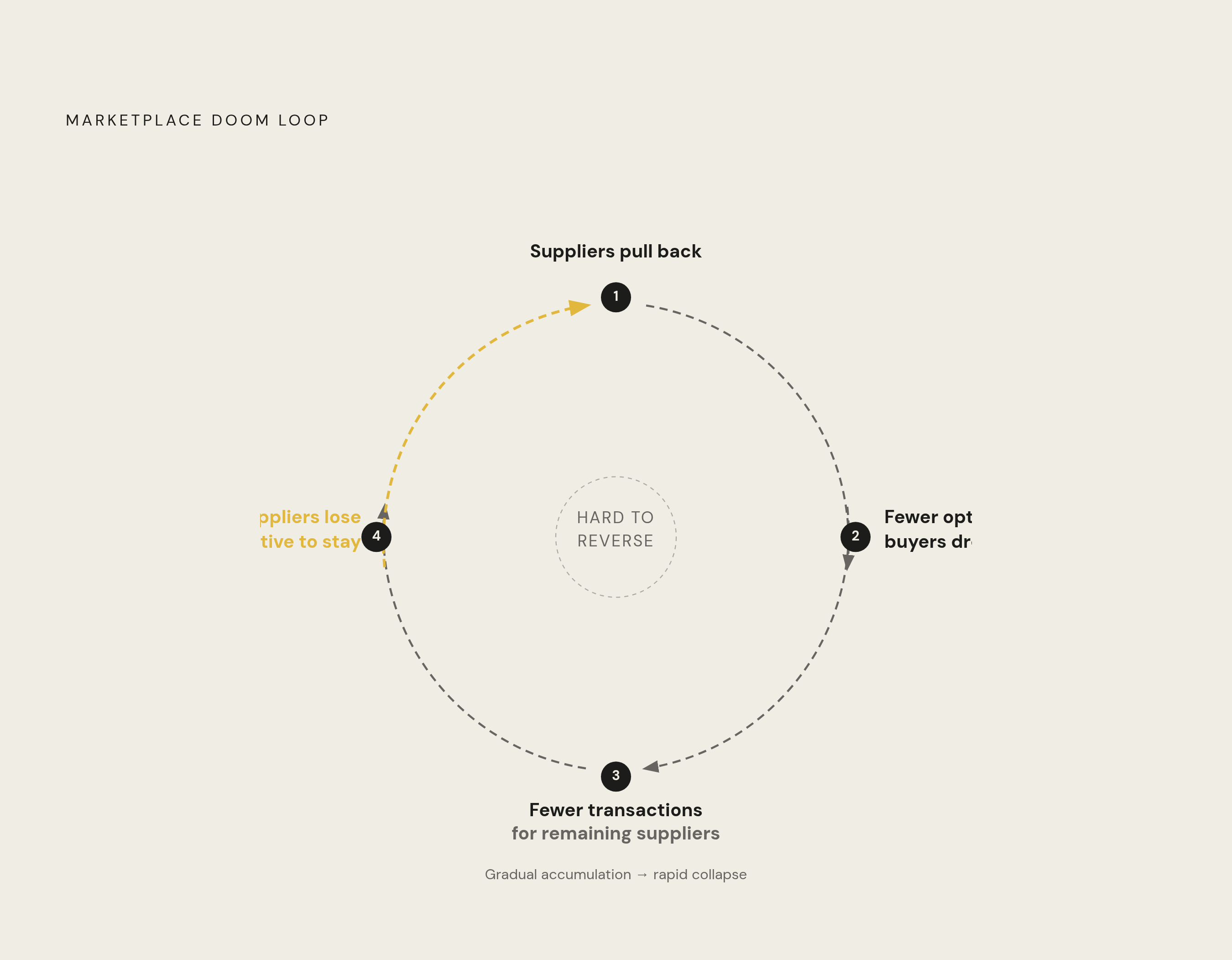
In a thin market, decline can feed on itself. When suppliers pull back, buyers are left with fewer suitable options, and matches deteriorate. Unhappy buyers also drop out, so the remaining suppliers see fewer transactions. That gives the remaining suppliers less incentive to keep participating, and the market weakens further. The linkages that once supported growth now accelerate the decline.
Getting back on track is not growth in reverse. Such effects accumulate gradually yet collapse rapidly, since one group leaving warns the remaining participants that conditions are worsening. Bringing in extra purchasers won't mend a thin vendor pool, nor will onboarding sellers amid sluggish interest give them grounds to remain. The real challenge lies in rebuilding mutual trust as chances to trade dwindle.
Every geography adds demands like localized marketing, sales presence, pricing structures, and reporting duties that revenue models often overlook. When that workload exceeds the team's capacity, existing markets suffer alongside the new one. Expanding isn't risky by default. The risk emerges when a company enters a new market before its current operations and infrastructure are ready to handle the added load.
What "beachhead saturation" actually means and how to measure it before moving
Many teams withdraw from the beachhead prematurely. Saturation occurs once supply and demand replenish themselves without requiring acquisition costs to rise disproportionately. Without that foundation, growth may divide one expanding market into two weak ones. Readiness hinges on how well renewal performs.
Operational testing must show whether that renewal can endure. Buyers and sellers need to return unprompted, reliably finishing transactions whenever they look through listings. Fresh vendors drawn in by referrals or the platform's standing show that outreach can succeed without ongoing spending. Marginal costs for acquiring and keeping users should likewise trend downward. These checks form a single standard, since rising transaction volume by itself cannot prove the network is self-sustaining.
Strong numbers within a segment can mask weak matching, poor retention, or both in other pockets, so the team may look more ready than it really is. Any team considering expansion should use the same measures at the marketplace layer where buyers and suppliers meet in practice. It should also ask whether the next unit of capital earns more abroad or at home. A strong beachhead can open the door to expansion, but other uses of capital may still be better.
Put the proof bar in writing before allocating the budget. Fixing measurable thresholds for retention, unit economics, and repeatable acquisition keeps growth pressure from quietly redefining the decision. For marketplaces built around SaaS-first software, developing the software layer before introducing demand provides another way to manage readiness. This sequence allows each geography’s supply density to develop before both sides must collaborate. It steers the bootstrap instead of demanding that recruitment happen on both sides at once.
How to pick the next market through adjacency rather than market-size ambition
A company needs assets that will still matter when it enters the next market. That carryover might be its supplier network, standing in the category, and a playbook that can travel without being rebuilt from scratch. Geographic proximity can lower logistics overhead and let participants close to a boundary serve on both sides. In a similar category, existing supplier ties can remain valuable. Adjacency, then, is not just a matter of miles.
How much adaptation remains depends on cultural and regulatory fit. By applying the CAGE framework, Ghemawat exposes administrative, economic, geographic, and cultural gaps that sheer market volume tends to hide. Pursuing a large opportunity with poor alignment may demand extensive localization, draining the assets required to protect that initial foothold. Competitive conditions also shift the entry requirement. Penetrating a space with mature supply chains costs more and requires distinct tactics compared to pioneering an undeveloped sector.
According to its S-1 filing, DoorDash deliberately began in suburban markets and smaller metro areas, where merchants and platforms had long failed to serve customers adequately. That meant steering clear of big cities where rivals already had greater density. In these less contested places, DoorDash had room to work out its playbook before taking on tougher markets. That sequence positioned it well for later competition, and it helped drive DoorDash to a 67% share of orders in the US food delivery market.
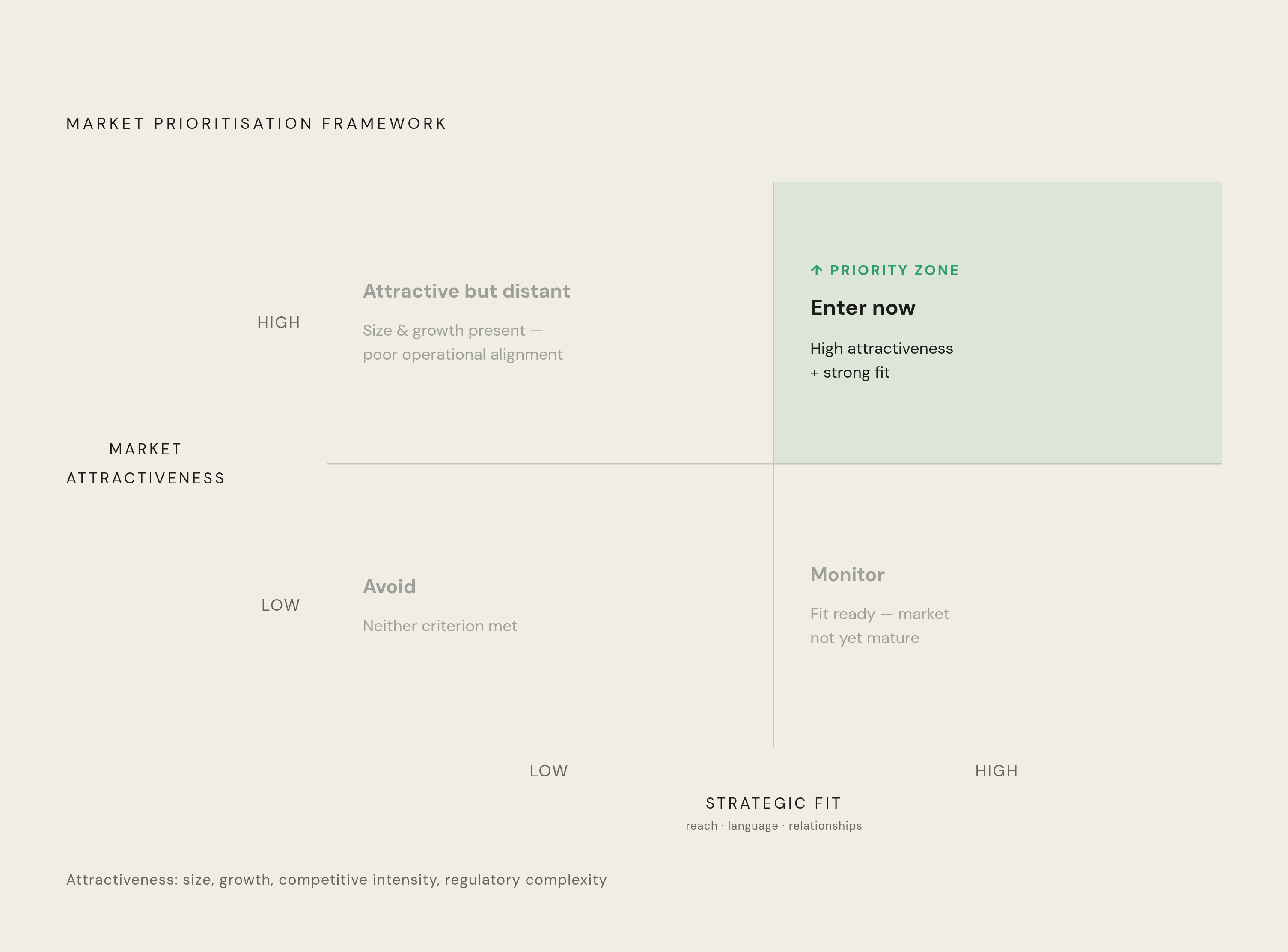
Operators pick their next move by rating both attractiveness and fit. Attractiveness covers size, growth, how competitive the space is, and regulatory complexity. Fit evaluates operational reach alongside language capability and existing relationships. The best targets score high on both. Dominance often beats partial presence. Concentrated coverage in a modest market often generates deeper liquidity than sparse involvement across a vast one.
Signals that a planned expansion move is premature
Before the team commits expansion funds, it should stress-test the plan with beachhead data. When supplier losses outpace natural sign-ups, the marketplace has not yet reached a self-supporting core. If repeat transactions remain uneven, buyers have not yet settled on trusting the platform. If acquisition remains beyond what the expansion budget can absorb, that points to one further weak spot. So the team cannot yet treat its growth motion as a reusable market-entry model.
Falling supply acquisition costs demand closer scrutiny. They can reveal network economics on the upswing, yet they can also signal that putting more money into the beachhead continues to compound in value. That signal forces the capital allocation comparison before resources shift elsewhere. Whether operations are ready and whether exiting looks appealing remain distinct questions.
Organizational gaps can prevent a move even when demand looks promising. When no operational milestone exists, growth pressure is choosing the launch timing over proof. Leaving compliance, localization, and reporting work undefined makes the actual staffing needs unclear. Better Place illustrates what happens when replicating comes before density develops. It ran concentrated pilots in Israel and Denmark under supportive regulatory conditions, yet pushed into new markets before one had achieved scale. Every market needed new infrastructure and partnerships with no cross-market gain, multiplying commitments while the model still lacked a dense base.
When acquisition can substitute for organic sequencing — and what it defers rather than solves
Buying another company offers a legitimate shortcut to density that skips organic development. It purchases established supplier networks and customer trust, enabling market access without building each local connection from scratch. DoorDash reports in its SEC filing substantial year-over-year Marketplace GOV gains, with Deliveroo adding significantly to that total. Bought density can thus sustain high transaction volume. The mode of entry alters the sequence of what needs to be constructed.
This does not demonstrate that the acquirer's operating model is transferable. Liquidity exists in the acquired market, yet integrating the platform remains necessary. Any further growth hinges on finishing that integration.
This reasoning also covers smaller acquisitions. A foothold next door can instead be gained by buying a local operator, regional competitor, or supply aggregator, as long as the integration work is mapped out before closing. Those milestones should then define what must be proven before growth extends beyond the new base. To judge readiness, start with its transaction record. Integration has to prove the purchased base is strong enough for the planned operating approach before expansion moves into an additional market.
The competitive timing objection and how to hold the line without being paralyzed by it
Delay can materially weaken a company’s position in local markets. A well-capitalized competitor may move into nearby territory, secure supplier relationships, and make future customer moves increasingly difficult. In that context, a rigid rollout may look like leaving prime markets uncontested as the initial foothold develops. That objection needs an operational answer. If competitive pressure alters which entry option is worth more, speeding up the rollout may be warranted.
Tightening adjacency logic provides the remedy. DoorDash’s suburban work demonstrates how sequencing around existing density can play out. On the flip side, a rival showing up proves neither that its playbook fits a different network nor guarantees lasting local engagement. Entry is not liquidity. Jumping at an announcement risks committing capital to untested territory.
Ordering nearby markets by priority keeps acceleration deliberate. Triggers can be set, such as a rival reaching the required supply density in a priority market, or the beachhead hitting its operational milestone ahead of schedule. Those triggers can change the sequencing clock, but not the evidence requirement. Entering too soon without adequate density can leave users disappointed and hand reputational weakness to a larger rival ready to exploit it. Competitor pressure cannot substitute for the local supply and demand needed to make transactions reliable.
Applying the sequencing framework as a decision sequence for the next expansion move
Any move to expand further begins by auditing the beachhead. They must review how well users stick around, pairing success, unpaid inventory growth, and profitability patterns across each local area and product type. Without evidence of durable, self-fueled exchange, expansion halts where it stands. A promising candidate geography can’t fix that. Choosing the next market requires passing that initial test first.
Now score nearby opportunities for appeal and strategic fit. Filter out non-starters first, so deeper analysis focuses only on markets where customer demand and portable advantages build on each other. The top option is then tested against the premature-move criteria. Supplier turnover has to stay manageable, customers need to buy again reliably, and the team needs a documented, repeatable acquisition routine. Leadership should also be able to fund and staff one new market fully, without scattering its focus over multiple launches.
The team should size the complete cost of entering only after that. Plan for supply-side onboarding, buyer acquisition, local adaptation, regulatory needs, plus the added overhead of management and reporting. If compliance has no budget, do not launch. Before committing funds, record which bar for retention, marketplace liquidity, or unit performance will justify opening the next market. For acquisitions, apply the same cadence to the purchased business’s measurement set, treating integration as the operational milestone.
Preserving these regional distinctions requires infrastructure. Zift gives operators overseeing several regions the tools to monitor liquidity, manage supply, and roll out markets in sequence. Careful sequencing is what allows network effects to build within each region.
Notes
- Market & geographic expansion: a practical guide
Informed the framework for scoring candidate markets on attractiveness and fit, and for stress-testing readiness, cost, and integration before entering a new geography.
Every new piece from marketplace crunch, as it's published.
Follow