Niche Supply Curation in Vertical Marketplaces
Curation alone won't survive without a defensible moat beyond the initial hand-picked listing.

Vertical marketplaces succeed or fail based on one choice: who can sell, and what can be sold. Supply curation, as it's known, is what makes buyers trust a platform instantly instead of seeing a prettier Craigslist. Curation by itself isn't a moat, and acting like it is ranks as the most common mistake vertical operators make. It's a starting point, a bootstrap move that either builds into a real moat or dies the instant a rival buys enough data to imitate it, and most operators never plan for which way they're headed.
Tough, high-risk procurement categories are shifting to vertical platforms faster than nearly anything else in commerce. About half of online adults say they'll trust a purchase through a marketplace they know even if the seller itself is a stranger, according to Forrester's 2024 Retail Topics Insights survey. Every vertical operator is competing to capture that borrowed trust. But narrowing to one category cuts the pool of eligible suppliers, sometimes drastically, and that raises a tougher question than "who do we let in": is the selection process itself what buyers are paying for, or just a nice story on the About page?
The three supply strategies available to any marketplace, and why curation is the one most specific to vertical contexts
In 2021, a16z offered a helpful framework: marketplaces can compete on comprehensiveness, exclusivity, or curation. Choose one, or choose a mix, but choose deliberately. Offer as much variety as you can so buyers have no reason to open a second tab, which is how Grubhub's early restaurant aggregation worked: more restaurants, more zip codes, more reasons to stay put. Exclusivity ties up supply so it can't appear elsewhere, which stops sellers from spreading themselves across five platforms at once (multi-tenanting, in the jargon). Curation means hand-picking who gets listed at all, so the buyer side stops wandering, because the platform becomes the one place that particular buyer actually wants to be.
Curation isn't verification, and mix-ups between the two are how many "curated" marketplaces quietly become glorified returns desks. Verification, as StockX and The RealReal do it, confirms if an item is genuine. Curation chooses which sellers or products are allowed in at all. Platforms often do both, but they serve different purposes, and blurring them is how you end up verifying fakes that shouldn't have been listed.
a16z notes a key risk: a platform that is neither comprehensive nor exclusive, in a market where buyers value variety, may struggle to retain users. Curation only pays off when a niche's particular needs outweigh sheer variety. Reforge adds a harsher caveat: curation works as an early bootstrap tactic, but algorithmic recommendations can often copy its early promise once a platform has enough data sloshing around. The real question is what curation sets up later, not how good it looks at launch, and founders who treat that early edge as permanent get caught off guard.
What supply curation actually does for buyer trust and marketplace liquidity
Trust carries over. That is the whole mechanism. Buyers will still click "buy" from sellers they've never heard of when the platform backing those sellers has a reputation they can borrow, and the clearest proof that platform-level reputation does real work, not decorative work, is Forrester's finding that roughly half of online adults extend trust this way.
Price shows up in dollars, not survey answers. In 2025, premium niche vacation rental platforms had average booking values 42% higher than similar listings on generalist sites. Buyers spend more since that curation signal cuts the risk before they click on a listing.
There's an identity layer under the price data as well, and it counts for more than most operators realize. Curated supply begins matching buyers' sense of who they are, beyond the practical problem that brought them, and identity is far harder to compete against than price. A broad platform can beat a curated one on price. It can’t beat it on identity: nobody tells a friend about the bargain they got on the horizontal site.
Operationally, curated supply packs listings tighter, and that tightness is what drives liquidity. With less irrelevant stock, buyers and sellers connect more quickly, speeding up time-to-fill even if total listings are far lower than a horizontal competitor's inventory. Conversion works the same way: buyers come in ready to buy, hit a catalogue made for exactly that, and the catalogue sells partly on its own before anyone fields a support ticket.
When you put those pieces together, the loop reinforces itself. Premium buyers come because curation sends a strong signal, drawing premium sellers who want those buyers, raising the bar, and bringing in more premium buyers. This doesn't happen on its own, and the next section covers how platforms create and protect it with sellers.
How platforms execute curation operationally: gatekeeping, quality programs, and tiered models
Gatekeeping starts at intake. Sellers are screened up front, products are checked before listing, and the platform curates the shelf rather than letting it fill on its own. The guiding rule is quality over quantity, even though quantity is the easier stat to show a board.
At first, this usually means checking every supplier by hand. That's how Thumbtack built its early professional database through manual verification of each supplier. Airbnb took a different approach, using incentives like free professional photography to improve supply quality.
Reverb chose a third approach worth pausing on, since it goes slightly against expectation. Rather than review each seller one by one, Reverb set a narrow category: every listing must connect to making music, playing it, performing it, or listening to it. That rule handles the initial screening on its own. A guitar marketplace won't see any lawnmower listings, and the category line itself curates, work that would otherwise need a person reviewing each submission.
After sellers join, curation keeps going. Some platforms use tiered seller programs to reward consistent service quality and penalize underperformance. Sales thresholds and user-flagged listings reduce how much manual review a human team must handle. Sites measure conversion per category, and they monitor net promoter scores, return rates, and retention to catch quiet drops in quality early.
Then there's the tiered approach, which is basically having your cake and eating it too. Uber Black and Airbnb Plus each added a curated layer on top of an open platform: the base product remains open to any lister, while buyers wanting extra vetting pay a premium for that tier. That preserves broad supply at the funnel’s base while giving quality-minded buyers a clear signal to choose.
Spending on supply quality earns returns through retention, and most operators undervalue what curation truly delivers. Niche vacation rental platforms offering white-glove onboarding and professional services see host retention rates exceeding 85%. Curation, done well, works both ways. It's an investment that holds onto good supply so it doesn't drift to a rival, and that retained supply builds a platform's edge in a way fresh supply acquisition can't fully match. Eventually both manual review and tiered models run up against limits, and that's when AI steps in, sometimes messily.
How AI is changing what curation can scale to, without replacing the domain judgment that makes it defensible
Growth overwhelms manual checks. Put simply, the scaling problem means that when supply grows, a platform must either drop its bar or automate to keep up.
The real answer is a mix, not a swap, and any platform saying otherwise is either overselling its tools or heading for a rough quarter. The model spots listings or sellers that seem off, but a person decides on anything close to the line. The system is only as sharp as its training criteria, and broad fraud signals miss what "quality" means in a specific vertical. A model built to spot fake sneakers will not recognize a bad fret job on a 1962 Stratocaster, and that gap is why vertical-specific training data is the asset, not the algorithm itself.
StockX gives you a feel for the scale involved. At scale, platforms like StockX reject large volumes of counterfeit or non-compliant items annually. At that volume, human-only authentication stops being a viable business model. The AI has to do the flagging while experts settle the cases that sit near the line.
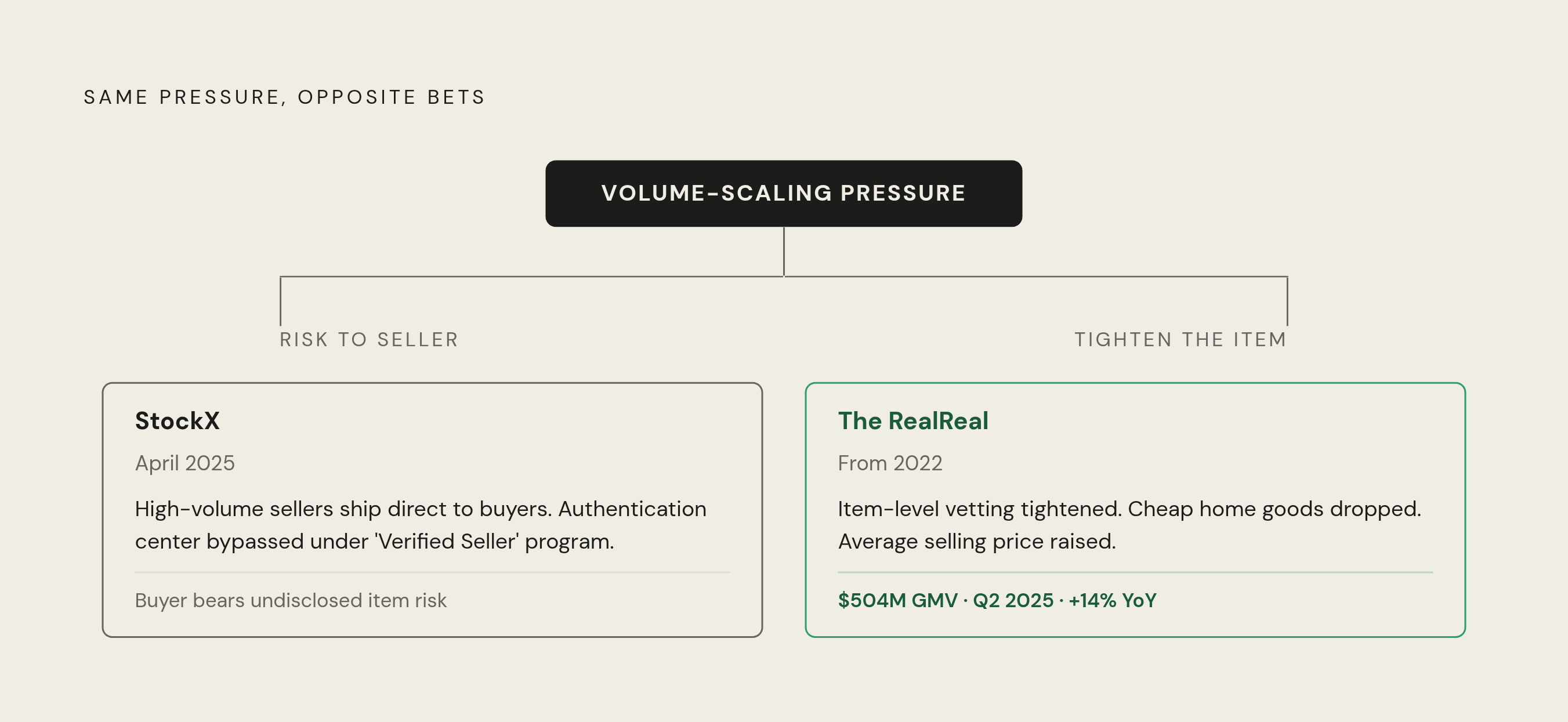
But pressure to scale can also weaken the standard it was meant to protect, and StockX's own 2025 history shows that most clearly. It looks like a downgrade quietly sold as innovation, and that label fits. In April of that year, StockX introduced a Verified Seller program where a small portion of items, a small fraction of total volume, ship directly to buyers without going through an authentication center. Before, the green verification tag said "this specific item was inspected." For those orders now, it says "this seller was vetted." Everyone else still gets standard inspection, but a tag carrying two meanings depending on which seller shipped the item isn't a stronger trust signal. It's a weaker signal wearing the old label, and StockX's buyers will eventually catch the difference, even if the platform stays quiet.
Platforms keep curation defensible during this growth when the AI layer follows criteria grounded in real domain expertise, not generic red flags from another industry's fraud model. That expertise is what holds value. The algorithm just speeds it up.
Three platforms that built defensible positions through distinct curation approaches
Reverb curated by defining its category, not by vetting individual sellers. Everything listed has to tie back to making, playing, or listening to music, and the platform can act on anything that crosses that line. Etsy acquired Reverb for $275 million in August 2019; Creator Partners and Servco repurchased it from Etsy in June 2025, making it independent again. Reverb made this work by building shipping for guitars and fragile gear, along with condition guides for vintage instruments, something a broad platform like eBay can't copy with a single returns policy. The category acts as the filter, and that filter becomes the product.
The RealReal made authentication the core of its curation, and is frequently called the biggest online marketplace for authenticated luxury resale, counting over 40 million members. Gemologists, horologists, and brand authenticators on staff go through thousands of items a day, and AI and machine learning assist with various operational tasks, including pricing. GMV reached $504 million in the second quarter of 2025, up 14% from the same quarter in 2024. Starting in 2022, the company deliberately took fewer items, dropped cheap home goods, and pushed up average selling prices, cutting returns and cash burn through 2024 and 2025. That approach carries risk: The RealReal paid $11 million to settle an investor lawsuit claiming its authentication process "fell far short of its description," proof that a curatorial reputation becomes a legal liability the moment the standard slips in public.
From day one, StockX centered its curation on authenticating each item, checking every piece before it went to a buyer. Those 2024 figures, a significant number of rejected items valued in the tens of millions, reveal the price of that commitment at scale. The April 2025 Verified Seller program is a true shift: high-volume sellers now skip authentication centers completely and ship directly to buyers, while vetting moves from the item to the seller's history, training, and audit record. Volume forced a real swap, vetting sellers instead of items, and that puts StockX right against The RealReal, which went the other way by tightening item checks instead of loosening them. Same scaling pressure, two different bets on where the risk should sit: one company decided the item was the risk, the other decided the seller was, and only one of those two bets is the kind of thing a buyer might notice going wrong.
When curation builds a lasting moat versus when it is only a bootstrap strategy
Reforge's critique warrants real attention, not dismissal: once enough data accumulates, algorithmic recommendations can come close to matching a curator's output, so curation is tough to defend against a well-funded competitor. When suppliers are not clearly better or worse, only different mixes of price, speed, and quality, curation’s advantage tends to fade over time. Most curated marketplaces that lean on curation as their entire strategy, instead of just the starting point, are running out the clock, and it's the wrong gamble for a whole business model.
So when does curation actually hold? It holds when applying the selection criteria demands genuine expertise, the way luxury authentication calls for gemologists and horologists instead of a checklist a junior employee could finish in an afternoon. It holds when a vertical's quality signals don't carry over neatly to a horizontal platform, the way grading a vintage instrument's condition doesn't fit a generic return policy built for broad categories. It lasts when the reputation shows up in buyer behavior itself, buyers paying a steep premium being the clearest vote that the trust relationship is worth the switching cost of leaving. It also lasts when supply retention remains high, north of 85% annually in the vacation rental data cited earlier, because quality supply that stays put is supply a competitor cannot lure with a signup bonus.
But curation only works as a bootstrap if the screening rules are easy for any algorithm to copy: seller ratings, response time, return rate. It is a bootstrap when an operator relaxes standards under volume pressure before the brand's trust is truly locked in, which is precisely the live experiment StockX is running right now with its Verified Seller program. It is also just a bootstrap when a horizontal platform, with more data and more distribution, ends up matching that recommendation quality in a niche too small to keep it out.
The version to build toward grows stronger over time, and it is not curation alone. Curation that generates proprietary data, pricing patterns, condition-grading history, authentication outcomes, and feeds that data into a platform-specific AI model: that's the version that's hard to copy. That expertise teaches the model, which then applies the rules far beyond what any group of human reviewers could handle.
What marketing and content strategy inside a vertical marketplace must do to support supply curation as a competitive position
All that operational machinery is wasted if the marketing undersells what curation is doing. A platform that vets gemologists and horologists yet talks about itself in the same generic way as a drop-shipping storefront is leaving its best argument unused, which is a strange thing to watch a company do.
A vertical marketplace's content strategy has a single task: show buyers who've never considered how sneaker authentication or vintage guitar grading works exactly how the curation happens. That means explaining how it works, not using marketing adjectives. Telling a buyer that a model trained on thousands of past authentications flags a listing before a person checks it says more than "quality guaranteed" ever could. Specificity builds trust, in copy as much as in vetting.
The marketing also has to stick to the standards operations lays down. When a platform tightens intake standards like The RealReal did in 2022, the content and positioning have to say it plainly, since buyers paying a premium for curation are the same ones who notice if the standard slips without an explanation. And if a platform changes its verification model like StockX did in 2025, from item checks to seller vetting for some volume, it should explain the change instead of hoping nobody reads the tag’s fine print.
Every day, the platform shows what curation means by the listings it keeps, the sellers it turns away, and the category lines it draws. Marketing's job is to keep that story aligned with the operational reality beneath it. Once they drift apart, even slightly, trust built over years drains away quicker than any content calendar can fix.
Notes
- Marketplace Supply Strategy: Comprehensive, Exclusive, or Curated | Andreessen Horowitz
Provided the three-part framework of comprehensive, exclusive, and curated supply strategies that structures the article's central argument.
- Niche Vertical Vacation Rental Marketplaces Market Research Report 2034
Supplied the figures on premium niche vacation rental booking values being 42% higher than generalist sites, and host retention rates exceeding 85%.
- Marketplace Supply Strategy: Comprehensive, Exclusive, or Curated | Reforge Blog
Provided the caveat that curation works as an early bootstrap tactic but algorithmic recommendations can replicate its benefits once enough data accumulates.
- https://www.retailtouchpoints.com/topics/market-news/etsys-latest-turnaround-efforts-selloff-of-reverb-seller-experience-improvements
Informed the account of Etsy's sale of Reverb and the subsequent repurchase that made it independent again.
- https://stockx.com/about/stockx-drops-annual-brand-protection-customer-trust-report-reveals-company-rejected-nearly-10-million-worth-of-counterfeit-sneakers-in-2024/
Provided the data on StockX rejecting large volumes of counterfeit items in 2024, illustrating the scale of its authentication operation.
Every new piece from marketplace crunch, as it's published.
Follow