Authentication and Counterfeit Prevention in Luxury Product Marketplaces
Technical tools replace expert eyes as counterfeiters match luxury manufacturing quality.
The paired rise of these two curves makes clear that authenticating luxury goods now relies on technical practice, not only expert visual assessment and judgment. In 2025, worldwide luxury goods sales hit USD 296.9 billion, with steady expansion projected through 2034, driven by rising Asia Pacific demand and an expanding base of wealthy consumers. As that growth accumulates, more authentic goods move through resale and retail channels, while counterfeiters gain a broader target to analyze, replicate, and pursue. As the legitimate sector expands, counterfeit networks get a richer catalog of items for modeling, labels and identifiers to mimic, and name-conscious shoppers with premium budgets, creating the opening they seek.
Counterfeiting of this magnitude is no mere footnote to the legitimate trade. OECD and EUIPO data estimate the worldwide market for fake and pirated products reaches into the high billions annually, with luxury goods comprising a portion of confiscated worth relative to mass that far exceeds their retail presence. This disparity stems from the unmatched profitability of luxury items: handbags and timepieces command prices far exceeding production expenses, driven by brand prestige rather than material worth, and this lucrative margin between low replication costs and high resale values entices criminal syndicates as well as petty thieves.
Counterfeits now reach buyers by routes that have shifted as quickly as the goods. Canal Street folding tables have given way to Instagram, where countless active profiles were openly promoting counterfeit fashion as of 2026, and to TikTok, where #dupe videos have drawn billions of views and recast fake-buying as lifestyle content. The change is just as consequential for policing the trade as for culture, because customs agencies were designed around container checks, while seizure work now overwhelmingly involves individual packages and fast air freight, leaving border controls aimed at an obsolete model of commerce. Resale makes the problem worse: secondhand luxury is a multibillion-dollar global business, and when authentication breaks down, buyers and brands both suffer because a fake passed off as “pre-owned authentic” damages the label’s reputation just like a newly sold counterfeit.
The threshold where visual inspection alone stopped working
The counterfeit problem didn't just get bigger; it became something else. For most of its existence, the trade authenticated goods by eye: counting stitch patterns, feeling the weight of hardware, reading leather grain, judging the pull of a zipper. Those methods worked because fakers could only match genuine manufacturing's tight tolerances if they got their hands on the maker's own equipment. That gap no longer exists. Today's counterfeiters deploy the same high-precision CNC tooling, 3D scanning, and AI-driven reverse engineering that premium makers use, so hardware contours, stitch geometry, and material textures can all be copied at microscopic scale.
The product of that capability has a name in the industry: the superfake, a counterfeit built well enough to pass the loupe test that professional authenticators have relied on for decades. Documented industry data shows that 30% of professional authenticators cannot initially distinguish a superfake handbag from a genuine one. That figure marks the actual break point for the entire authentication discipline, because the loupe test was never built to be infallible against casual fakes. It was built to be a reliable final check performed by someone who had seen thousands of genuine items. Nearly a third of exactly those experts failed, so the traditional method has stopped doing the job it was designed for.
The danger has shifted earlier as well, to a point where nothing physical exists to inspect. By 2026, listings from counterfeit sellers feature AI-generated product photography alongside deepfake-style imagery, so an item can look authentic to you before any package reaches the door. Some consumers see nothing wrong with the purchase, and that sustains demand even while buyers know more about these products: EUIPO's 2023 IP Perception Study reports 31% of Europeans consider buying counterfeits acceptable if the price of the real thing feels too high, and the share reaches 50% among 15-to-24-year-olds. That tolerance, together with manufacturing quality that survives scrutiny more and more, keeps demand high whatever unfolds at the border.
This is about more than IP protection or brand pride. Fake clothing and accessories have turned up containing dangerous substances such as poisonous colorants plus lead, making the purchase of knockoffs a matter of physical safety alongside legality. Each undiscovered replica quietly undermines an asset no budget can restore: when a label becomes known as simple to imitate well, the rarity justifying its elevated cost fades, alienating the exact shoppers whose devotion sustains it. The brand loses twice, first in sales taken by the counterfeit and then in standing among customers who remain authentic.
The four authentication techniques luxury brands and platforms have deployed
Luxury authentication now draws on four separate tools: blockchain passports, AI microscopy checks, NFC tags fitted to the product category, and unique QR codes. Each closes a gap the others do not cover, and each has a weakness tied to the way it works.
Digital BRABUS put the idea into practice beginning with the 2025 model year, when each Masterpiece supercar gained a Digital Product Passport: one tap of a phone on the vehicle's NFC-enabled Spec Plate hands the owner proof that the car is genuine, confirmation of ownership, and a blockchain provenance record, all in a single gesture. Breitling does something comparable for its timepieces, giving each one a blockchain passport holding its whole repair record and chain of owners, letting an owner hand it over via a blockchain transaction as servicing is logged across the watch's lifetime. The limitation lies in how the chip relates to the object that carries it. The chip itself is a trustworthy witness to its own identity, yet nothing in its design prevents someone from prying it off a real piece and fitting it into a fake, so authenticity becomes a matter of whether the tag and the item facing the buyer remain the couple they were when the product left the factory.
AI-driven visual microscopy works another way altogether: authentication happens by comparing images, not embedded hardware. With Entrupy, a handheld scanner takes microscope-level pictures of the luxury item, compares them with what the company describes as a multimillion-record archive of genuine and fake goods, then lets machine learning decide the result. Entrupy says it can verify Chanel, Dior, Prada, Burberry, and Goyard goods, and claims accuracy close to flawless. LVMH-owned Patou uses a similar method, deriving a tiny product "fingerprint" from thousands of identifiers found in a single photo. The weakness appears in the cases the topline figure leaves out: in 2025, Entrupy returned "unidentified" for 8.1% of submitted luxury items because it could not say whether they were real or fake. Its strong results on items it can classify offer scant reassurance once examples stray beyond familiar data, the very space occupied by today’s most advanced superfakes.
Embedding NFC chips tailored to a product category works best for timepieces, since their tightly secured assembly makes post-production interference far more difficult compared to pliable items such as jackets or handbags. Yet leading horology brands have not all followed suit. Rather than adopting blockchain verification, Patek Philippe relies on institutional safeguards: the proprietary Patek Philippe Seal, evaluations at authorized repair facilities, and internally maintained historical documentation.
Serialized QR codes represent a fourth approach, swapping the hardware demands of NFC for verification that anyone with a smartphone camera can perform. Prada grounds its authenticity guarantees in the Aura Blockchain Consortium, yet its separate Adobe partnership pursues live tailoring of the shopping journey spanning both online and in-store channels, a function entirely apart from authentication. A QR-based setup's strength lies in how far it extends: it needs no reader hardware beyond an ordinary phone camera, and it covers a much broader span of goods and price levels than embedded chips permit. Where the system falls short is built into how it works. Anyone can photograph and duplicate a QR code affixed to a box or hang tag. Security rests entirely with the server-side verification system the code references, not the printed pattern itself.
Operational authentication in resale platform business models
Brand-run tools address only part of the issue; most buyers confront authentication later, when they shop secondhand and the operating demands shift. At Vestiaire Collective, physical inspection is embedded in the purchase process itself: the company checks every purchase above its cutoff price and lets buyers choose a paid, opt-in inspection for items below it. That work runs through five regional authentication centers, in Crawley, Brooklyn, Hong Kong, Seoul, and Tourcoing, underscoring the continuing need for specialized human judgment at scale.
Authentication has become a standalone industry of its own, and the legal side of that shift now carries the same weight as the technical side. StockX's own experience shows it. In 2022, StockX refreshed how it checked goods and abandoned definitive authenticity claims, rolling out its own "StockX Verified" label instead, a shift that followed a resolved trademark suit Nike had pursued over the wording StockX had previously used. For the rest of the field, an authentication claim is as much a legal vulnerability as a quality commitment, and any platform assuring a buyer that an item is "authentic, full stop" is making a statement it must be prepared to back up in court, not merely in customer support.
The legal constraints run headlong into practical limitations. Because secondary-market firms risk having to return unsold or contested goods, they must verify authenticity without causing damage, working quickly and at a scale that precludes unhurried specialist inspection of each piece. Such rushed, hands-off mass screening creates the ideal opening for convincing counterfeits, replacing the careful individual examination that formerly gave the loupe test its dependability.
Why no single authentication method is sufficient
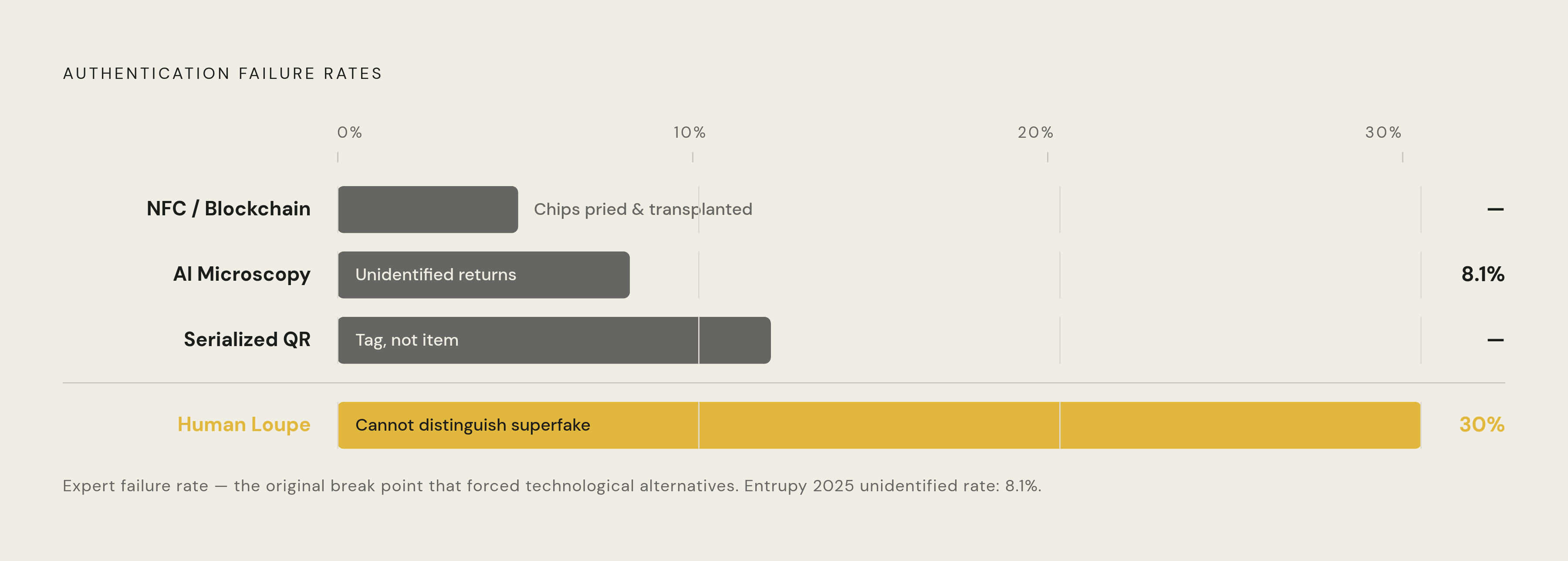
No authentication technique currently deployed lacks a documented way to defeat it, and skilled forgery networks actively target all of them, including the digital passport built on blockchain that is widely regarded as the sector's most robust safeguard. This vulnerability represents the core reality of the discipline, and the challenges raised against every approach deserve serious consideration instead of assuming any single solution is definitive.
Take NFC and blockchain first, the method that comes nearest to the industry's gold standard in brand messaging. At the Milan "Spot the Fake" event, Catawiki fashion expert Lorenzo Altimani demonstrated that today's most advanced superfakes already replicate NFC chips, with some of those copies working properly and returning a verified outcome on an authentic authentication check. The phone tap designed to confirm whether an item is genuine is also vulnerable to replication. Even the strongest proof of authenticity available now can be turned against the buyer.
The objection grounded in AI microscopy works differently, but it hits just as hard. Entrupy's accuracy rate, taken on its own, sounds almost decisive, yet the 8.1% share of luxury submissions in 2025 that came back "unidentified" is precisely the group needing confirmation most, since those items hover right at the boundary separating verified genuine from verified fake. Its mistakes cluster in the highest-stakes cases rather than being scattered uniformly over both simple and difficult ones. Real Authentication has also voiced a wider concern regarding AI tools: fashion houses debut fresh products, fabrics, metal finishes, and lettering styles each season, and a model trained on past data has no way to instantly learn things it has never encountered. A model built on yesterday's information may find the latest authentic pieces strange, and the latest counterfeits are designed to take advantage of exactly that strangeness.
A demand-side objection also weighs against turning to AI, even when its technical performance is strong. Peer-reviewed work appearing in the Academy of Marketing Science's Journal (Vol. 54, 2026), drawing on eight studies run both in controlled settings and in the field, showed that buyers favor luxury goods vetted by human experts rather than by AI, a tilt the authors attribute to the sense that buyer and authenticator see things alike. That leaves the market in an awkward spot: the trust cue buyers value most is delivered by exactly the experts whose verdicts at the loupe are what superfakes are now engineered to fool.
QR codes carry the simplest vulnerability among the four. A detachable tag, whether a label, hang tag, or printed code, only verifies its own authenticity rather than confirming the legitimacy of the item it accompanies. A fraudster who attaches an authentic tag to a convincing imitation body defeats the system while leaving the underlying verification database intact.
That does not amount to a failure of the technology. Rather, counterfeit operations adapt to every added authentication layer by targeting that layer itself, not by abandoning the market, exactly as one would expect from opponents backed by the money and motivation now found in luxury-grade counterfeiting. The system is built around overlapping checks, so breaking one authentication method still leaves the rest intact. A copied NFC chip still cannot rescue stitching that breaks down under microscopic image comparison. Duplicating a QR code on a counterfeit won’t fabricate the maintenance logs Patek Philippe cross-checks internally. Combining techniques doesn’t render any individual safeguard invincible. Instead, layering defenses forces forgers to spend far more and synchronize their efforts simultaneously, making escalating expense rather than a single tool the true foundation of tomorrow's verification contest.