Wholesale Product Marketplace Platforms Compared
Five wholesale marketplaces closed, taking sellers' stockist networks with them.
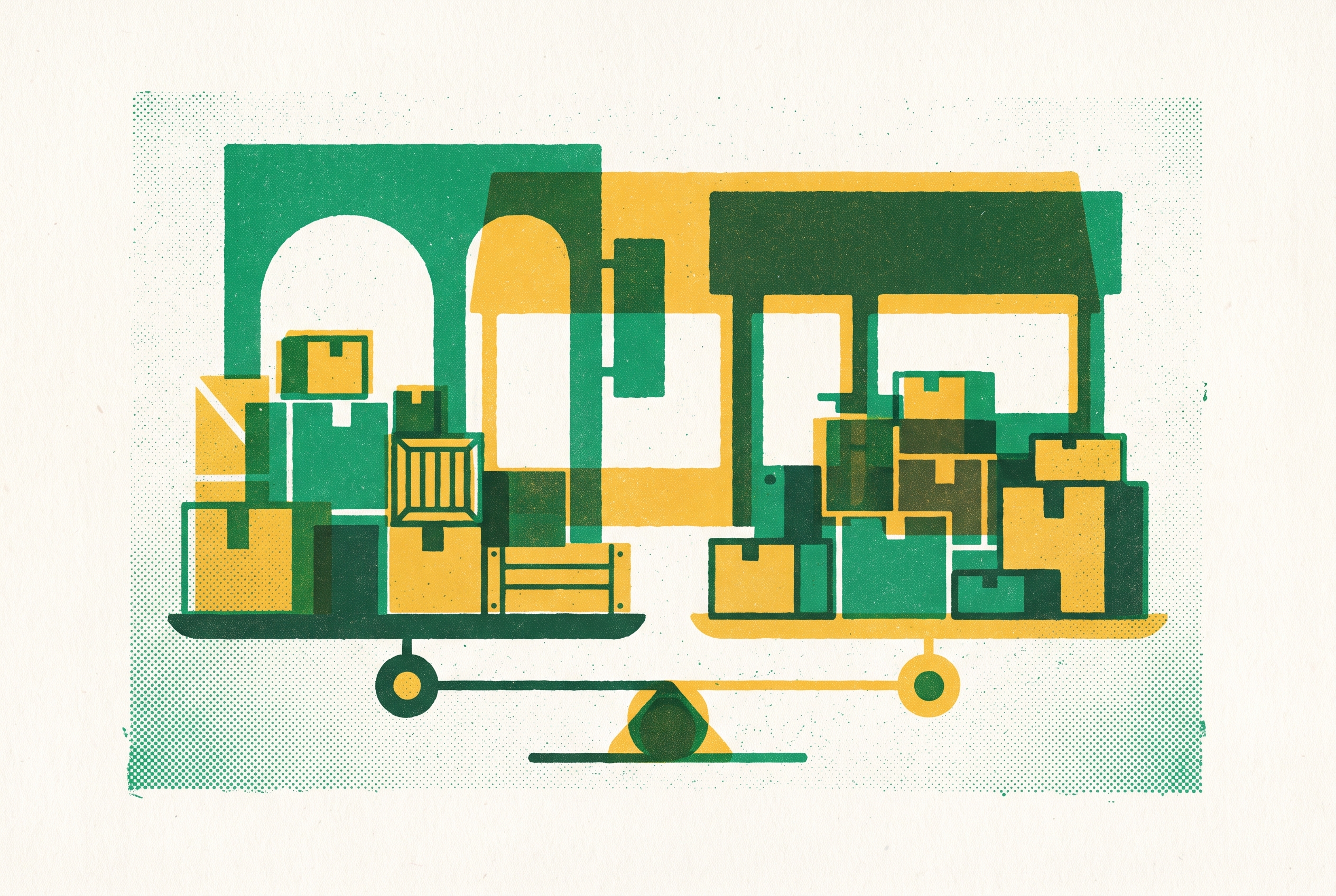
Tundra closed. The same happened to Abound, Handshake, JuniperMarket, and Bulletin. Powered By People exited traditional wholesale altogether as of January 2025. For brands weighing sales channels, the key reality is that five once-useful marketplaces for finding and managing stockists have effectively vanished. Once the marketplace is gone, the stockist ties created there are not portable assets the brand can carry elsewhere. The only thing left is a login tied to a storefront that won't come up anymore. So picking a platform matters more than most sellers realize when they're getting started, because a bad call doesn't just burn a few dollars or shave the thinnest slice off the bottom line. It can take a brand's entire wholesale network down with it. What should drive the decision is how a business fits into the supply chain rather than which platform looks shiniest or has the most buyer reviews, something most comparison guides ignore by lumping every option together.
The four platform categories and the problem each solves
There are four kinds of wholesale platforms, and each one tackles a separate problem. These curated dual-sided exchanges tackle discovery and buyer access by giving independent brands a shared storefront where retail buyers can find them, while the platform takes care of payment terms as well as returns and building basic buyer trust. By mid-2026, Faire, Creoate, Ankorstore, IndieMe, Orderchamp, RangeMe, FashionGO, plus JOOR belong here, yet their audiences and fee structures differ sharply.
These global sourcing and manufacturing platforms are built instead for high-volume purchasing and store-brand manufacturing. Some global sourcing marketplaces give buyers direct factory access, leaving them, rather than the platform, responsible for supplier vetting and quality control.
Vertical specialist platforms take on an even narrower problem: each one targets a single category, say handmade goods, fashion, or CPG retail, and builds its buyer communities and order-handling routines around how that particular trade really runs. Brands in these categories mostly follow wherever their key buyers already are, so it's network effects, not features, that decide the outcome.
SaaS platforms that sellers host themselves put them in complete charge. When a brand sets up its own wholesale storefront, it pockets the entire margin without paying any commission, though it must shoulder all the expense and work of bringing in buyer traffic itself, since no platform provides it.
These four categories don’t compete with one another. Comparing Alibaba with Faire means measuring a sourcing tool beside a discovery tool, yielding no useful insight for any brand. Brands must lock in the right category before they begin assessing individual platforms.
How cost structure works across platform types
Using the headline commission figure as the only yardstick will probably lead to the wrong decision. Even a seemingly cheaper platform may prove more expensive once payout timing, processing charges, buyer-acquisition costs, and subscription fees are included.
Here is what these live platforms charge sellers, confirmed in July 2026. Faire collects both a commission and a first-time buyer surcharge for standard marketplace sales, yet purchases routed via the brand's personal Faire Direct link to current retail partners avoid that cut entirely, leaving only routine processing costs. Creoate collects 20% for initial retailer purchases plus 15% for subsequent ones, while waiving all fees if current wholesale partners buy via a link the brand shares directly. Ankorstore takes zero commission, collecting just standard transaction costs, an approach that uniquely benefits brands pushing large quantities. Orderchamp’s commission is higher for an initial purchase than for a repeat one, while waiving commission altogether for relationships the brand had before it joined. IndieMe instead uses a $49 monthly seller fee that covers as many as 500 product listings, and orders carry no commission. Amazon Business applies a fixed monthly subscription, plus referral fees on each order.
The Faire Direct setup proves that cost structure can move even inside a single platform. Rerouting an existing retail contact through the brand's Faire Direct link leaves it on the hook for nothing beyond processing fees, a sliver of the usual marketplace commission. So the margin on that exact same order gets noticeably better, simply because the buyer clicked a different link. Faire Direct is not designed to bring in new buyers, only to preserve the profit on connections the brand had already made elsewhere. That gap between the platform's advertised promise and the seller's actual take-home is the real number worth watching, not the figure shown in the pricing breakdown.
What buyer access means
Buyer access is why most independent brands sign up with a curated marketplace at all, yet a big buyer pool only helps when those buyers are the right fit. A platform listing hundreds of thousands of retail buyers won't do a brand much good if none of them carry its category or sell in its region.
No curated marketplace for independent retail connects more buyers than Faire, whose reach extends across Canada, the US, the UK, Australia, New Zealand, and most of Europe. Buyers receive net-60 terms and may return their opening order free, a setup that reduces the risk a retailer assumes when first trying a brand it doesn't know. That generosity toward buyers genuinely explains how big the network has become.
Niche platforms connect brands to buyers that broad marketplaces never reach. RangeMe links CPG and wider retail labels spanning pharmacy, electronics, food, and beauty with major-chain buyers throughout the EU, Australia, the UK, the US, Mexico, New Zealand, and Canada, a purchasing mix unmatched by any broad platform. JOOR works with fashion buyers worldwide in luxury and contemporary categories through a subscription model where brands set their own minimum order sizes. IndieMe targets retailers who want goods made entirely by hand by artisans based within Canada and the US, fulfilling a specific buying goal that general marketplaces cannot reliably filter for.
By taking a stake in Faire and making it the recommended wholesale marketplace, Shopify signaled the real value of deep buyer reach. For a company with one of the world’s biggest commerce infrastructure operations, Shopify still judged that partnering for that buyer depth made more sense than trying to create an equivalent wholesale network itself.
Self-hosted options are the opposite case: they bring no buyer network with them. A brand must generate every visit to its hosted storefront through the channels it builds and promotes itself. There is no middle ground in how buyers are reached here. Either the brand creates its route to customers itself, or no such route exists.
How much control sellers retain: pricing, relationships, and data
On any marketplace, brands give up control in exchange for visibility, and the fine print of that bargain carries as much weight as the visibility itself. Marketplace operators dictate the pricing customers encounter, the ownership of connections once established, and the information returned to merchants, frequently undermining a brand's future autonomy.
Relationship poses the biggest challenge among the three issues. If a marketplace closes or rewrites its rules, the brand's years of stockist work there are not carried over to its next sales channel. When JuniperMarket, Handshake, Bulletin, Abound, and Tundra shut down, the pattern became clear across the market: sellers relying on them to find stockists were cut off from those retailers immediately.
A brand's pricing authority depends on which of the four categories its platform occupies. Within curated marketplaces, sellers typically determine their own bulk rates and minimum quantities, yet the platform still runs the promotions and discounts around those listings. On proprietary storefronts, companies handle all cost factors themselves, including tiered account rates, bulk savings, custom contract terms, and minimum quantities, reaching purchasers without any intermediary.
Data access is a more recent front in the same fight. What used to be little more than a useful report, tracking product results on the sales floor, has turned into something brands lean on to manage stock and output. On most marketplace platforms, the people who supply that sales-floor performance information still don't get it returned to them.
Faire Direct helps with the relationship issue as well: if a brand invites an existing retail contact via its Direct link, the order is commission-free and the buyer connection remains direct. But the contact remains housed with Faire rather than in the brand's CRM, leaving the relationship free of commission yet still tied to the platform.
When sellers run their stores on SaaS platforms they host themselves, Adobe Commerce, BigCommerce, Shopware, and Shopify Plus among them, they get more control than anything else this market offers. Everything stays with the brand: its data, its relationships, its pricing. The cost of that is giving up all the discovery a marketplace would otherwise supply.
Phantom Farm as the curated, relationship-first option for independent brands and makers
Phantom Farm serves makers and brands that grow wholesale through genuine buyer connections rather than broad visibility in an algorithm-curated retail stream. The challenges outlined earlier, shrinking margins, broken buyer connections when platforms pivot, and the gap between what brands require and what mass marketplaces actually provide, are precisely what Phantom Farm was designed to solve.
Its difference starts with curation. Phantom Farm is designed for discovery, pairing brands with the right retail buyers instead of functioning like a broad marketplace that rewards algorithmic rank or paid ad placement. That reshapes the idea of “getting discovered” within Phantom Farm. The platform puts each brand in front of buyers aligned with its category and products, rather than forcing it to compete in a crowded auction for the same visibility.
With relationships at the center, sellers gain leverage missing from both guided discovery and broad marketplaces: Phantom Farm's approach rests on buyer-brand alignment, not volume for its own sake, so sellers are less vulnerable to having the platform take over the stockist connection. A brand that grows through curated introductions has more leverage if a platform later rewrites its terms or shifts its model, since those connections were not simply transactional from the start.
Artisans in particular can learn a lot by looking at how IndieMe operates. That platform asks for one fixed payment each month, takes no cut of sales, and connects US and Canada shoppers with entirely handmade items, offering a straightforward path for creators in the right niche. Phantom Farm occupies a similar niche yet provides creators an alternative focused on matching and visibility instead of sheer transaction volume, targeting labels seeking vetted connections over bulk purchasing. Solo creators seeking new retail partners while keeping those connections off a marketplace's rails will find that Phantom Farm's emphasis on curation resolves the trio of structural vulnerabilities explored above: pricing, reach, and ownership.
Faire as the dominant marketplace: its real strengths and the margin dependency problem
Faire honestly built its reputation as the top curated marketplace serving independent brands. A retailer that gambles on an untested label faces less jeopardy thanks to the platform's buyer-side protections, its net-60 terms, and returns waived on a first order, which largely explains why the network now spans Canada, the US, the UK, Australia, New Zealand, and the EU.
The expense sellers face is not as kind as the headline commission rate makes it look. On each marketplace order, sellers pay the commission plus the added charge for first-time buyers, and once delayed payouts and card-processing expenses are included, the usual order costs more than the figure sellers tend to quote for the platform.
Faire Direct is the main way sellers can claw back margin on Faire. When a brand moves retailers it already knows onto Faire via Faire Direct, those orders avoid commission and incur only processing fees, so the seller retains more of the sale. But Faire Direct depends on the brand doing its own outreach to create that contact first. It improves economics for retail ties the brand has already developed elsewhere; it does not provide the marketplace discovery that initially brought most sellers to Faire.
After the exits of Tundra, Abound, Bulletin, Handshake, and JuniperMarket, Faire's seller fees face much weaker competitive checks than before, and brands should be explicit about that concentration risk. When a brand relies on one platform for most wholesale sales, it should treat that setup as an ongoing structural issue to monitor rather than something to flag once and then leave behind.
By making Faire both an investment and Shopify’s preferred wholesale partner, the deal underscores the strength of the marketplace’s reach among buyers. It also makes clear that Faire has become part of the digital commerce plumbing independent brands use for almost all their other online needs.
How Creoate, Ankorstore, and IndieMe serve narrower but better-matched audiences
Ankorstore, IndieMe, and Creoate work with a narrower seller base than Faire does. When a brand actually fits one of those profiles, the buyer pool and cost structure tend to beat what any bigger general platform provides.
Creoate serves sellers in Canada, the US, the EU, and the UK, with a 20% cut on an initial retailer purchase and 15% on subsequent orders, while stockist purchases cost the brand nothing when placed using its own referral link. It is best suited to home and lifestyle brands seeking flexible returns in its covered markets, a package that few rival platforms match.
Ankorstore is active in 25 European countries, and rather than taking a commission, it takes nothing beyond a payment processing fee. This setup favors merchants with substantial order flow rather than ones making rare, tiny purchases. Its footprint remains largely within Europe's independent retail scene, so it fits a brand poorly when most of its customers sit in North America.
IndieMe is available only in the US and Canada, costs $49 each month, and takes no commission on orders. When a maker’s customers are looking for entirely handmade products, IndieMe’s fixed monthly pricing and handmade-focused audience make it a much stronger choice than a broad marketplace geared to high-volume retail. Across the three platforms, the takeaway is consistent with this comparison: a brand should choose less by marketplace scale than by how well the buyers, fees, and category align with its products.
Notes
- Top 16 Wholesale Marketplaces to Sell Online (2026) - Shopify
Provided specific fee figures cited in the article, including Creoate's 20% initial and 15% repeat commissions and IndieMe's $49 monthly fee.
Every new piece from marketplace crunch, as it's published.
Follow