Product Marketplace Catalog Quality Standards
Poor product data costs conversions, inflates returns, and erodes buyer trust.

Product Marketplace Catalog Quality Standards.
Product data quality as a revenue problem
Catalog quality standards, the rules governing titles, images, attributes, identifiers, and descriptions across a marketplace, exist because inconsistent or incomplete product data suppresses conversion, inflates returns, and erodes buyer trust at every scale. Most operators still treat catalog cleanup as something to get to later, a task for the ops team once the "real" priorities clear. The data says otherwise. Akeneo's shopper research found that 66% of shoppers have abandoned a purchase because product information was missing or inaccurate, and 40% of global consumers have returned products because the product data was wrong. Salsify's consumer research breaks that abandonment into distinct causes rather than one vague "bad listing" problem: 45% walk away over missing or low-quality images and video, 42% over incomplete or poorly written titles and descriptions, 41% because the information contradicts itself across channels.
Opening frame: every major marketplace publishes its own image requirements, and none of them agree, so managing a catalog across even three simultaneously means maintaining multiple distinct technical outputs from every SKU. A retailer fixing photography while ignoring title quality is solving a third of the problem and calling it done. Atropim cites data showing 87% of consumers rank product information as the single most critical factor in a purchase decision, meaning incomplete data doesn't just dampen conversion rates, it removes the product from consideration entirely, as if it were never listed.
For a single-brand storefront, this is bad enough. For a marketplace, the risk compounds, because the operator doesn't control the data directly. A brand's own site reflects one team's standards. A marketplace reflects the practices of hundreds or thousands of independent sellers, each entering titles, uploading images, and filling attribute fields with a different level of care and a different understanding of what "done" means. That's not a content gap. That's a systemic exposure sitting on the balance sheet.
What well-structured listings unlock (conversion, visibility, and fewer returns)
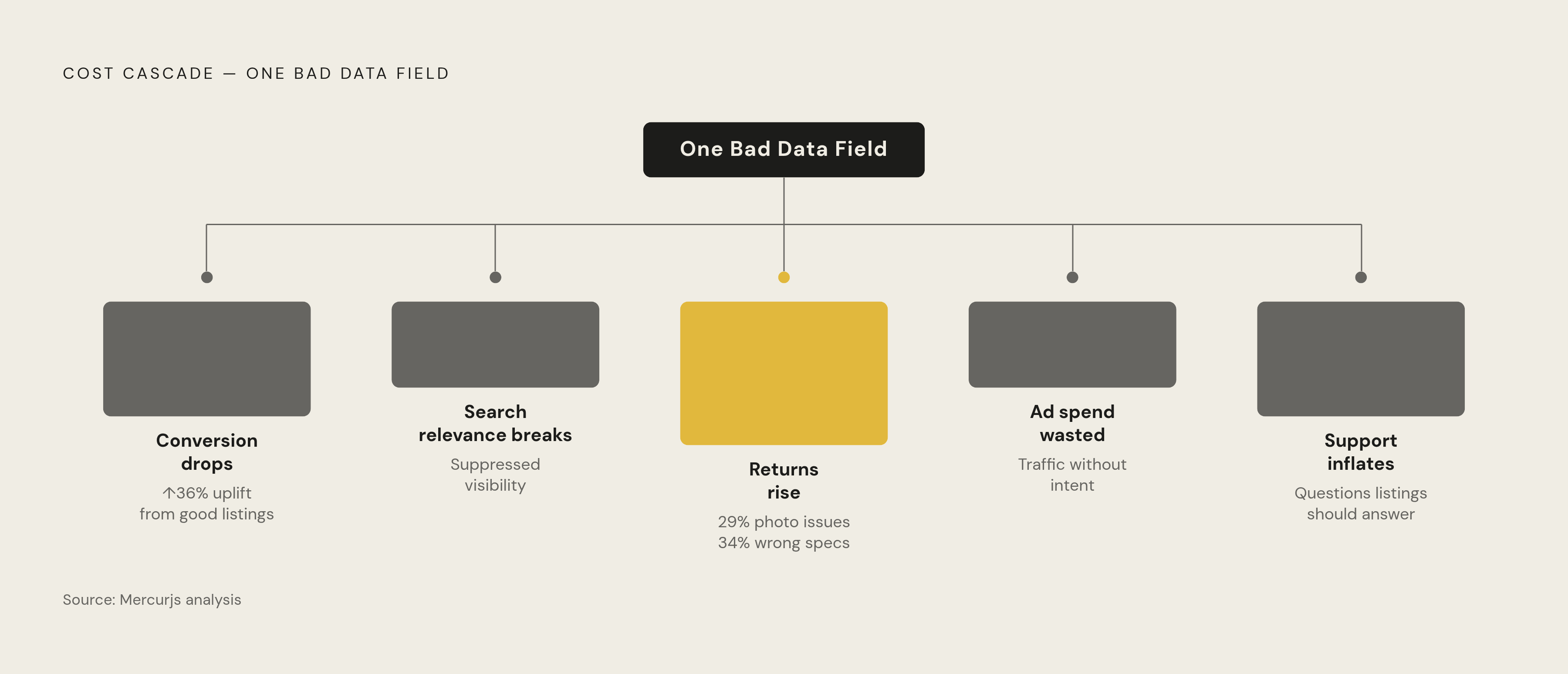
Flip the frame: the upside is just as measurable. Onramp Funds' checklist puts the conversion lift from optimized listings at up to 30%, alongside better search rankings, and Salsify's figures, cited via Xictron, show enriched and well-syndicated content lifting conversion by as much as 36%, with an average lift near 15%. GS1 US data, cited in Atropim's research, adds a detail that matters for margin, not just volume: 62% of consumers say they're willing to pay more for a product with detailed information, meaning better data doesn't just win the sale, it can win a better sale.
Filters are where this becomes concrete. Roughly 74% of shoppers use filters to narrow their choices, so a product missing its color, size, or material attribute doesn't rank lower, it vanishes from the result set the instant a buyer filters by that field, regardless of price or quality. No amount of competitive pricing rescues a product that never appears in the list.
Images carry perhaps the sharpest swing of any single variable. Smapit's analysis shows well-optimized Amazon listings converting at 10 to 15%, while listings with poor images can sit below 1% no matter how much qualified traffic reaches them, a gap that advertising spend cannot close, because the problem isn't visibility, it's persuasion at the point of decision. The same quality gap appears in the returns data. 1WorldSync's analysis attributes 29% of returns to inadequate product photography and 34% to inaccurate specifications, both catalog quality failures rather than fulfillment failures. Set against the NRF and Happy Returns benchmark, which puts 2025 online return rates at 19.3% against 15.8% across retail overall, with total U.S. retail returns projected at $849.9 billion, catalog quality stands out as one of the few levers an operator can pull that touches that number directly, rather than through customer service policy or logistics redesign.
How scale turns catalog quality into a structural problem
Mercurjs's analysis frames poor catalog quality in a multi-vendor marketplace as a structural condition. Errors don't get caught one at a time anymore, they compound faster than any team, however diligent, can chase them down individually.
Walmart's growth curve shows what that scale actually looks like in practice. The platform surpassed 200,000 active sellers by mid-2025, adding 44,000 in the first five months of that year alone, while ecommerce sales cleared $150 billion for the first time in fiscal 2026. The catalog itself grew past 420 million products, with 95% of that volume coming from third-party marketplace sellers rather than Walmart's own retail operation. At that density, manual review isn't a staffing problem to solve with more reviewers, it's a mathematical impossibility. The only workable path is enforceable standards paired with automated pre-publication checks that catch problems before a listing ever goes live.
The cost of skipping that step doesn't stay contained to one metric either. Mercurjs's analysis notes that bad data cascades across multiple systems at once: it drags down conversion, breaks on-site search relevance, drives up returns, wastes advertising spend chasing traffic that won't convert, and inflates support costs when buyers contact sellers to ask questions the listing should have already answered. Tolerating a data problem in one field doesn't cost once. It costs on every system that field touches.
Product title standards and enforcement
Titles sit at an odd intersection: they need to satisfy a search algorithm and a skeptical human reader at the same time. Get the balance wrong in either direction and the listing suffers. Evinent's research identifies the two failure modes clearly. One is the title that says too little, offering no real information about what the product is or does. The other is the keyword-stuffed title, something like "New 2026 Premium High Quality Luxury Waterproof Shockproof Phone Case For iPhone 15 Pro Max Black Gift," technically packed with searchable terms but functionally untrustworthy to anyone actually reading it.
Amazon tightened its enforcement of this considerably. Its January 21, 2025 update capped most product categories at 200 characters, banned special characters such as exclamation points and dollar signs except where they're genuinely part of a brand name, and limited repeated words, with enforcement scaling up sharply through the second quarter of that year. The process matters as much as the rule. Amazon issues correction suggestions first, giving sellers a 14-day window before the system applies automatic updates on its own. For a seller running a small catalog, that's plenty of time to review and adjust. For a seller managing thousands of SKUs, a two-week window can close before anyone notices, and the platform then edits listings without further consultation.
A well-built title generally carries the same core elements regardless of category, formatted so it can be scanned in under two seconds rather than read like a paragraph: the brand name, a clear statement of what the product actually is, and the one or two differentiators, size, material, color, model, that a buyer actually searches on. None of that is exhaustive. It's the floor, not the ceiling. What matters more here is the enforcement pattern itself, automated flagging, a notification to the seller, a correction window, then platform action if nothing changes, because that same sequence reappears almost everywhere else these standards get enforced.
Product image requirements across major platforms
Every major marketplace publishes its own image specification, and they don't agree with each other on almost any dimension, background, resolution, aspect ratio, file size, or count. A seller listing the same SKU on even three platforms simultaneously is maintaining three separate technical outputs from a single photoshoot, not one image reused three times.
The stakes justify the complexity. Baymard Institute research puts the first action of 56% of online shoppers on a product page as exploring the images, ahead of the title, the bullet points, or the description. Whatever a listing says about itself, the picture gets there first.
The specifics diverge sharply by platform. Walmart accepts JPEG, PNG, or BMP, recommends 2200x2200 pixels with a 1500x1500 floor for zoom, requires a 1:1 square ratio for most categories (apparel needs 3:4 portrait), demands a pure white background on the primary image, caps file size at 5MB, and automatically unpublishes any listing whose primary image drops below 500x500 pixels, with four images as the stated minimum and six or more typically recommended for stronger content quality scores. Etsy, by contrast, has no background requirement at all, accepts up to twenty images per listing, and allows files up to 10MB (though 1MB is recommended for faster uploads), making it the most permissive of the major platforms by a wide margin. Zalando, the largest fashion marketplace in Europe, takes the opposite approach: JPEG only, a strict 1:1.44 portrait ratio, and outright rejection of any article that doesn't meet the minimum image count, with no partial credit for getting close.
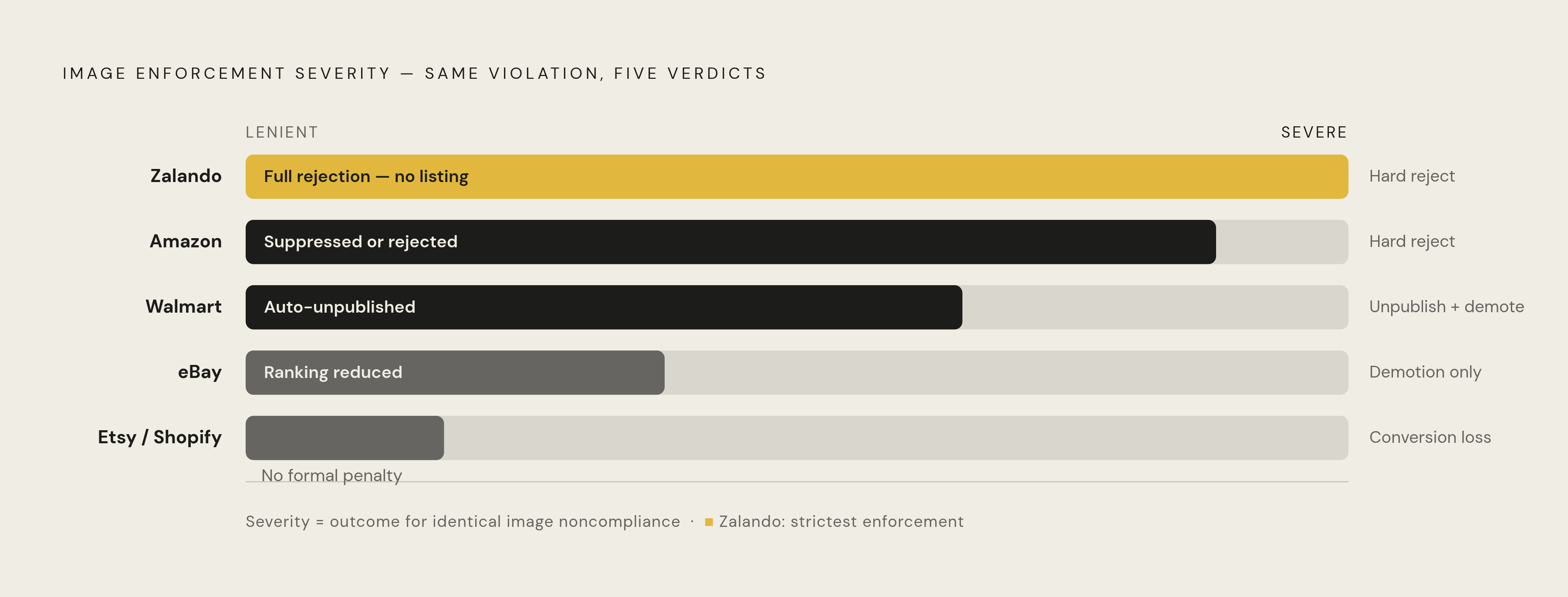
Enforcement outcomes track that same divergence. Amazon suppresses or rejects the listing. eBay and Walmart tend to demote search ranking rather than pull the listing. Etsy and Shopify stay lenient, though meeting the recommendations still measurably helps conversion. Amazon, ASOS, and Zalando all run automated compliance checks that flag dimension, background, or format errors, and Jinkomage and Isopeel's documentation shows that none of them send back error messages specific enough to fix the problem quickly. A rejected image and a vague reason code is its own kind of tax on a seller's time.
AI-generated product imagery hasn't triggered a blanket ban on any major platform as of 2026, but every platform applies its existing accuracy and quality standards regardless of how the image was produced, so a synthetic image still has to meet the same background, resolution, and framing rules as a photographed one. Video adds its own lift: most categories see a meaningful conversion bump, typically in the 10 to 30% range, from adding even one short clip, and Amazon's specification calls for MP4 or MOV, a 720p minimum, a 5GB cap for standard listing video (500MB for Sponsored Brands Video ads), and a runtime under 60 seconds.
None of this is difficult at 500 SKUs. At 5,000 SKUs, multi-platform image compliance becomes a production infrastructure problem, because it needs a pipeline, not a photographer working through a list. Pixofix, Nightjar, and Isopeel document the platform-by-platform specs below, verified against current platform documentation as of 2026. On Amazon, the pure white background is enforced algorithmically at exactly RGB 255,255,255, with a minimum of 1000px on the longest side required to activate zoom, 1600px recommended for optimal zoom quality, and 2000–3000px recommended overall, the product must fill at least 85% of the frame, no text overlays or models are allowed on the main image for most categories, up to 9 images per listing are permitted, and non-compliance triggers suppression or full rejection; eplaybooks.com, isopeel.com, and sizemarker.com document these specifications.
Attributes, identifiers, and variant structure (the quality layer buyers never see but always feel)
Identifiers, UPC, EAN, GTIN, ASIN, produce everything else that follows in a listing. Without accurate identifiers, a listing can't be matched correctly in search, can't be de-duplicated against identical listings from other sellers, and can't be verified as authentic. Buyers never see this layer directly, but they feel its absence the moment search returns nothing, or returns three duplicate listings with conflicting prices.
Attribute completeness governs whether filtered search even works. Since 74% of shoppers narrow results using filters, a product missing its color, size, or material field simply disappears from the filtered list, even when it's the exact item the buyer is hunting for. Variant structure carries a related risk. Products sold in multiple configurations need a clear parent-child relationship linking those variants together, so that a buyer selecting "blue, size M" sees an image, price, and stock status that all actually correspond to that selection. When the page sends mixed signals, most buyers don't stop to investigate which version is accurate, they simply leave. They leave.
Industry classification schemes like ETIM or ECLASS extend this logic into procurement. These standards let buyers compare products across suppliers using a shared set of attributes, and B2B-facing marketplaces frequently require that structured data as a precondition of listing at all, not an enhancement, a gate. Skipping it makes the product invisible in exactly the channels built to surface it.
What makes this layer dangerous is how quiet the failures are. A wrong category mapping, a duplicated SKU carrying a slightly different brand name, a dimension recorded in the wrong unit, none of these look catastrophic in isolation. Stacked across a large catalog, though, they function as a hidden tax on search performance and conversion, appearing not as a single dramatic incident but as a slow bleed nobody traces to its source.
Compliance documentation and regulated category requirements
Quality standards improve conversion and reduce returns, while compliance requirements determine whether a product can legally be listed. The two get lumped together in casual conversation, but they don't behave the same way operationally.
Amazon's policy shift in January 2025 requires sellers to upload compliance documents, supply chain records, certifications, directly to the seller portal for verification before a listing gets approved. From July 13, 2025 onward, that documentation has to originate from a laboratory meeting Amazon's own internal safety standards, a lab that doesn't appear on Amazon's Suspended Validation Labs list, not merely any lab holding general accreditation. That's a meaningfully higher bar than "certified somewhere."
Children's products carry an additional layer on top of that. Starting September 3, 2025, sellers of children's toys face annual testing or document verification through a compliant Testing, Inspection and Certification provider, and under existing U.S. law, any children's product subject to an applicable safety rule needs a Children's Product Certificate backed by testing from a CPSC-accepted laboratory, a requirement that reaches any item intended for a child under 12, toy or otherwise.
Certain claims are barred outright regardless of category. Onramp Funds' checklist flags "FDA Approved" as a prohibited claim, and certifications like UL or CE have to be displayed in the correct format on the listing, not simply held on file somewhere. Prop 65 warnings, CPSIA tracking labels, and CE marks each carry their own required display format, and the obligation is visibility to the buyer at the point of purchase. For sellers operating in regulated categories, this means catalog quality can no longer stay confined to a content or catalog operations team. Legal and sourcing functions need a seat at that table, because a missing certificate or a malformed warning label isn't a content defect, it's a listing that shouldn't exist yet.
Enforcement mechanisms (pre-publication checks, automated suppression, and seller-facing tooling)
Pre-publication automated checks have become the standard mechanism across major platforms: a listing has to clear required attribute presence, minimum image resolution, and description length thresholds before it ever goes live, and a listing that fails gets kicked back to the seller with specific fixes attached. Titles, images, attributes, and compliance documents all pass through some version of the same gate.
The consequences of failing that gate aren't uniform. Amazon suppresses or fully rejects noncompliant listings. Walmart automatically unpublishes any listing whose primary image drops below 500x500 pixels and demotes ranking for other violations. eBay tends toward ranking reduction rather than removal. Etsy and Shopify stay more forgiving, though ignoring the recommendations still costs conversion even without formal punishment. Zalando rejects outright the moment the minimum image count isn't met, with no provisional listing allowed while the seller fixes it.
The quality of the feedback a seller receives matters nearly as much as the enforcement action itself. Field-level comments that appear next to the exact field needing correction save time; standardized rejection reasons save confusion. Vague or missing error messages, documented across Amazon's, ASOS's, and Zalando's automated systems, create friction that slows down exactly the remediation the system is supposed to encourage. A rejection with no clear reason just becomes a second problem stacked on the first.
Walmart's seller-facing tooling shows what a more mature version of this infrastructure looks like. Its Listing Quality API delivers offer-level insights to help sellers spot problems and recommended fixes, while its Content Quality API works at the item level, surfacing content and attribute issues directly, both documented in Walmart Marketplace's own release notes. As of September 14, 2026, Walmart extended that system further, adding personalized recommendations designed to help sellers improve multiple listings at once rather than working through fixes one at a time. That shift, from a single rejected listing toward portfolio-level guidance, points at where enforcement is heading generally: not just catching what's wrong, but showing sellers, at scale, how to fix it before the next automated check runs.
Notes
- Checklist for Consistent Product Listings on Marketplaces | Onramp Funds
Provided the 30% conversion lift figure for optimized listings and flagged prohibited claims like 'FDA Approved' in compliance sections.
- Marketplace Learn
Sourced Walmart's Listing Quality API and Content Quality API details, including the September 14, 2026 personalized recommendations update.
- Marketplace Product Data Quality: The Hidden Revenue Problem
Provided the Akeneo and Salsify statistics on purchase abandonment, returns due to bad product data, and the two title failure modes.
- Marketplace Product Image Guidelines: Specs, Compliance & Scale for Ecommerce Brands (2027) | Pixofix
Documented platform-by-platform image specifications verified against current platform documentation as of 2026.
- Marketplace Catalog Management: 3P Data Quality · Mercur
Framed poor catalog quality in multi-vendor marketplaces as a structural condition and detailed how bad data cascades across multiple systems.
- https://www.atropim.com/en/blog/product-catalog
Provided the statistics that 87% of consumers rank product information as the most critical purchase factor and that 62% will pay more for detailed product data.
- https://www.xictron.com/en/blog/pim-strategy-product-data-sovereignty-shops-2026/
Cited Salsify figures showing enriched content lifting conversion by up to 36%.
Every new piece from marketplace crunch, as it's published.
Follow