Creator Economy Platforms Compared by Monetization Model
YouTube's 55% split masks a forty-times income gap between content categories.
The logic fits on a napkin. Platform sells ads against your content, you get a cut, everybody wins. YouTube is the clearest expression of this model: 55% to the creator on long-form, 45% on Shorts. Non-negotiable, platform-set, take it or leave it.
The entry structure is where most people stop reading the fine print. The lower YouTube tier unlocks fan funding only, not ad revenue. Getting into actual ad revenue participation requires 1,000 subscribers and either 4,000 watch hours or 10 million Shorts views. That gate means a significant portion of creators are working inside the model's rules without yet qualifying for its primary benefit. The model rewards scale before rewarding early effort, and patience only pays if your content already serves a segment advertisers are actively trying to reach.
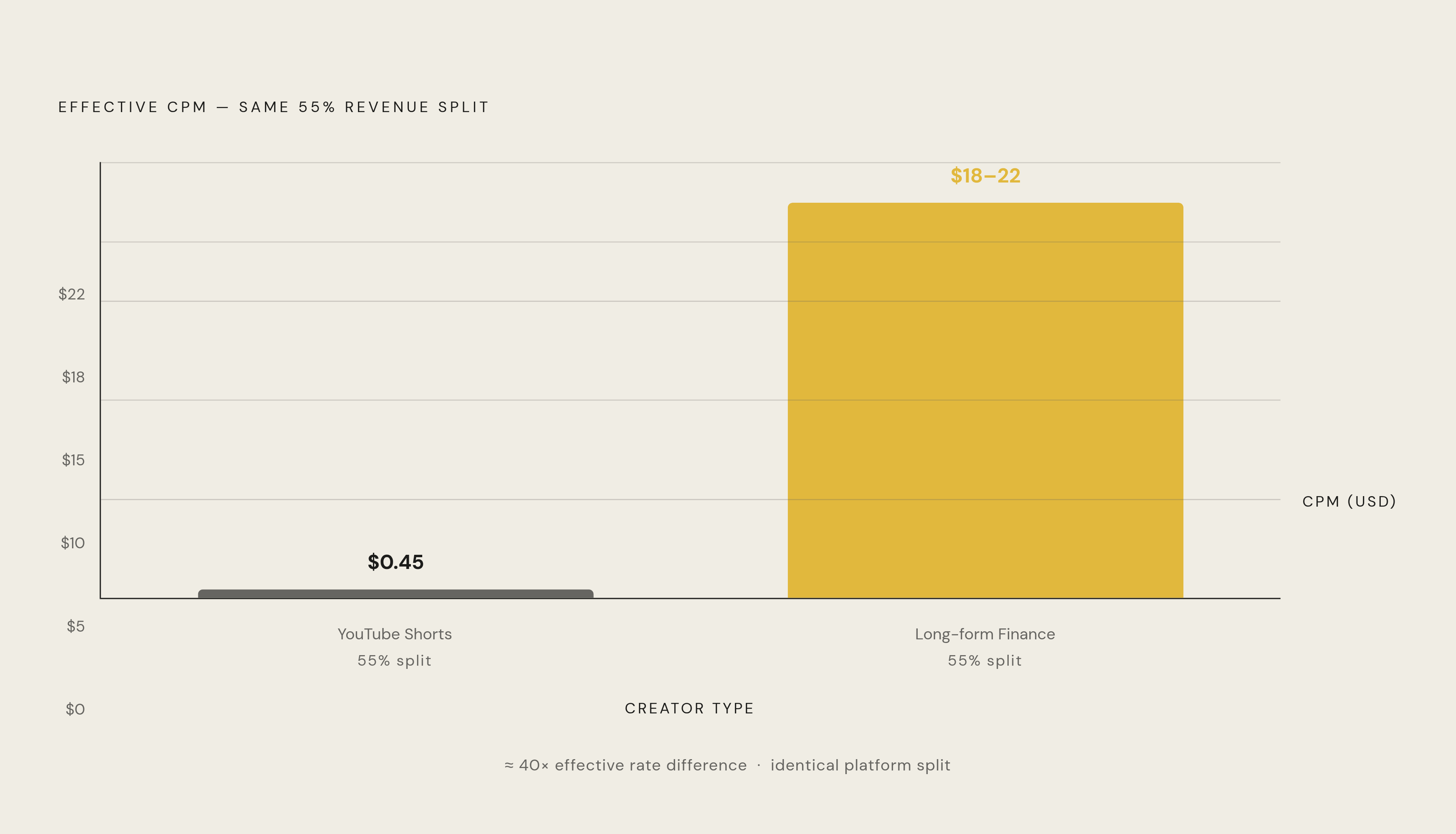
That last condition is where things get quietly brutal. The 55% split sounds uniform until you see the CPM sitting underneath it. A Shorts creator pulling consistent views earns roughly $0.45 per 1,000; a long-form finance creator on the exact same platform earns $18 to $22 per 1,000. Same percentage. Same platform. Roughly forty times the effective rate. The model pays more to creators who serve premium advertisers, irrespective of audience size, engagement quality, or creative output. Your 55% is only as good as the advertisers who happen to want proximity to what you make.
YouTube paid out tens of billions of dollars to creators between 2021 and 2023, according to figures the company has disclosed publicly. Large aggregate payouts at the top of a steeply skewed distribution confirm the model works for the people it works for. They tell you nothing about what's happening for the 90th-percentile creator still grinding toward that 1,000-subscriber threshold.
The structural vulnerability underneath all of this is the part most creators absorb too late, usually after a Q1 CPM drop hits their account and they realize they had no idea it was coming. CPM drops seasonally and predictably; Q1 is reliably soft across the industry. Geographic variance is high enough to move the needle materially. Platform policy changes, including originality requirements introduced in 2025, can affect eligibility without meaningful advance notice. Your income depends on advertiser demand, which is a market condition entirely external to your relationship with your audience. If your viewers love you and advertisers have no interest in being adjacent to your content category, the model does not compensate you for that loyalty. At all.
Ad revenue share is the highest-volume model in the creator economy. It is also the lowest-control one.
TikTok's Discovery-First Economics and Why High Views Don't Translate to High Income
TikTok's Creator Rewards Program pays between $0.40 and $1.00 per 1,000 qualified views in the US. A real improvement over the Creator Fund it replaced, but structurally thin in ways that compound fast. Videos under 60 seconds are ineligible regardless of view count. TikTok Pulse, the platform's ad-revenue-share tier, requires at least 100,000 followers and consistent placement in the top 4% of content by views, with a 50% ad revenue split. Most creators on TikTok will never see either mechanism generate meaningful income, and many don't realize this until they've already built their entire strategy around the platform.
This is the discovery-income gap, and it is the defining structural fact about the platform. TikTok is a powerful organic discovery engine — a creator with zero existing audience can reach millions within days. But at $400 to $1,000 per million views at the high end of the Creator Rewards rate, native per-view income requires a kind of scale that most viral creators never actually sustain. Going viral without a monetization plan downstream is, at best, a very exciting week.
The real monetization on TikTok lives in brand deals and commerce. Average brand payments to TikTok creators reached $2,049 in early 2025, up 23% year-over-year, according to industry data from Influencer Marketing Hub. TikTok Shop drove roughly $26 billion in gross merchandise value in the first half of 2024, with creators driving a significant share of US Shop sales. Commerce commission is where income actually concentrates for most serious TikTok earners, not the per-view payout.
TikTok is a top-of-funnel platform. Its monetization value is largely exported to brand deals and off-platform products rather than captured natively. If you're building on TikTok expecting the platform's own payment mechanisms to be your primary revenue stream, the numbers don't support that. If you're building on TikTok to accelerate audience growth and monetize that audience elsewhere, the discovery economics work strongly in your favor. Those are two different businesses that happen to use the same app, and conflating them is an expensive mistake.
How Subscription and Membership Models Shift Value from Platform to Creator
Subscription models replace advertiser demand with direct audience demand. Your income becomes subscriber count multiplied by price, and both variables are largely yours to control. No algorithm determining your CPM, no seasonal advertiser pullback, no policy change that restructures your revenue overnight. A creator with 1,000 paying subscribers at $10 per month earns $10,000 per month regardless of what the view count looks like anywhere else that month.
Patreon
Patreon is the canonical membership-first platform. As of August 2025, it operates on a flat 10% platform fee. The platform crossed multiple billions in annual payouts in 2025 and paid hundreds of millions of dollars to podcasters from millions of paid memberships in 2024.
The income distribution is real and worth sitting with. A small top tier of Patreon creators earn over $25,000 per month. Most earn closer to $500. This is not Patreon's failure; it reflects the underlying distribution of creator audiences, the same distribution that governs most creative markets. And the vast majority of Patreon subscribers come from a creator's existing audience on other platforms, not from Patreon's internal discovery. Patreon is a monetization layer you build on top of an audience you built somewhere else. Monthly churn is the persistent operational challenge; retention, not acquisition, is the business problem this model actually presents.
Substack
Substack takes 10% of paid subscription revenue. After payment processing, creators retain the majority of revenue, the cleanest effective split among major creator platforms. The platform returned hundreds of millions of dollars to writers in 2025, across tens of millions of active subscriptions.
The income distribution is steep here too. The top authors collectively earn tens of millions of dollars per year; the median creator with paying subscribers earns around $4,000 annually. That median is the number that matters for anyone making an honest assessment of the model.
Substack's most structurally durable advantage is email delivery. Content reaches subscribers directly in their inbox, not through an algorithmic feed, and no platform decision can reduce your open rate the way a feed algorithm change can crater your social reach overnight. That protection is real and compounds over time in ways the revenue split percentage doesn't capture. Substack has also expanded into podcast hosting, video, a social feed called Notes, and a free follower tier with a paid upsell path, each increasing surface area while keeping subscription economics at the center.
Both platforms share the same foundational constraint: neither one generates the audience. The creator must bring it.
OnlyFans' 80/20 Split and What the Most Creator-Favorable Revenue Structure Actually Requires
OnlyFans retains a flat cut across subscription, pay-per-view, and tip revenue. The creator keeps the large majority. That is the most favorable revenue split among major creator platforms operating at scale, and it applies uniformly rather than to one revenue type selectively.
The model combines three distinct income streams: (i) recurring subscriptions, (ii) pay-per-view content drops, and (iii) direct tipping through messaging. That structure enables income to spike meaningfully with exclusive releases in ways pure subscription platforms don't accommodate as naturally. It also creates an operational incentive toward frequent, high-touch fan interaction, which functions simultaneously as a monetization mechanism and a retention strategy.
The scale is not marginal. As of 2025, the platform counts millions of active creators and hundreds of millions of registered users.
What the revenue split doesn't show is brand association risk. Despite a broad range of creator categories on the platform, OnlyFans carries a reputational context rooted in its adult-content origins. That context affects cross-platform brand partnership opportunities in ways that are consequential but appear nowhere in the fee structure. Discovery is also minimal; like Patreon, OnlyFans functions as a monetization layer rather than a growth engine. Traffic must come from somewhere else.
A favorable percentage is necessary but not sufficient. Platform context, brand implications, and operational demands are part of the real cost structure, and if you ignore those variables in favor of the headline split number, you're reading an incomplete spreadsheet.
Brand Deals and Creator Marketplaces (the Income Source Most Creators Actually Rely On)
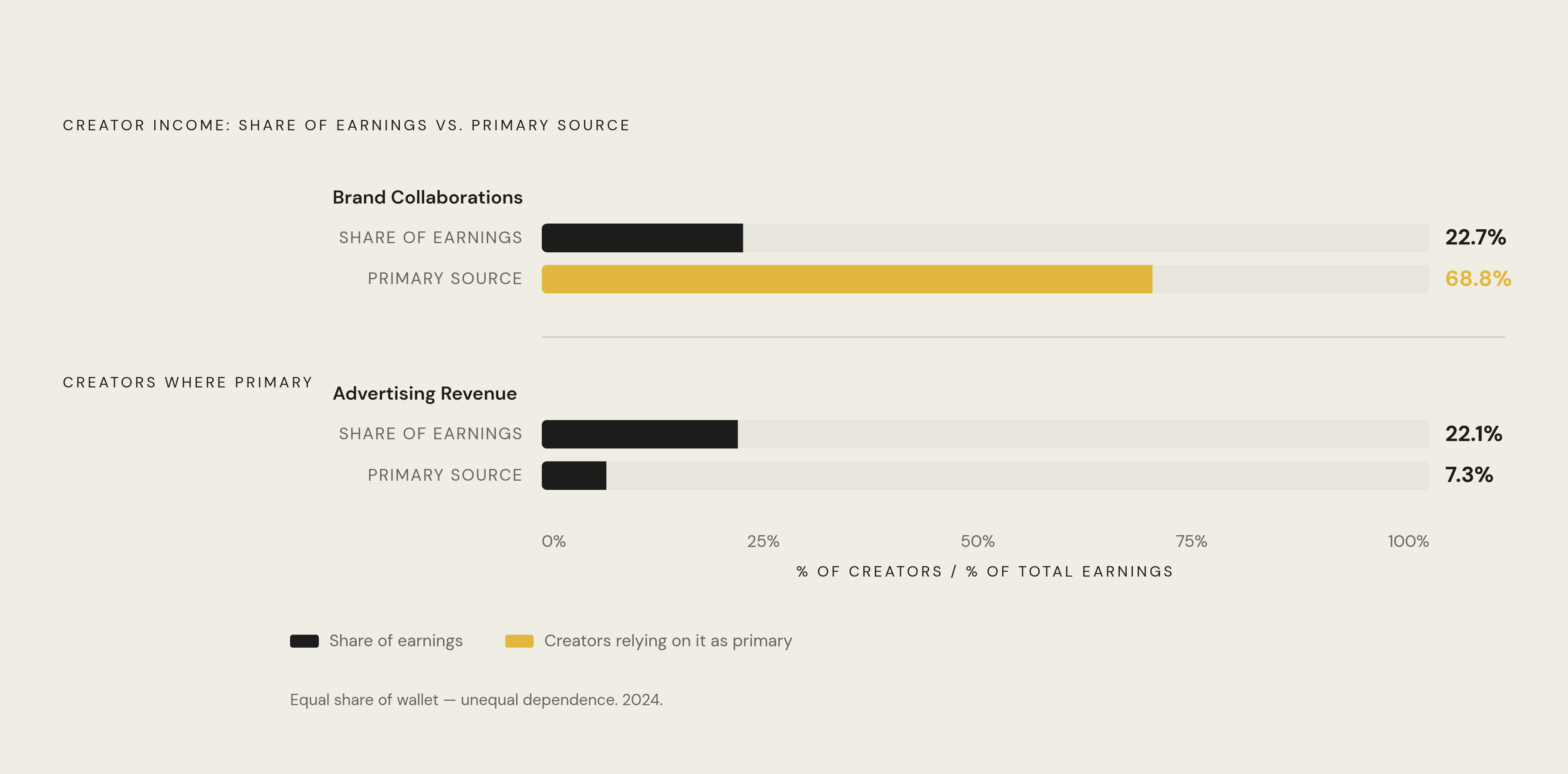
Brand collaborations accounted for 22.7% of creator earnings in 2024, with advertising revenue close behind at 22.1%, according to industry survey data. Brand deals have displaced ad revenue as the top income source, and the operating reality reflects it: 68.8% of creators rely on brand deals as their primary income source, while only 7.3% earn primarily from ad revenue. The ad models covered earlier are, for most creators, secondary income at best.
Total influencer marketing spend exceeded $32.55 billion in 2025. The money is real. The competition for it intensifies every year.
Platform-based brand marketplaces, including TikTok Creator Marketplace, YouTube BrandConnect, and Instagram's creator tools, act as intermediaries. They match creators to brand campaigns and take a platform cut or data advantage in return. The structural difference from ad revenue share is meaningful: (i) you negotiate rate or accept posted campaign terms, (ii) you retain more control over which brands you represent, and (iii) income is per-campaign rather than per-view. TikTok's Shop GMV figures illustrate how commerce-integrated brand models can scale beyond one-off sponsorships into something more systemic.
The structural risk is equally clear. Brand income is project-based, not recurring. It doesn't compound the way subscription revenue does, and it depends on your audience being attractive to the right advertisers. That creates an echo of the CPM problem from YouTube: the value of your audience is partly determined by who's in it, not just how many show up. When a platform's brand marketplace shifts its algorithm, loses marketer confidence, or restructures its terms, brand income can evaporate even if your underlying audience is completely intact and deeply loyal.
Creators who use brand deals most successfully treat them as one layer of a multi-stream model. Not a standalone business.
Digital Products and Owned-Channel Monetization as the Exit from Platform Dependency
The digital product model works differently from everything else covered here. You sell courses, templates, ebooks, workshops, coaching, or software directly to your audience through platforms like Gumroad, Teachable, or Podia, or through your own storefront. You set the price, own the customer relationship, and retain the contact data. Income is contingent on none of the following: (i) platform policy, (ii) algorithmic reach, or (iii) advertiser demand.
Revenue splits on digital product platforms are generally favorable. Most take a small transaction fee or a flat subscription, leaving the substantial majority of revenue with the creator. The subscription segment broadly is projected as the fastest-growing monetization channel through 2033, capturing both platform subscriptions and direct creator-to-audience product sales, which suggests audience-direct models are gaining structural share over advertiser-mediated ones.
The operational requirement this model imposes is real. It demands an existing audience and a product worth buying. The setup cost in terms of audience trust and content infrastructure is the highest of any model discussed here, even though platform fees are the lowest. You cannot build into digital products from nothing. You build toward them, deliberately, over time, and usually after you've made a fair number of wrong turns figuring out what your audience actually wants to pay for.
The most effective implementation layers digital products onto a subscription or YouTube base. The platform provides discovery and credibility; the owned product captures the highest-margin revenue. Content that builds toward a product sale requires a different editorial discipline, one oriented around demonstrated expertise and solved problems rather than pure reach or virality.
Reading the Revenue Split Table (What the Percentages Actually Mean for Different Creator Types)
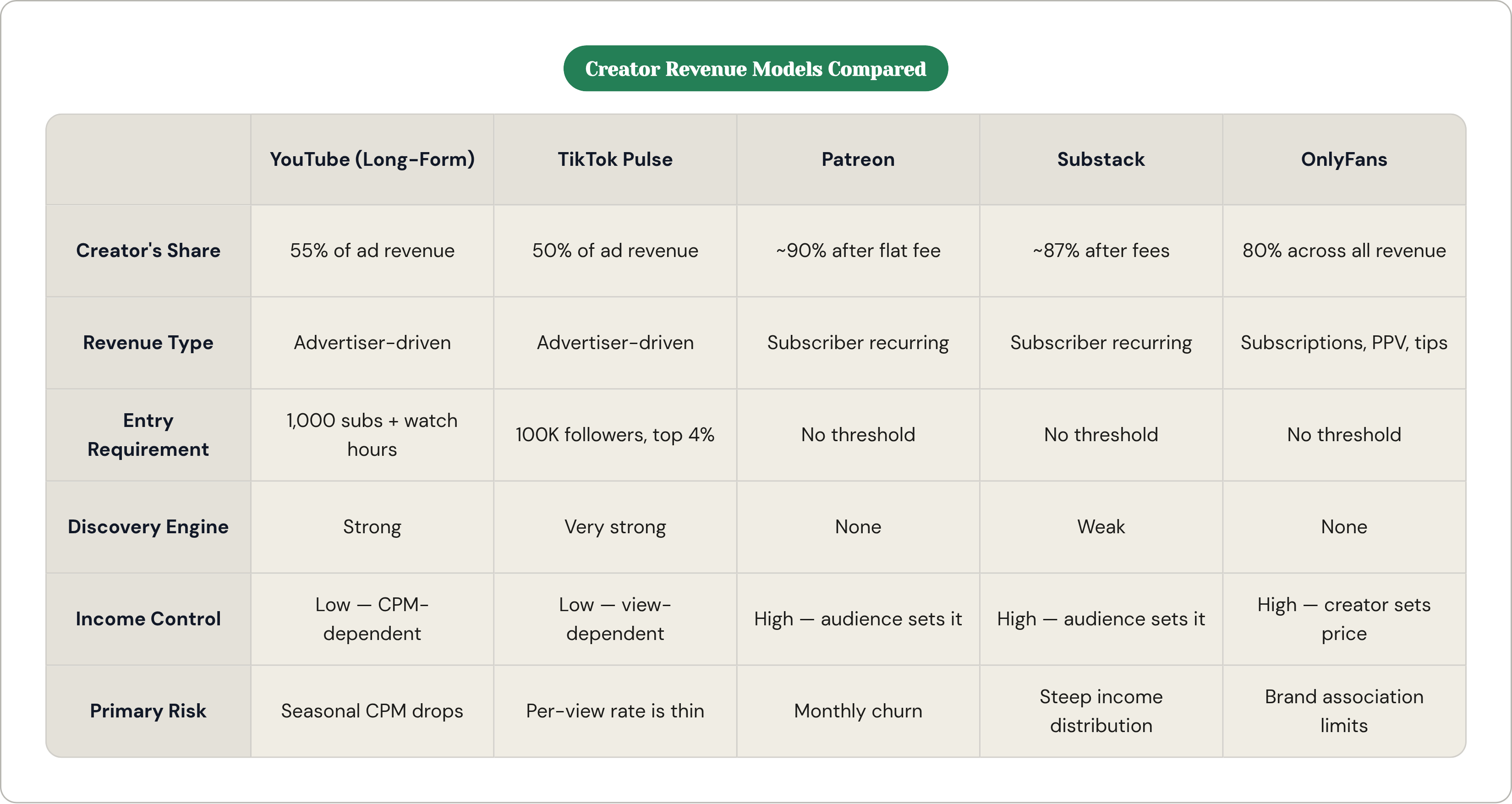
The splits, consolidated. YouTube long-form: 55% to the creator on ad revenue. YouTube Shorts: 45%. YouTube Super Chat and Channel Memberships: a majority cut to the creator. TikTok's Creator Rewards Program: $0.40 to $1.00 per 1,000 qualified views, not a percentage. TikTok Pulse: 50% ad revenue share, gated at 100,000 followers. Patreon: the substantial majority after its flat fee. Substack: roughly 87% after platform and payment processing fees. OnlyFans: 80% across subscriptions, pay-per-view, and tips.
These numbers are real. They also matter less than most creators think, because the percentage is only one variable. The more important variable is the revenue base underneath it.
A 55% share of ad revenue on 10,000 monthly views produces very little. A large share of $10,000 in monthly subscription revenue produces around $9,000. Any creator operating below mass scale (which is most creators) who optimizes for a higher revenue-share rate while running on a thin revenue base is making a structural error. You can have the most creator-favorable split in the industry and still be broke.
The practical framework for matching model to creator type: creators with large existing audiences and advertiser-friendly content can extract meaningful income from YouTube's ad revenue model. Creators with smaller but deeply engaged niche audiences are better served by subscription models, where loyalty translates directly to income rather than being mediated through CPM. Creators with high social discovery momentum, especially on short-form platforms, should treat native platform income as secondary and focus on brand deals and commerce as the primary monetization layer. Creators with established authority in a specific domain have the strongest case for digital products, where the revenue multiple on effort is highest and platform dependency is lowest.
Most working creators operate across several of these models simultaneously. Discovery platforms build the audience. Subscription layers stabilize the income. Brand deals spike it. Digital products capture the highest-margin revenue from the most engaged segment. Knowing which model dominates each platform, and what you're actually trading away to participate in it, is what separates building a sustainable creative business from chasing algorithm changes and wondering, every quarter, why the numbers never quite add up.
Notes
- https://electroiq.com/stats/creator-economy-statistics/
Provided the statistics on the share of creators relying on brand deals versus ad revenue as their primary income source.
Every new piece from marketplace crunch, as it's published.
Follow