ConTech Companies Building Construction Marketplace Infrastructure
Late-stage funding is shifting to platforms that connect construction's fragmented supply chain.
The early years of ConTech investment were a lot of one-off tools. A better RFI workflow here. A drone inspection app there. Useful on the jobsite, largely irrelevant to the underlying dysfunction. What's happening now is a different kind of bet: the industry stopped buying band-aids and started pouring concrete.
After a 44% downturn in 2023, ConTech investment stabilized at $3 billion that year, then edged to $3.1 billion in 2024, with deal count rising from 236 to 325. Then the recovery turned sharp: the first three quarters of 2025 alone drew more than $3.7 billion, more than double the same period in 2024.
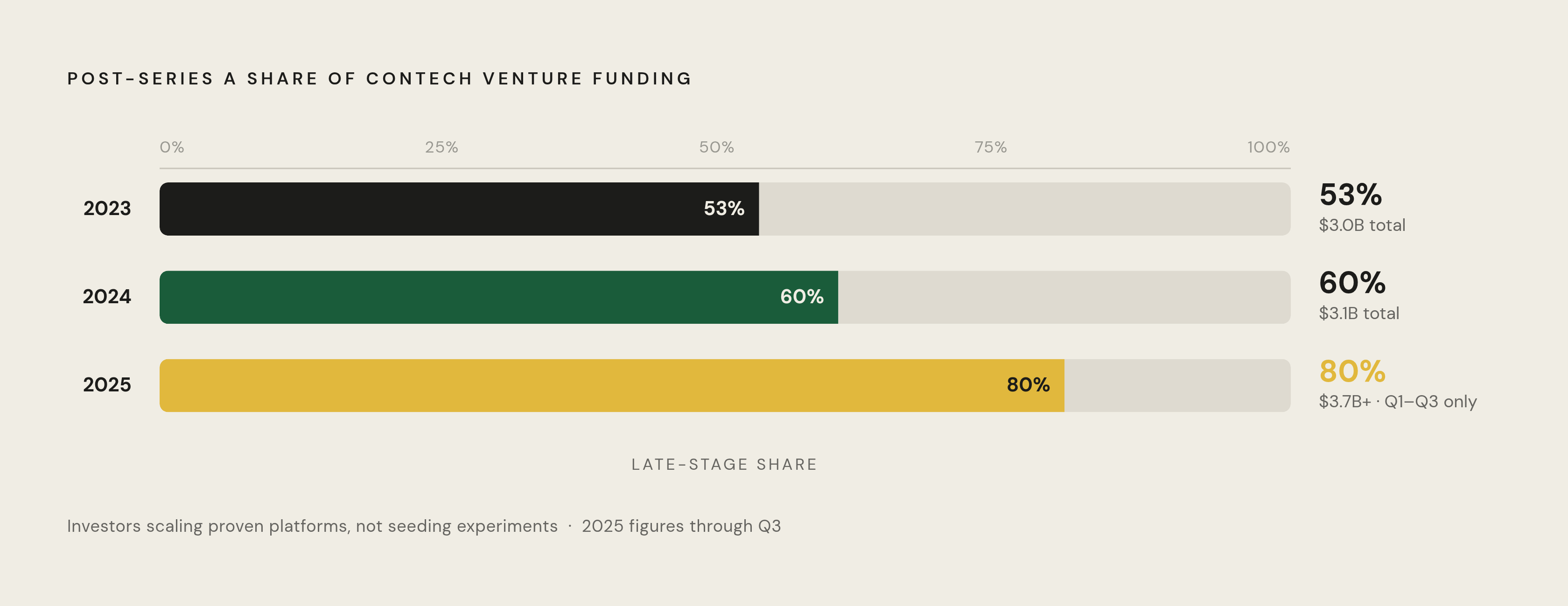
The composition of that capital tells the real story. In 2023, roughly 53% of venture funding went to post-Series A deals. By 2024, that figure was 60%. By 2025, it reached 80%. Investors aren't seeding experiments anymore. They're writing larger checks to scale platforms that have already demonstrated traction, and that shift changes who gets funded and what they're incentivized to build.
Look at where the money landed in 2024. Enhanced productivity tools anchored by BIM, digital twins, and AI led with approximately $1.5 billion. Construction supply chain tools, the marketplace and procurement layer, drew approximately $231 million. Smaller, yes, but a defined and growing slice. AI-specific investment reached $2.22 billion in just the first three quarters of 2025, and increasingly that capital is being embedded in marketplace infrastructure rather than deployed as standalone point tools.
Geographically, North America generated a large share of investment dollars and a majority of all deals in 2024. Together with Europe, those two regions accounted for the vast majority of investment. That concentration reflects where the infrastructure buildout is most active, and where the regulatory, labor, and procurement environments make platform-scale solutions most viable.
The current wave is funding platforms that aggregate parties, connect data environments, and operate across the full project lifecycle. That is a structural shift in what the industry is willing to pay for, and it's accelerating.
The project management layer: platforms that became the first connective tissue
Before anyone used the phrase "marketplace infrastructure" in a ConTech pitch deck, the project management platforms were quietly doing infrastructure work. They just called it something else.
Construction management software is a $7.67 billion global market in 2025, with the top five vendors controlling roughly 45% of revenue. General contractors are the largest buyer segment, accounting for roughly 47% of 2025 spending. Cloud delivery now represents roughly 64% of revenue, which means the foundational data portability that real infrastructure requires is already in place. That's not a minor footnote.
Procore made one architectural decision early that most people still underestimate. By pricing on annual construction volume rather than per seat, it removed the licensing barrier that would have kept subcontractors and extended project teams off the platform. When GCs can pull subs onto the same data environment without a procurement conversation about software seats, they do. Consistently. And when shared access becomes the norm, shared data follows. Procore's 300-plus marketplace integrations, spanning design tools, scheduling software, and communication platforms, formalize what that network effect enables: the platform functions less as a tool and more as an integration hub that other systems plug into.
Autodesk Construction Cloud took a different path to a similar destination. By connecting design-side tools, Revit, AutoCAD, BIM 360, to field execution, it bridged the historically wide gap between what architects draw and what superintendents build. Its acquisition of Payapps in January 2024 is the more telling move. A project management platform crossing into payment and compliance infrastructure signals that Autodesk sees the connective layer extending well beyond project data into financial settlement, which is where the real friction lives.
CMiC occupies a distinct position in this ecosystem. As a full construction ERP, it handles accounting, financials, and payroll natively alongside project management, serving contractors who need a single system of record across the entire operating business rather than a platform built for project-level network effects. Less marketplace hub, more back-office-to-field integration layer.
What these platforms share is significant: they created shared data environments where previously siloed parties, owners, GCs, subs, architects, could operate on common information. What they haven't solved, procurement of materials, sourcing of labor, financial settlement across the supply chain, is the territory newer companies are now building into. They're building on top of the foundation these platforms laid.
Procurement networks: digitizing how construction buys materials at scale
More than $5 trillion flows through the construction materials supply chain globally. The median construction firm in Asia-Pacific, per Deloitte, works across eleven separate data environments. That's not a software problem. It's an organizational posture that has resisted integration for decades, and for reasons that made sense at the time they calcified.
The cost of that resistance is concrete. Labor costs in construction procurement run roughly double those of comparable industries like auto parts and electronics. Late payments cost the construction materials industry hundreds of billions of dollars in 2022, a direct consequence of disconnected billing and procurement systems. When you're managing purchase orders across phone calls, email chains, and disconnected vendor portals, payment latency isn't a failure mode, it's the architecture.
Parspec is building specification and procurement infrastructure specifically for the materials supply chain. Its multi-million-dollar Series A targeted the workflow where a significant share of procurement errors originate: upstream in specification, before a single order is placed. Most platforms try to fix procurement at the ordering stage. Parspec is intervening earlier, which is where the actual leverage sits, because by the time an order is wrong, the schedule has already started slipping.
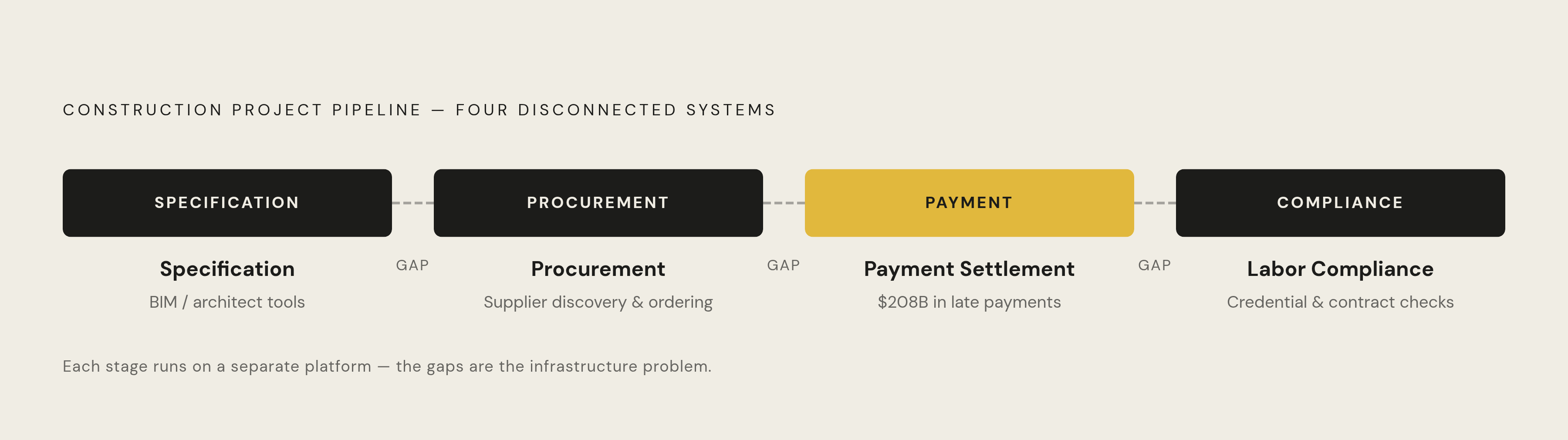
BuildStock represents a different architectural choice: a construction material marketplace combined with a fintech layer, addressing both the discovery and procurement problem and the payment problem simultaneously. Its pre-seed framing called out the $208 billion late-payment burden directly. That's not just marketing language; it signals that the founding team understands something the purely product-focused platforms miss. Procurement infrastructure that doesn't solve payment latency just moves the bottleneck downstream. The project still loses.
A platform connecting specification to supplier discovery to ordering to payment settlement is collapsing four problems that have historically lived across four separate systems into one flow. That's the infrastructure play, and it's why fintech integration isn't a nice-to-have in this layer.
Procurement also intersects with sustainability in ways that are becoming commercially material, not just reputationally. Green construction drew approximately $772 million in 2024 venture funding. Sustainable materials sourcing is increasingly a procurement-layer problem. The platform that controls specification and procurement controls which materials get specified, placing it at the nexus of cost optimization and sustainability decisions at the same time.
Labor platforms: matching skilled trades to projects as workforce scarcity intensifies
Acute skilled-labor shortages affect more than 80% of North American contractors. That is not a cyclical dip that normalizes when interest rates come down. It's a structural condition produced by decades of demographic shift, reduced vocational training investment, and an industry that has always relied on local, relationship-based networks to source crews rather than building any scalable infrastructure to do it.
The traditional model works until it doesn't. GCs maintain rosters of known subs and tradespeople, sourced through relationships built over years. That model breaks down when project volume spikes, when work moves into new geographies, or when a key sub's crew is already committed elsewhere. At that point, the GC is calling around manually, working back-channels, hoping someone is available. That is not a procurement process. It's an improvisation, and it's remarkably expensive.
Labor marketplaces in construction are structurally different from general gig platforms, and the distinction matters more than most people realize. Construction work requires verified credentials, trade certifications, insurance documentation, and safety compliance records. The platform can't just match supply to demand; it has to function as a credentialing and compliance layer simultaneously. That raises the barrier to entry, but it also creates defensible infrastructure. A platform holding verified trade credentials and work history for tens of thousands of workers becomes genuinely difficult to displace because the data asset compounds with every completed transaction.
Robotics investment reached $1.36 billion in the first three quarters of 2025. Some of that is autonomous equipment. Some of it is workforce multiplication, using technology to extend the productive capacity of fewer available workers. The thread connecting robotics investment and labor platform investment is the same underlying constraint: construction projects need to get built, and the traditional labor model cannot scale to meet current demand.
The infrastructure question in the labor layer is specific: which platform will own the verified identity, credentials, and work history of the skilled trades workforce? That data asset is the moat. Whoever holds it controls the matchmaking, the compliance verification, and ultimately the liquidity of the labor market. It's a winner-take-most dynamic in a category that doesn't yet have a clear winner.
Materials exchanges and specification platforms: the emerging middle layer
A specification platform is not a catalog, and conflating the two is an expensive mistake. A catalog digitizes what exists. A specification platform translates design intent, what an architect specifies in a BIM model, into actionable procurement, matching product specifications to available suppliers in real time. The former is a reference tool. The latter is infrastructure sitting between design and delivery, and it's precisely where projects routinely hemorrhage time and money.
The design-to-procurement handoff fails in a very specific, repeatable way. Products get specified in design that aren't available at the time of ordering. Lead times don't get factored into the project schedule during specification. Substitutions happen late, expensively, and often without the architect's sign-off, producing both cost overruns and quality disputes. The specification layer is where those failures originate, which is why building infrastructure there is high-leverage work that most of the industry hasn't touched.
Parspec operates explicitly in this space, targeting the product selection and specification workflow where a significant share of procurement errors originate upstream rather than at the order stage.
The materials exchange concept extends further. Platforms that create liquid markets for construction materials, standardizing grades, quantities, and pricing, reduce the opacity that makes materials procurement slow and expensive. Price transparency and supply availability surfaced in real time change the negotiation dynamic between contractors and suppliers in ways that benefit the contractor and, ultimately, the project schedule.
BuildStock's combined marketplace-and-fintech architecture addresses a related constraint worth stating plainly: even when the right materials are identified, payment terms and credit access determine whether smaller contractors can actually transact at scale. A mid-size mechanical contractor who finds the right product but can't get net-60 terms from a supplier they've never worked with is still stuck. The financial rails are as much a part of the infrastructure as the product data, and most platforms building in this layer haven't fully grasped that yet.
The construction and design software market was estimated at roughly $11 billion in 2024 and is projected to reach roughly $19 billion by 2030. What distinguishes the companies building toward the upper end of that trajectory is that they are connecting specification data to supply chain availability to financial settlement: three systems that have never natively communicated with each other, whose disconnection costs the industry real money every single day.
How AI is shifting from a feature inside platforms to the connective logic between them
AI investment in ConTech reached $2.22 billion in the first three quarters of 2025 alone, making it the largest single category of ConTech venture capital, larger than robotics, larger than supply chain tools. Intelligence has become the primary infrastructure investment. That shift happened faster than most people in the industry expected, and the implications haven't fully landed yet.
At the project management layer, the pattern is already visible. Procore's Helix and Autodesk's Construction IQ embed risk scoring and quality flagging into existing project workflows, AI operating on data the platform already holds, surfacing insights that a project manager would previously have had to derive manually, if at all. That's AI as a feature, and it's valuable. But it's not the more interesting thing that's starting to happen.
At the procurement and specification layer, AI enables real-time substitution logic: if a specified material is unavailable, surface compliant alternatives; predict lead times; analyze spend patterns across a fragmented supplier network to identify consolidation opportunities. These functions require processing large, messy datasets across many transactions simultaneously, exactly what AI handles well and what human procurement teams cannot do at that scale without significant staffing overhead.
At the labor layer, AI handles scheduling optimization, credential verification workflows, and productivity tracking across projects. Wherever the data exists but the synthesis doesn't, AI creates value.
The more structural point is this: AI works best when it has access to clean, connected data. Marketplace infrastructure is the mechanism for connecting previously siloed data environments. Each layer feeds the other. Better infrastructure produces better AI outputs. Better AI makes the infrastructure more valuable to every party operating on it. These are not parallel bets; they are the same bet made from different angles.
The risk is real and underappreciated. AI tools operating inside a single platform's data silo can optimize within that platform, but they cannot coordinate across the ecosystem. A scheduling AI that only sees Procore data cannot optimize against supplier lead times sitting in a separate procurement platform. True cross-layer intelligence requires open data standards or platform partnerships the industry has not yet developed. McKinsey's estimate that digital transformation can deliver a significant productivity increase in construction is a ceiling, not a guarantee. The actual gains depend entirely on whether AI operates across connected systems or within isolated ones.
Why the infrastructure buildout is still early and where the gaps remain
The ConTech platforms market stood at $6.85 billion in 2025 and is projected to reach $23.65 billion by 2033. That growth rate reflects genuine white space. Anyone calling this a crowded category is looking at the wrong numbers.
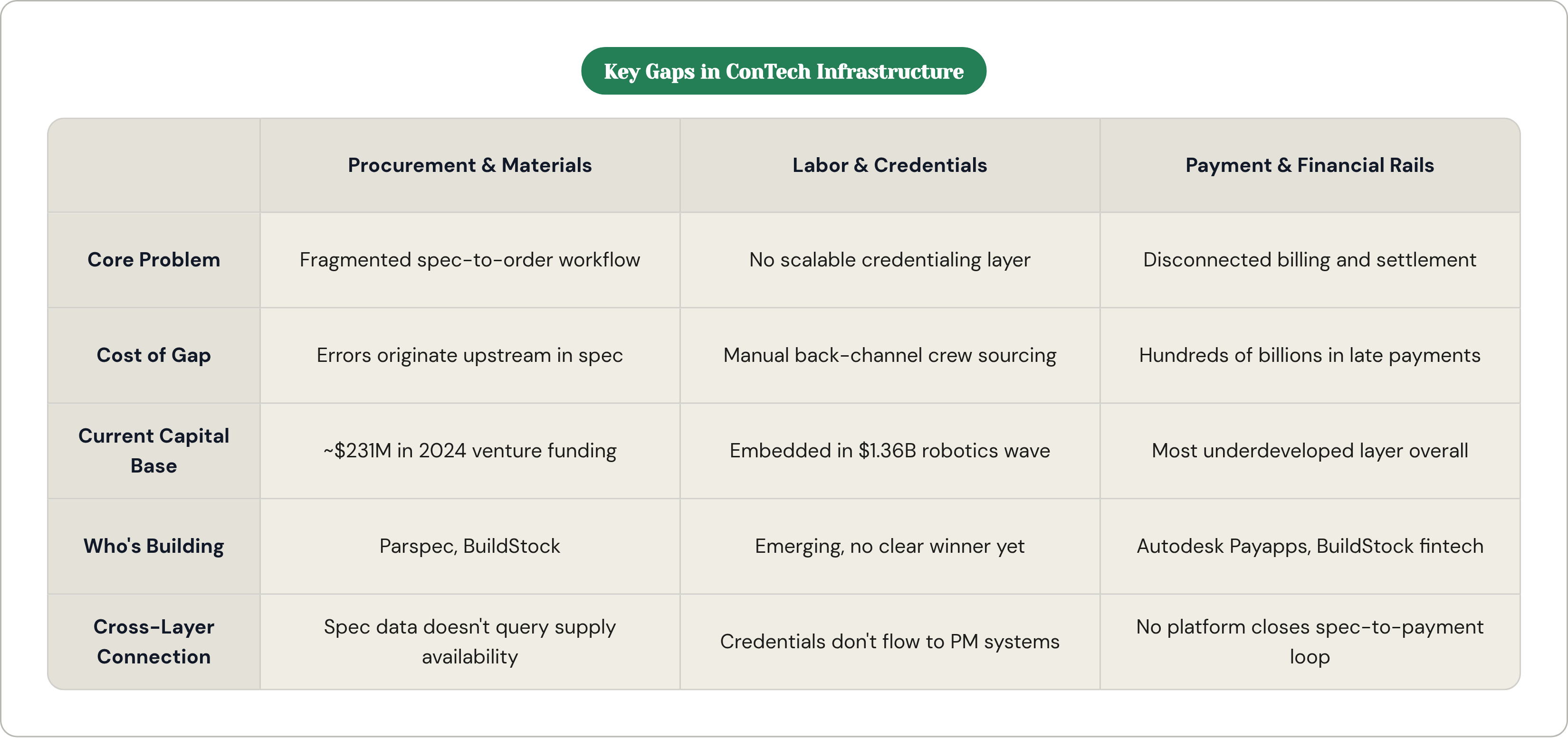
Start with capital allocation. Construction supply chain tools, the marketplaces, materials tracking, and procurement platforms most directly relevant to this analysis, drew approximately $231 million in 2024 venture funding. Relative to the $5 trillion materials supply chain that layer serves, that is a remarkably thin capital base for the scale of the problem. The category is underfunded relative to its addressable market, which means opportunity and constraint exist simultaneously, often inside the same company.
Interoperability is the central structural gap, and the industry rarely talks about it with the directness it deserves. The project management layer, the procurement layer, and the labor layer are being built by different companies on different data models. They don't natively connect. A subcontractor's verified credentials in a labor platform don't flow into a GC's project management system. A material specification in a design tool doesn't automatically query availability in a procurement network. The layers exist. The connections between them are mostly still manual, which means the full productivity potential of this infrastructure is sitting unrealized, waiting for someone to build the bridges.
The demand-side constraint gets systematically underweighted in how people analyze this market. Seventy percent of construction firms have no formal technology roadmap. Most allocate just 1 to 5% of annual revenue to technology. Forty-eight percent of construction leaders cite training and skills development costs as the biggest barrier to technology investment. Even well-built infrastructure stalls at the adoption layer when onboarding is expensive or operationally disruptive, and right now most enterprise-grade platforms are both.
Small and mid-size contractors represent a large share of the industry by firm count and are systematically underserved by platforms designed for GCs running a hundred simultaneous projects. The next wave of purpose-built infrastructure will need to target this segment directly, with simpler onboarding, more accessible pricing, and workflows calibrated to firms running ten projects at a time.
The payment and financial infrastructure layer remains the most underdeveloped piece. Autodesk's acquisition of Payapps and BuildStock's fintech combination both signal the same gap from different directions: no dominant platform has closed the loop between project management, procurement, and financial settlement. That gap costs the industry hundreds of billions of dollars annually in late payments alone. That is not a rounding error. It is a structural failure that the next generation of platforms will be measured against closing.
The next phase of infrastructure will be defined by platforms that can bridge the specification-procurement-payment-labor loop in a single connected flow. The companies that solve cross-layer connectivity, not just within-layer efficiency, will define the sector's next decade. The problem is large enough and complex enough to produce several very large companies. The work has started. Most of it is still ahead.