Creator Economy Trends Shaping Platform Strategy in 2025
Only a sliver of creators actually earn meaningful money on platforms.

Roughly 207 million people globally identify as creators. More than 2 million operate at a full-time, professional level. In the United States, close to half of Americans between 16 and 54 engage in some form of content creation, and 83% of Gen Z consider themselves creators. The supply pipeline is not thinning.
The number that actually shapes platform strategy, though, is narrower and less flattering: the monetizable tier is a sliver. Platforms are designing tools and interfaces for millions while generating meaningful revenue from thousands. Think of it like an iceberg — the visible surface is the thriving creator class platforms put in their ads, but the mass underneath is largely invisible and largely unpaid. Sit with that gap for a moment. It is the central, uncomfortable fact of creator economy platform design in 2025, and most platforms would prefer you not know.
Gen Z creators rank autonomy and passion as their top motivations, being their own boss, pursuing something they actually care about. Those are outcome-loyal motivations, not platform-loyal ones. A creator optimizing for independence will route around friction wherever they find it. Platforms that mistake user volume for user commitment will feel that difference eventually, usually right when it is most inconvenient.
Geographically, North America holds roughly a third of global creator economy revenue. Asia Pacific is projected to grow at the fastest rate over the next decade. Brazil has the largest raw count of creators globally; the United States follows. These markets do not share symmetrical needs, and platforms trying to build for both simultaneously are making a fundamentally different structural wager than those that pick one and go deep.
Creator tools are table stakes now. Every platform has them. What few platforms have is a coherent theory of which creators they are actually building toward, and that absence is more revealing than any feature announcement.
The Income Distribution That Exposes the Flaw in "Creator-First" Platform Messaging
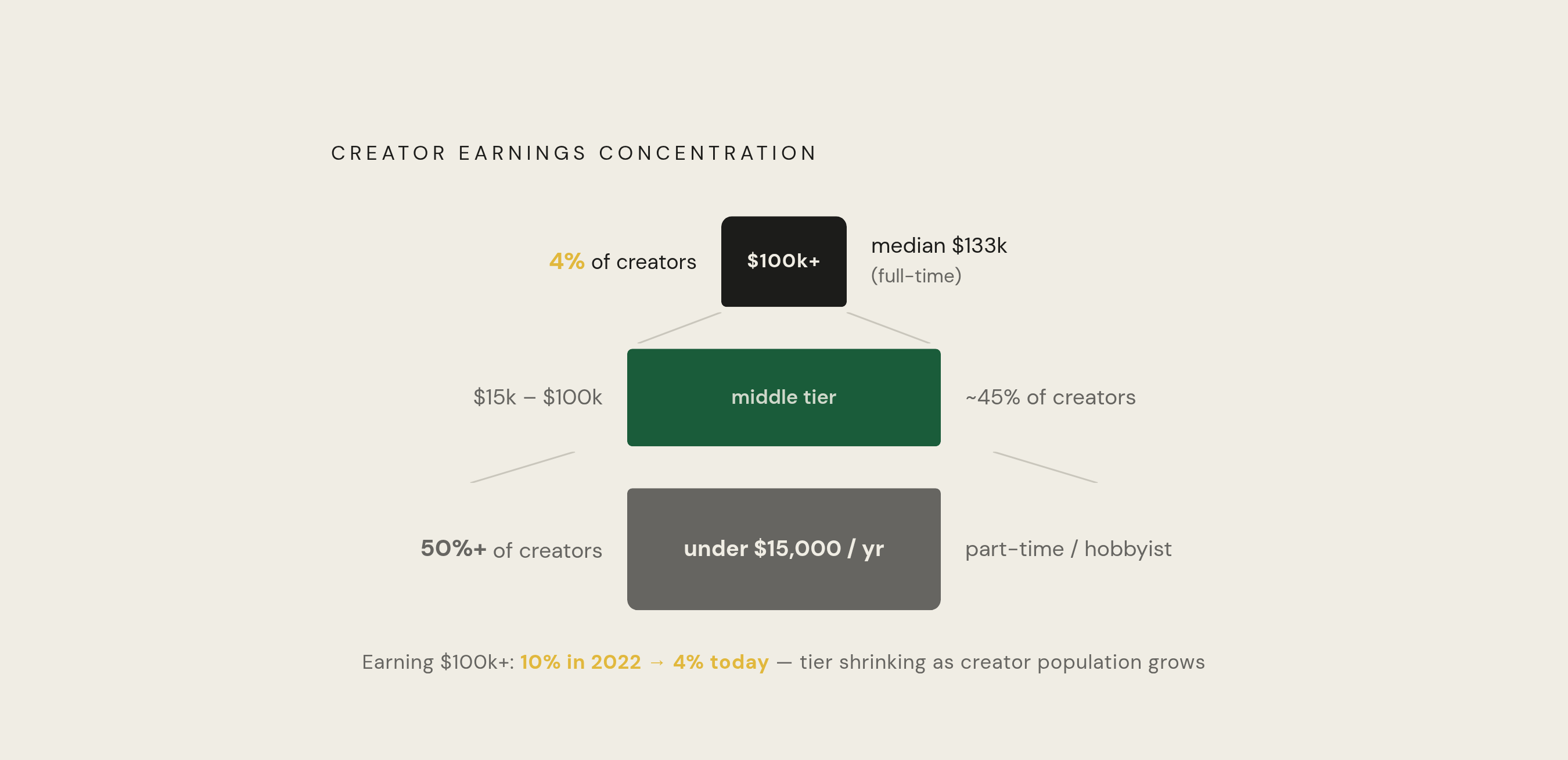
Platforms market themselves as vehicles for creator income. The income data does not cooperate with that story, and the gap between the two is widening.
More than half of creators earn under $15,000 annually. Established full-time creators post a median income of $133,000. Only 4% of creators globally earn over $100,000 per year, down from 10% in 2022. That decline is worth sitting with: earning concentration is worsening as the creator population grows faster than monetization infrastructure can absorb it. The platform narrative is getting more optimistic as the underlying math gets harder. That is not a coincidence.
A large majority of creators rely on brand deals as their primary income source. Only a small fraction depend mainly on platform ad revenue. The ad rev-share models platforms promote most loudly as their creator value proposition have not become how most creators actually pay their rent. Platforms have essentially subsidized their own relevance by anchoring a brand deal pipeline that flows through their interfaces while the actual money originates elsewhere. That is an elegant arrangement, if you are the platform.
This is not a creator welfare argument. It is a supply-side risk argument. If most of your creator base earns primarily through off-platform deals and the only thing keeping them on your platform is distribution reach, you do not have loyalty. You have leverage, and leverage is only as durable as your next algorithm update.
The structural choice platforms face is concrete: build monetization tools that genuinely expand the earning base, or keep optimizing for the top tier and accept churn everywhere else. Both are defensible strategies. Neither should be dressed up as something more egalitarian than it is.
How Platform Payout Structures Reveal Where Each Platform Is Placing Its Bet
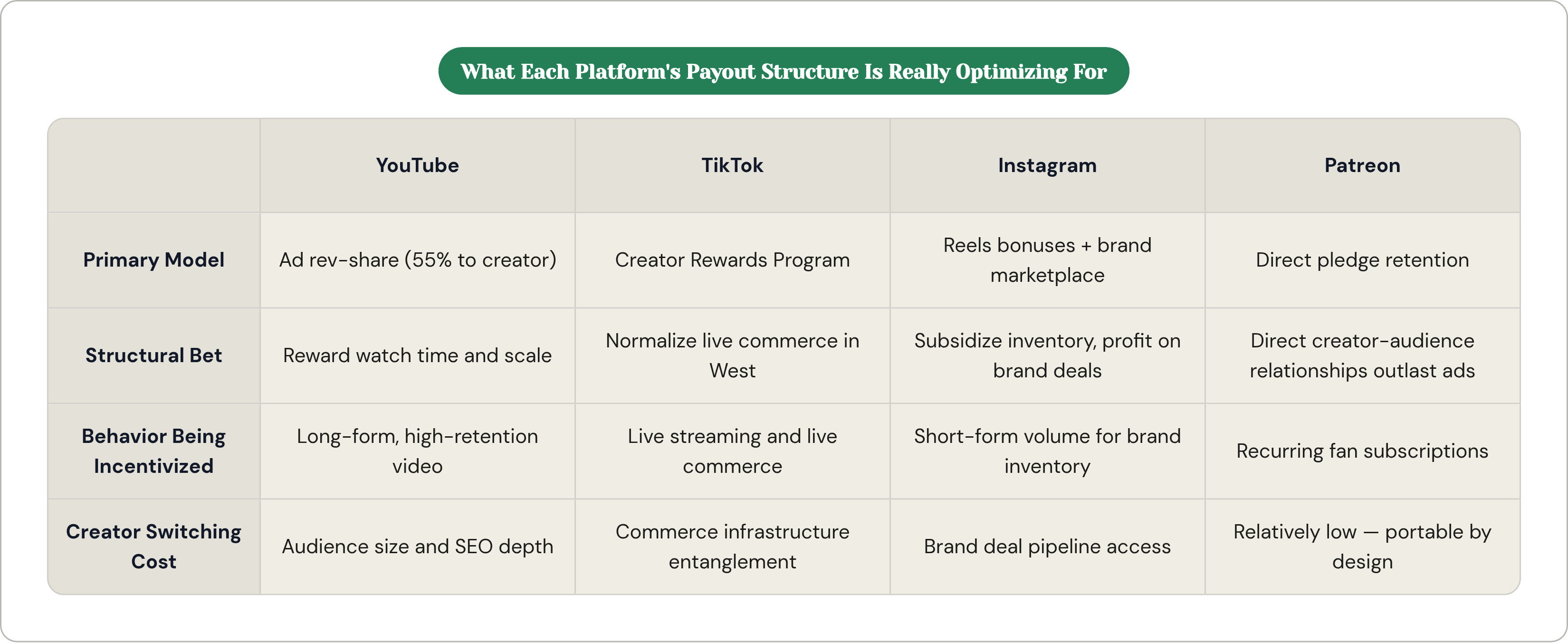
Payout rates are not compensation structures. They are behavioral specifications. Reading them as generosity metrics is the wrong frame entirely.
YouTube pays $2 to $25 per 1,000 views for standard video, with creators keeping 55% of ad revenue. That is a mature rev-share model rewarding watch time and scale, built for audiences that stay with content rather than scroll past it.
TikTok's Creator Rewards Program pays considerably less per 1,000 views for standard content, but live streams can reach up to $35,000 per show. That spread is deliberate. TikTok is structurally subsidizing live formats because live commerce is the behavior it needs to normalize in Western markets, having already proven the model in Asian ones. The payout differential is a policy instrument masquerading as a compensation schedule.
Instagram Reels bonuses sit below YouTube's rates, but Instagram still anchors the majority of all creator brand collaboration deals. Instagram is subsidizing Reels volume to keep inventory flowing while profiting on the brand marketplace it controls. The payout is not the product; the brand deal infrastructure is.
Patreon occupies a different position entirely. Creators retain the vast majority of pledges. Patreon has opted out of the ad model, betting that direct creator-to-audience financial relationships outlast every ad-dependent alternative. That is a philosophical wager as much as a product one — it is the kind of bet that looks either prescient or naive depending on which five-year window you are standing in. You could say Patreon is playing a long game while everyone else is playing for the next quarter.
Each payout structure encodes a prediction about which content behavior becomes dominant over the next three to five years. Reading those predictions clearly is an underrated competitive skill.
Why Social Commerce Has Become the Most Consequential Platform Strategy Variable
U.S. social commerce sales reached tens of billions of dollars in 2025, up sharply year-over-year. This is no longer a format any platform can treat as something it will get around to. It has become a baseline structural requirement, and the window for treating it as experimental has closed.
TikTok Shop's U.S. sales grew explosively in 2024, then more than doubled again in 2025 to tens of billions of dollars, capturing a significant share of total U.S. social commerce. That share is projected to approach a quarter of the market by 2027, in a market already measured in the hundreds of billions.
What this forces on competitors is not subtle. Instagram and YouTube cannot approach commerce as a bolt-on to a content platform. It has to be native to the creator monetization loop, embedded in the same session where discovery happens, rather than handed off to a separate checkout experience that breaks the session's momentum.
TikTok's structural advantage is that it collapsed the funnel before competitors recognized what collapsing the funnel actually meant. Entertainment, discovery, and purchase occur in a single session. Other platforms are attempting to replicate that loop without TikTok's original algorithm architecture, which was built around interest-graph discovery rather than social graph distribution. That is not a gap that closes with a product update cycle. It is an architectural inheritance problem.
Commerce also does something to creator retention that ad rev-share never quite accomplished. When creators earn transactional income through a platform's commerce infrastructure, they become economically entangled with that infrastructure in a specific, hard-to-unwind way. A creator who has built a product-selling operation inside TikTok Shop faces a materially different cost of leaving than a creator who is only chasing view counts. Commerce creates switching costs that engagement metrics simply do not.
Video Podcasts as a Format That Is Redrawing Platform Audience Ownership Boundaries
YouTube disclosed vast numbers of monthly active viewers of podcast content in early 2025. Spotify hosts hundreds of thousands of video podcast shows, with hundreds of millions of users having streamed video podcast content, representing growth of more than half year-over-year. A 2025 podcast industry report found that A majority of podcast fans either watch and listen equally or prefer to watch. The audio-only assumption is already a minority position.
This matters for platform strategy because podcasting was one of the only major content formats that historically lived outside platform control. RSS-distributed audio gave creators direct audience relationships: no algorithm mediating the connection, no platform owning the engagement data, no feed controlling discoverability. Video podcasts are quietly dismantling that arrangement. They are being absorbed into closed platform environments, and the platforms doing the absorbing understand precisely what that transaction accomplishes.
For platforms, video podcasts convert an audience that was previously unowned into an owned, algorithmically addressable user base. Every podcast listener who migrates to a video format on YouTube or Spotify becomes a recommendation target, an ad impression, a data point feeding a model the creator has no access to.
For creators, the tension is real and rarely discussed with the directness it deserves. RSS distribution preserves a direct relationship with the audience. Platform-hosted video trades that control for discovery infrastructure and monetization tooling. Those are not equivalent arrangements, and most advice encouraging podcasters to go video glosses over which side of that trade benefits more. The platforms investing aggressively in video podcast infrastructure are acquiring access to a high-attention, loyal audience segment that ad spending data already identifies as premium inventory. They are doing it to acquire that inventory. The creator opportunity is real; it just exists alongside a strategic objective the platform is not advertising.
Livestreaming and the Platform Race to Own Real-Time Creator Economics
Twitch alone saw hundreds of millions of hours streamed in 2025. The livestreaming market grew substantially that year, with projections suggesting it roughly doubles by decade's end.
YouTube's partnership with a prominent creator during its first free-to-watch NFL game deserves more scrutiny than most industry commentary has given it. A platform that built its entire identity on uploaded, on-demand video is now acquiring live sports access to anchor creator-audience moments that cannot be replicated or rewatched with the same meaning. That is not a feature launch. That is a repositioning of what kind of cultural institution YouTube is trying to become. The ambition there is significant, and it should be read as such.
TikTok is executing the same strategic move through economic levers rather than rights acquisition. Structuring live stream payouts to reach multiples of what standard content earns is a deliberate subsidy, designed to shift TikTok's creator base toward live commerce behavior. The payout architecture is doing the cultural work that TikTok cannot yet do through sports rights or tent-pole live events.
The underlying logic is the same in both cases: live content creates appointment-driven, community-anchored moments that on-demand content cannot replicate after the fact. A creator who builds an audience around a live show at a specific time has created a commitment mechanism. That stickiness accrues to the platform as much as to the creator, and often more.
The risk is real and specific. Live infrastructure is expensive, quality expectations are rising fast, and audiences calibrated on professional-quality live productions do not lower their standards for smaller platforms trying to compete. This bet heavily favors platforms with existing video scale and the engineering capacity to support concurrent viewers at volume. Platforms that attempt live as a competitive differentiator without that foundation will hit a quality ceiling they cannot engineer past quickly.
How AI Tooling Is Shifting from Creator Productivity Feature to Platform Differentiation Layer
By mid-2025, every major platform had shipped AI tools as core product features, not optional additions. Instagram introduced an AI Creator label. YouTube launched conversational search and AI remixing tools. TikTok released AI-powered transition features. LinkedIn deepened its analytics and lead generation capabilities with AI-native interfaces. The feature arms race is effectively over. This is now infrastructure competition, and that distinction changes what it means to make a platform choice.
The shift from AI feature to AI infrastructure changes the platform relationship in one specific, underappreciated way: workflow gravity. A creator who builds their editing process, distribution cadence, and analytics review inside a single platform's AI layer accumulates switching costs that have nothing to do with audience size or content quality. The cost of leaving becomes the cost of rebuilding an entire production workflow from scratch — like trying to move out of a house only to realize the furniture was built into the walls. That friction is exactly what platforms are engineering for, whether they say so or not.
Instagram's AI Creator label is a trust-signaling mechanism that simultaneously creates a new content tier with downstream consequences for how brand partners evaluate content and how audiences assign credibility. It is infrastructure dressed as a disclosure policy.
YouTube's AI remixing tools point somewhere different: toward a new class of derivative, remix-native content behavior that generates volume and keeps the algorithm supplied without requiring proportional increases in creator labor. If remixing becomes a rewarded content behavior on YouTube at scale, the platform's content library grows without a corresponding growth in production costs. That changes the economics of the entire platform, not just the creators using the tool. Worth thinking through if you are a creator deciding where to invest your production time.
Marketing teams treating AI tooling as neutral productivity infrastructure are operating one layer above where platform strategy is actually being executed. The AI layer is where algorithmic reward structures are being shaped, where decisions about which content formats surface and which behaviors the distribution algorithm reinforces are getting made. Optimizing workflows without accounting for how those workflows interact with platform AI incentive structures is, functionally, optimizing for conditions that are already shifting.
The Audience Ownership Question That All Platform Strategy Decisions Are Really About
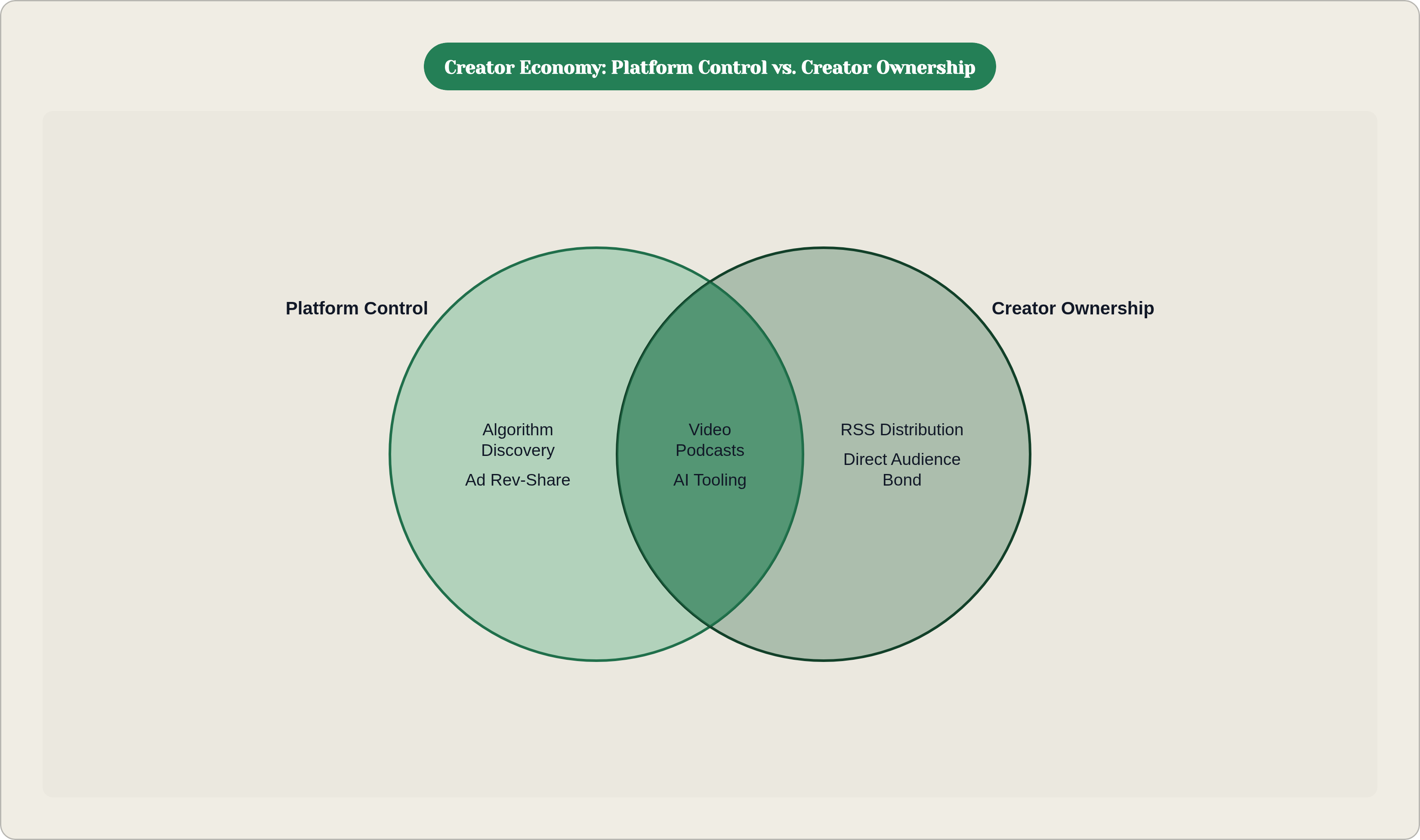
Every platform investment examined here is, underneath the product announcements and payout restructurings, a bid to become the irreplaceable layer between creator and audience. Payout structures, social commerce infrastructure, live event investments, AI workflow tooling, video podcast hosting: these are not separate product decisions with separate rationales. They are converging on a single objective.
The creator economy's income distribution maps directly onto audience ownership. Creators earning above the threshold have built audience relationships strong enough to monetize across channels: owned newsletters, direct community platforms, off-platform product sales. Creators below that threshold remain dependent on platform distribution for discoverability and therefore for income. Platforms generate leverage from that dependency, and the leverage grows as the creator population grows faster than the earning base.
Direct monetization models represent the counter-bet. Patreon's revenue retention structure, newsletter platforms, owned community infrastructure: these are architectural choices that route value back toward direct creator-audience relationships rather than through platform-controlled environments. The most valuable creators are increasingly aware of this distinction, and some are acting on it deliberately enough that platforms have noticed and responded.
Platform responses are not subtle. Social commerce, live tipping, AI-native workflows: these are mechanisms designed to keep the transaction and the relationship inside the platform environment. Even when platforms publicly champion creator independence, their product roadmaps are oriented toward making platform infrastructure too embedded to abandon without significant cost. There is nothing cynical about noting that. It is just the business they are in.
The video podcast format competition is the clearest proxy for this dynamic. Open RSS distribution means the creator owns the audience relationship directly. YouTube or Spotify hosting means the platform owns the discovery mechanism and therefore the data. The platforms investing aggressively in video podcast infrastructure understand exactly what they are acquiring, even when the pitch to creators frames it as a distribution opportunity.
The most sophisticated platforms are not pursuing crude lock-in. They are designing for creator portability while simultaneously making their infrastructure load-bearing, wanting creators to feel free to leave while discovering, practically, that leaving costs more than staying. If you are making brand investment or creator partnership decisions, that is the frame worth orienting around, before the shift becomes obvious enough that every competitor is already responding to it.
Notes
- https://amt.ai/blog/creator-economy-market
Provided the figures on total global creator count, full-time professional creators, and the share of Americans engaged in content creation.
- https://learn.g2.com/creator-economy-statistics
Provided the statistic that 83% of Gen Z consider themselves creators.
Every new piece from marketplace crunch, as it's published.
Follow