Game Startups Using Marketplace Mechanics for Player Economies
Developers are treating player economies like stores instead of two-sided markets.
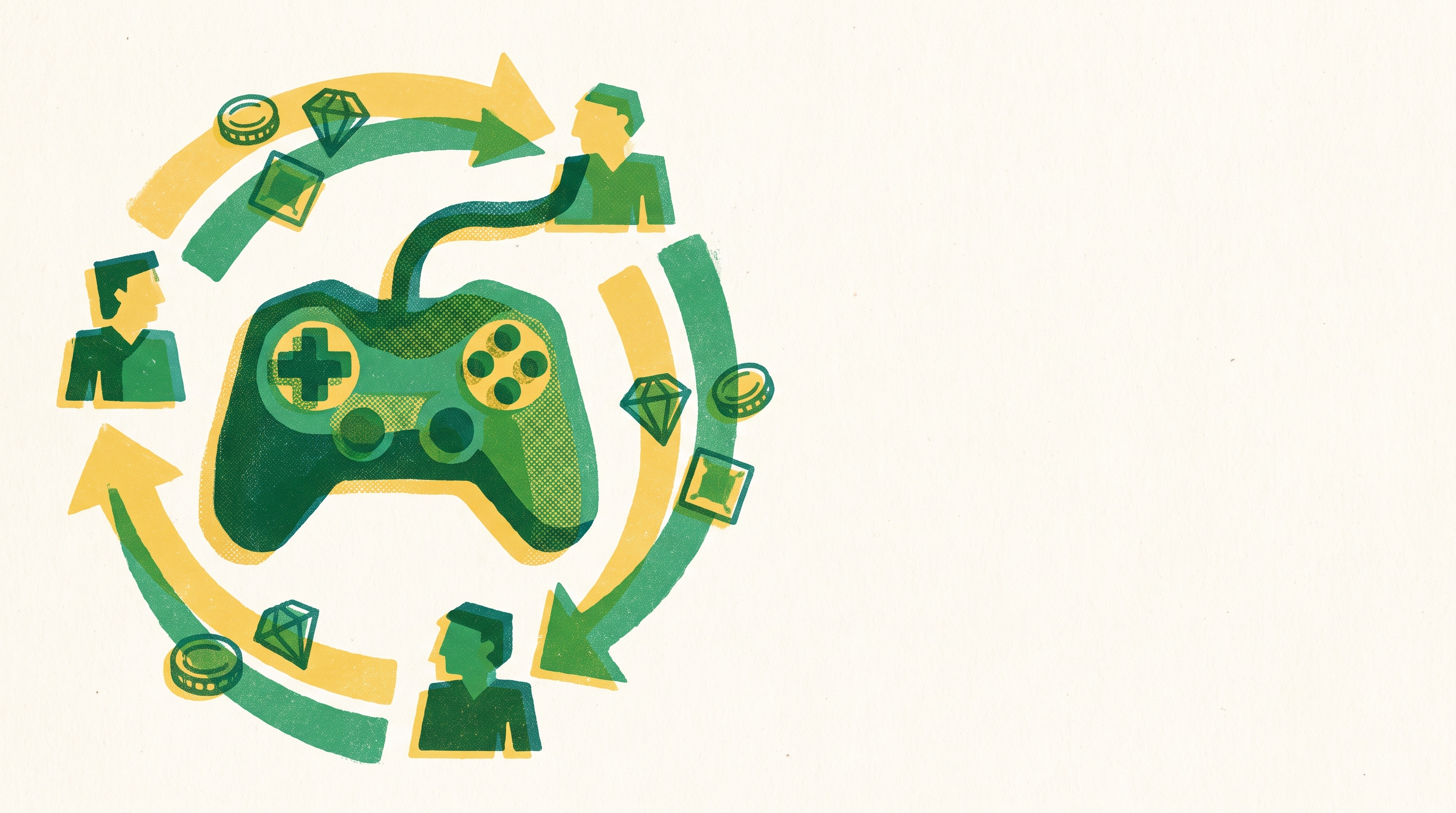
A player economy is not a store. It's a two-sided market with its own supply, demand, price discovery, and trust infrastructure, and it demands the same rigorous design attention that any serious marketplace does. Most studios never fully reckon with that distinction, and most player economy failures trace directly back to that blind spot — like a shop owner who never notices the back door is wide open.
Three conditions have to coexist for the thing to actually work. Liquidity: enough buyers and sellers that trades clear at a price both sides consider fair. Trust: participants have to believe the assets they hold are real, transferable, and won't be arbitrarily devalued by a patch note or a poorly timed content drop. Supply-demand balance: infinite minting collapses prices; excessive restriction calcifies the economy around its earliest participants and locks out everyone who arrives later.
These conditions are harder to achieve in games than in traditional markets, and not for subtle reasons. The developer controls supply unilaterally and can produce new items at zero marginal cost whenever they need a revenue bump. Platform rules can change overnight and instantly reprice or destroy what players have accumulated. And players are consumers, not pure speculators. Emotional attachment to items distorts price signals in ways that don't show up in commodity markets at all.
One more variable compounds all of it: in free-to-play games, somewhere between five and ten percent of players account for the majority of spending. The economy has to serve that thin stratum of high-value participants while remaining legible to everyone else. Design exclusively for the whales and you hollow out the community that gives the economy its social meaning. Design purely for casual accessibility and you drain the liquidity that keeps prices stable. Neither extreme works, and most studios pick one anyway.
That three-condition framework is the lens worth keeping in mind for everything that follows. Nearly every collapse traces back to one of them failing.
The walled-garden model: how Steam built liquidity at scale and what it gave up
The Steam Community Market is the closest thing gaming has to a functioning liquid marketplace at genuine scale: tens of thousands of distinct items, tens of millions of listed offers at any given moment. Valve engineered that liquidity deliberately, and the mechanism is worth understanding precisely because it's so structurally simple.
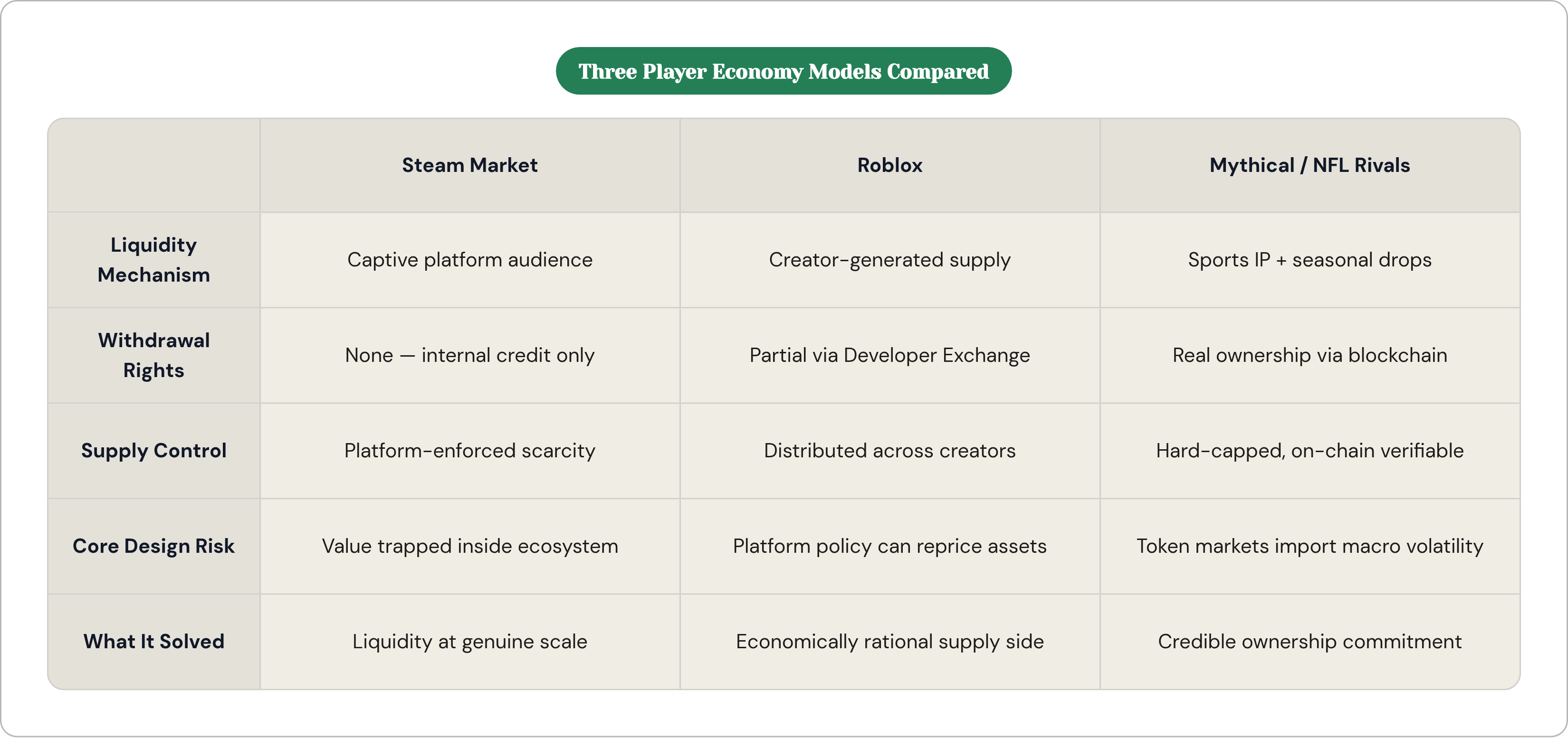
The foundation is a captive audience. The same platform where you play is where you trade. The fee structure, a five-percent Steam transaction fee stacked with a game-specific fee of up to fifteen percent for titles like CS2 and Dota 2, is high enough to generate real revenue but calibrated to keep casual sellers participating rather than fleeing to peer-to-peer workarounds. Artificial scarcity, enforced through item grades, drop rates, and case-opening mechanics, keeps supply controlled enough that prices hold. It functions.
But Valve made one structural choice that defines everything downstream: money earned on Steam cannot leave. No bank withdrawal, no external wallet. It exists only as Steam balance. This isn't a technical constraint. It's a deliberate design decision to keep capital inside the Valve ecosystem.
The consequence is interesting, and somewhat ironic. An entire startup category exists specifically to convert Steam's walled value into real-world liquidity. The gap Valve created funded businesses whose sole reason for existing is to provide the exit ramp Valve refused to build. Players want genuine ownership of value they've earned. The platform won't provide it, so someone else does.
The lesson is durable: liquidity solves one problem, but asset portability and withdrawal rights determine whether your economy creates real value or just internal credit. Most studios treat that distinction as a later-stage problem. It isn't.
Roblox and the creator-economy variant: when players are also the suppliers
Roblox is the most mature non-blockchain player economy operating at scale today. Its 2025 revenue reached $4.891 billion, with nearly 19 million monthly unique payers in Q4 2024. The numbers are significant, but what's actually instructive is the design inversion underneath them.
On Roblox, creators generate the supply, not the platform. User-generated items, limited-edition drops, tradeable assets, all of it comes from the community. This distributes the supply-creation function across millions of participants rather than concentrating it inside one studio, and that structural difference changes the economics of the whole thing.
The mechanics that hold it together aren't complicated. Robux as a single internal currency means all prices denominate in one unit, which simplifies price discovery across wildly different item categories. Fixed-quantity limited editions create secondary trading prices that behave like real asset markets in miniature. And the Developer Exchange program lets creators convert Robux earnings into actual money: Roblox distributed $923 million to developers in 2024 alone, over $1 billion cumulatively as of September 2025.
That last piece is what Roblox solved that Steam didn't: partial withdrawal. Creators can extract real economic value from participation, which makes contributing to the supply side economically rational rather than purely driven by passion or community belonging. That changes who shows up to supply the market and how seriously they take quality.
What Roblox didn't solve is platform risk. Policy changes can reprice items overnight. The platform retains ultimate authority over every asset regardless of how much a creator has invested in building their catalog. This is the core design tension in every centralized player economy: the more the platform controls, the more it can protect stability; the less it controls, the more authentic ownership becomes. It's not a tension that resolves cleanly, and if someone tells you it does, they're selling something.
How Mythical Games designed a marketplace around asset ownership rather than access
Mythical Games built its model around a specific and testable hypothesis: sports IP combined with true asset ownership can bring blockchain mechanics to mainstream audiences who would never seek out crypto natively. NFL Rivals is the proof of concept, and the numbers are honest validation.
The game surpassed 7 million downloads in 2024 and maintained over 1 million active wallets, with roughly 100,000 users actively trading on the Mythical Marketplace. That last figure is consistent with the five-to-ten percent pattern that defines free-to-play economies broadly. The active trading population being that size, relative to total players, isn't a problem; it's essentially what the model predicts.
The seasonal structure is deliberate in ways worth acknowledging. Drops timed to the real-world sports calendar, Super Bowl cards, playoff releases, generate predictable liquidity spikes that mirror the demand rhythms of physical collectibles. Scarcity is real and on-chain verifiable, not simulated. Players who've accumulated cards around a championship run hold something that cannot be diluted by a studio decision to print more. That's a credible commitment, which is rarer than it sounds.
The QuickTrades mechanic addresses a structural problem most player economies quietly ignore. Players accumulate mid-tier items that are individually illiquid: not worthless, but not tradeable at any practical velocity. Left unaddressed, that inventory overhang suppresses prices and discourages continued participation. QuickTrades lets players bundle multiple lower-value items and exchange them for a single higher-value asset, which is lot consolidation borrowed directly from traditional asset markets. It's a small mechanic that does real structural work — turning a drawer full of spare change into something you'd actually spend.
The token-burn flywheel connects marketplace activity to asset value: each transaction generates fees tied to the MYTH token, with a portion of those tokens burned. Usage volume creates mechanical scarcity. That's a designed relationship between participation and value preservation, not decoration.
What the whole design reveals is that the marketplace functions as a retention mechanism, not just a monetization surface. Players with tradeable assets have an economic reason to return that pure gameplay cannot replicate. That's a genuinely defensible retention moat.
One thing worth naming honestly: Mythical laid off roughly fifteen percent of its workforce in 2023 during the broader crypto downturn. Token-based economies import macro volatility into the game, and growth-phase assumptions proved fragile when external conditions shifted. That's not a design failure unique to Mythical. It's a structural risk of tying in-game economics to token markets that respond to forces entirely outside any studio's control.
Infrastructure startups that build the marketplace layer rather than the game
A distinct startup category has emerged around companies that don't ship games but provide the exchange, settlement, and ownership infrastructure that studios plug into. They are, in a straightforward sense, the picks-and-shovels businesses of player economies.
Immutable built its platform around a specific friction point that was quietly killing blockchain marketplace participation: gas fees. On base-layer Ethereum, a variable transaction fee can exceed the value of a two-to-five dollar item, which effectively shuts out the long tail of the market. When low-value items can't trade, the market loses depth and price discovery degrades across the whole system. Immutable's Layer-2 solution eliminates gas fees for minting and trading NFTs, restoring the economic viability of smaller transactions. Alongside King River Capital and Polygon Labs, Immutable launched a $100 million fund to back early-stage Web3 gaming and infrastructure, a signal that institutional capital now treats the infrastructure layer as a distinct investment category, separate from individual studios.
Dapper Labs took a complementary approach. Rather than solving fee friction first, they built Flow Blockchain as a purpose-designed network for gaming and collectibles, then proved the model with NBA Top Shot. The lesson from Top Shot is that franchise collectibles can generate durable marketplace volume without requiring players to understand blockchain mechanics at all. The ownership verification happens below the surface; the player experiences highlights and trading. In September 2025, Dapper extended that model by launching a new NFT marketplace specifically for gaming assets, moving from single-IP depth to general-purpose trading infrastructure.
The pattern across both companies is the same: make marketplace participation invisible to the player. Settlement, ownership verification, fee optimization, all of it happens at a layer the player never sees. This surfaces a real build-versus-buy decision for your studio. The cost of building compliant, scalable trading infrastructure in-house can be high enough that plugging into an existing platform is often the more defensible use of engineering resources. That's not a philosophical argument; it's arithmetic.
The supply-demand mechanics that separate stable economies from those that collapse
Most player economy failures share a common root cause: the studio treated supply as a revenue lever rather than a market variable. The sequence is predictable once you've seen it. Revenue pressure builds, more items get minted, prices fall, early adopters feel devalued, trust erodes, and the market stops functioning. The studio then tries to stabilize through promotions or new content, which adds more supply, and the cycle repeats. It's less a death spiral than a slow leak — you don't notice how flat the tire is until you're already on the side of the road.
The scarcity mechanics that actually work are all variations on one principle: make supply limits credible and verifiable. Hard-capped supply with on-chain verification removes the studio's ability to inflate inventory under financial pressure, which matters because the temptation will always be there. Burn mechanics, where items are destroyed through use or upgrade, create natural deflationary pressure that counteracts new minting without requiring active intervention. Seasonal rotation cycles items out of availability on fixed schedules, preventing the permanent accumulation of oversupply that quietly kills price floors.
Liquidity incentives borrowed from financial market design add stability. Maker-taker fee structures, where sellers who list at market prices pay lower fees than buyers demanding immediate execution, reward the patient behavior that keeps order books deep. Bundle mechanics like QuickTrades convert illiquid small holdings into tradeable assets, reducing the inventory overhang that discourages participation. Promotional trading events tied to real-world moments generate predictable liquidity spikes that re-engage dormant sellers and bring fresh capital into the market.
Trust systems are the underappreciated variable across all of this. Blockchain verification addresses one dimension of trust, authenticity and scarcity, but not all of it. Platform policy risk remains even with on-chain assets. A studio can deprecate the game, shift gameplay balance, or revoke API access in ways that destroy an item's utility value regardless of verified scarcity. The most durable trust signal, in the end, is track record. The CS2 skin market has been running for more than a decade. That longevity carries embedded credibility no new entrant can manufacture by press release.
What determines whether a player economy survives long enough to mature
The Axie Infinity collapse is the reference point the entire field returns to, and for good reason. It's a play-to-earn economy that grew explosively, then lost most of its value when the emission rate of in-game tokens outpaced demand, a textbook supply-control failure at scale. The mechanics were defensible in isolation; the incentive structure made them unsustainable under growth pressure, which is precisely when the structural weaknesses you need to guard against tend to surface.
The player economies that have shown durability share observable characteristics, not abstractions. They designed supply constraints before launch, not after prices started falling and confidence was already eroding. They tied the economy to something players wanted to do anyway, collect sports moments, build inside a game they already loved, compete in a familiar genre, rather than asking players to engage with the economy itself as the primary activity. And they built marketplace infrastructure that reduced participation friction enough that the cost of a trade didn't consume the margin of the trade.
The Gen Z spending contraction adds a specific warning for economies that built their liquidity assumptions on younger, high-frequency participants. Players aged 18 to 24 cut gaming expenditure by 25% between January and April 2025, while older cohorts saw less than five percent decline. If your secondary market depends on that demographic as its most active trading layer, that contraction is not a macro footnote. It's a structural variable that changes the liquidity math.
The deeper question worth naming directly: if your player economy depends primarily on new entrants buying assets from existing holders, you're operating close to pyramid dynamics. The ones that avoid that pattern are those where assets carry ongoing utility inside gameplay, not just speculative resale value. When holding an item makes the game better to play, you have a demand floor that doesn't require continuous new capital inflows to sustain.
Blockchain gaming secured 30% of Web3 industry activity in 2024, measured by daily active wallets at 4.2 million. Real scale, but still a fraction of the 1.6 billion paying players in the broader gaming market. The ceiling is genuinely high. Reaching it requires mainstream players to trust economies they didn't build and didn't watch develop, which takes time that most studios are unwilling to give.
The mechanics, dynamic pricing, burn mechanisms, bundle liquidity, trust verification, are all transferable. Studios can implement them from day one. What isn't transferable is the patience to let an economy develop credibility across multiple market cycles before optimizing it for revenue extraction. The studios that built durable player economies understood that sequence. The ones that collapsed reversed it, and then wondered what went wrong.
Notes
- https://coinmarketcap.com/academy/article/mythical-marketplace-evolution-of-scalable-player-owned-economy
Provided details on Mythical Games' marketplace mechanics, including the QuickTrades feature, token-burn flywheel, NFL Rivals download and wallet figures, and the seasonal drop structure.
- https://bitcoinist.com/2024-was-a-big-year-for-mythical-games-2025-is-shaping-up-to-be-even-better/
Supplied background on Mythical Games' 2024 performance, including download milestones and the workforce reduction during the 2023 crypto downturn.
Every new piece from marketplace crunch, as it's published.
Follow