Future of the Creator Economy as a Marketplace Category
Research firms now agree the creator economy is a $252 billion category worth measuring seriously.
Multiple independent research firms converged on a 2025 global market somewhere between $252 and $254 billion. Grand View Research placed it at $252.3 billion. Precedence Research placed it at $254.4 billion. Future Market Insights at $253.1 billion. When analysts working from entirely different methodologies land within two billion dollars of each other, the category has become legible enough to measure with genuine consensus.
The spread in projected growth rates, sharply — ranging widely depending on the firm, isn't noise. It reflects a genuinely contested definition: some analysts count only creator-native revenue streams; others fold in all brand spend that flows through creator channels. Think about how long it took for "search advertising" or "streaming" to settle on agreed-upon measurement frameworks. The creator economy is in that earlier, messier phase — like a teenager who's grown six inches but hasn't quite figured out what to do with their arms yet. The resolution of that definitional argument will itself be the maturity milestone worth watching.
The growth rate contrast is what anchors everything else. The creator economy is expanding at roughly 22.5% annually versus the broader media industry's 5.7%. WPP's mid-2025 analysis made the structural inversion undeniable: user-generated content eclipsed ad revenue from professional media produced by TV networks, cinemas, and news companies combined. A channel growing four times faster than your own is not something you compete with directly. You integrate, or you atrophy.
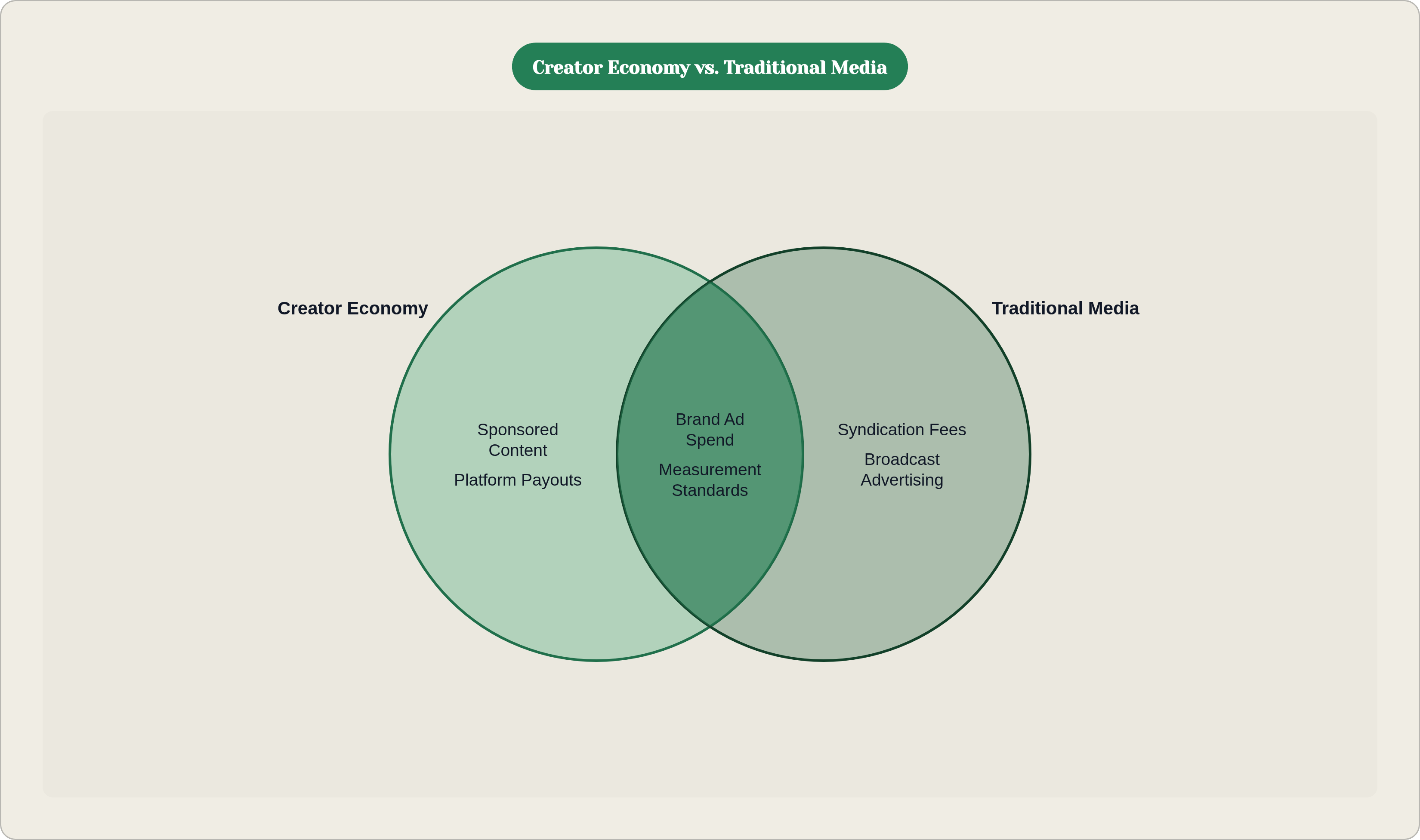
Brand Ad Spend as the Clearest Indicator of Category Institutionalization
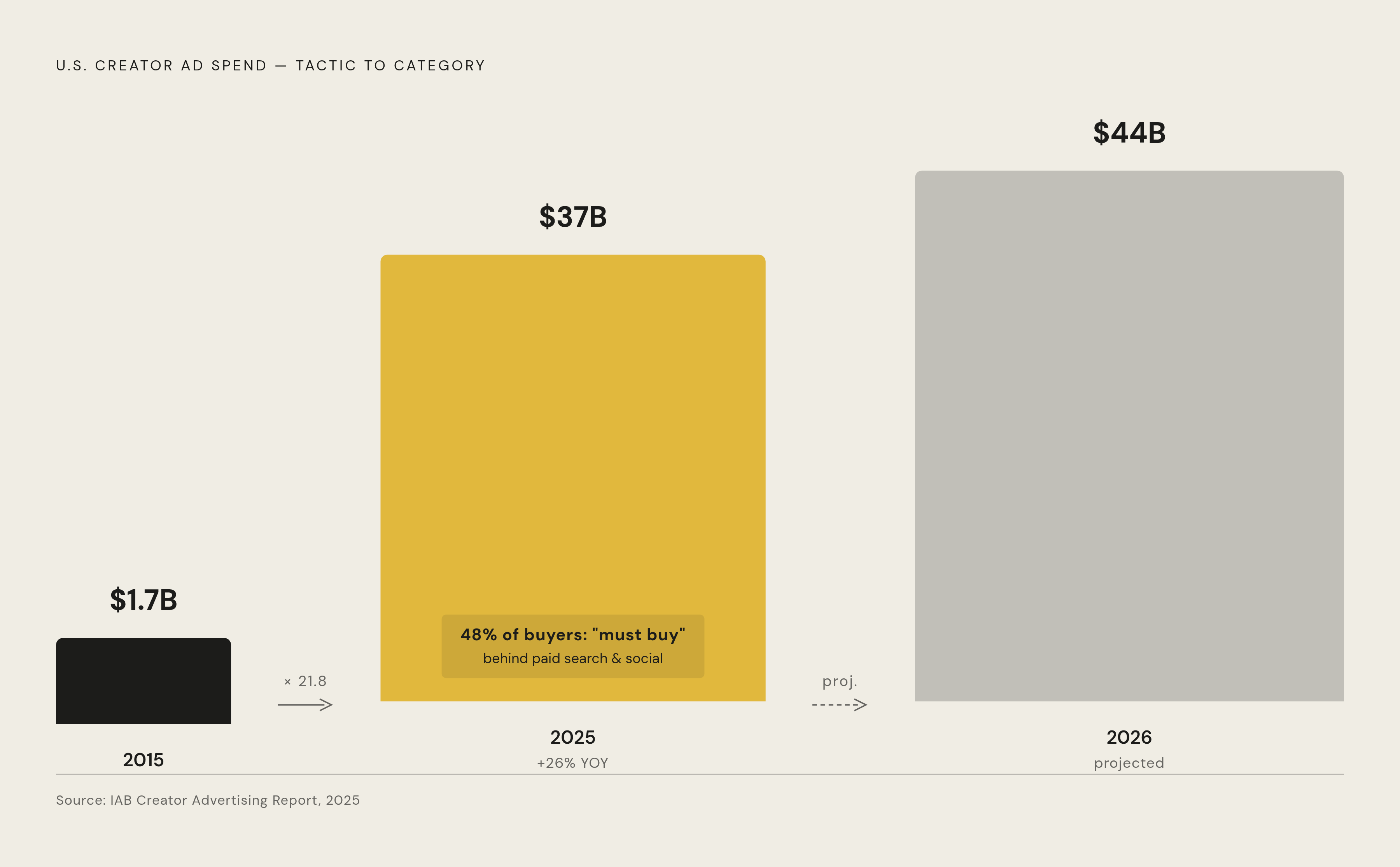
U.S. creator ad spend reached $37 billion in 2025, up 26% year-over-year per the IAB's 2025 Creator Economy Ad Spend and Strategy Report. Zoom out a decade and it gets harder to dismiss: influencer marketing went from $1.7 billion in 2015 to $32.55 billion in 2025, a roughly twenty-fold expansion that mirrors what search and social advertising did during their own consolidation phases.
The IAB found that 48% of all creator ad buyers now classify creators as a "must buy," placing them just behind paid search and social media in the media plan hierarchy. "Must buy" is procurement language. It means the channel has cleared the threshold from discretionary to structural, and that crossing has consequences: measurement standards, brand safety protocols, audit trails. The demand for accountability infrastructure is not a bureaucratic inconvenience. It is what drives the next layer of category tooling into existence.
Sprout Social's Q1 2025 Pulse Survey found that 76% of C-suite executives are expanding influencer budgets. When a CFO approves a dedicated line item, the channel has institutional standing. The decision migrating from marketing teams to executive budget lines is precisely how a tactic becomes a category. The IAB forecasts U.S. creator ad spend reaching $44 billion in 2026. The scrutiny is intensifying at the same pace as the spend.
How Creator Revenue Is Stratifying Inside the Category
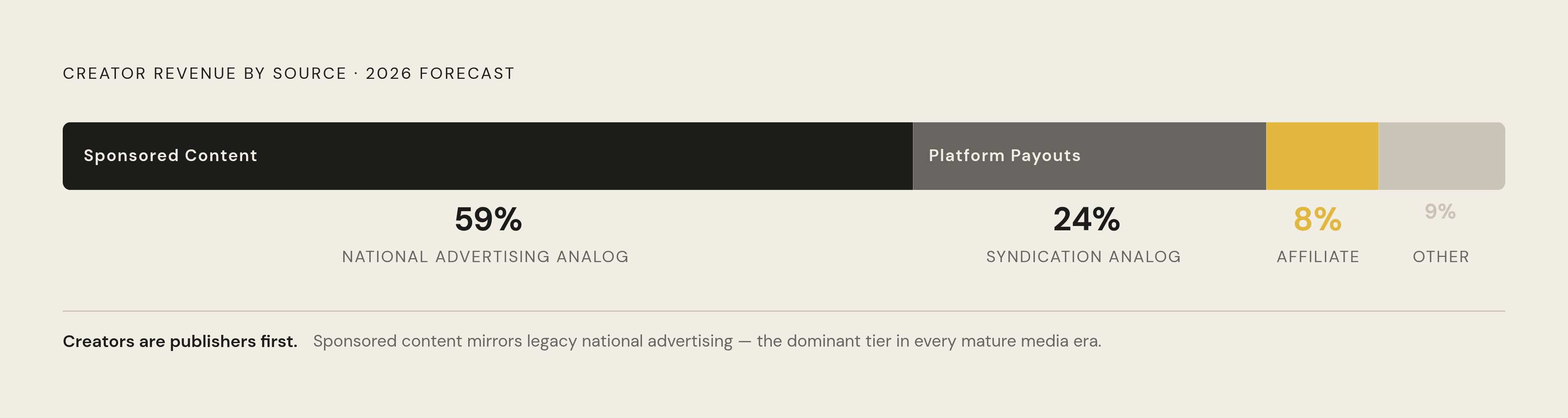
Creator revenue is settling into a hierarchy that mirrors how older media categories have always organized themselves. By 2026, EMARKETER forecasts creators will earn roughly 59% of revenue from sponsored content, around 24% from platform payouts, and approximately 8% from affiliate marketing. That hierarchy maps almost exactly onto how advertising, distribution, and performance-commerce have always stratified in older media categories. The pattern is not coincidental.
The dominance of sponsored content complicates a popular narrative. If the creator economy were primarily a commerce story, affiliate revenue would sit at the top. It doesn't. Creators are functioning primarily as media publishers, not as product sellers. Affiliate is significant; it is just secondary.
Platform payouts are the category's equivalent of syndication revenue. YouTube has paid creators more than $100 billion since 2021. Platforms competing for supply by paying creators directly is a market dynamic with a simple logic: if you want to retain talent, you have to pay for it. The structure that results, brand deals flowing into platform payouts flowing into affiliate and commerce revenue, mirrors how broadcast television stratified across national advertising, affiliate fees, and merchandise licensing decades ago.
What that structure also exposes is a supply-side inequality that deserves more attention than it gets. YouTube's Partner Program has roughly 3 million credentialed members. The global supply base is estimated at 207 million creators. Most creators are not yet inside the revenue-sharing economy. That gap generates pressure for professionalization standards, which is exactly what happened in talent representation and financial advisory as those markets matured and started distinguishing credentialed from uncredentialed practitioners.
Social Commerce as the Point Where the Creator Economy Becomes a Transaction Layer
TikTok Shop reached $15.82 billion in U.S. sales in 2025, more than doubling in a single year. EMARKETER placed that volume ahead of Target, Costco, Best Buy, and Kroger in U.S. ecommerce. That is not a pilot. That is a category-defining data point.
The conversion rate gap makes the structural argument more clearly than any trend piece could. Live shopping events convert at up to 30%, compared to the 2 to 3% average for traditional ecommerce. A gap that wide reflects a fundamentally different purchase mechanism: trust-mediated, real-time, socially validated. People buy because they trust the person selling, not because they clicked a banner. You could say traditional ecommerce is a fish out of water — and live shopping handed the fish a lake.
During TikTok Shop's Black Friday and Cyber Monday 2025 event, hundreds of thousands of livestream sessions generated hundreds of millions of dollars in sales across four days. Salsify, via EMARKETER, found that a large majority of U.S. Gen Z consumers say social media is their primary source for learning about new products. The demand-side behavior shifted first; the commerce infrastructure is catching up to it.
What that shift changes is what creator infrastructure actually needs to accomplish. Discovery and influence measurement are table stakes now. The full stack requires inventory management, payment processing, returns handling, and trust verification. The creator is simultaneously the distribution channel, the salesperson, and the brand. That is where the category's operational complexity starts to bite hardest, and where the most durable infrastructure plays are being built.
The Trust Deficit That Category Maturity Hasn't Resolved Yet
Sixty-four percent of consumers distrust influencers who don't disclose their brand relationships. Twenty-six percent distrust influencer marketing overall, more than double those who distrust advertising generally. The creator economy's trust advantage over traditional advertising is real, but it is conditional on transparency in ways that are easy to underestimate.
The trust signal that actually works is specific. Sixty-four percent of consumers cite genuine reviews as the top influencer content quality that compels a purchase, and nearly half make purchases at least once a month because of influencer posts, per Sprout Social's 2025 research. The category's power is entirely contingent on perceived authenticity. The moment a consumer suspects performance over sincerity, the mechanism collapses.
Here is the structural tension that does not resolve easily: as sponsorship revenue becomes the dominant income model at roughly 59% of creator earnings, the economic pressure is toward more sponsored content. More sponsored content is precisely what erodes the authenticity that makes the model function. This is a classic marketplace quality-control problem, and it surfaces predictably when a category scales faster than its trust and verification infrastructure can accommodate.
The same pattern appeared in peer-to-peer lending, gig economy platforms, and online travel. The response in each case followed a recognizable sequence: (i) disclosure standards, (ii) third-party verification, (iii) reputation systems, and (iv) eventually liability frameworks. That response is arriving in the creator economy now, not by coincidence but because the scale has made avoidance untenable.
Regulatory and Professional Norms Starting to Formalize the Category's Edges
The compliance conversation has moved from voluntary best practice to legal exposure. Brands, agencies, and creators are developing liability frameworks simultaneously, not because anyone particularly wanted to, but because the scale of undisclosed partnerships has become too visible to ignore.
Platform-level credentialing is one early form of emerging professionalization. YouTube's Partner Program gatekeeping monetization access is structurally similar to how financial or medical categories use licensing to distinguish credentialed from uncredentialed practitioners. You can create without credentials. Monetizing at scale requires meeting the platform's threshold, and that distinction carries real economic consequences.
India's government-announced $1 billion fund for content creators in 2025 illustrates something important: nation-states are now treating the creator economy as a strategic industry sector worth public investment, the same legitimizing move governments made for film, software, and biotech. That is a different category of recognition than a trade publication trend story.
The formalization of disclosure norms, brand safety standards, and measurement protocols is the category's equivalent of a trade association moment, comparable to when the advertising industry developed the Audit Bureau of Circulations or when digital advertising developed viewability standards. These instruments feel bureaucratic from the inside. From the outside, they signal that a category has arrived. For creators building durable businesses, professional norms adopted proactively are not compliance overhead. In a market where trust is the scarce resource, they function as a competitive differentiator.
The Geographic Expansion That Will Reshape Who Defines the Category
North America currently holds the largest revenue share at 33.2% in 2025, per Grand View Research. That dominance is already being contested. Asia-Pacific is projected to expand at a CAGR of 36.8% between 2026 and 2035, significantly faster than the global average, and the direction of influence between these regions is less obvious than most Western industry commentary suggests.
TikTok Shop's success in the U.S. was itself a technology and commerce model imported from China's established live-commerce ecosystem. The category is already importing infrastructure from Asia, not just exporting Western models to it. That directionality matters more than most people working in North American creator strategy currently acknowledge.
What changes when Asia-Pacific dominates growth is not cosmetic. The platform norms, content formats, commerce integration patterns, and creator-brand relationship structures that emerged from North American defaults will be challenged by models that assume live shopping, super-app integration, and community-first monetization from the outset. Those are not incremental differences; they are architectural ones. The category's future infrastructure will look considerably more like what is already standard in Southeast Asia and China than like what currently defines the North American creator economy. Brands and platforms that recognize this early have a material advantage over those still treating the current North American model as a permanent template.
What Infrastructure Investment Patterns Reveal About Where the Category Is Heading
Video streaming held the largest revenue share at 52.2% in 2025, per Grand View Research, and is projected to grow at a CAGR of 34.5% through 2035. Investment in video infrastructure is the category's most defensible long-run bet, and the allocation data supports that without much ambiguity.
Podcasting is the second major infrastructure bet worth watching. YouTube surpassed 1 billion monthly active viewers of podcast content. Spotify's video podcast catalog has expanded rapidly. Ad spending on podcasts was up 26% year-over-year in Q3 2025, per Magellan AI. Audio and video hybrid formats attract investment because they combine creator trust with broadcast-scale reach, a combination traditional media spent decades chasing and largely couldn't achieve.
The investment logic consolidating across the category right now generally maps to three things: (i) tools that reduce creator production costs without degrading perceived authenticity; (ii) commerce infrastructure that closes the gap between influence and transaction; and (iii) measurement and compliance systems that make creator spend defensible to CFOs. Everything significant being built in the space fits one of those three buckets.
If you are managing a brand or marketing team, the operational implication is straightforward. Creator partnerships will increasingly require the same strategic rigor as any other media channel: (i) content strategies, (ii) measurement frameworks, and (iii) editorial standards. Category maturation raises the floor on what competent looks like, which raises the premium on workflows that deliver quality without sacrificing speed.
What Defines a Durable Position in a Maturing Creator Marketplace
Mature marketplace categories do not eliminate participants. They stratify them. A small credentialed tier captures most of the brand revenue; the long tail competes on authenticity and niche audience trust. That stratification is already visible in the gap between YouTube's 3 million Partner Program members and the estimated 207 million creators globally, and it will widen as measurement infrastructure improves and brand buyers get more sophisticated about where their money is actually working.
The trust-authenticity tension is the central constraint the category has not solved. The monetization model pushes toward more sponsored content. The value model requires perceived independence. Whoever resolves that through format innovation, credible disclosure norms, or revenue diversification will do more to define what the category looks like in five years than any platform algorithm change.
Platform dependence is the structural vulnerability that professionalized creators will eventually have to address directly. If your revenue as a creator depends on a single platform's algorithm or monetization policy, you are not running a durable business; you are renting one. Multi-platform presence, owned audiences, and direct revenue streams are not idealistic goals. They are the economically rational response to a category that is standardizing its infrastructure and, in doing so, concentrating power in the platforms that own the rails.
If you are on the brand side, the 48% of ad buyers who now call creators a "must buy" represent the early majority. The question is no longer whether to invest. It is whether your internal workflows and measurement infrastructure exist to treat creator channels with the same analytical rigor as paid search. The brands that have already built those workflows will be positioned to capture the most value when attribution and accountability infrastructure finally catches up to the spend levels. The ones still constructing internal capability when that moment arrives will be competing from behind, and in a maturing category, that gap compounds rather than closes.
Notes
- https://www.precedenceresearch.com/creator-economy-market
Provided the $254.4 billion 2025 market size figure and India's $1 billion government fund for content creators.
- https://www.grandviewresearch.com/industry-analysis/creator-economy-market-report
Provided the $252.3 billion 2025 market size, North America's 33.2% revenue share, and video streaming's 52.2% share figures.
- https://evolvancemarketresearch.com/reports/creator-economy-market/
Provided the Asia-Pacific projected CAGR of 36.8% between 2026 and 2035.
- https://www.futuremarketinsights.com/reports/creator-economy-market
Provided the $253.1 billion 2025 global creator economy market size estimate.
Every new piece from marketplace crunch, as it's published.
Follow