EdTech Companies Redefining Marketplace Learning Models
Investors are consolidating EdTech around workforce skills, not content libraries.

Depending on which research firm you consult, the global EdTech market in 2025 is worth somewhere in the hundreds of billions of dollars. That spread is not a rounding error. It reflects a genuine disagreement about what EdTech even means, whether corporate LMS deployments, university tuition platforms, and government procurement contracts belong in the same category as a consumer language app.
That disagreement is the signal. When a market's definitional boundaries are this contested, the category is mid-transformation, no longer mappable onto its prior shape. "Online courses" stopped being an adequate frame some time ago — like trying to describe the ocean by pointing at a puddle.
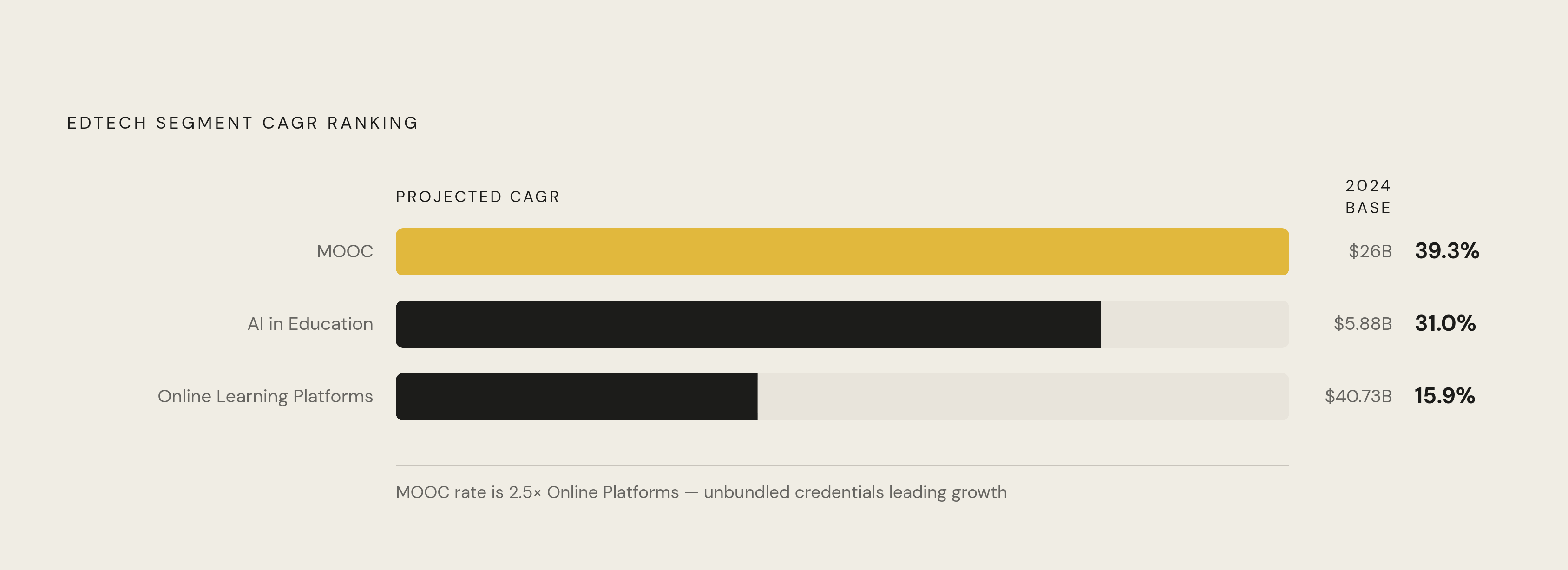
The slice that matters most for marketplace learning is more specific. According to Grand View Research, the online learning platforms segment reached $40.73 billion in 2024, with a projected 15.9% compound annual growth rate through 2034. The MOOC segment alone was valued at $26 billion in 2024, with a projected 39.3% CAGR through 2034, per Research and Markets, making it the fastest-growing layer in the stack. That acceleration is driven by learners abandoning fixed-term enrollment in favor of on-demand credentials. Behavioral shift and structural signal, both at once.
AI-in-education is operating on its own trajectory entirely. According to MarketsandMarkets, the segment was valued at $5.88 billion in 2024 and is projected to reach $32.27 billion by 2030, at a 31% CAGR. Geography adds texture. North America contributes over 37% of incremental EdTech growth, while Asia-Pacific is expanding at the highest regional CAGR in digital education, according to HolonIQ's 2024 Global EdTech Market Report. One market is credential-hungry, optimizing for advancement within systems that already exist. The other is credential-building, establishing institutional trust from scratch. Those are different demand drivers, and any platform with genuine global ambitions has to be honest about which one it was actually designed to serve.
Where Investor Capital Is Actually Going, and What That Reveals About the Models Gaining Ground
EdTech venture funding fell to roughly $2.4 billion in 2024, the lowest level in a decade, according to Brighteye Ventures' 2024 EdTech Funding Report. Q1 2026 was still down 24% in value versus the prior year, per Metaari's Q1 2026 Global Learning Technology Investment Patterns report. Those numbers look like retreat. They are not.
The more accurate read is concentration. More than 300 mergers and acquisitions closed in 2024 alone, with strategic buyers consolidating niche innovators to build end-to-end platforms, according to Metaari. Capital is leaving the undifferentiated middle and consolidating around a specific thesis — it is not abandoning EdTech broadly.
That thesis has a clear shape: workforce training captured more than 70% of Q1 2026 EdTech venture funding, per Metaari. In a sector as sprawling as education, that level of concentration does not happen by accident. It points directly at platforms tied to jobs, productivity, and skills verification — the three outcomes enterprises will actually pay for on a recurring basis. You could say investors have stopped betting on the whole farm and started betting on the barn that actually produces something.
Preply's $150 million raise in January 2026 is instructive here. A language-learning marketplace with a human tutor loop, AI support, global repeat usage, and tangible career relevance. Outcome proximity plus recurring engagement. That combination is what the current investment thesis rewards, and the funding data makes the preference legible.
The Structural Shift from Content Repository to Skills Infrastructure
The old defensible layer in marketplace learning was inventory. Whoever held the most courses, the most instructors, or the lowest price held the advantage. That layer is no longer defensible, and the speed at which it eroded surprised a lot of people who had built businesses on it.
Analysis of the competitive dynamics in the Coursera-Udemy space, including from Lumos Capital Group's work on the sector, points to three interlocking capabilities that now constitute the actual moat: (i) a continuously updated skills ontology, knowing what skills matter now, not what mattered when the curriculum was designed; (ii) assessment and verification, the ability to demonstrate who can actually do something, not merely who sat through a module; and (iii) workflow integration for employers, learning outcomes connected to business performance metrics, not HR records filed somewhere and forgotten.
Traditional LMS platforms were built for content delivery and compliance tracking, genuinely useful work, but they were never architected for dynamic skill mapping or employer integration. The infrastructure was designed for different questions than the ones enterprises are now asking.
AI's role in enabling this shift is material but gets overstated in most coverage of the space. What it actually does is collapse content-creation costs, freeing platform resources to invest in the verification and integration layers that create durable defensibility. It does not build skills infrastructure on its own. Rather, it creates financial and operational headroom to build it. Someone still has to decide what to build toward.
For learners, the practical change is this: discovery stops being browsing and becomes matching. The platform's job is surfacing the right next step toward a specific outcome, not presenting a catalog and leaving you to sort through it.
What the Coursera-Udemy Merger Reveals About the Limits of Either Model Alone
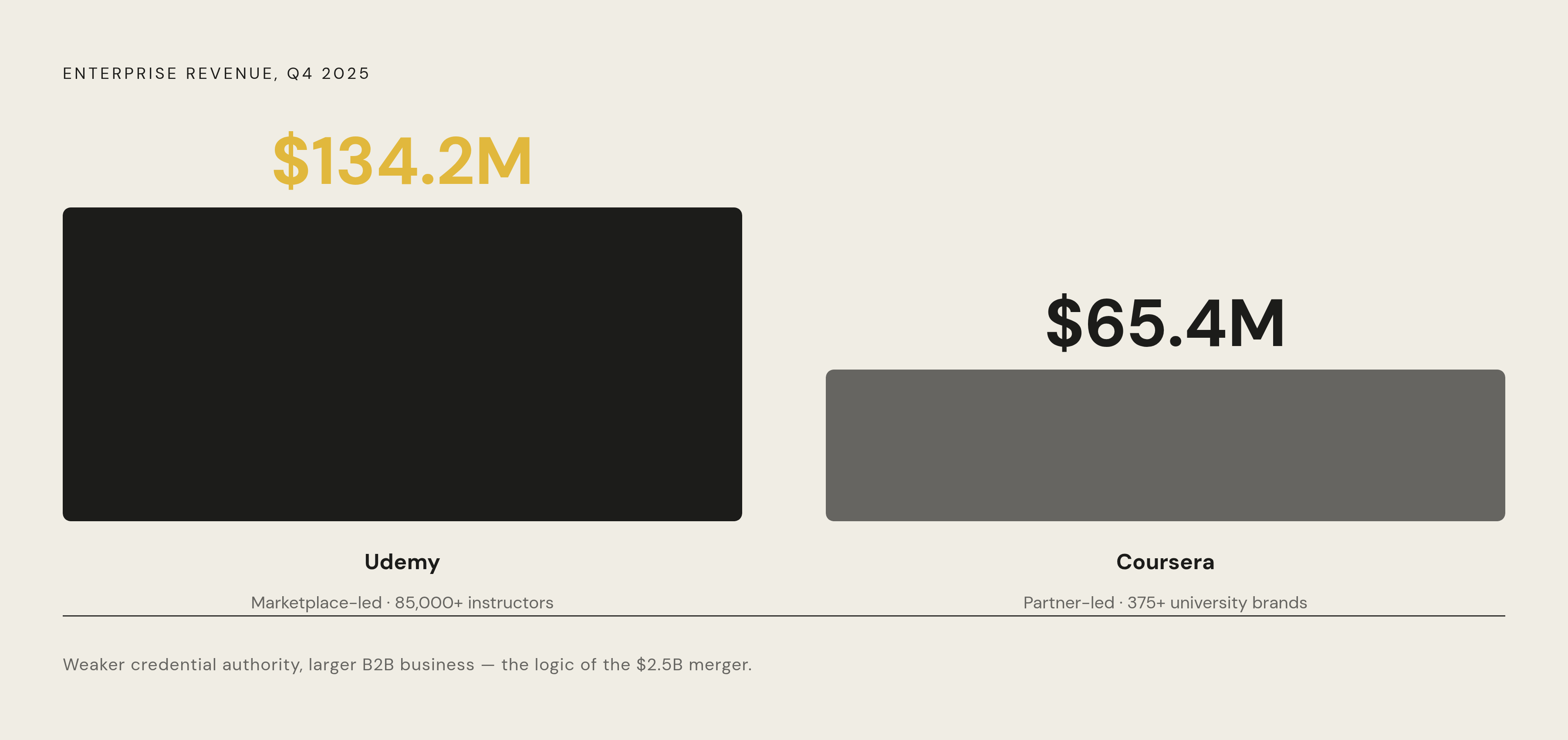
In December 2025, Coursera agreed to acquire Udemy for $2.5 billion, creating a combined platform serving over 270 million registered learners and nearly 19,000 enterprise customers, according to the companies' joint press release. It is the most consequential consolidation in marketplace learning to date. More than the scale of it, though, what's revealing is what each company was effectively admitting by agreeing to the deal.
Udemy's model was marketplace-led: more than 85,000 subject matter experts, decentralized content creation, genuine agility. In fast-moving domains like generative AI, the ability to publish new courses in days rather than months is a real competitive advantage. The structural weakness was limited institutional authority and fragmented credential signaling. A Udemy certificate is readable to learners who understand what they are looking at; it is harder to parse for an HR team evaluating candidates at scale.
Coursera's model was partner-led: more than 375 university and industry brands, verified credentials, strong labor-market signal value. The structural weakness was lagging enterprise scale and a documented consumer retention challenge. The brand prestige was real. The enterprise revenue was not keeping pace with it.
Here is the asymmetry that made the deal make sense: in Q4 2025, Udemy's enterprise revenue was $134.2 million against Coursera's $65.4 million, according to each company's publicly reported earnings. Udemy had built the larger B2B business, despite Coursera's credential prestige. The combined 2025 revenue was anticipated at roughly $1.5 billion, with projected annual cost synergies of roughly $115 million within two years, per the merger announcement. This is margin engineering as much as it is a growth story.
Neither pure marketplace nor pure credential platform is sufficient at scale. The combined entity is attempting to build the full skills infrastructure stack: content breadth plus verified outcomes plus enterprise integration. The unresolved question is whether a merged organization can execute on both models simultaneously without eroding what made each defensible in the first place. Integration is where these deals usually go sideways.
The Tension Inside Udemy's Transition, and What It Means for Marketplace Instructors
Udemy's Udemy Business segment grew from under a fifth of total revenue at the 2021 IPO to a clear majority by late 2024, according to Udemy's SEC filings. That is not gradual drift. It is a fundamental change in who the platform is actually built to serve, and the creator economics show it plainly.
Consumer payouts to individual instructors peaked in 2020 and have declined every year since, according to Udemy's annual reports. The number of instructors earning above seven figures annually dropped meaningfully from 2022 to 2024, per Udemy's publicly released creator earnings data. Small absolute numbers, but the direction is unambiguous.
One of Udemy's largest creators publicly asked whether the Coursera merger signals "the end of affordable education as we know it." The concern is substantive. Coursera's subscription- and enterprise-first orientation, applied to the Udemy marketplace, will absorb and sideline the à la carte model that made individual creators viable. That is a reasonable inference from the revenue trajectory, and the outcome depends entirely on how the combined entity structures its marketplace going forward.
The tension here is irresolvable through positioning alone. The marketplace model's original promise — accessible, cheap, creator-led learning at scale — and the enterprise SaaS model that actually returns investor capital are pulling in genuinely different directions. Whether a platform that has pivoted this decisively toward enterprise can maintain the instructor diversity and content velocity that made the marketplace valuable is an open question, and nobody currently has a convincing answer to it.
How Duolingo's AI-Driven Content Model Resets the Economics of Course Production
In Q1 2026, Duolingo published tens of thousands of language course units, according to Duolingo's Q1 2026 earnings release. In the equivalent quarter of 2025, several thousand. In 2024, a fraction of that. That is AI collapsing content-creation costs in real time, documented on a public earnings call, with revenue to match.
Duolingo crossed $1 billion in annual revenue in 2025, growing sharply from 2024, according to Duolingo's 2025 annual earnings report. Daily active users reached tens of millions in Q4 2025. Per Statista, the platform holds an estimated dominant revenue share in the global online language learning market. That dominance was built on engagement design rather than content breadth — a distinction that matters for understanding what is actually replicable here.
When AI removes the cost constraint on content volume, the competitive question shifts entirely. The moat is no longer production capacity; it is engagement architecture and habit formation. Duolingo's bet is behavioral: the app as daily ritual, as an obligation that feels optional. That is structurally different from the enterprise skills infrastructure play. It requires neither employer integration nor credentialing. It requires users to keep coming back, and the product is designed from the ground up around making that happen. In other words, Duolingo is less like a classroom and more like a gym membership you actually use — the value is in the showing up.
The implication for other marketplace platforms is specific. AI does not automatically create skills infrastructure. What it does is eliminate the old content moat, which forces every platform to locate its actual defensible layer. If you were competing on content volume, that competition is over. Many platforms are still figuring out what they are competing on instead.
The B2C-to-B2B Shift as a Structural Trend Across the Sector, Not Just a Coursera Story
The U.S. Bureau of Labor Statistics estimates that nearly half of American workers will require reskilling by 2030. Corporate e-learning spending in the U.S. surpassed tens of billions of dollars in 2024, according to Training Industry's 2024 Training Industry Report. The corporate segment is growing at the fastest CAGR in the EdTech market, and multiple platforms are chasing it for the same underlying reasons.
The enterprise SaaS economics are straightforward: (i) recurring revenue replaces one-off course purchases; (ii) customer acquisition cost per learner seat drops sharply relative to B2C; and (iii) employer integration creates switching costs that consumer products structurally cannot replicate. Once a platform is embedded in a Fortune 500 company's HR and compliance infrastructure, as Coursera for Business, Udemy Business, and Guild Education already are, the friction of leaving becomes significant.
The risk the pivot carries rarely gets equal airtime. Platforms that fully optimize for enterprise lose the creative and pedagogical diversity that made them attractive to individual learners, and individual learner engagement is the signal that makes enterprise customers willing to pay in the first place. A corporate learning platform where nobody actually completes anything is a liability. The B2C roots are not legacy infrastructure to be rationalized away; they are the proof of concept the B2B sale depends on. Platforms that forget this discover it expensively.
What Distinguishes the Marketplace Models Actually Gaining Ground from Those That Aren't
The platforms gaining ground share five characteristics. The ones running the old playbook share a notable absence of them.
Outcome proximity. Platforms gaining ground can demonstrate a measurable connection between learning activity and employment or performance outcomes. Completion certificates are table stakes now. What matters is whether the learning moves the learner's career and whether the platform can show that with data rather than testimonials.
A living skills ontology. Static curricula cannot keep pace with a labor market reshaping skill requirements on compressed cycles, a dynamic documented extensively in the World Economic Forum's Future of Jobs Report. Platforms need continuous signals from employer data, not periodic updates from subject-matter experts who reviewed the curriculum eighteen months ago and moved on.
AI deployed for personalization and verification, not just content volume. Khan Academy's Khanmigo and Coursera's AI Coach both illustrate the shift from AI-as-publisher to AI-as-adaptive-guide. Generating more content is operationally easy now. Guiding a specific learner toward a specific capability, accounting for what they already know and where they keep getting stuck, is still genuinely hard.
Engagement architecture that survives outside a fixed enrollment window. Duolingo's daily-habit model and Preply's human tutor loop both solve for sustained return. One-time course purchases do not. Engagement that depends entirely on a learner's intrinsic motivation, with no structural reinforcement built into the product, consistently loses to engagement that is architecturally embedded in daily behavior or professional accountability.
A credentialing layer that employers actually recognize. Whether through university partnership, verified skills badges, or employer co-design of curricula, the signal has to be legible to the labor market. Learning that cannot be translated into career movement is a consumer product, not a skills platform, whatever it calls itself.
What the models still failing share is simpler: content abundance without these connecting layers. A decade of MOOC expansion made this hard to ignore. Enrollment volume and outcome delivery are not the same thing, and platforms still optimizing for the former are measuring the wrong thing.
What the Structural Shifts Mean for Marketing and Content Leaders Building Learning-Adjacent Strategies
The patterns running through this piece are not unique to EdTech. The erosion of production capacity as a moat, the shift from content volume toward outcome-connected ecosystems, the pull toward recurring enterprise relationships over one-off consumer transactions: marketing and content leaders are navigating all of it, often without the benefit of watching another industry work through the same transitions first.
The skills ontology problem translates directly. Knowing what questions your audience is actually trying to answer right now, not what you published last quarter, is the editorial equivalent of a living curriculum. Most content teams are running static curricula and calling it strategy. Real-time audience signal, not editorial intuition alone, is what keeps content relevant when the landscape is moving fast.
Duolingo's production trajectory surfaces something counterintuitive: AI can collapse creation costs while maintaining output quality, but only when paired with editorial judgment that preserves signal-to-noise ratio. The platforms that struggled used AI to generate volume. The platforms gaining ground used it to generate precision. Content teams face the same fork, and the consequences of choosing wrong look the same.
The B2B pivot in EdTech also contains something worth borrowing. Platforms that built enterprise integrations stopped depending on individual consumer acquisition for growth; they created recurring engagement through structural embeddedness. Content strategies that build owned channels and workflow-embedded distribution follow the same logic: less exposure to algorithmic discovery cycles, more recurring contact with an audience that opted in and keeps showing up. One of those positions compounds over time. The other resets every time the platform changes its mind about what to surface.