Live Commerce Integration in Product Marketplace Platforms
Platforms that integrate live commerce poorly leak value before conversion happens.
Live Commerce Integration in Product Marketplace Platforms.
Live commerce integration as a critical infrastructure question for marketplace platforms
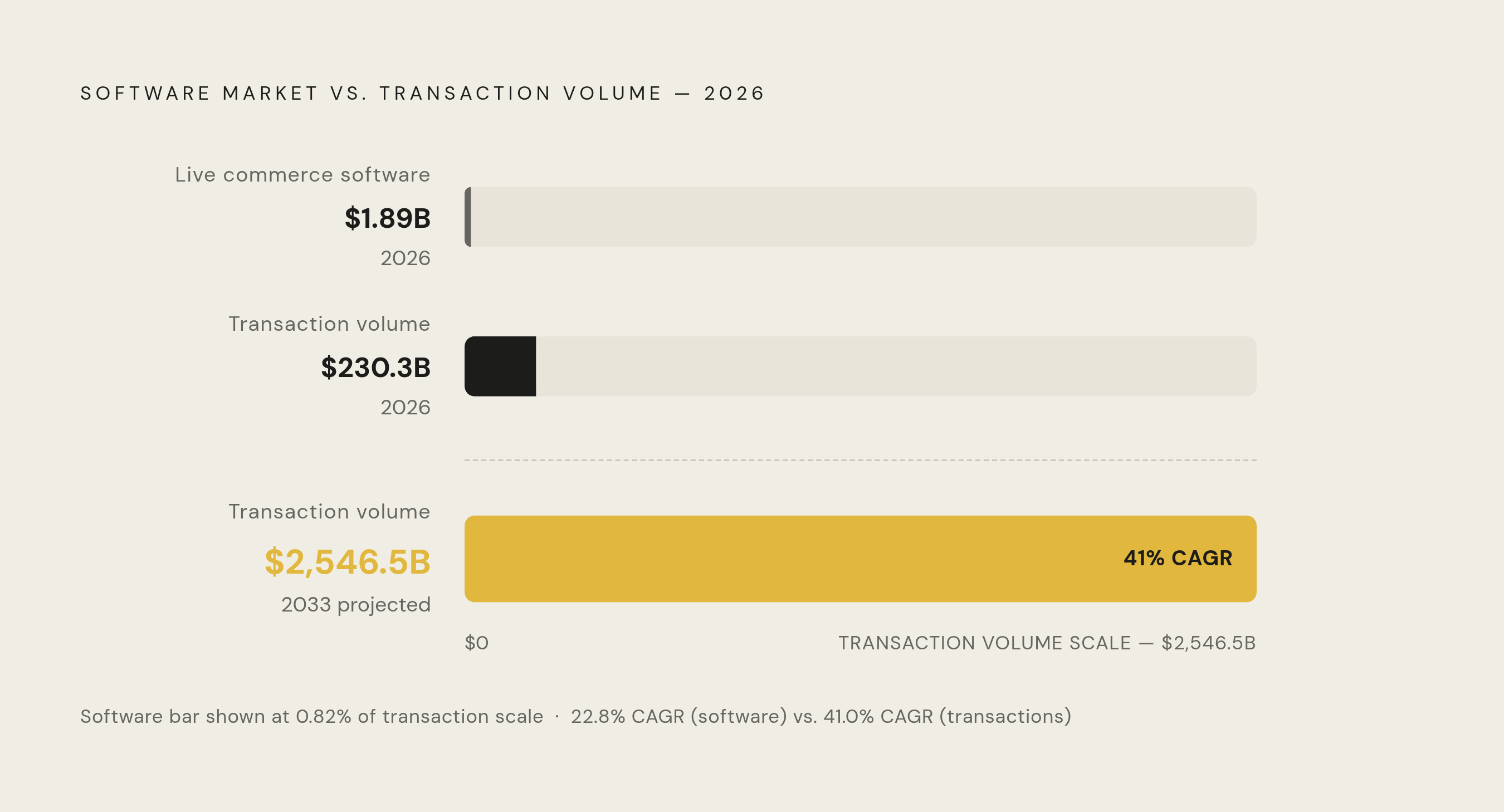
Live commerce is a distinct commerce architecture. It is a distinct commerce architecture, one that either integrates cleanly across video, inventory, and checkout or breaks down the moment real traffic hits it. The stakes are not abstract. Live commerce platform infrastructure, the software layer alone, grew from $1.54 billion in 2025 to $1.89 billion in 2026, a 22.8% compound annual growth rate, just the tooling. That's just the tooling. A transaction layer worth $230.3 billion in 2026, projected to reach $2,546.5 billion by 2033 at a 41.0% CAGR, generates that tooling. The distance between those two numbers is the whole argument: a relatively small software market is expected to carry an enormous and fast-growing volume of actual commerce, and the platforms that get the plumbing wrong will leak most of that value before it ever converts.
Conversion is the reason any of this matters commercially. That gap is conditional.
For a marketplace operator, this creates a genuine architectural dilemma. Building or embedding live commerce means making layered decisions, video delivery, overlay design, inventory synchronization, checkout flow, and each layer has to talk to the others in real time without breaking the session. This piece is written for the people who have to make those decisions: marketplace operators, platform engineers, and ecommerce leads evaluating how to build, embed, or extend live commerce capability. It is not a buyer's guide comparing social shopping apps. What follows works through each integration layer in order, video first, then overlays, then inventory, then checkout, then the engagement mechanics that keep a session alive long enough to convert, and shows where the breakdowns tend to happen.
What live commerce integration means inside a marketplace context
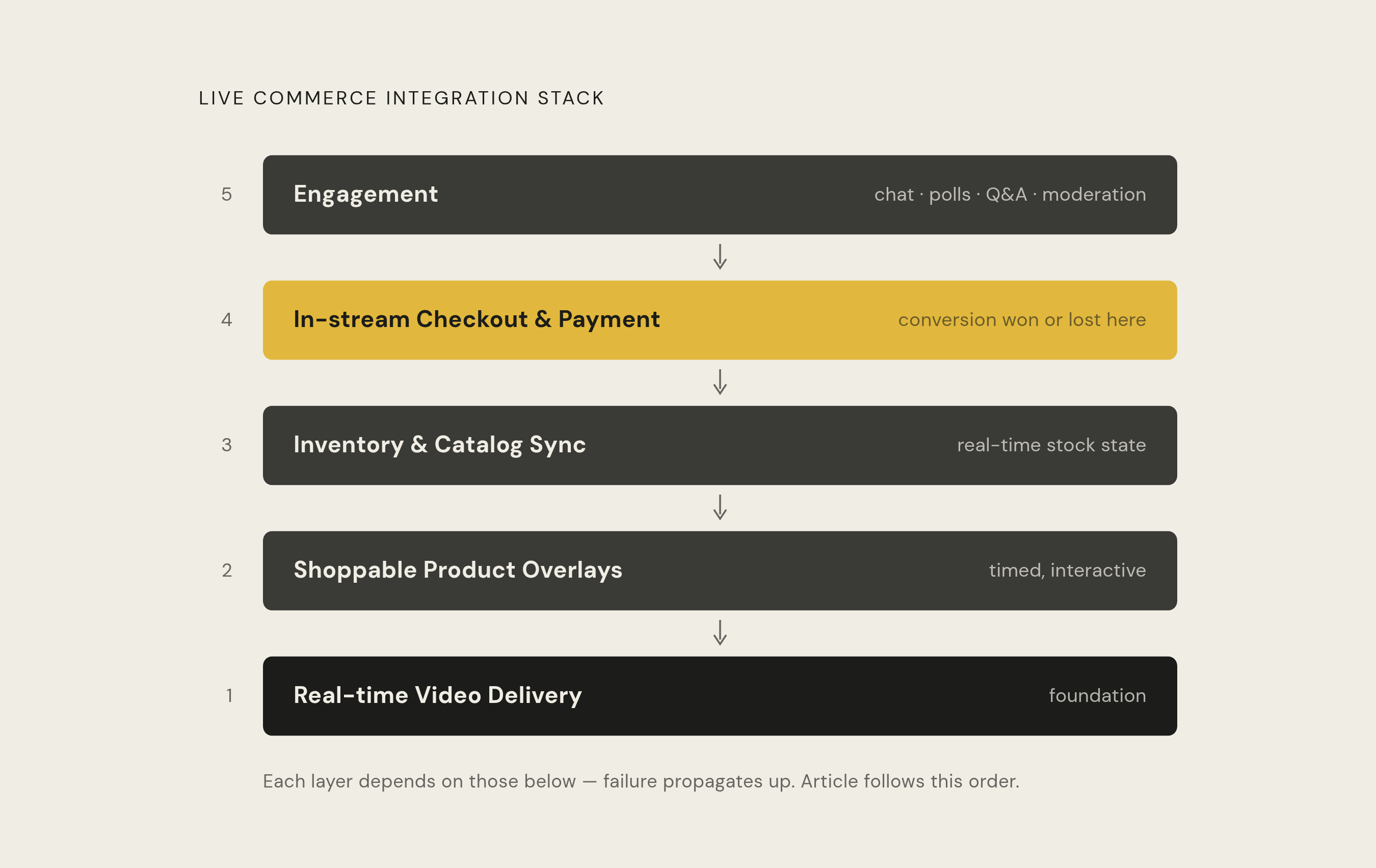
Live commerce integration is a stack. It includes a real-time video delivery layer, a shoppable product overlay layer, a synchronized inventory and catalog layer, an in-stream checkout and payment layer, and an engagement layer covering chat, polls, Q&A, and moderation. Platforms that execute this well process an order the instant a viewer decides to buy, with no redirect interrupting the moment. That is a specific technical outcome, not a vague aspiration, and it is what separates a live commerce platform from a webcam pointed at a product table.
The distinction matters more than it sounds. What separates live commerce software from a generic streaming tool is that the video is wired directly into commerce infrastructure, catalog sync, checkout, inventory, rather than existing as a content layer someone glues a "buy" button onto afterward.
Marketplace operators generally choose among three integration models. Social-native integration embeds the marketplace inside or alongside an existing social platform, the pattern used by TikTok Shop, Instagram Live, and Amazon Live. Owned-site integration has the brand stream from its own domain using a standalone tool that plugs into its commerce backend, the approach taken by Channelize.io, Bambuser, and eStreamly. Hybrid integration multistreams simultaneously to both owned and social surfaces, extending reach without multiplying production overhead.
None of these models is inherently superior. They solve different distribution problems. A marketplace platform serves multiple sellers, each with a different catalog, a different inventory system, and a different payout structure, a wrinkle a single-brand streamer doesn't face. The integration has to work at scale across all sellers simultaneously. That constraint reshapes almost every decision downstream, starting with the video layer itself.
The video delivery layer: streaming infrastructure decisions that set the ceiling for everything else
Low latency is the entire premise of the format. It's the entire premise of the format. A delay between what the host does and what the viewer sees breaks the real-time selling dynamic outright: when the host says "only three left," the viewer needs to see that claim reflected on screen in near-real time, or the urgency mechanic simply doesn't work.
Mobile is the default environment, not an edge case worth accommodating later. Bandwidth conditions vary constantly on mobile networks, so streams need to degrade gracefully under variable connections without losing the commerce layer in the process. A viewer who loses the product overlay because the stream buffered has effectively been un-sold; that's a lost conversion, not a minor glitch.
Marketplace platforms also have to decide whether to own ingestion, having the seller stream directly into the platform's own infrastructure, or to accept streams from third-party tools. Each path carries its own latency profile, reliability tradeoffs, and moderation complications, and there isn't a universally correct answer; it depends on how much control the platform needs over the seller experience versus how quickly it needs to scale seller onboarding.
Scale events are where this layer gets tested hardest. On Black Friday 2024, TikTok Shop ran more than 30,000 livestream sessions in the US alone. Infrastructure capable of absorbing that kind of concurrent load isn't a feature checkbox, it's a core platform capability that has to be engineered for, not discovered under pressure.
Dwell time is the payoff for getting this right. Viewers tend to stay three to five times longer in a livestream than in a pre-recorded video, when the stream includes some mix of entertainment, interactivity, or exclusive behind-the-scenes access. Delivery reliability is what protects that extended attention span, and that attention span is, functionally, the conversion window. Every buffering event or dropped frame shortens it. IntexSoft's 2026 report found that 76% of livestream viewing happens on smartphones, so the delivery layer must be optimized for mobile playback and mobile checkout, not desktop.
Shoppable overlays: how product information surfaces during a live session without breaking the watch experience
A shoppable overlay is a clickable product card, pin, or banner that surfaces on or beside the video frame during a live session, showing SKU, price, and availability without forcing the viewer to leave the stream to find that information.
Platforms generally support two models for triggering these overlays. In the host-driven model, the seller or a producer manually pins a product at the exact moment it's being featured, which produces precise timing but demands operational coordination during the broadcast itself. In the automated model, the platform surfaces product cards based on stream timing, a script, or AI cues, which reduces operator burden but risks mistiming. Most enterprise-grade platforms offer both, and the choice has real staffing implications: host-driven overlays need a producer in the loop, automated ones need a reliable trigger system built ahead of time.
The design constraints are unglamorous but decisive. The overlay can't cover the part of the frame where the host is demonstrating texture or fit, or it defeats the purpose of showing the product live. It has to be large enough to tap accurately on a phone screen, since mobile accounts for 76% of viewing. And it has to render fast: a product card that lags behind a host's "buy now, this is going fast" moment is a missed sale dressed up as a technical delay.
Overlays are also entirely dependent on what's feeding them. Catalog sync is the upstream requirement here, since an overlay showing a price or an in-stock badge that doesn't match the live commerce backend isn't just wrong, it actively misleads the person watching.
A few named platforms illustrate the range of approaches. TikTok Shop uses in-feed product links and pinned product cards during LIVE sessions, and its May 2026 Countdown Bidding and LIVE Auctions expansion added a time-pressured variant of the overlay concept. Stage TEN's Live Creator Suite, integrated into Shopify's Shop app, builds shoppable overlays with instant checkout directly inside the video player. Channelize.io, Bambuser, and eStreamly each treat live shopping and shoppable video as core product features rather than add-ons. What none of these platforms can do is make the overlay smarter than the data behind it. And that data problem, inventory, is the next layer down.
Synchronized inventory: why catalog and stock data must be live, not polled
Inventory distortion, the gap between what a live session displays as available and what's actually sitting in stock, is not a cosmetic bug. It causes overselling, cancelled orders, and a direct hit to buyer trust. IHL Group estimated that inventory distortion cost global retailers $1.7 trillion in 2024, and live commerce makes this worse because demand spikes in a live session are sudden and compressed into a narrow window, unlike the steadier trickle of standard ecommerce traffic.
The technical distinction that matters here is polled versus event-driven sync. Polled inventory, periodic batch updates, works fine for standard ecommerce but turns genuinely dangerous in a live session, where hundreds of concurrent viewers might add the same SKU to their cart within seconds of each other. Event-driven inventory, where stock decrements the instant an add-to-cart or purchase happens rather than on a schedule, is what live commerce actually requires to function without oversells.
Marketplace platforms carry an added layer of complexity here that a single-brand stream doesn't. Each seller may run inventory through a completely different system, their own warehouse management software, a Shopify backend, a third-party logistics provider. Shopify Marketplace Connect handles part of this problem for Shopify merchants selling across Amazon, Walmart, eBay, and Target Plus, but a custom marketplace build has to construct equivalent real-time sync logic from scratch.
Scarcity messaging is where this all comes to a head. The "only 3 left" signal is one of the format's most effective conversion tools, but its power is entirely borrowed from accuracy: the moment it flashes false urgency and the checkout resolves to out-of-stock, the session's credibility is gone, probably for that viewer permanently. Compounding the risk further, the average seller manages inventory across six marketplaces, with 34% managing seven or more, so a seller running a live session on one channel can get blindsided by simultaneous sales draining the same stock elsewhere unless inventory is reserved globally at the moment a viewer commits to buy. For platform builders, the practical lesson is sequencing: inventory sync architecture needs to be designed before the overlay system, because overlays only ever display what the inventory layer tells them, and any lag in that state propagates straight through to what the viewer sees on screen.
In-stream checkout: the integration layer where most conversion is won or lost
Every redirect away from the stream to finish a purchase kills conversion. The viewer has to leave the moment, navigate to a separate flow, and re-enter payment details, and by the time all that's done, the impulse that made them want to buy has usually evaporated. This is the layer where the theoretical advantage of live commerce either gets banked or gets thrown away.
Standard ecommerce checkout simply wasn't built for this. It assumes a deliberate, browse-then-purchase journey. Making in-stream checkout actually work requires a few specific things to be true. Session authentication has to persist: the viewer's identity and payment credentials are already on file so the entire checkout is one or two taps rather than a form to fill out. Cart state has to coexist with video playback, so adding an item never pauses, minimizes, or redirects the stream. Payment processing has to run inside the streaming surface itself rather than launching as a separate web flow, and order confirmation has to return the viewer to the broadcast rather than dumping them on a thank-you page that quietly ends the session.
The platforms executing this well make it visible in their numbers. TikTok Shop lets buyers transact without ever leaving the app, and its February 2026 cross-listing integration with Amazon goes further, letting shoppers see real-time pricing, delivery estimates, and Prime eligibility, then purchase Amazon products directly inside the TikTok feed, checkout integration spanning two separate commerce ecosystems. Stage TEN's integration into Shopify's Shop app enables instant checkout directly inside the video player. Whatnot has built frictionless in-app checkout as a core design principle, and the results back up the approach: the platform pushed more than $8 billion in live GMV in 2025, roughly double what it moved the prior year.
One friction point deserves specific attention: requiring account creation before purchase. A viewer who made an impulse decision mid-stream will not pause to register for an account, so guest checkout or social sign-on tends to be the right default rather than the fallback. Return rates offer a useful downstream signal of whether all of this actually worked. Live demonstrations tend to reduce returns, since buyers have already seen the product in motion and gotten their questions answered before buying, but that advantage only holds if checkout completed correctly and fulfillment delivered what was actually shown on screen. A broken handoff between checkout and fulfillment erases the lower-return benefit.
The engagement layer: chat, moderation, and interactive mechanics that sustain the conversion window
Engagement stretches the conversion window, giving the commerce stack its function rather than merely decorating it. Viewers stay three to five times longer in a live stream than in a pre-recorded video, and every extra minute of attention means more exposure to product demonstrations, more add-to-cart moments, and ultimately more completed purchases.
Real-time Q&A does specific, measurable work here: it removes purchase objections on the spot. A question like "is this true to size" or "does this work on sensitive skin," left unanswered, sends a viewer off to search elsewhere and probably away from the stream. Answered live, in the moment, that same question turns into a reason to buy immediately.
A handful of mechanics carry most of this weight. Real-time chat paired with a visible viewer count creates social proof, seeing that others are watching and buying reduces hesitation. Polls and reactions keep otherwise passive viewers active and signal product interest back to the host in real time. Pinned questions and moderation surface the most conversion-relevant chat while filtering out spam and off-topic noise that degrades session quality. Gamification, raffles, quizzes, treasure hunts, offered by platforms like Sprii, extends dwell time and builds urgency through mechanics that have nothing to do with price.
Auctions and countdowns form their own distinct engagement category. Whatnot has built its entire model around live auctions and show formats, and its streamers run more than 175,000 hours of broadcast per week.
Moderation is infrastructure. An unmoderated chat during a high-traffic session can allow harmful content, competitor links, or coordinated spam to appear fast enough to degrade the whole experience and suppress purchases in the same window it was meant to drive them. Moderation tooling has to scale with concurrent viewer counts, the same way the video delivery layer does. And the chat itself is a data source, not just a feature: which questions got asked, which products triggered spikes in activity, when viewers dropped off. That signal needs to feed back into the platform's analytics, because treating engagement as an isolated feature throws away exactly the information that explains why a session converted or why it didn't. TikTok Shop's Countdown Bidding / LIVE Auctions feature, expanded May 22, 2026, positions real-time bidding as an interactive shopping format, making viewer engagement the mechanism of price discovery. eBay Live incorporates live auctions with integrated eBay listings and seller reputation carry-over, representing a different trust architecture than social-native platforms.
Notes
- Live Streaming Commerce in 2026: Best Platforms, Strategies & ROI for Retailers- IntexSoft
Provided the statistic that 76% of livestream viewing happens on smartphones, cited in both the video delivery and overlay sections.
- Live Shopping Platforms: The Complete Guide for 2026
Cited as the source for gamification mechanics like raffles, quizzes, and treasure hunts offered by Sprii to extend dwell time.
- Live Commerce Platforms Market Size, Trends Report 2026-2030
Provided the live commerce platform software market figures: $1.54 billion in 2025, $1.89 billion in 2026, and the 22.8% CAGR.
- Real-Time Multi-Channel Inventory Sync: Event-Driven 2026 | XICTRON®
Supported the distinction between polled and event-driven inventory sync and why the latter is required for live commerce's sudden demand spikes.
- How Livestream Ecommerce Drives Engagement & Sales (2026)
Informed the discussion of how viewers stay three to five times longer in livestreams and how live demonstrations reduce return rates.
Every new piece from marketplace crunch, as it's published.
Follow