Product Marketplace Launch Sequencing for New Categories
Executing marketplace launches in the right sequence prevents costly missteps.
The majority of Amazon product launches fail within their first 12 months. That reading misses the mechanism. Over 30,000 new products get introduced in major markets each year, and the ones that make it through are sequentially smarter than the ones that don't. They're sequentially smarter. Every section that follows interrogates one link in that sequence: what gets built first, what gets measured before scaling, and what gets deferred until the market has actually told you something. The idea is rarely the problem. The order in which you execute on it almost always is.
Diagnosing whether you are supply-constrained or demand-constrained before choosing any tactic
At any given moment in a category launch, exactly one constraint is binding: either there isn't enough supply, or there isn't enough demand. These two states call for opposite resource allocation, and the most expensive failure mode in this business is applying the wrong one. A category with eager buyers and thin seller inventory needs an entirely different playbook than a category with deep inventory and no buyer awareness, yet founders routinely import a global playbook without first running this diagnostic.
The playbook they import is often correct. It's just aimed at the wrong constraint. If the bottleneck is recruitable sellers and transactable inventory depth, spending on buyer acquisition is money into a market that has nothing to sell them. If the bottleneck is qualified buyer acquisition and conversion, adding more sellers just deepens a supply base nobody is browsing.
Getting this diagnosis wrong doesn't just waste a marketing budget. It burns the launch window itself, because the diagnosis governs hiring priorities, resource allocation, and which metrics actually signal progress versus which ones are noise. A team measuring demand-side conversion in a supply-constrained market is watching the wrong dashboard.
Operationalizing supply before demand arrives
Once supply is confirmed as the binding constraint, the established sequence is to recruit quality sellers, build inventory depth, and only then flip the switch on demand acquisition. Flipkart's Home and Kitchen category launch in 2011 followed exactly this order: the category required more than a thousand sellers on board before any demand-side activity began.
OpenTable is the cleanest illustration of why this works. It didn't launch as a consumer discovery app looking for restaurants to join. It launched as a restaurant table-management tool, which meant restaurants adopted it for their own internal operations, not as a favor to some future diner. That table-management utility built supply-side density on its own terms, and consumer demand only got turned on once that density existed. The tool was the recruitment mechanism. Supply joined because it solved their problem, not because a marketplace asked nicely.
This distinction matters because sign-ups are not the same thing as transactable supply. A seller who has registered an account has not necessarily been given listing tools, a pricing structure, or the workflow support needed to actually fulfill an order the moment one arrives. Recruiting supply and operationalizing it are two separate phases, and collapsing them into one is a sequencing error that produces a roster that looks impressive on a dashboard but can't deliver when a buyer shows up.
Trust infrastructure has to be built alongside that operational layer, not bolted on afterward. Verification, ratings, dispute resolution, and payment protection need to launch with supply, because without them, any transaction with real stakes or any repeat buyer relationship will simply migrate off-platform. At that point trust tools stop being an acquisition lever and become, at best, a retention feature for the transactions the platform never fully captured. OpenTable's approach is the canonical supply-side Trojan horse: it began as a restaurant table-management tool, building supply-side density before turning on consumer demand, with the tool itself serving as the mechanism that made supply willing to join.
Liquidity as the determinant of a new category's survival
Liquidity is the probability that a buyer finds what they need the moment they show up. It is not a headcount, and it is not a GMV figure printed on a slide. A marketplace can post an impressive number of registered users or listed SKUs and still be functionally dead, because none of those numbers describe whether a real buyer's real search resolves into a real transaction.
This is where premature breadth becomes the enemy. A wide launch across many geographies or many sub-categories at once creates a lot of weak, unstable networks, each one thin enough that buyers show up and find nothing worth buying. A narrower launch that pushes for genuine density in one geography or one sub-category builds what's often called an atomic network: a pocket dense enough to be stable on its own, which can then be replicated elsewhere once it's proven. The logic holds for digital marketplaces organized around category or niche rather than physical geography. Depth first, breadth later.
Expanding too fast fragments liquidity across pockets that never individually cross the density threshold, so none of them compounds and all of them stay fragile. The way to catch this before it becomes a crisis is to track search-to-fill rate, time to first transaction, and per-channel unit economics, since these are the leading indicators of whether density has actually been achieved, long before aggregate volume would show a problem. Before any of that gets automated, the first several dozen transactions should be handled by hand. Manual handling makes the friction points visible in individual transactions, points that never appear in an aggregate report because aggregate data smooths over exactly the failures that matter at this stage.
The sequencing logic that changes entirely when the category does not yet exist in the buyer's mind
Everything above assumes buyers already know what they're looking for, even if they can't yet find it reliably. Established categories can run supply-first sequencing straight into demand capture, and that's sufficient. Genuinely novel categories require an additional step first: category education.
If nobody is searching for the product type yet, a paid search campaign or a conversion-optimized landing page has nothing to capture. It goes live into a vacuum. Awareness has to precede demand capture in these cases: content, PR, and thought leadership turn on first, and paid acquisition only follows once there's measurable search intent worth capturing.
Voila Pets, a premium dog treat pouch brand, ran directly into this problem. The category it was trying to create, a premium food-grade silicone treat pouch, simply didn't exist in the buyer's mind. Consumers saw treat pouches as a disposable commodity, and nobody was searching for a premium version of something they didn't think warranted a premium version. The lesson from that case is blunt: launching into a category that doesn't yet exist requires the education phase to run well ahead of any conversion push, or the conversion push has nothing to convert.
This is also where the sales research gets interesting. Matt Dixon's analysis of millions of sales conversations found that a large share of qualified deals are lost to buyer indecision rather than to competitors. In a new category, that indecision is structural, because the buyer literally cannot yet frame what they're deciding. It's structural. The buyer literally cannot yet frame what they're deciding, because the category hasn't given them a mental model to decide within. No amount of conversion optimization fixes a buyer who doesn't yet know what question they're answering.
The 90-day pre-launch sequencing structure that separates compounding launches from day-one bets
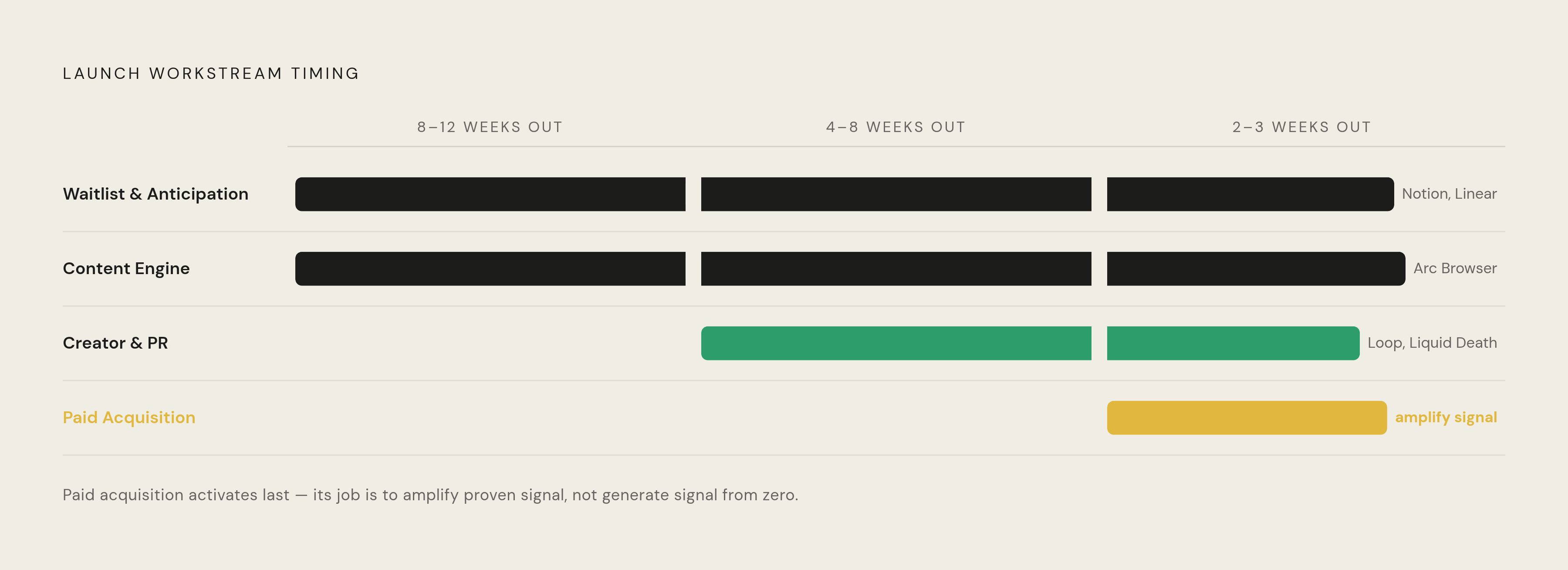
Everything discussed so far becomes concrete in a specific temporal structure. A coordinated launch runs four parallel workstreams: a waitlist-and-anticipation engine, a content engine that builds organic discovery, a creator and PR motion that earns third-party validation, and a paid-acquisition layer. The mistake is treating these as simultaneous. They aren't.
The sequencing across those four workstreams is fixed. Waitlist and content begin 8 to 12 weeks before launch. Creator and PR activity ramps 4 to 8 weeks before launch. Paid acquisition comes last, in the final 2 to 3 weeks, and its job is to amplify signal that's already proven itself, not to generate signal from a standing start. Launches that try to fire all four workstreams at once on launch day never build the compounding signal that paid amplification actually needs to work against. Paid spend against nothing just burns budget at a slightly faster rate.
Notion, Linear, Arc Browser, Loop Earplugs, and Liquid Death all built waitlist depth and content presence well before a single paid ad went live. None of them treated launch day as the starting gun. They treated it as the moment existing momentum got amplified.
Slack matters here too. Gartner's product manager survey found that 45% of product launches slip their scheduled date, and the ones that slip are markedly more likely to miss their targets afterward. That's a case for building slack into estimates rather than for optimism about compressed timelines. It's an argument for building slack into the 8-to-12-week and 4-to-8-week windows rather than assuming everything lands exactly on schedule.
The metrics that matter during this window are waitlist conversion, day-1, week-1, and month-1 revenue or signups, cost-per-acquisition by channel, branded search lift, and earned media volume. Launch-day pageviews tell you almost nothing about whether any of this is working.
Amazon as the category launch environment where sequencing errors are most measurable and most punishing
Amazon added more than 100,000 new ASINs per day in 2025, and most of those never reached page one of search results. At that density, sequencing becomes a survival variable rather than an optimization exercise.
Listing optimization comes after that. PPC activation only starts once the listing is actually complete, and early SEO signals, review velocity and conversion rate among them, get built during the first 90-day window on the platform. Reordering any of these steps means spending PPC dollars against a listing that isn't finished, or trying to build review velocity before inventory can reliably fulfill the orders those reviews would come from.
Realistic launch benchmarks: a 10–15% conversion rate in month one, page-one ranking for primary keywords by day 60, and 25–50 verified reviews by day 90. The soak period that produces those numbers is itself a sequencing concept, not simply a waiting game. The behavioral signal Amazon's algorithm uses to assign organic rank gets built during those first weeks, and changing creative, pricing, or ad structure too early resets that signal rather than improving it.
Whether an account is ready to expand into an additional category channel comes down to a specific set of checks: CTR, CVR, and TACoS sitting at or above category benchmark and holding steady there, A+ content and the image stack fully built out, and PPC spend that isn't leaking. If any one of those is still soft, adding a new channel at that point is a sequencing error, not an act of ambition. Post-launch scaling from months 3–6 involves shifting budget toward profitable keywords, testing new ad formats, expanding to additional marketplaces, and building a Brand Store as a long-term discovery asset, sequenced expansions rather than simultaneous moves.
Whatnot's food category expansion and sequencing complexity in live commerce
Whatnot began selling shelf-stable food, candy and snacks specifically, in the summer of 2025. Between July 2025 and January 2026, that food category grew 30% month-over-month. Only in early 2026, around February, did Whatnot introduce a fresh food category that included fish and steak.
That ordering wasn't incidental. Shelf-stable SKUs carry almost none of the logistics risk that perishable goods carry, so putting candy and snacks first let Whatnot prove category-level demand and operational health before taking on the cold-chain and spoilage risk of fish and steak. The sequencing logic here is different from the supply-versus-demand framework governing earlier sections. It's logistics complexity versus category maturity. A platform earns the right to handle operationally difficult categories by first demonstrating it can run the simple ones cleanly.
In April 2026, Whatnot appeared on the TIME 100 Most Influential Companies of 2026 list. Whatever the reasons behind that recognition, the food category rollout stands as a clean example of a platform that respected its own operational limits rather than launching a category because demand for it existed somewhere in the market. Demand alone was never the gate. Fulfillment infrastructure was.
Etsy's category scope and the sequencing opportunity in large, underpenetrated markets
Etsy's marketplace GMS in 2025 represented only a small fraction of the total online retail opportunity, a figure the company itself cites as evidence of how much room is left to capture. Etsy's category list includes apparel and footwear, personal accessories, beauty and personal care, home and garden, toys and games, pet care, craft supplies, paper and party, and art and collectibles.
Per Consumer Edge data cited in Etsy's Q4 2025 earnings materials, Etsy outperformed peers in half of its top six categories during that quarter, and its Home and Living category grew year-over-year. That's targeted strength in specific categories rather than uniform dominance across the board. It's targeted strength in specific categories, which is precisely what a sequencing argument would predict: even modest penetration of a correctly sized total addressable market compounds into a real position, provided the categories get sequenced according to where the strategic leverage actually sits, rather than pursued all at once.
Etsy's machine learning investment in ad relevance and seller budget pacing drove take-rate expansion, and that detail matters for the sequencing argument specifically. Algorithmic investment in matching quality is itself a lever, but it's a lever that has to follow category depth, not precede it. There's no meaningful signal to optimize against until a category has enough transaction volume to generate one.
ML-driven recommendation breakdowns during a new-category launch before the model has data
Cold-start is the condition where a machine learning system doesn't have enough historical data to make a confident prediction, and in ecommerce it takes three distinct forms: new product cold-start, where there are zero purchases or reviews to work from; new user cold-start, where there's no purchase history to draw on; and new category cold-start, where the platform is entering an entirely new market or product type. Each of these needs its own mitigation, and treating them as one problem is itself a sequencing mistake.
The most common failure inside ML-driven platforms is an abrupt switch, the "today we use metadata, tomorrow we use ML" approach, where recommendations shift overnight from one system to another. Users experience that shift as a sudden drop in relevance, because the new model hasn't had time to learn what the metadata system already knew by brute force.
The fix is itself a sequencing protocol, not a technical fix in the usual sense. Running the ML score at a higher weight and the metadata score at a lower weight for one to two weeks, watching purchase rates and bounce rates over that window, means only deprecating the metadata path once both metrics actually improve. Skipping that overlap period is the same error, in a different domain, that recurs everywhere else in this piece: collapsing two phases that need to run in sequence into a single move, because the single move looks faster on a roadmap. It rarely is.
Notes
- How to Launch a Product on Amazon: Strategy and Execution
Provided the Amazon ASIN volume figure and the specific launch benchmarks for conversion rate, keyword ranking, and review velocity in the first 90 days.
- 7 Product Launch Strategies to Maximize Success in 2026
Provided the figure of 30,000 new products introduced in major markets each year.
- Whatnot
Provided background on Whatnot's food category expansion timeline, including the shelf-stable food launch in summer 2025, the month-over-month growth figure, and the February 2026 fresh food introduction.
- Cold start (recommender systems)
Provided the definition of cold-start as a machine learning condition and its three distinct forms relevant to ecommerce platforms.
- How To Know If You're Supply or Demand Constrained 🤹♂️ - Phase 2 of Kickstarting and Scaling a Marketplace Business
Informed the framework for diagnosing whether a marketplace is supply-constrained or demand-constrained and the distinct resource allocation implications of each state.
- Supply Acquisition — Marketplace Pattern | The Marketplace Guide
Informed the discussion of supply-side recruitment sequencing and the distinction between signing up sellers and operationalizing them as transactable supply.
- The Two-Sided Marketplace Playbook: Sequencing, Liquidity, and What Actually Breaks at Scale | The Marketplace Guide
Informed the section on liquidity as a survival determinant, atomic network strategy, and the danger of premature breadth fragmenting density below the threshold needed for stability.
Every new piece from marketplace crunch, as it's published.
Follow