SEO Strategy for Vertical Marketplace Category Pages
Category pages drive most marketplace search traffic—here's how to optimize them at scale.

Search accounts for 43% of ecommerce traffic and 23.6% of online orders, per Reboot Online's 2025 analysis, and vertical marketplaces earn most of that traffic through category pages, not product listings. That makes the architecture of those pages a revenue question as much as a rankings question, and most marketplace teams get the order backwards: they polish product listings first and treat category pages as connective tissue, then wonder why traffic plateaus once the catalog crosses a few hundred thousand SKUs.
A vertical marketplace is a platform where multiple sellers list within one defined niche: fashion, real estate, auto parts, B2B equipment. A general retailer might carry a few hundred SKUs in a tidy catalog; a vertical marketplace throws off thousands to millions of pages dynamically, built from listings, vendor profiles, filters, and whatever buyers and sellers happen to type into user-generated fields. Category pages in that environment carry an odd triple burden: rank for head terms, serve people who are just browsing, and push authority down to the listing pages where money actually changes hands. Get that wrong and two things happen. Subcategory pages start fighting each other for the same search slot, which is keyword cannibalization, or seller subdomains and over-sliced geographic categories bleed domain strength out of the site entirely, which is authority fragmentation.
Generic ecommerce SEO advice was built for catalogs of a few hundred products. It falls apart against the combinatorial mess a marketplace generates once it crosses a few hundred thousand listings, and that mismatch is the real reason so many category page strategies quietly fail. What follows builds in layers, and each one leans on the one before it.
What category pages actually do — and why they outperform product pages as SEO assets
Category pages often get treated like plumbing: the boring pipe between the homepage and the stuff people actually buy. That framing costs real revenue. A category page does five jobs at once, and most sites are only aware of one or two of them.
It targets keywords too broad for any single product to own. "Women's running shoes" or "commercial kitchen equipment" carry search volume no listing page will ever touch. It pushes link authority down to subcategories and listings. It shows Google topical depth, the accumulated proof that a site knows a niche rather than just selling into it. It forms the skeleton crawlers use to find everything underneath. And it catches a large, underrated group of shoppers: people who know the type of thing they want but haven't picked the exact item yet. That group is often bigger than the "ready to buy this specific SKU" crowd, and category pages are the only asset built to serve them.
Do all five well, and a category page will often out-earn an individual product page by a wide margin, simply because it ranks earlier in the buying journey and for far more queries. Most marketplaces never get there. Per Reboot Online's 2025 research, 86% of ecommerce brands fail to have properly optimized internal links, which means the distribution job category pages are supposed to do is broken on most sites before content or keywords even enter the picture.
What does the failure actually look like? Product grids with zero supporting text. Meta descriptions copy-pasted across five sibling categories with one word swapped. Internal links scattered with no logic behind them. Crawl budget burned on filter URLs nobody searches for. None of these sinks a site on its own. Stacked across ten thousand category and subcategory pages, though, they add up to a site Google can't quite figure out, and a site Google can't figure out doesn't rank.
Building keyword architecture that matches how vertical buyers actually search
Here's a question worth sitting with: if the category hierarchy and the keyword targets aren't the same document, which one is wrong? Usually both, a little, but the fix starts by making them one thing, and most teams skip that step because it feels like paperwork rather than strategy.
Vertical marketplaces have a natural three-tier keyword structure, and it should map directly onto the page hierarchy. Top-level category pages absorb the head terms: "women's running shoes," "commercial kitchen equipment." These pages pull in most of the external links, so they need to be built to hold that weight. Subcategory pages carry the mid-tail modifiers, the phrases that show how buyers actually narrow a search: "women's trail running shoes," "commercial convection ovens." This tier does the real work on a vertical marketplace, and it's also the tier most often ignored, because it feels like the middle child between the glamorous top-level page and the transactional listing. Faceted or filtered pages handle the long tail, things like "red leather sofas under $500," but only a fraction of those combinations deserve an indexable URL. The rest need to be controlled, a technical problem covered two sections down.
Buyers on niche marketplaces don't search like general shoppers. They use trade language: certification names, material grades, brand-family shorthand a generic keyword tool will undercount or miss outright. A marketplace selling industrial fasteners will see real search volume around a spec number or grade designation that means nothing to a mainstream keyword planner but everything to the buyer typing it in. Getting that vocabulary right means talking to actual buyers, not running another tool and calling it research.
Cannibalization is the recurring injury here, and one rule prevents most of it: one primary keyword per page, no exceptions. The keyword map becomes the reference document for URLs, titles, and internal anchor text. When a subcategory and its parent start drifting toward the same query, the fix is to consolidate the pages or differentiate them with distinct content, rather than letting both quietly compete and hoping Google sorts it out on its own.
Scale changes the shape of this problem but never removes it. ASOS ranks for more than 3.8 million organic keywords and draws an estimated 13.1 million monthly visitors, a scale at which category pages are central to the entire traffic architecture. At that size, keyword architecture becomes systems engineering: a taxonomy that has to hold together across millions of pages without contradicting itself anywhere.
Site architecture and URL structure that scales without fragmenting authority
Architecture is the skeleton the keyword strategy hangs on. Get the skeleton wrong, and it won't matter how good the muscle is; nothing moves the way it should.
The basic shape is a pyramid: homepage links to top-level categories, top-level categories link to subcategories, subcategories link to listings. That flow decides which pages accumulate PageRank and which pages just sit there, technically live, functionally invisible. URLs should follow the same logic, short and descriptive, like /category/subcategory/, rather than /category/subcategory/attribute/filter/sort/ stacked five layers deep. The hierarchy needs to reflect how a buyer thinks about the industry, not how the database happens to be organized internally. A category URL built around an internal seller ID or a warehouse code tells a crawler nothing and tells a buyer even less.
A few live examples make this concrete. Amazon's /electronics/phones/apple/ mirrors a category structure a shopper would actually recognize. Etsy uses paths like /c/jewelry/necklaces/pendant-necklaces/, paired with individually indexable listing URLs carrying descriptive titles, an architectural choice that compounded over time into serious long-tail search dominance. Airbnb's /us/california/los-angeles/homes adds geographic relevance without splintering the site into disconnected regional silos.
Here's the mistake worth calling out directly: putting sellers on subdomains, something like seller.marketplace.com. That splits domain authority instead of concentrating it, since search engines treat subdomains as semi-distinct properties in many contexts. A subdirectory structure, /sellers/brand-name/, keeps that authority inside the main domain, where it can actually build up instead of leaking out.
One useful stress test before locking in an architecture: would it still hold up with ten times the current number of listings and sellers? If the honest answer is no, the site is one growth spurt away from a migration, and migrations are slow, expensive, and never as clean as the project plan promises. Even a well-built architecture, though, runs into a wall the moment faceted navigation starts generating URLs on its own. That's the next problem, and it's a nastier one.
Controlling faceted navigation so filters help buyers without destroying crawl budget
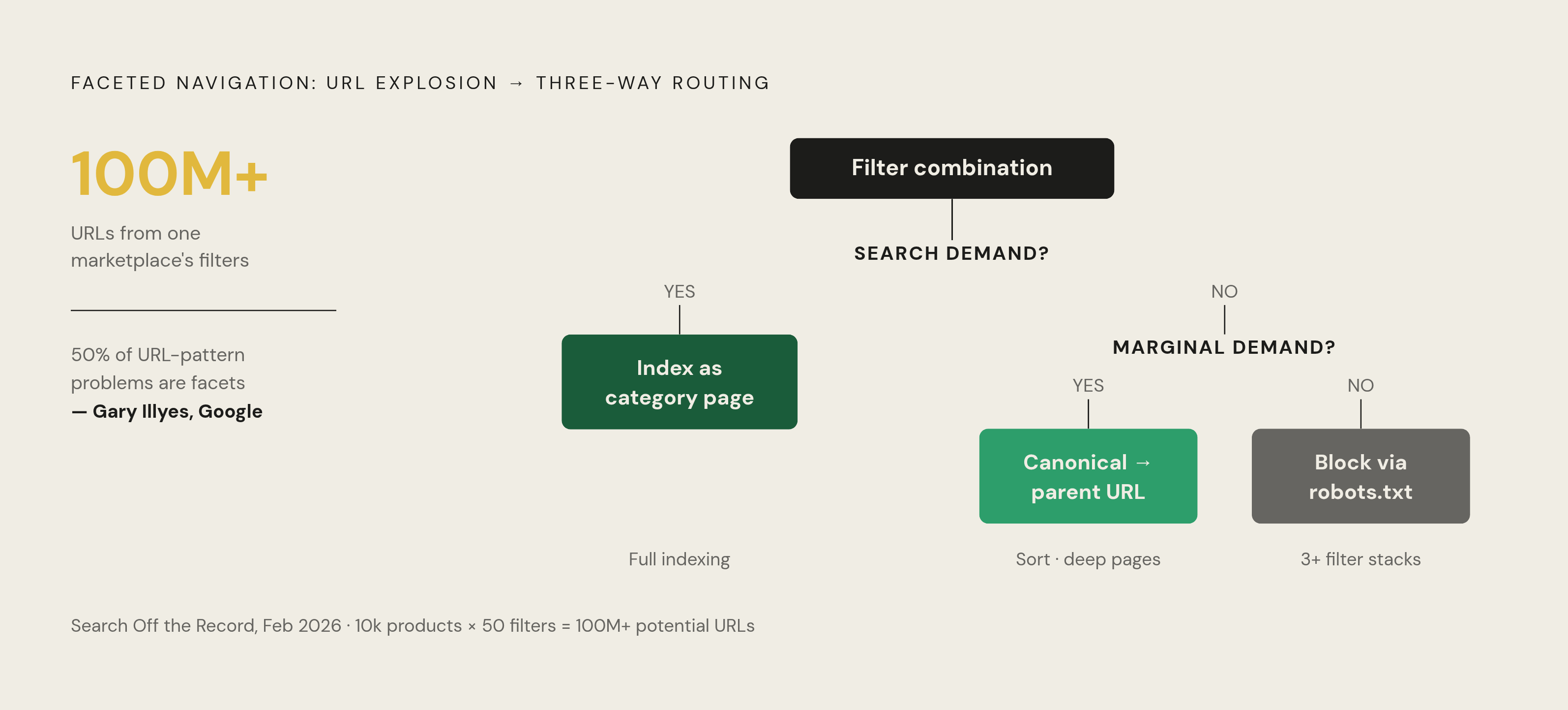
Faceted navigation is the single most common crawl budget killer in ecommerce, and the math gets uglier fast on a marketplace compared to a single-brand store. A clothing category with 10 sizes, 20 colors, 15 brands, and 5 materials can spin off 15,000 potential URL combinations from one page. Scale that logic across a marketplace with 10,000 products and 50 filter options, and the combinatorial total climbs past 100 million URLs, nearly all of them near-duplicates with no unique commercial value whatsoever.
That's also a dilution problem. Link equity spreads thin across pages nobody searches for and nobody buys from, some of those pages start reading as thin content, and meanwhile the pages that actually make money get crawled slowly because Googlebot burned its budget wandering through filter combinations that don't matter to anyone. Gary Illyes of Google cited faceted navigation as accounting for 50% of the URL-pattern problems flagged in Google's 2025 year-end crawling report, with action-based URL parameters responsible for another 25%, according to comments on the Search Off the Record podcast in February 2026. Three-quarters of the crawling mess, in other words, traces back to two fixable causes.
The fix is a three-way sort applied to every filter combination a platform generates. Combinations with real search demand, "red leather sofas" being the classic case, get indexed and treated like proper category pages: unique content, a real title tag, canonical signals pointing to themselves. Combinations with marginal or unclear demand get a canonical tag pointing back to the clean parent category URL; users can still reach the filtered view, it just stops competing for crawl budget or splitting link equity. Everything else, sort-order parameters, pagination past page two or three, filter stacks combining three or more attributes, gets blocked outright through robots.txt.
So how do you decide which bucket a given combination falls into? Cross-reference it against the keyword map from the earlier section. If a combination shows up as a real query with real volume, it earns a page. If it doesn't show up, it doesn't get one, and that decision comes from the keyword data, never from whatever the platform's filter engine defaults to. Google's own documentation, updated December 2025, lists exactly two levers for expanding crawl budget: faster server response times and higher-quality indexable content. Both point the same direction: fewer, better pages. The mechanics, canonical tags, noindex directives, robots.txt rules, parameter handling inside Search Console, are implementation details a dev team can knock out in an afternoon. The strategic call about what deserves to be indexed has to come first, and skipping that step is how sites end up with a robots.txt file nobody can explain two years later.
On-page content that earns rankings without getting in the way of the buying experience
Google's John Mueller has said plainly that a category page consisting of nothing but a product grid is genuinely hard to rank. Take that literally: supporting text is the mechanism Google uses to understand what a page is actually for, and it deserves more attention than most teams give a compliance checkbox to tick before launch.
There's a placement question worth settling here, and enough major retailers have tested it that the answer isn't really in dispute anymore: shoppers want the products first. The winning structure puts a short introduction, somewhere around 50 to 100 words, above the fold, and saves a longer description, 200 words or more, for below the product grid where it stays out of the way of browsing.
What should that text actually do? Address what someone's really looking for when they land in that category, work the primary keyword and its natural variants in without forcing them, and read differently from every sibling category page. No templates where "sofas" gets swapped for "sectionals" and nothing else changes. On a specialist marketplace, industrial equipment, high-end audio, professional apparel, the copy also has to show real knowledge of the niche, because buyers in those categories spot generic filler within a sentence or two. Category pages carrying 150 to 300 words of unique descriptive content rank 2.7 times higher than pages relying on the product grid alone, according to digitalapplied.com, and the content has to address actual intent, not just recite product nouns in a slightly different order.
Title tags matter more than most teams treat them. The primary keyword should lead ahead of the brand name; a page targeting "men's trail running shoes" should open its title tag with that exact phrase. A well-built title on a strong category page can be worth thousands of monthly visits on its own, which makes it one of the highest-leverage two-line edits on the entire site. H1s should track the primary keyword closely, and H2s are the natural spot to surface subcategories, buying guides, or the attribute groups that turned up during keyword research.
The recurring failure modes on vertical marketplaces are specific enough to name outright. Vendor-supplied descriptions get copy-pasted across dozens of category pages with zero editing. Subcategory pages get treated as navigation stubs, filter labels dressed up as URLs, instead of actual content destinations. And copy gets written entirely for the "buy now" moment, ignoring that a large share of category visitors are still early in their research, comparing options, not ready to check out yet.
Internal linking as the mechanism that distributes authority across thousands of pages
Internal linking is arguably the single highest-leverage SEO lever on an ecommerce site, and on a marketplace running into the thousands of pages, it decides which pages accumulate authority and which sit orphaned, regardless of how good the content on them is.
Without a deliberate link structure, PageRank pools at the homepage and the top-level categories and never really moves past them. Subcategory pages and listings technically exist. They're crawlable, they're indexed, but they get almost no internal equity and rank accordingly, which is to say, barely at all. The pyramid from the architecture section needs to actually function as links, not just as folder structure: homepage links to every top-level category, top-level categories link down to subcategories in both navigation and body content, subcategories link to relevant listings and to related subcategories, and listing pages link back up to their parent category rather than only sideways to other listings.
Anchor text needs the same discipline as everything else here. If a subcategory targets "commercial convection ovens," the internal links pointing at it should use that phrase or something close, rather than vague labels like "click here" or "view more" that tell Google nothing about what's on the other end. The 200-plus-word descriptions built in the last section are the natural home for this kind of link: editorial anchor text embedded in real sentences, pointing to related subcategories, reads as organic because it is organic.
That 86% figure from Reboot Online's research bears repeating here, because this is where it actually bites: most ecommerce sites don't have internal linking under control, and on a marketplace that means thousands of pages published with no plan for how authority ever reaches them. A useful audit trigger: if top-level categories rank fine but the subcategories and listings underneath them don't, internal linking is almost always the primary suspect. Check crawl depth and incoming internal link counts on the underperforming pages before blaming content or keywords.
One pattern worth avoiding specifically: automated "related products" widgets that link listings only to other listings at the same level. They create a kind of horizontal sprawl, plenty of links, none of them moving authority up or down the hierarchy where it's actually needed. Fine as a supplement. Weak as a substitute for real structural linking.
Structured data that makes category pages eligible for rich results and AI
Structured data is the layer that turns a category page from something Google can read into something Google, and increasingly the AI systems generating answers, can parse and represent with rich features. It's the final piece, and it only works because everything above it, architecture, keyword mapping, content, internal links, gives the structured data something coherent to describe in the first place.
CollectionPage and ItemList schema tell a search engine explicitly that a URL is a category page holding a defined set of items, distinct from a single product or a generic content page. Product-level structured data nested within that, price, availability, review counts, aggregate ratings, is what separates a plain blue link from a result showing star ratings and price ranges right in the search results. BreadcrumbList schema reinforces the hierarchy built back in the architecture section, giving Google a machine-readable version of the same pyramid: homepage, top-level category, subcategory, listing.
None of this makes up for a weak category page underneath it, and that's the point worth taking a position on: structured data describes what's there; it can't manufacture quality that isn't. A category page with thin content and a broken internal link structure, wrapped in perfect schema markup, is still a weak page. It's just a weak page a crawler can identify faster. The order matters: architecture first, then keyword targeting, then content, then internal links, and structured data last, because it's the wrapper, not the substance. Get the substance right, and the wrapper is a straightforward technical task. Get the order backwards, and no amount of markup fixes what's actually missing underneath.
Notes
- https://seotesting.com/blog/ecommerce-category-page-seo/
Provided the ASOS organic keyword and monthly visitor figures used to illustrate keyword architecture at scale.
- https://keytomic.com/blog/ecommerce-category-page-seo-best-practices
Supplied the Reboot Online 2025 statistics on search traffic share, order share, and the 86% figure on brands lacking properly optimized internal links.
- https://www.digitalapplied.com/blog/ecommerce-seo-product-category-page-guide-2026
Provided the figure that category pages with unique descriptive content rank 2.7 times higher than product-grid-only pages, and the 100 million URL estimate for faceted navigation combinations.
- https://seohandbook.co.uk/ecommerce-seo/faceted-navigation/
Sourced the Gary Illyes citation attributing 50% of URL-pattern crawling problems to faceted navigation and 25% to action-based URL parameters from Google's 2025 year-end crawling report.
Every new piece from marketplace crunch, as it's published.
Follow