Vertical Marketplace Expansion Into Adjacent Categories
Expansion pays only where trust, supply, and logistics carry over.
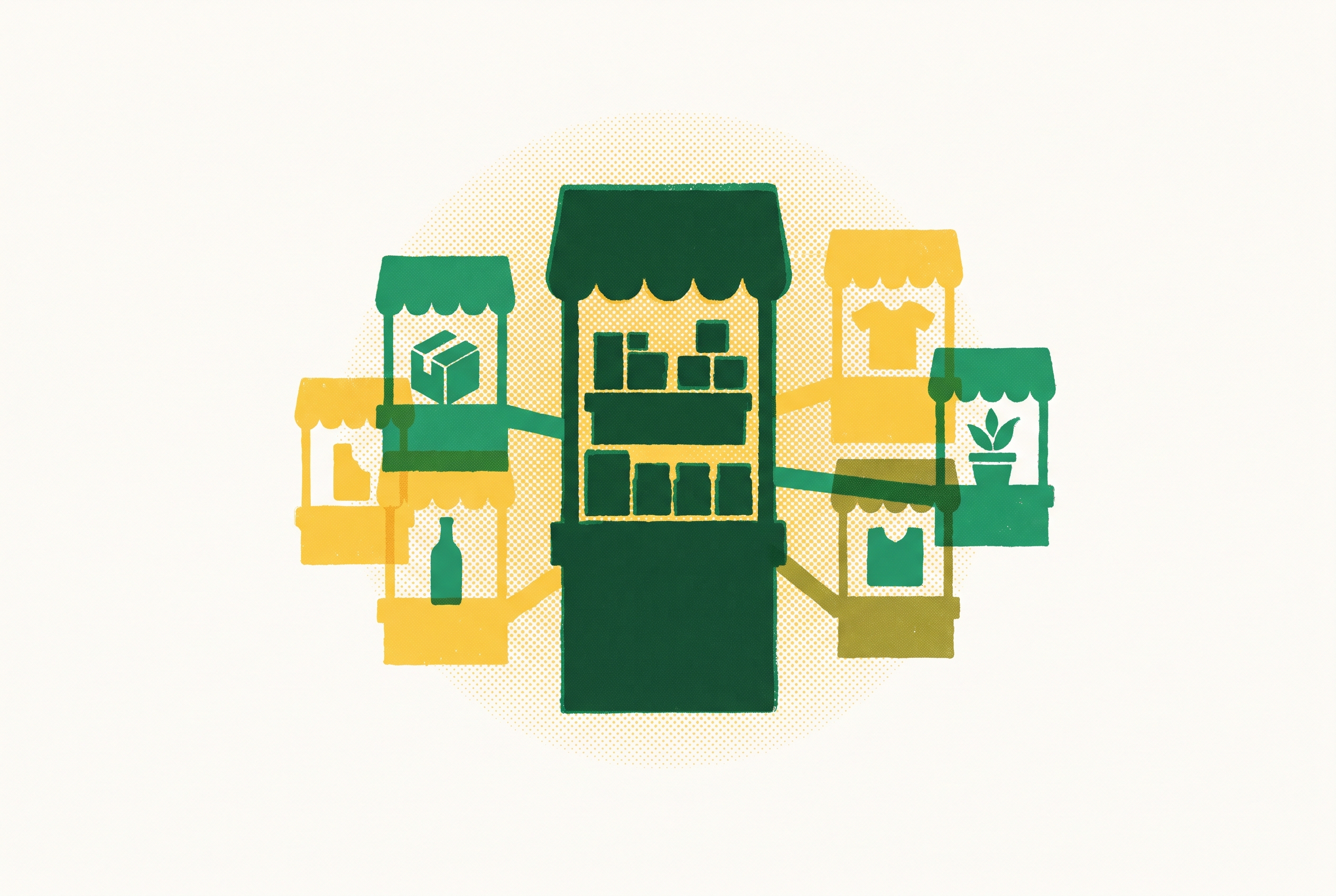
Vertical marketplace expansion into adjacent categories works when depth reduces the cost of entry. A mature specialist already has trust, supply relationships, transaction infrastructure, and behavioral data, advantages that a blank-slate entrant must build. Those advantages transfer only where the neighboring category shares the structures that made them valuable, so expansion is a test of compatibility.
The sections below examine which assets transfer, the pathways expansion follows, and the costs and risks seen at companies such as StockX, Faire, Vinted, and Whatnot. They also cover when acquisition is faster than organic growth, how B2B marketplaces apply the same logic, and a framework for deciding whether, when, and how to enter a neighboring category.
Why vertical marketplaces build durable assets
A mature vertical marketplace embeds category knowledge in its operations. Its standardized listings reflect what buyers need to evaluate, while its repeatable workflows address the risks that shape transactions in that category. Specialization is the source of the advantage. A horizontal platform deliberately trades some of this depth for breadth, while a vertical platform competes through expertise and trust.
That depth makes the platform’s assets durable, but category-encoded. Euromonitor's 2025 marketplace analysis shows the third-party seller share of global marketplace sales rising steadily, reinforcing the importance of seller relationships. Yet relationships become useful only when they produce liquidity. Buyers must reliably find what they came for, within the relevant category and geography. Even a large platform needs that local density, because trust depends partly on whether buyers can find the goods they came for.
The four assets that transfer
Four assets provide a working checklist for expansion. Trust is the acceptance of the platform as an authoritative intermediary for authentication, dispute resolution, and quality signaling. It is the hardest asset for a blank-slate entrant to replicate, because the entrant has not yet earned that acceptance. Supply relationships are the vetted sellers and suppliers recruited at cost. They give an expanding platform access to a supply base that could otherwise take years to assemble.
Transaction infrastructure includes payment rails, escrow logic, return and dispute workflows, and authentication pipelines calibrated to category-specific risks. These are operating capabilities. Euromonitor’s analysis identifies logistics and fulfilment as the last physical touchpoint shaping satisfaction, which makes their compatibility especially consequential. Behavioral data provides a different advantage through purchase histories, searches, and cross-category browsing signals that reveal latent demand before supply recruitment begins. AI-driven analysis of payments and procurement data can sharpen those signals further.
The assets do not transfer as one package. Sellers already on the platform may have the right goods even if the authentication workflow needs to be rebuilt, while buyers already using it may want goods that need different logistics. The platform must therefore consider which assets retain their value under the neighboring category’s authentication requirements, logistics profile, and buyer intent pattern, rather than whether it possesses these assets in the abstract.
Three pathways expansion follows
Demand-pull expansion begins with behavior on the existing platform. Users signal unmet needs before the new category launches, giving the marketplace evidence that demand exists within its current buyer base. Behavioral data reduces uncertainty about buyer intent, although it does not establish that the platform can supply or operate the category economically.
Infrastructure leverage begins with capabilities. StockX’s expansion into collectibles and trading cards reused the physical in-person authentication and pricing infrastructure built for sneakers. The products changed, but the verification workflow remained structurally similar. Faire’s move from home goods into fashion, beauty, and food followed the wholesale relationship model already established with gift and home goods buyers and boutique retailers. In both cases, existing operations provided access to new supply.
A third way to expand is to sell the transaction infrastructure itself. Financing, embedded payments, and B2B terms extend an existing workflow rather than requiring recruitment of a new category of suppliers. Euromonitor’s analysis identifies financial services, retail media and advertising, logistics, and loyalty programmes as common adjacent business verticals. These pathways are not mutually exclusive, and a mature marketplace may use all three. Keeping the pathways separate still helps show whether the move depends most on evidence of demand, the ability to supply goods, or transaction infrastructure.
What Vinted & Whatnot reveal about expansion
Vinted expanded from fashion resale into electronics, sports equipment, collectibles, and homeware in response to member demand. GMV grew substantially year-over-year as new categories were added, indicating that buyers responded to the broader offer. In April 2026, Vinted completed a large secondary share transaction at a multi-billion-euro valuation while its margins were under pressure in the near term. Investor confidence and pressure on profitability can coexist because category expansion creates operating demands beyond the initial cost of entry.
An established buyer base can make a category easier to launch without making it inexpensive to run. Vinted’s expansion illustrates how GMV growth and profitability can diverge during an expansion cycle. Demand validates the opportunity, but it does not settle the economics.
Whatnot exposes a different and more serious constraint. Its regulatory exposure in card-break categories illustrates a trust-and-safety failure associated with expansion speed, where infrastructure suited to one category’s fraud and dispute profile proved inadequate for another’s. The slower route to profitability is not the only cost here. The operating burden therefore includes extending trust-and-safety to the new category.
When assets transfer & when they break
An existing trust mechanism can still work if it meets the new category’s authentication needs. StockX’s move into trading cards drew on grading and price benchmarking that could apply across categories within its verification infrastructure. Prescription medical equipment, by contrast, would need a very different kind of credentialing, which would be a new trust problem. When the proof needed changes, even a platform with established authority must build the authentication capability it lacks.
Logistics compatibility tests whether existing fulfilment and return workflows fit the neighboring category. A shared buyer base does not answer that question, because buyer demand and physical operations are separate conditions. If the logistics profile is very different, the platform must rebuild the infrastructure it needs. Buyer intent supplies the third test. Rover’s expansion into nearby pet care services worked because the same buyer still wanted to find a trusted carer for a pet.
These conditions also answer the objection that expanding specialists eventually become generalists and surrender their original advantage. The asset-led logic holds only while the platform preserves depth in its core category. Sequencing governs how much operational strain the asset base must absorb, so a platform should focus on one expansion type at a time, whether geographic, categorical, or product. Although several pathways may coexist, simultaneous expansion across those different axes compounds complexity.
Liquidity is the final operational constraint within that sequence. Launching multiple categories before any has sufficient supply density weakens the buying experience and retention across them. Each adjacency must therefore be treated as its own liquidity problem before the next begins. If building enough supply density or the skills and systems needed would take too long, the platform must move from choosing a category to deciding how to get those assets.
When acquisition beats organic expansion
Buying a niche vertical marketplace provides access to recruited suppliers, category-specific authentication, logistics relationships, and established dispute resolution norms. These assets arrive together, although their integration remains uncertain. The rationale for acquisition is that the target already holds capabilities or relationships whose absence would otherwise delay entry.
GMV measures size, while liquidity quality measures how reliably a buyer arriving with intent finds the required supply. The latter is closer to the asset being purchased. Agentic commerce adds another dimension as AI systems begin executing procurement decisions autonomously on behalf of buyers. Clean supplier data, pricing signals, and trust credentials can make a well-structured niche marketplace more valuable than its GMV alone would suggest.
Integration can still undermine the purchase thesis. Seller loyalty may belong to the acquired marketplace’s identity. If that loyalty does not survive integration, the acquirer may lose the supply relationships it intended to obtain. Acquisition compresses the time required to assemble assets, but it does not establish that those assets will transfer to a different owner.
How B2B marketplaces apply the same logic
B2B marketplaces apply this logic where sourcing has remained fragmented and offline. Construction materials, equipment rental, and data center infrastructure need deep category knowledge and supplier trust, both of which take more than a wide choice of goods. New marketplaces launched or expanded across these sectors in early 2026. Those launches and expansions are in categories where digital transaction infrastructure lags far behind existing supply relationships. They do not, by themselves, establish that the entrants have achieved liquidity or solved the economics of expansion.
Embedded payments and B2B financing are natural first adjacencies because the underlying workflows already handle multi-party approvals, invoices, and settlement. The payments layer extends an existing transaction process. ServiceTitan illustrates the broader sequence through core ERP for HVAC and plumbing, followed by financial services and then roofing, while surpassing a $1 billion annualized run rate. It is a software-led example of the same asset logic used by transaction-led consumer marketplaces. Established workflows serve as a base for expansion as well as a channel for selling unrelated products.
Clean product information, pricing signals, and trust credentials help AI-driven systems recommend what to buy and gain value as agentic systems begin making purchases. Buyer intent remains the compatibility test, however. A B2B marketplace that stores the context behind sourcing decisions embeds itself in a process. Its switching cost then rests in the purchasing workflow as well as buyer preference.
A framework for deciding whether to expand
For a team considering expansion, the first question is which assets are genuinely developed enough to transfer. Core-category liquidity is the practical proxy. Without reliable supply density, the platform has not yet demonstrated the depth on which the proposed entry-cost advantage depends. A shallow asset inventory makes the apparent adjacency less economical than it looks.
Authentication, logistics, and buyer intent identify which capabilities can be reused and which must be built or acquired. Behavioral evidence of existing users attempting to transact in the neighboring category is the strongest available signal that the buyer intent condition is met. Its absence should prompt skepticism while leaving expansion open to consideration. A large capability gap may favor acquisition, but only if the target’s supply relationships and trust are likely to survive integration.
Timing then depends on the platform’s capacity to establish liquidity without weakening its core. Teams should pursue one expansion type before the next and concentrate supply in a defined segment, avoiding thin coverage across an entire adjacency. Trust-and-safety costs belong in that decision before launch. Whatnot’s regulatory exposure shows why an established reputation cannot stand in for protections suited to a new category. The expansion case is strongest when transferable assets reduce entry costs and the remaining operating obligations are understood, funded, and compatible with preserving the marketplace’s original depth.
Notes
- Digital Disruptors: Online Marketplace Trends & Insights 2025 - Euromonitor.com
Supplied the points on third-party seller share of marketplace sales, logistics as the last physical touchpoint, and common adjacent business verticals such as financial services and retail media.
Every new piece from marketplace crunch, as it's published.
Follow