Vertical Marketplace Definition and Horizontal Comparison
Vertical marketplaces win through deep expertise, horizontal ones through breadth and reach.

A vertical marketplace connects buyers and sellers in one industry and nothing else. A horizontal marketplace tries to hold as many categories as it can fit under one roof. That split sounds simple, and it is, but almost every decision a marketplace founder makes traces back to it: are you betting on depth or on breadth?
The word "vertical" describes how markets stack, not how boutique the branding feels. A vertical marketplace is one narrow column running deep into a single category. A horizontal marketplace is a wide row, shallow across many. It's a structural label, not a vibe, and people mix this up constantly. Etsy gets called niche because it feels handmade and craft-forward, but its actual category range, home goods, jewelry, art, clothing, party supplies, is wide enough that plenty of analysts treat it as horizontal in practice. What matters is depth within a category, not how quirky the storefront feels.
Here's a quick test. If a horizontal marketplace bolts on a new product category, it's still horizontal, and if a vertical marketplace builds a better tool for the one category it already owns, it's still vertical. Depth and breadth are the axes; everything else is decoration. Keep that in mind, because every section below is really the same question, asked from a slightly different angle.
How the two models diverge across six structural dimensions
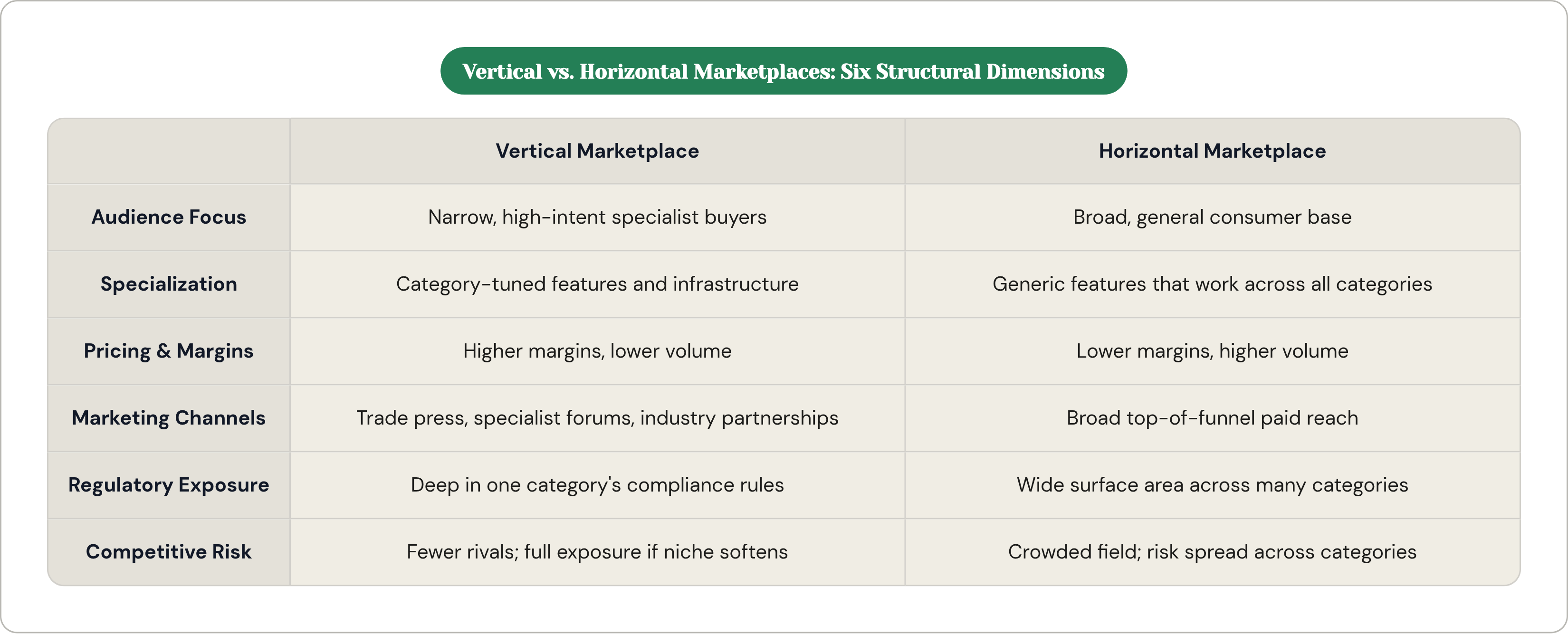
The two models diverge across six structural dimensions, audience, specialization, pricing, marketing, regulation, and competition, and each split reveals a different strategic trade-off. Line the two up and the differences show up fast. None of them make one model flatly better than the other, so resist the urge to declare a winner too early.
Audience focus is the clearest split. Vertical platforms chase a specific crowd: sneakerheads, wholesale buyers, home renovators knee-deep in a bathroom remodel. Horizontal platforms chase everybody, which means building a product page that has to work for a lawnmower and a diamond ring at the same time. A single filter set rarely works well for both.
Specialization follows from that. A vertical platform builds features tuned to what one category actually needs, sizing charts calibrated to specific sneaker models, credential checks for wholesale buyers who need to prove they're a real business. A horizontal platform builds features that work fine everywhere and shine nowhere in particular.
Pricing and margins split the same way. Vertical marketplaces tend to run higher-margin, lower-volume economics; horizontal marketplaces run the opposite. Depth lets a platform charge for something buyers can't easily find elsewhere, and that pricing power shows up directly on the income statement.
Marketing diverges too. Vertical platforms lean on trade publications, specialist forums, and industry partnerships, the kind of channels where trust is already baked in. Horizontal platforms buy broad top-of-funnel reach and hope it converts across a dozen unrelated buyer types at once.
Regulatory exposure gets more interesting. A vertical platform often inherits whatever compliance baggage its industry already carries: healthcare credentialing, financial-product disclosure rules, food safety standards. A horizontal platform dodges most single-category rules but touches more categories overall, so its total surface area for legal risk ends up bigger even if no single rule bites as hard.
And competitive dynamics cut in opposite directions depending which side you're standing on. A vertical platform faces fewer direct rivals but takes the full hit when that one market has a bad year. A horizontal platform wades through a crowded field but spreads the risk, so a slump in furniture doesn't sink the business if electronics are still moving units.
There's one place, though, where horizontal platforms carry a real weakness, and it's worth saying plainly instead of hedging around it: high attrition. Buyers show up, transact, leave, and feel no particular loyalty to the platform itself. Vertical platforms build stickier relationships, the kind where someone keeps coming back not because it's convenient but because nowhere else actually gets what they're shopping for.
Why vertical marketplaces can outcompete on trust, matching, and pricing power
Vertical marketplaces earn their competitive edge through superior trust, matching quality, and pricing power, advantages that flow directly from deep category focus. Trust is where the vertical model earns its money, and the mechanism is straightforward: when category knowledge gets built into the product itself, you don't need to bolt trust on as an afterthought feature.
Take sneaker resale. StockX built a platform that looks and behaves like a stock exchange, complete with price charts and authentication before every single shipment. That business posted $2.1 billion in gross merchandise volume in 2025. Authentication, credential checks, provenance verification, insurance: a horizontal platform can't prioritize any of that, because it has forty other categories fighting for the same engineering hours.
Matching quality runs on the same fuel. A vertical platform knows exactly what its buyers are looking for, so its search filters can be built around real intent instead of generic keyword matching. Pricing power shows up here too, and here's the interesting part: on a horizontal platform, price is often the only thing a buyer can actually judge, because they don't have the context to evaluate anything else. On a niche platform, buyers bring their own expertise to the table. A vintage guitar seller on Reverb reaches people who know the difference between a 1962 reissue and a 1965 original, and who'll pay a real premium for the original. Someone browsing a general classifieds site won't have the context that justifies that price gap.
There's a brand-credibility effect too, and it's easy to miss if you're not looking for it. Operating inside a defined vertical signals expertise the way a specialist doctor signals more confidence than a general practitioner for a specific ailment, even when both went to the same med school. A buyer with a niche need trusts the specialist, full stop, even if the generalist happens to carry the identical product on the identical day. Community stacks on top of that: reviews, informal norms, shared vocabulary that outsiders don't know exists. That kind of slow-built layering is genuinely hard to copy, and that's exactly why it functions as a moat instead of a nice-to-have.
The network effects logic that makes starting narrow a smart move
Starting narrow accelerates network effects because category focus lets a platform build liquidity faster than a broad one ever could. Every marketplace lives or dies on network effects. Each new buyer makes the platform more useful to sellers, each new seller makes it more useful to buyers. That part is universal, true of Uber and true of a farmers market app nobody's heard of. What differs is how fast that loop spins up, and category focus is the accelerant.
Liquidity is the real scoreboard, more than user counts or funding headlines. A marketplace wins when people show up, find something relevant fast, and actually complete the transaction. eBay is the textbook case here: it started with collectibles, not "everything," and every new seller improved selection for a narrow, high-intent group of buyers. The breadth that eBay is known for today came later, once that first loop had already proven it could spin on its own.
Constrained supply and demand build liquidity faster. A platform trying to serve every category at once needs critical mass everywhere, all at the same time, which is a brutal problem dressed up as a simple one. A niche platform only needs critical mass in one place. It's the same logic as geographic constraint in ride-sharing: densify one pocket first, then expand outward once that pocket is actually working.
So what does that mean if you're the one building this thing? Depth first, breadth later, assuming breadth is even the goal at all. The vertical phase isn't usually a permanent identity. It's a launch strategy, a way of dodging the cold-start problem that kills horizontal platforms before they ever get near scale.
What real vertical marketplaces look like at scale
At scale, successful vertical marketplaces tend to share a common pattern: each one built category-specific infrastructure that a general platform would rarely prioritize. Airbnb built trust infrastructure, host reviews, listing photos, traveler protection, specifically for vacation rentals, in ways a generic rental-listing site never bothered to. That focus helped it hit $91.3 billion in gross booking value in 2025.
Faire connects independent retailers with small-brand wholesalers, and it worked because B2B wholesale runs on payment terms, return policies, and trust mechanics that a general marketplace simply ignores. Faire has crossed $400 million in annual recurring revenue and carries a $12.4 billion valuation.
Vinted, the secondhand fashion marketplace with more than 200 million users, made zero seller fees a deliberate strategic choice rather than a charitable one. Cutting friction on the supply side grew its seller base faster than any fee-charging competitor could keep pace with, which is a reminder that a pricing decision can be a growth lever just as easily as a revenue lever.
Reverb went deep into musical instruments and built trust specific to that community, the kind where a buyer who can date a guitar to its production year will pay for that knowledge instead of shopping around it. Houzz connects homeowners with contractors, designers, and suppliers, a category that needs portfolio review, local filtering, and project-specific messaging that no general services platform bothers to build.
Each of these is a case study in a different structural edge: authentication for StockX, B2B-specific terms for Faire, supply-side incentive design for Vinted, community trust for Reverb, complicated matching for Houzz. Stack that against horizontal giants: Amazon posted roughly $830 billion in gross merchandise volume in 2025, with other major horizontal platforms operating at similarly massive scale. That kind of scale is real, but depth within any single category on those platforms stays structurally capped, because depth was never what they were optimizing for.
How vertical marketplaces make money and what take rates reveal about category dynamics
Commission-based pricing is still the most common, most scalable model for two-sided marketplaces heading into 2026, and the take rate a platform can charge tells you a lot about what it's actually worth to its users. More trust, more curation, more specialized infrastructure means more room to charge above commodity rates.
Look at how the spread breaks down by category. B2B wholesale platforms like Faire tend to run relatively moderate take rates to reflect the relationship-driven nature of the category. C2C resale platforms like StockX run higher rates, which reflects the authentication work happening on every single transaction. Live commerce platforms occupy their own band, typically shaped by the real-time format and shipping mechanics of each transaction.
There's a ceiling and a floor here worth knowing cold. Push rates high enough and supply starts to churn, sellers move to a cheaper channel elsewhere. Drop rates too low and the unit economics usually can't cover what the platform has to invest in that category's infrastructure. Horizontal platforms get pushed toward that lower end almost by default: commoditized goods, price-sensitive buyers, and huge seller pools all strip away pricing leverage. Niche platforms can charge more because sellers reach buyers they genuinely can't find anywhere else, and because the category-specific work, authentication, credentialing, specialized logistics, actually earns its keep.
The lesson here isn't "charge whatever you can get away with." It's that the take rate needs to follow the category's own dynamics instead of copying whatever Amazon happens to charge. A rate built for commodity electronics would strangle a specialty B2B platform overnight, and the reverse is just as true.
The B2B vertical marketplace surge and what the numbers signal
B2B is the fastest-growing frontier for vertical marketplaces, driven by the complexity and compliance demands that generalist platforms consistently fail to meet. Here's a number worth chewing on: B2B marketplaces grew from roughly 75 platforms five years ago to more than 750 industry-specific marketplaces today, with projections pointing toward 1,000 by 2026. That's a tenfold jump in half a decade, and it's not noise. It's real, sustained demand for procurement built around a specific industry instead of a generic catalog that treats a hospital's supply chain the same as a hardware store's.
The scale underneath that number is enormous. Global B2B ecommerce hit $32.8 trillion in 2025, and marketplace platforms are taking the dominant share of that volume. Digital Commerce 360 had earlier projected B2B marketplaces would generate $3.6 trillion in sales by 2024, with vertical industry marketplaces already driving an increasing share of that growth back then.
Why does B2B tilt so hard toward vertical? Business buyers have narrower needs, longer relationships, and compliance requirements that don't bend just because a checkout flow is smoother somewhere else. They also have way less patience for irrelevant supply than a consumer browsing for fun on a Tuesday night. Generalism is a minor annoyance for a shopper; in B2B it's a real liability, because a wasted procurement cycle costs actual money and actual weeks. Venture capital has followed that math: the biggest funds have made sizable bets on vertical B2B players, and Faire's trajectory is one visible marker of where that money has landed.
But 750-plus platforms existing doesn't mean 750-plus platforms survive. It signals real opportunity, sure, but it also means the differentiation logic from earlier in this piece, trust, matching, pricing power, matters more now, not less, as the field fills in and the players start looking interchangeable.
The real risks of going vertical and when the model fails
Going vertical carries real risks, and the model fails in predictable ways when founders overlook them. One of the most common ways a vertical marketplace can fail is picking a niche too small or too fragmented to ever hit liquidity. No amount of clean design can fix a category that simply doesn't have enough underlying demand to support real two-sided matching.
Concentration risk is the flip side. A vertical platform has no backup revenue stream if its one niche softens, unlike a horizontal platform that can lean on other categories while one goes cold. And that high barrier to entry, the thing keeping competitors out, cuts against the founding team too: hiring specialists in a narrow field is structurally harder than hiring generalists you can train on the job.
There's imitation risk on top of that. Once a vertical marketplace proves the model works, competitors copy the playbook fast, and the original needs a moat deeper than the concept itself: community, proprietary data, real switching costs. Otherwise it gets cloned right out of its own lead. There's also something close to a winner-take-most requirement in these markets, and a vertical platform that doesn't win its category outright often has no fallback position at all. Second place in a niche market is a genuinely tougher business than second place in a broad one, simply because the niche usually isn't big enough to feed two winners.
So before you bet on a vertical, ask the uncomfortable question directly: does this niche have needs a general platform structurally cannot serve? Or is it a category where an existing horizontal platform is already good enough that nobody bothers switching?
How to think about choosing between the two models
This isn't about which model wins in some abstract sense. It's about which model actually fits the market structure, buyer behavior, and competitive field sitting in front of you right now.
A few signals point toward vertical. Does the category carry real trust or quality uncertainty that a plain five-star rating can't resolve? Do buyers bring specialized knowledge they'd pay a platform to meet them at? Do compliance requirements build in a natural moat that generalists tend to avoid entirely? Are the existing horizontal platforms already serving this category badly, thin inventory, weak matching, commodity pricing eating everyone's margin?
Other signals point toward horizontal. Is the product commoditized enough that price is the only thing that matters in the decision? Do buyers actually want convenience across many categories more than they want depth in one? Do the network effects get stronger across categories than they ever would within a single one?
Starting vertical doesn't mean staying vertical. Plenty of platforms, eBay included, start narrow to build liquidity and only expand once that first loop is humming on its own. The vertical phase is sometimes just the on-ramp, not the final destination. You see the same logic in content strategy, actually: a brand publishing inside one defined lane builds authority faster than one scattering itself across every topic at once, because depth compounds while breadth tends to just dilute.
The real question, then, isn't which model is fashionable this year. It's understanding your own structural advantage first, and picking the model that actually lets you use it, instead of copying whatever a famous platform happened to make work in a market that was never yours to begin with.
Notes
- https://www.shopify.com/blog/what-is-a-vertical-market
Linked in the article's opening paragraph as the primary reference for the vertical marketplace definition.
- https://www.codica.com/blog/horizontal-vs-vertical-marketplace/
Provided the six structural dimensions framework used to compare vertical and horizontal marketplaces.
- https://www.sharetribe.com/marketplace-glossary/vertical-marketplace/
Cited as the source for the structural label distinction between vertical and horizontal marketplaces.
- https://virtocommerce.com/blog/vertical-b2b-marketplaces
Supplied the Digital Commerce 360 projection of $3.6 trillion in B2B marketplace sales by 2024.
- https://www.flipkartcommercecloud.com/horizontal-vs-vertical-marketplaces
Cited in the article as the source for the depth-versus-breadth axes framing.
- https://pimberly.com/blog/definition-and-key-characteristics-of-vertical-markets/
Linked as a reference for the metaphor of a vertical marketplace as a narrow column running deep into a single category.
- https://flycommerce.com/blog/multi-vendor-marketplace-examples/
Provided the GMV, revenue, and user figures for StockX, Airbnb, Faire, Vinted, and Amazon cited throughout the article.
Every new piece from marketplace crunch, as it's published.
Follow