Strategic Content Marketing for Marketplace Liquidity
Attract sellers first with content that solves their problems before pitching your platform.

Every two-sided marketplace faces the same structural trap at launch. Buyers won't join without sellers. Sellers refuse to join without buyers. This isn't a marketing execution failure; it's an architectural feature of the model. The mistake most teams make is reaching for paid reach to solve it. More visibility into an empty marketplace doesn't create liquidity. It accelerates abandonment. Users show up, find nothing useful, and leave with a first impression that's genuinely difficult to walk back.
The sequencing principle that has worked, repeatedly, across categories and geographies: acquire supply first, then introduce just enough demand to generate early matches. A marketplace with supply but no buyers feels early. A marketplace with buyers but no supply feels broken. One is recoverable. The other destroys trust before the platform has had a real chance to earn it.
Content accelerates this sequencing by removing the dependency. You don't have to wait until you've hit critical mass to recruit sellers. You can build a qualified supply pipeline before a single buyer has registered, using content that addresses potential sellers' existing needs before any platform pitch surfaces.
Eventbrite didn't launch as a marketplace. It launched as a SaaS ticketing tool that gave event organizers something genuinely useful regardless of buyer volume. The marketplace layer followed after the supply-side relationship was already established. The content equivalent is building educational resources, operational guides, or practical tools that intercept potential sellers while they're searching for answers to problems they already have. Problems that have nothing to do with your platform yet. You earn their attention first. The recruitment is a downstream consequence of demonstrated utility, and that sequencing is harder to replicate than it looks.
How to build supply-side content that recruits without pitching
Sellers and service providers are not users in the conventional sense. They're evaluating a distribution channel. The questions they're asking aren't "what is this platform?" They want to know what they'll earn, how reliable the buyer base is, and whether this is worth their time. Content that addresses those questions directly does the work of a sales team without requiring one, and often does it better because it's available at the exact moment the question exists rather than when a salesperson happens to call.
Search-optimized educational content is the highest-leverage starting point. A potential Etsy seller searching "how to price handmade jewelry" is not yet affiliated with any platform. They're solving a business problem. An article that answers that question with real economic specificity, not just general advice, positions the platform as a knowledgeable partner before any pitch materializes. Trust is earned at the moment of intent. Platform affiliation follows.
Earnings transparency content is underused and undervalued. Most platforms obscure their economics behind aspirational case studies. But the sellers you actually want — the ones serious enough to build a viable supply base — respond to honesty. What does the median seller earn? What are the fee structures? What conditions produce better outcomes? Publishing this clearly signals platform confidence. It also filters for supply quality, which matters more than supply volume in early stages.
Seller spotlights work not because they're testimonials but because "someone like me succeeded here" is among the most persuasive recruitment messages a marketplace has available. A spotlight featuring a ceramicist who went from side income to full-time revenue speaks directly to a ceramicist considering the same path. Specific peer narratives do not dissolve into noise.
Supply-side content also needs its own destination and distribution channel, separate from buyer-facing content. The vocabularies are different, the trust triggers are different, the decision timelines are different. One audience is evaluating a purchase. The other is evaluating a business relationship. Conflating them produces messaging that feels slightly off to both, and slightly off is enough to lose people who were otherwise close to committing.
What Etsy and Airbnb actually did and why it worked structurally
Etsy's Seller Handbook is one of the clearest examples of supply-side content functioning as a structural asset rather than a marketing channel. The platform grew to more than 7.5 million active sellers and $13.2 billion in annual sales, and the Handbook was a genuine contributor to that supply base, not an afterthought.
Etsy built SEO-optimized articles targeting queries potential sellers were already running: "how to price handmade jewelry," "what to know before selling online." These weren't brand pieces. They were genuinely useful answers to real business questions, and each one became a permanent recruitment asset, compounding in search visibility over time. Separately, Etsy maintained a dedicated social presence called Etsy Success, focused entirely on seller education and spotlights, with no buyer-facing content mixed in. That separation kept the messaging coherent and credible rather than diluted by trying to serve two audiences at once.
Airbnb's approach was less editorial and more infrastructural, though the underlying logic was identical. When early hosts joined but their listings underperformed, Airbnb deployed professional photographers to properties at no cost. Listings with professional photography booked at dramatically higher rates, a finding Airbnb co-founder Joe Gebbia has cited directly. That's a content strategy, just not the kind that lives in a CMS. Airbnb also enabled hosts to cross-post listings to Craigslist, piggybacking on existing demand infrastructure rather than building from scratch. And as hosts added listings, Airbnb's location-based pages began appearing prominently in local search across thousands of travel destinations. Supply growth and SEO infrastructure growth were, functionally, the same activity.
The contrast case matters. Beepi, the peer-to-peer used car marketplace, never developed differentiated content for either side of its market. Neither buyers nor sellers received content tailored to their specific trust concerns or decision contexts. Harvard Business Review has noted that the majority of marketplaces replicating existing models without a distinct positioning identity fail within their first two years. Beepi followed that pattern.
The common thread across Etsy and Airbnb isn't sophisticated technology or exceptional budget. Both companies identified what supply-side participants needed to succeed and built content around that, not around the platform's promotional agenda. Recruitment was a consequence of demonstrated value, not the pitch itself.
Running dual-audience content without diluting either side
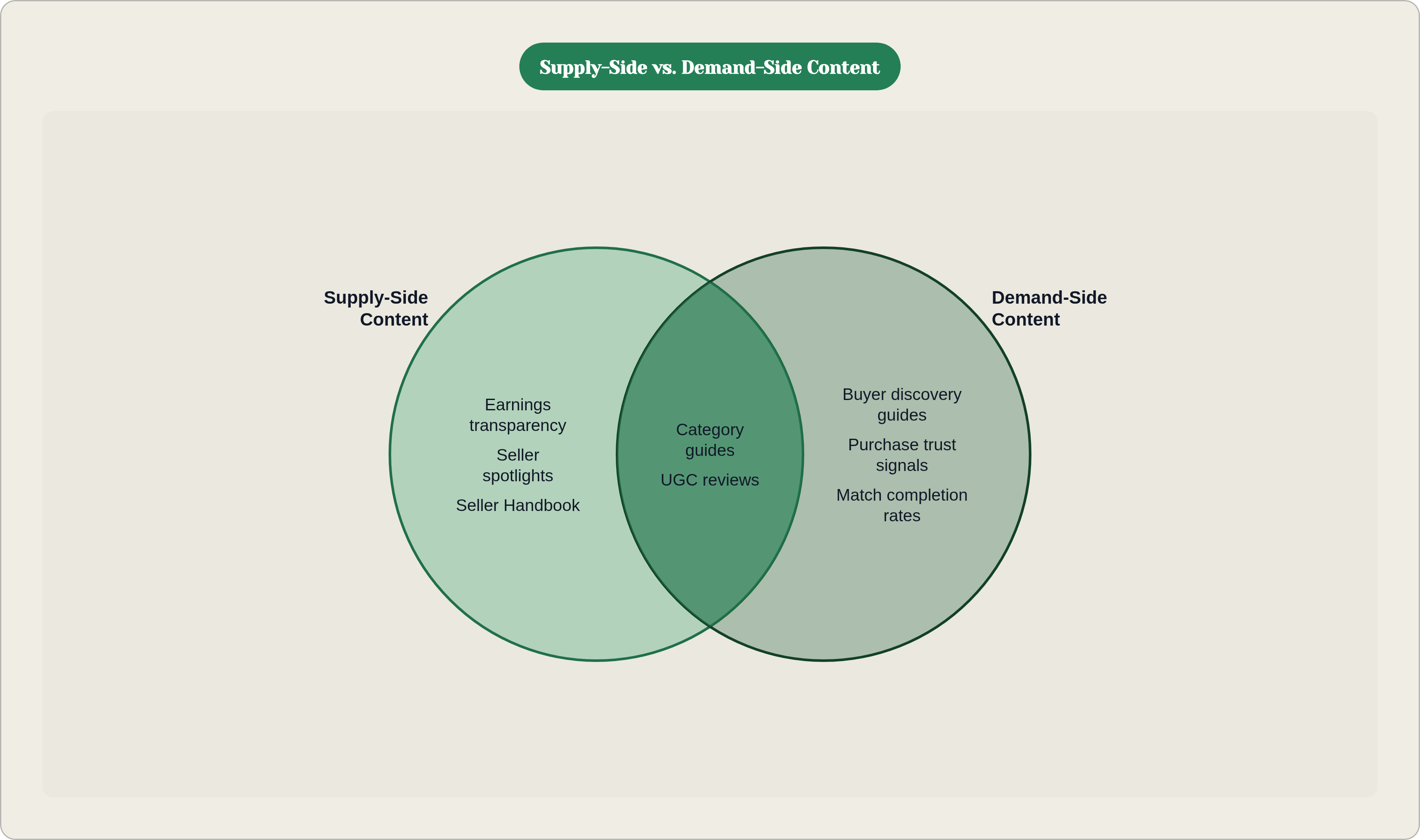
The most common dual-audience mistake is attempting to serve both sides with unified messaging. The reasoning that produces it is understandable: one brand, one voice, one content team. The outcome is messaging that sounds generically wrong to both audiences or defaults to framing so broad it converts neither. A marketplace that opens with "buy and sell" isn't speaking to anyone in particular.
The structural requirement is two distinct content programs, each with its own audience definition, intent map, and distribution channel. Supply-side content lives in the economics of the seller relationship: what participants earn, how the platform supports their success, what peers have achieved. Demand-side content lives in the buyer's discovery journey: what's available, why sellers are trustworthy, what makes a match worth completing. Different conversations, different evidence, different calls to action.
There are productive intersections. Seller spotlights are the clearest example. For potential sellers, they're peer-success narratives. For buyers, they're trust signals: real, accountable people stand behind the transactions on this platform. Category guides can work similarly, introducing buyers to available inventory while signaling to sellers that the platform understands their domain with genuine fluency.
FanPass faced a different version of this problem: excess demand relative to available supply. Their approach was operationally specific. They drove steady buyer volume through SEO and editorial content while running a separate, parallel seller acquisition effort. They also integrated a CMS directly with their platform to auto-generate and auto-refresh event landing pages, keeping content current at scale without manual overhead for each event cycle. Critically, their content planning tracked marketplace balance, not just content performance. When supply outpaced demand, investment shifted toward demand-side content. When demand exceeded supply, buyer-facing acquisition was deliberately throttled until supply could catch up.
Most teams miss this entirely. Content strategy in a marketplace is a liquidity management instrument. It has to respond to the actual state of the ecosystem, not execute against an editorial calendar someone built three months ago in a spreadsheet.
Programmatic SEO as a structural content layer for liquidity at scale
Marketplaces have a native content advantage that most single-brand businesses can't replicate: their listing inventory is the content. Every seller who adds a listing, every new location or category that populates, is a potential indexed page targeting a query someone is already running. The question is whether your platform is architected to capture that advantage or simply leaving it inert.
Programmatic SEO means building templated pages generated systematically from structured data: location, category, price range, attribute combinations. TripAdvisor has built more than 700 million indexed pages generating upwards of 226 million monthly organic visits, built from destination guides, hotel listings, and restaurant pages powered by user-generated content. Airbnb's location-based templates used real-time availability data to dominate local search across thousands of destinations. Zillow and Yelp operate on the same principle. The scale math is direct: at even a modest number of monthly visits per page, tens of thousands of programmatic pages generate organic session volume that's structurally impossible through conventional editorial output alone.
A visitor arriving through a query like "project management software for remote construction teams" already knows precisely what they need. They're not browsing; they're ready to evaluate options. These visitors convert at meaningfully higher rates than broad-keyword traffic, and they arrive pre-qualified for a specific match.
One SaaS marketplace structured its listings so that each listed software company generated SEO content as part of the listing process, producing roughly 150 new content pieces per month, reaching nearly 25,000 organic sessions, and generating thousands of monthly marketing-qualified leads for its vendors. The supply side was building the platform's SEO infrastructure as a natural consequence of participating in it.
The risks at scale are real and worth naming: (i) thin inventory pages that waste crawl budget and degrade domain authority, (ii) keyword cannibalization when similar pages compete for the same query and dilute each other, and (iii) duplicated metadata across thousands of pages, a structural problem that doesn't arise in single-brand publishing. These are solvable, but they require deliberate architecture upfront. Programmatic SEO works when listings are genuinely differentiated. It fails when it manufactures pages without real supply behind them.
User-generated content as both trust infrastructure and liquidity signal
UGC serves two distinct functions in a marketplace. The first is trust: peer content removes purchase uncertainty in ways that brand content structurally cannot. Edelman's 2025 Trust Barometer found that 80% of consumers now look to peers rather than brand experts as their primary trust signal. In marketplace terms, transactions are increasingly won or lost on UGC before a buyer ever contacts a seller. The second is discovery infrastructure: reviews, ratings, Q&As, and seller-generated listing content produce long-tail indexed pages the platform didn't have to create or maintain.
Research on e-commerce conversion consistently finds that featured reviews and ratings on listing pages produce substantial lifts in transaction completion rates. The mechanism is direct: high-quality UGC closes the gap between discovery and purchase by resolving the uncertainty that would otherwise send a buyer back to search results.
What counts as UGC here is broader than most teams consider. Reviews and ratings are the obvious category. But seller-generated listing content — descriptions, photography, FAQs, spec details — is also UGC, and its quality is directly modifiable by how the platform structures the listing creation experience. Buyer questions and seller responses generate indexed content. Community forums and seller discussion threads compound into a body of authentic peer experience that no editorial calendar could produce at equivalent cost.
Creative Fabrica seeded this flywheel by giving away digital assets for free to attract non-paying users, then converting a portion of them to paid recurring subscribers. Free content seeded UGC activity and word-of-mouth simultaneously, reducing acquisition cost while growing both the supply catalog and the community layer around it.
Your platform's role here is usually framed as a product decision. It's also a content strategy decision. What you prompt users to generate, how you surface and structure that content, and which seller-generated material you promote are all editorial choices with direct liquidity consequences.
How content accelerates network effects once early liquidity forms
Network effects are the reason marketplaces are worth the difficulty of building. Each new buyer makes the platform more valuable to sellers; each new seller increases selection and match probability for buyers. The cycle is self-reinforcing when it's working. The tipping point is the moment when interaction density becomes high enough that growth is driven increasingly by existing participants rather than by new acquisition spend.
Before that tipping point, your content is doing heavy lifting: recruiting participants, seeding both sides, and manufacturing early trust where organic trust hasn't yet accumulated. After it, the job changes.
Post-tipping-point content deepens engagement, expands use cases, and protects match quality as volume grows. Community content — forums, seller groups, buyer communities — creates participant-to-participant value that the platform facilitates but doesn't have to generate directly. Success story amplification, once genuinely abundant, builds supply recruitment and buyer trust at a cost-per-outcome that paid acquisition rarely matches. Category expansion content introduces existing buyers to adjacent offerings and helps sellers find new buyer segments, extending the network's surface area without requiring new participant acquisition from scratch.
The defensibility argument is the most important long-term consideration. A competitor can match your fee structure. They can match your interface. They cannot replicate three years of accumulated seller reviews, indexed long-tail pages, and seller community threads on any timeline that matters competitively. Once interaction density and trust are established through a mature content infrastructure, the platform compounds. Without network effects, marketplace growth stays linear and acquisition-dependent.
Measuring content against liquidity outcomes, not just traffic
Most content teams report on traffic, rankings, and engagement. In a single-brand business, those metrics have a reasonable relationship to business outcomes. In a marketplace, they can be actively misleading. High traffic into an imbalanced marketplace accelerates churn, not revenue. Strong seller-side content performance while demand-side content underperforms widens the imbalance further. You end up with confident reports about a system that's quietly deteriorating.
The metrics that actually matter connect content to liquidity. On the supply side, track (i) the volume of qualified new sellers arriving through organic content channels, (ii) seller activation rates (the share who complete a first listing after discovering the platform through content), and (iii) seller retention at six and twelve months. On the demand side, track (i) buyer-to-match conversion rates for visitors arriving through different content entry points, (ii) time-to-first-transaction segmented by acquisition source, and (iii) repeat transaction rates for buyers who engaged with trust-building content before their first purchase.
At the ecosystem level, match rate is the organizing metric. What percentage of buyers who arrive on the platform successfully complete a transaction? Content's contribution to that number is what ties editorial work to marketplace health. Programmatic SEO pages can be evaluated on conversion-to-match, not just session volume. UGC investment can be evaluated on match completion rates for listings with high-quality reviews versus listings without them. Supply-side content can be evaluated on the economic quality of sellers it recruits, not just the count.
The operational implication for you is a content dashboard that sits alongside the liquidity dashboard, not inside the marketing dashboard. When match rates are falling, your content strategy should respond. When one side of the market is oversupplied relative to the other, your content allocation shifts accordingly. The editorial calendar is a lagging instrument. Marketplace health is the leading one, and your content team needs to be reading it in real time.