Thought Leadership Strategy for Early-Stage Marketplaces
Reach buyers before they're ready to move with founder credibility instead of proof.

Most of the market a marketplace needs to reach isn't looking. Not because they're satisfied, but because they haven't decided to move yet. Think of it like fishing before the fish are hungry — the platform that earns their attention before they're in buying mode becomes the default choice when they finally are. This is the mechanism early-stage marketplaces need to understand, and most don't.
Thought leadership is structurally useful here, not as a brand exercise, but as a functional substitute for proof that doesn't exist yet. No transaction history, no testimonials, no case studies. The published thinking has to do that work instead. The 2024 Edelman-LinkedIn B2B Thought Leadership Impact Report found that 73% of decision-makers rate thought leadership as more trustworthy than traditional marketing materials, and more than 75% said a compelling piece prompted them to research something they weren't originally considering. That second number matters most: brand recognition starts at zero and cold outreach alone won't close the gap fast enough.
There's another dynamic that rarely gets discussed honestly: hidden buyers. In complex B2B deals, more than 40% stall because of internal misalignment among stakeholders who influence the decision but never appear in a sales conversation. Thought leadership reaches those people directly, often before the primary contact does. No sales call gets to them. A well-distributed piece of content does.
Trust built through ideas is also portable. It follows the founder across channels and survives product pivots, slow months, and press coverage gaps in ways that paid acquisition simply cannot. Performance marketing stops the moment the budget does. A founder's published perspective persists and compounds, even when the rest of the early-stage machinery sputters.
The Quality Bar That Separates Useful Thought Leadership from Content That Gets Ignored
The volume of content being produced right now is not the problem. Sameness is the problem. With the large majority of B2B marketers now using AI-generated content, the bar for anything worth reading has risen considerably. What AI cannot produce is the founder's authentic experience, proprietary transaction data, or a contrarian take that requires having been in a dozen uncomfortable deal rooms to credibly hold.
The content that earns trust has a specific point of view, one that a reasonable person in the industry will actually push back on. If it offends no one, it persuades no one. Most content published by early-stage founders is still careful, hedging, straining to be inoffensive, and it gets ignored accordingly.
Evidence behind every claim matters too: original data, a named scenario, attributed research. Assertions without backing are indistinguishable from opinion, and opinion without credentials earns nothing from a decision-maker evaluating whether to trust an unfamiliar platform with real transactions and real money.
The content that builds the deepest trust is genuinely instructive. It makes the reader a little better at their job. Something that leaves you thinking "huh, I hadn't framed it that way" is doing more work than something that confirms what you already knew — the way a seasoned chef knows a reheated meal on the first bite.
The Edelman-LinkedIn data surfaces one more thing worth noting: senior decision-makers are more likely to engage with content from a named individual executive than from a company page. The founder is the brand before the platform has enough transactions to speak for itself. Company content has its place, but it should be built on top of the founder's established credibility, not in place of it.
How to Direct Thought Leadership at Both Sides of a Two-Sided Market Without Diluting Either Message
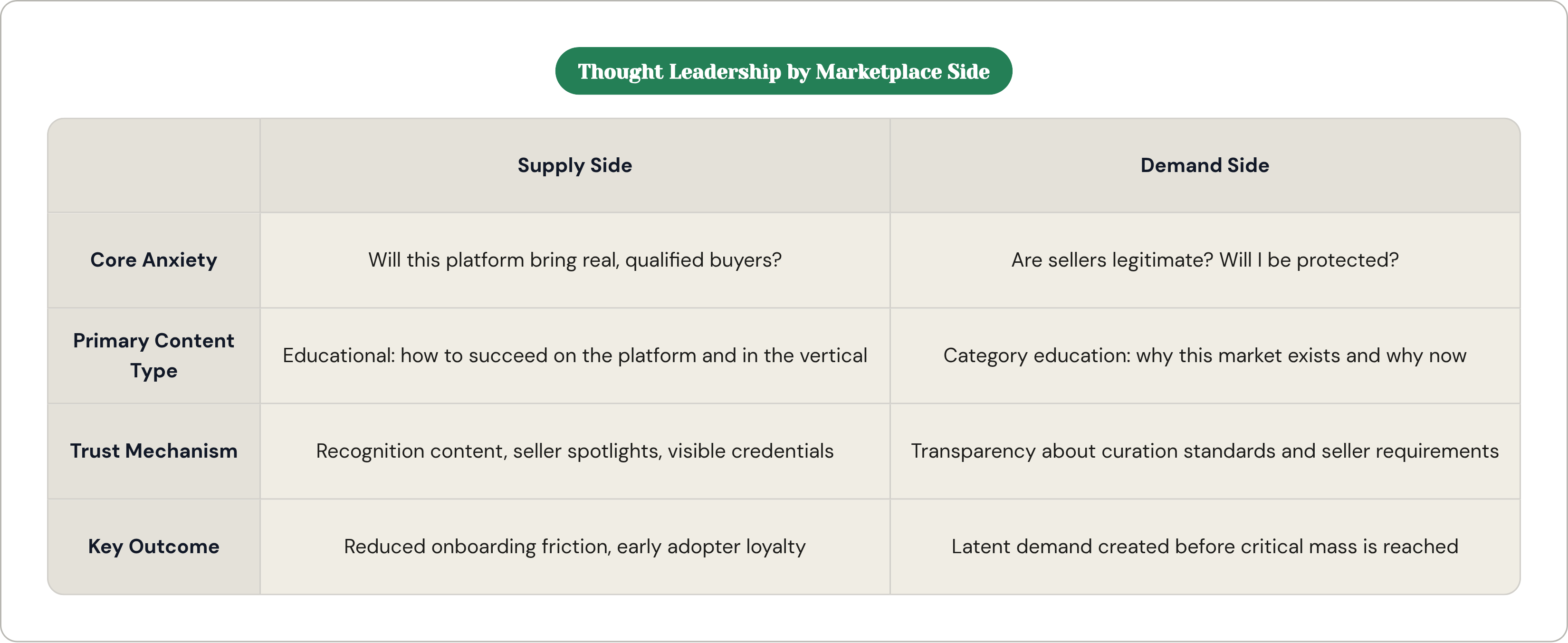
Supply and demand have different trust deficits. They are asking different questions before they commit, and content that tries to answer both simultaneously usually answers neither well enough to move anyone.
The supply side is asking: will this platform bring me real, qualified buyers? Is the team serious enough to invest in? The demand side is asking: are the sellers here legitimate? Will the platform protect me if something goes wrong? These are structurally distinct anxieties that do not yield to the same content, and pretending otherwise is a common early mistake.
For the supply side, the most effective content is educational: how to succeed on the platform, how to succeed in the vertical more broadly. This reduces onboarding friction while building loyalty, and signals that the marketplace views sellers as professionals rather than inventory — a distinction serious suppliers notice immediately. Pair that with recognition content: spotlight early sellers, create visible credentials, make early adopters legible within the community. Borrowed credibility gives the first cohort a reason to stay and gives the next cohort a reason to join.
For the demand side, the priority is category education. Why does this market exist? Why now? What is the buyer missing by relying on incumbent solutions? This content creates latent demand before the platform reaches critical mass. Pair it with transparency: how curation works, what standards sellers must meet to be listed. Transparency substitutes for the social proof a more established platform would already have in abundance.
The founder voice works across both sides because it signals something neither side can fully assess from a product alone: commitment and domain expertise. At this stage, neither sellers nor buyers are betting on a platform — they are betting on a team. A generic "we're building the future of X" narrative impresses no one. The supply side needs to know you understand their economics. The demand side needs to know you understand their risk. Those are two different pieces of writing.
Why Proprietary Transaction Data Is the Most Defensible Content Asset a Marketplace Founder Has
Unlike a SaaS founder, a marketplace founder starts accumulating proprietary insight from the first deal. Pricing. Supply and demand ratios. Time-to-close. Behavioral patterns. Category-level trends that shift month over month. A marketplace with a few hundred transactions already possesses data that no industry analyst, no incumbent, and no well-funded competitor can replicate, because none of them has visibility into that same transaction set.
Original research is among the most valuable content types for building trust and credibility, and proprietary marketplace data is original research by definition. Publishing it builds authority faster than any ghostwritten op-ed because the insight is genuinely exclusive. In a content environment saturated with recycled takes and aggregated surveys, a founder with real transaction data has something no one else can produce.
The most effective formats for this: quarterly or annual state-of-the-market reports that surface pricing trends, category growth, and seasonal patterns; supply and demand imbalance analyses that reveal where the market is underserved; behavioral insights showing what successful sellers do differently or what buyers search for most. Each published data report also generates backlinks, press mentions, and citations that raise domain authority and attract the next cohort of supply and demand.
Data strategy and content strategy are the same investment at this stage. Instrument the platform to capture publishable insights from the beginning, and decide which data points to track before the first transaction closes. Retrofitting that infrastructure later is painful and usually incomplete.
One caveat worth stating plainly: early sellers will not contribute data to a platform if they fear exposure. Anonymize and aggregate appropriately, be transparent about methodology, and handle this carefully. Done right, the methodology itself becomes part of the credibility argument.
Naming and Defining the Category Before the Competition Does
For marketplaces in emerging or fragmented verticals, the highest-leverage content move is often not winning in an existing category but defining a new one. Being an active thought leader in the category jumped from 20th to 3rd place globally as a key B2B buyer decision driver in a single recent measurement cycle.
Category creation through content means naming the problem the marketplace solves, coining the language the market eventually adopts, and publishing the data that makes the category feel real and measurable. Brian Chesky's "belonging economy" framing normalized the behavior Airbnb was monetizing before the product could prove itself at scale. The content did trust work the transaction history couldn't yet do.
The founder's task is to identify the problem the two-sided market solves that no one has articulated with precision yet. That name, argued consistently across every format and channel, becomes the category. It draws press and analyst attention, pulls in early adopters on both sides frustrated by incumbent solutions but lacking the vocabulary to explain why, and gives every subsequent piece of content a coherent home.
The calibration risk is real. Define the category too broadly and large incumbents absorb it before you've established a beachhead. Define it too narrowly and you constrain addressable supply and demand before the platform has room to grow. The right frame is specific enough to be credible and expansive enough to allow compounding — like drawing a circle wide enough to dance in, but tight enough that you're still the one running the room. Publish something specific and be willing to refine it as the market responds, rather than waiting for a perfect formulation that never arrives.
Which Formats and Channels to Prioritize Given Limited Early-Stage Resources
Resource constraints are real. The answer is not to do everything at reduced quality. It is to do fewer things at the level that actually earns trust.
State-of-the-market reports should be the anchor: quarterly or annual, built on proprietary transaction data, designed for high shareability and backlink value. This format positions the founder as the category's default reference point before anyone else occupies that role, and gives every other content format something to draw from.
Founder essays on LinkedIn should run consistently, addressing the "why now" of the vertical, the category definition, and the supply and demand dynamics specific to the market. LinkedIn's algorithm continues to favor individual voice over company page content, and the platform's scale makes it the most efficient channel for reaching professional audiences without a paid budget.
Educational content for the supply side deserves more investment than most marketplace founders give it. When sellers share content from a platform within their own professional networks, that is organic distribution to pre-qualified supply and a retention mechanism: sellers who feel educated and supported are less likely to defect when a competitor arrives offering lower fees.
Podcasts and webinars featuring recognized figures from both sides of the market function as credibility transfer. Association with established experts moves faster than building original authority from scratch, particularly in the early months before transaction volume provides social proof.
Email is owned infrastructure and should be treated as such. Unlike LinkedIn, it delivers directly to the subscriber regardless of algorithm shifts. Build the list through opt-in research reports and exclusive analysis drawn from proprietary data. An email list that grows through genuine value is durable; one built through generic lead magnets is not.
Video and live formats should enter the mix once the founder has a point of view worth performing and a format that serves it. Producing live content without that foundation wastes the credibility the written work has already built.
Across all formats, own one or two topics deeply rather than chasing the week's trends. For a marketplace founder, those topics are the category definition and the supply and demand dynamics unique to the vertical. The founder who holds a clear, specific position consistently is far easier to remember than the one who covers everything adequately.
On AI: use it for research synthesis, draft structure, and distribution logistics. Do not use it as a substitute for the founder's perspective, the interpretation of proprietary data, or any contrarian take that requires lived experience to be credible. The primary failure mode is using AI to produce what only a human can credibly say.
How to Measure Whether the Thought Leadership Strategy Is Working Before Pipeline Data Catches Up
Only about a quarter of marketers can demonstrate a clear link between thought leadership output and positive business outcomes. This is not evidence that the strategy doesn't work. It is evidence that most teams are applying the wrong measurement framework.
The mistake is applying direct-response attribution to content whose mechanism is influence over time, not immediate conversion. Thought leadership compounds through repeated exposure and trust built incrementally, through the belief that forms when a reader encounters a consistent point of view across multiple formats over several months. Expecting this mechanism to produce pipeline data in the first quarter causes founders to abandon strategies that were, in fact, working.
The more productive approach is to measure influence before attribution becomes possible. Track sales cycle length for accounts that engaged with content versus those that didn't. Track win rates and deal size for content-engaged accounts. Monitor inbound quality: are the sellers and buyers reaching out already familiar with the platform's point of view? That familiarity is a content effect worth tracking systematically.
In the earliest stage, when the pipeline is too small to yield statistically meaningful signal, use proxies. Is the category language the founder coined appearing in how others describe the problem? Are recognized industry figures agreeing to podcast appearances or co-authoring content? Are early sellers or buyers citing a specific piece of content as the reason they reached out? Are press and analyst mentions referencing the platform as a data source?
Each of these signals means the trust infrastructure is accumulating. The mechanism that solves the cold start problem and the mechanism that builds durable thought leadership authority are the same: get enough credible participants to show up that the ones still watching from the outside decide it's worth the risk to join. Run them together from the beginning, measure the leading indicators honestly, and resist the pressure to abandon the strategy before it has had time to work.