SaaS Marketing Strategies Adapted for Two-Sided Platforms
Two-sided platforms demand distinct marketing strategies that standard SaaS playbooks cannot solve.

Building a two-sided platform and applying standard SaaS marketing to it is like navigating a city with a map of a different city. The streets look similar enough to feel useful; they will get you lost. The tactics that work beautifully for a single-audience software product, from acquisition funnels to CAC reporting to content strategy, break down structurally when your product only works if two interdependent audiences show up at the same time. What follows is not a critique of SaaS marketing; it is a translation of it, built for the specific mechanics of platforms that broker relationships between two distinct user populations.
The scale of the environment makes this translation urgent. The top 100 global online marketplaces were projected to reach $3.832 trillion in GMV by the end of 2024. B2B marketplace sales in the U.S. rose 519% between 2021 and 2024, now representing 14% of all B2B sales. This is not a niche model finding its footing; it is the dominant architecture of digital commerce, and it demands a distinct playbook.
The cold-start problem and why supply almost always comes first
The fundamental tension of every two-sided platform launch is this: buyers will not join a platform with nothing to buy, and sellers will not join a platform with no buyers. Both sides are waiting on the other. The platform has to break this deadlock before any conventional marketing motion can function.
Supply-first is the dominant answer, and it holds for a clear reason: a marketplace with supply ready can demonstrate immediate value to incoming demand. An empty platform cannot be marketed into relevance. You can run the most sophisticated demand-generation campaign ever devised, and it will fail if the person who clicks through finds nothing on the other side.
Uber's launch methodology made this concrete. Before a single rider campaign ran, the operations team was manually calling limo companies, handing out flyers, and texting drivers. Supply infrastructure came first. Demand ignition came second, through local celebrities as "Rider Zero" and promotional stunts like "Uber Puppies" and "Uber Ice Cream" that generated PR-driven spikes in a specific, supply-ready market. The sequencing was deliberate and replicable. They built a city-launch playbook that encoded it.
Airbnb solved the same problem differently. Rather than chasing broad supply, they built categorical density in specific cities during major events when hotel supply was genuinely scarce. Demand was guaranteed; buyer risk was reduced because alternatives were limited. They also offered professional photography to early hosts. That is worth examining closely, because it looked like a supply-side quality investment and functioned simultaneously as a demand-side marketing asset. Better photos meant more bookings, which meant more host revenue, which meant more hosts. Academic research later modeled the consumer uncertainty of booking unreviewed listings as roughly equivalent to a 3% discount on daily booking price. Early trust-building had measurable economic value, not just qualitative appeal.
DoorDash added another variable: competitive context. They launched in suburbs and mid-sized cities specifically to avoid head-to-head competition and establish dominance quickly. The cold-start strategy was adapted not just to supply and demand sequencing, but to the competitive landscape in which that sequencing would play out.
There is also the concept of "single-player mode," which refers to delivering value on one side before a marketplace match even exists. A tool that helps sellers manage inventory before buyers arrive, or content that helps buyers discover options before a transaction is possible, gives the platform something to offer before network effects engage. It is a bridge tactic, not a growth engine; it buys time to build the supply depth that makes demand acquisition viable.
The sequencing decision, which side to seed first, in which geography, and through which channel, is a marketing decision with compounding consequences. Getting it wrong does not just delay launch; it delays the network effects that eventually make the platform self-sustaining, and those delays are difficult to recover from.
How CAC calculations break down when two audiences must be acquired simultaneously
Standard SaaS CAC is elegantly simple: divide total acquisition spend by the number of customers acquired. One number. One audience. Clean.
On a two-sided platform, that single figure conceals a structural distortion. Seller acquisition costs and buyer acquisition costs are either bundled together or, worse, seller acquisition costs are omitted entirely on the assumption that seller growth is organic. Neither approach survives contact with reality.
The reason seller CAC cannot be treated as optional is straightforward: sellers attract buyers. Their acquisition is not a separate line item on a spreadsheet; it is a precondition for buyer value. Omitting it systematically understates true acquisition cost and obscures where the actual bottleneck lives.
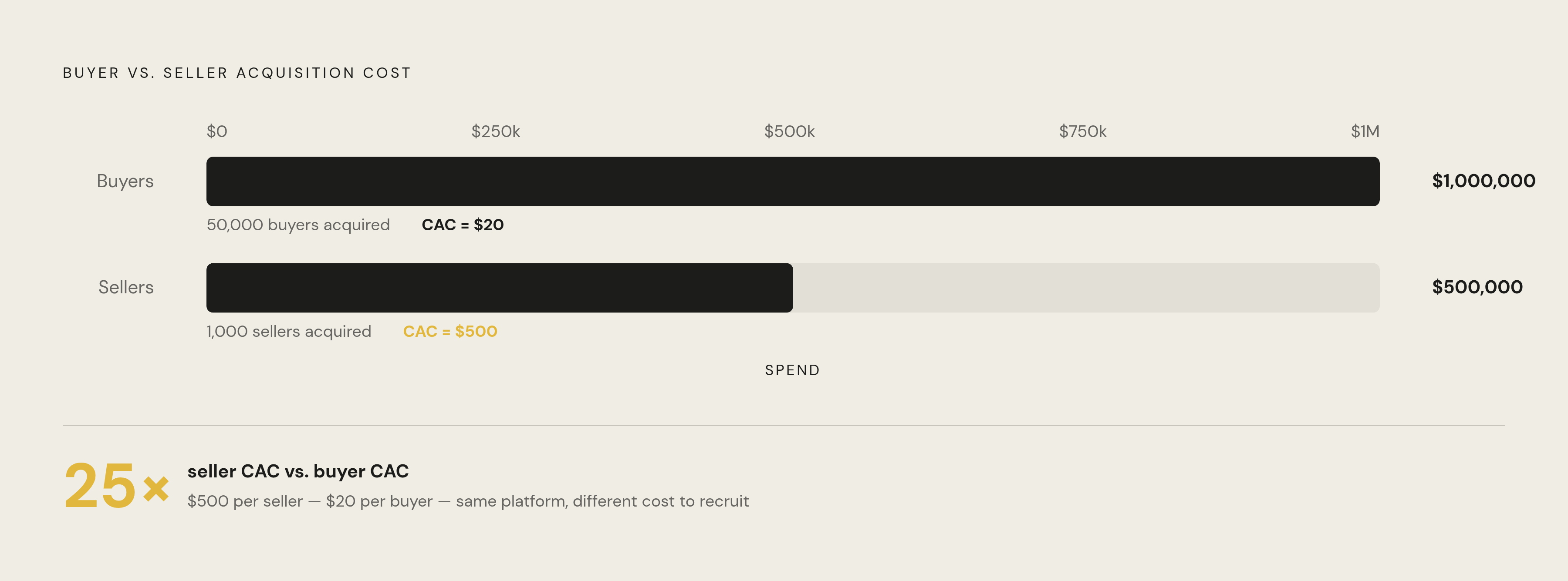
Lightspeed offers a useful illustrative framework. Suppose a platform spends $1 million on social media and acquires 50,000 buying customers. Buyer CAC: $20. The same platform spends $500,000 on trade shows and targeted outreach to acquire 1,000 sellers. Seller CAC: $500. That asymmetry is striking. Seller acquisition costs 25 times more per unit than buyer acquisition, yet both are necessary for the platform to function at all. A blended CAC would make the platform look efficient while hiding the fact that supply acquisition is consuming an outsized share of budget.
The two sides of a marketplace rarely harmonize naturally. One side typically costs more to acquire. One churns faster. One converts more slowly. These imbalances require ongoing management through practical interventions: subsidizing demand to stimulate activity, offering incentives to expand supply, using dynamic pricing to stabilize flux during high-volatility periods, and adjusting algorithmic visibility to surface new providers or highlight inventory most likely to convert.
The implication for marketing leaders is direct. Reporting a single blended CAC produces a metric that looks clean but is strategically misleading; it can mask a platform that is quietly starving one of its two audiences while appearing, on paper, to be growing efficiently.
Pricing logic on two-sided platforms: subsidize one side to monetize the other
The foundational principle here comes from Nobel laureate Jean Tirole's research in platform economics: subsidize the side that provides the most value to the other side, and monetize the side that derives the most value from the platform. That is not just a pricing heuristic; it is a structural rule that governs every revenue decision a platform makes.
OpenTable is the clearest illustration. Reservations are free for diners. Restaurants pay a per-booking fee. The diner subsidy is precisely what makes restaurant participation on the platform valuable. Remove the subsidy, charge diners, and restaurant participation loses its rationale. The pricing architecture is not arbitrary; it reflects the directional flow of value between the two sides.
This framing makes something important explicit: pricing is a marketing decision. Choosing which side to subsidize is equivalent to choosing which audience the platform is recruiting and which audience it is asking to fund that recruitment. The two decisions are inseparable.
Take rates are the most common monetization mechanism in marketplace businesses, with commissions typically ranging between 5% and 25%, varying by industry, transaction value, and competitive dynamics. But the percentage matters less than the stage at which monetization is activated.
Early-stage platforms generally run free or heavily subsidized pricing on both sides. The objective is user acquisition, not revenue extraction. Growth-stage platforms shift toward freemium structures with upsells, beginning to extract value from whichever side has developed stronger lock-in. Mature platforms, where network effects provide genuine pricing power, can support value-based pricing with multiple tiers. Moving through these stages prematurely is one of the more common strategic errors in marketplace development.
Freemium on the supply side functions as a seeding tactic: seed network density before activating monetization. The standard B2B SaaS freemium conversion benchmark sits around 2% to 5%, though platforms with strong network effects can substantially exceed this. Slack's conversion rate exceeds 30%, a figure that reflects the degree to which network effects create switching costs that justify paying.
Usage-based pricing, now deployed by 38% of SaaS companies as of 2025, maps naturally to take-rate models on transactional platforms, where revenue scales with activity rather than subscription tiers. The alignment between platform growth and revenue growth is cleaner under this structure.
Per Deloitte's Platform Strategy Group, 65% of platform businesses face significant pricing pressure within their first three years. The pricing architecture chosen at launch carries durable competitive consequences. The underlying tension does not resolve: pricing must be attractive enough to retain both sides while extracting enough value to sustain the platform. Getting this wrong does not just hurt your revenue line; it can reverse the network, as one side exits and the platform's value proposition for the remaining side deteriorates accordingly.
Growth loops replace linear funnels as the platform's primary acquisition engine
Standard SaaS growth follows a linear funnel: awareness, acquisition, activation, and retention. Each stage feeds the next. The loop ends at the user. Paid acquisition drives awareness; the product does the rest.
Two-sided platforms can engineer something more powerful: self-reinforcing loops where each user acquired improves the product for the next user, progressively reducing dependence on paid acquisition over time.
The most potent variant is cross-side virality. On platforms like Airbnb and Etsy, buyers can become sellers. Each user acquired is a potential supply-side recruit; each seller brings their own personal audience to the platform as potential demand. Former Eventbrite VP of Growth Brian Rothenberg put it plainly: "If cross-side virality is happening on your marketplace, be very happy. This is a huge lever." The compounding logic is clear: a new buyer becomes a seller, that seller attracts new buyers, some of those buyers become sellers. Exponential growth is baked into user behavior rather than engineered through paid channels.
Airbnb's mature loop architecture illustrates what this looks like at scale. An SEO loop: new listings get indexed on Google, attract travelers, who generate reviews, which index more competitively, which attract more travelers. A host promotion loop: hosts promote their own listings to personal audiences, driving platform traffic without ad spend. A review loop: traveler reviews increase demand for reviewed listings, pulling in new travelers. Invite loops on both sides. These are not independent tactics; they are stacked, interlocking systems where activity in one loop feeds activity in another.
Programmatic SEO is a specific and underutilized loop that turns supply-side activity directly into demand-side acquisition. Platforms like Tripadvisor, Zillow, and Expedia transform the data generated by users into indexed content that attracts more users, who generate more data. Supply-side participation funds demand-side acquisition automatically, at scale.
Grubhub's early content loop is a transferable case study. Casey Winters built landing pages that organized restaurants by region and cuisine type. A user searching for local Thai restaurants found a curated platform page in search results. At launch, Grubhub was a Series A startup with roughly 30,000 users, 15 employees, and two markets. The content loop was the primary growth engine before paid acquisition could scale at all. The eventual outcome: a $10 billion public company with three million users.
The B2B variation follows the same logic in a different form. Platforms like Faire and Ankorstore encourage existing sellers to bring their established buyer relationships onto the platform, offering commission-free logistics handling as the incentive. Supply-side relationships seed demand-side activity. The loop structure is the same; the mechanics are adapted to enterprise purchasing behavior.
Identifying which loop is native to your platform's user behavior, and then engineering it deliberately rather than waiting for it to emerge organically, is generally a higher-leverage marketing investment than optimizing a paid acquisition funnel. Funnels stop; loops compound.
Content strategy when every piece of content must serve two different readers
Standard SaaS content strategy is built around a single ideal customer profile, a single editorial voice, and a single conversion event. Every piece of content is aimed at one buyer and optimized to move that buyer forward.
On a two-sided platform, every content decision carries a second question that cannot be deferred: which side is this for, and what does it signal to the other side?
The two audiences are motivated by fundamentally different things. The supply side, whether that means sellers, hosts, or service providers, cares about economics, control, tools, platform credibility, and income potential. The demand side cares about selection, trust, price, convenience, and social proof. These are not variations on a theme; they are distinct editorial briefs that require distinct content programs.
Segmentation by audience is a prerequisite, but it is not sufficient on its own. The editorial calendar must reflect the platform's current supply and demand balance. Early-stage platforms should weight content production toward supply-side acquisition: host guides, seller onboarding content, and earnings calculators. As the platform scales, weight shifts toward demand-side conversion: buyer-facing trust signals, review aggregation content, comparison frameworks. At maturity, the goal becomes reinforcing community and lock-in on both sides simultaneously, which requires content that works horizontally across the relationship.
Programmatic content is where supply-side activity becomes demand-side marketing infrastructure. Listings, profiles, and reviews generated by suppliers become indexed content that attracts demand. The supply side is doing content marketing for the platform without recognizing it as such, and a well-designed content architecture amplifies that effect rather than leaving it to chance.
Your SEO strategy must account for both audiences' search intent through separate keyword clusters and separate landing page architectures. Supplier-facing queries, such as how to list on a platform or what the seller fees are, require entirely different content assets than buyer-facing queries like best option near me or comparative searches across platforms.
Trust signals are content. Review counts, verification badges, guarantee copy, and dispute resolution language appear in the product interface, but they function as conversion content for both sides simultaneously. A buyer reading a host's 200 five-star reviews is consuming content that the platform's trust infrastructure made possible.
The Grubhub model offers the most transferable template: structure content around supply-side inventory in a way that answers demand-side search queries. The same asset serves both audiences. That is the editorial ideal for platforms operating at any stage.
Editorial cadence matters here in a way that static content programs often miss. A platform adding supply rapidly needs a content operation that can respond in near real time. Editorial calendars built weeks in advance and disconnected from supply-side activity will always be slightly out of date, which means the demand-side audience is encountering content that does not reflect the platform's actual state.
Trust infrastructure as a retention and re-acquisition tool, not just a safety feature
On two-sided platforms, trust is not a feature adjacent to the product. It is the product. Without it, transactions do not happen. Without transactions, the network effect reverses, and a platform in reverse network effect is not a platform in slow decline; it is a platform in accelerating decline.
Trust must be constructed simultaneously in two directions. The supply side needs to trust that the platform will deliver customers and handle payments fairly. The demand side needs to trust that the platform will deliver on what the supply side promises. Both must be true at once, and a failure on either axis undermines the other.
The components of trust infrastructure are well established: (i) identity verification, (ii) dispute resolution processes, (iii) review systems, (iv) payment guarantees, and (v) insurance products. Each of these reduces friction for one or both sides. None of them are optional at scale.
Platform leakage, also called disintermediation, is the retention problem that is unique to this model and largely absent from SaaS. Unlike conventional churn, where a user stops using the product entirely, marketplace leakage occurs when users complete transactions off-platform. The platform loses take-rate revenue without losing the user. Once a buyer and seller have an established relationship, the economic incentive to remove the platform from the transaction grows with each interaction. Leakage accelerates as relationships mature.
Prevention requires tools that make on-platform transactions durably more valuable than off-platform ones. Strong review and ratings systems create social proof that cannot be transferred off-platform; a seller with 200 five-star reviews loses that asset the moment they transact outside the platform's infrastructure. Guarantees and insurance products that apply exclusively to on-platform transactions make the platform's mediation worth more than the commission savings of disintermediation. Machine learning monitoring of buyer-seller communication patterns can surface leakage signals before they become leakage behavior.
This is also where trust functions as a re-acquisition tool. A seller who has accumulated significant review equity on your platform is generally easier to win back after a period of inactivity than one who has none, because their sunk investment in the platform's reputation system has ongoing value. Trust infrastructure, in this sense, can extend the LTV of acquired users by creating exit costs that are genuinely meaningful.
The marketing reframe that matters here: trust investment is not a cost of operations; it is the mechanism that keeps acquired users transacting on-platform and returning for subsequent transactions. It belongs in the same planning conversation as CAC and LTV, not in a separate product or safety budget that marketing leadership never reviews.
Measuring platform health when standard SaaS metrics give an incomplete picture
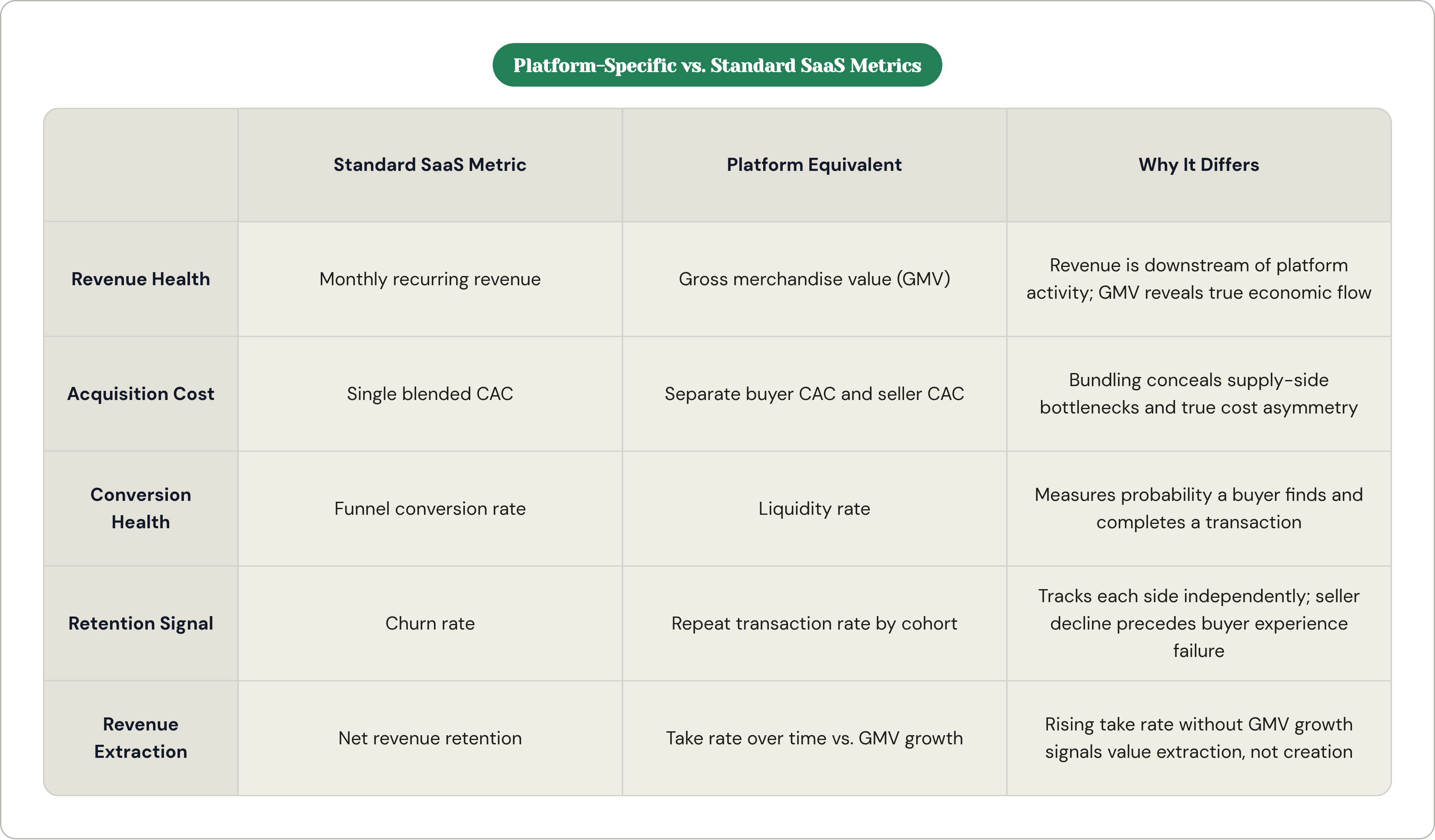
Standard SaaS metrics are built around a single-audience model: monthly recurring revenue, churn rate, CAC, LTV, and net revenue retention. These are excellent instruments for what they measure. On two-sided platforms, they measure the wrong things, or measure the right things incompletely.
Gross merchandise value is generally a more meaningful primary metric for transactional platforms than revenue, because GMV reflects the total value of economic activity flowing through the platform. Revenue is downstream of GMV; optimizing for revenue without understanding GMV dynamics can produce short-term extraction that hollows out your platform's long-term health.
Liquidity is arguably the most important platform-specific metric and the one most likely to be absent from your standard SaaS dashboard. Liquidity measures the probability that a buyer who arrives on the platform finds what they are looking for and completes a transaction. A platform can be growing in users and declining in liquidity simultaneously; the former is visible in standard metrics, the latter is not. Declining liquidity is often the first signal of a supply-demand imbalance that will eventually surface as churn, but by the time it appears in the churn number, the damage is already compounding.
The supply-demand ratio by category, geography, and time period is not a marketing metric in the traditional sense; it is one of the most actionable signals your team can have. An undersupplied category in a specific market is a marketing brief: it tells you where to run supply-side acquisition campaigns, what content to prioritize, and which pricing levers to activate.
Repeat transaction rate by cohort is the LTV metric adapted for platforms. It measures how frequently acquired users transact, how that frequency changes over time, and whether it differs meaningfully between buyer and seller cohorts. A platform where repeat transaction rate is declining in the seller cohort while growing in the buyer cohort has a supply retention problem that will eventually manifest as a buyer experience problem; the signal appears first in the seller data.
Take rate over time is a platform-specific revenue health metric. A take rate that is rising faster than GMV growth suggests a platform extracting more value than it is creating, which typically precedes competitive disintermediation. A take rate that is declining relative to GMV growth can indicate pricing pressure, competitive erosion, or leakage. Neither trend is visible in a standard revenue or churn dashboard.
Standard SaaS metrics are not wrong for two-sided platforms; they are incomplete. Building a measurement system that treats both sides of the market as distinct data streams, tracks liquidity alongside retention, and monitors the supply-demand balance as a leading rather than lagging indicator gives you the visibility to intervene before problems compound. The platforms that scale reliably are, more often than not, the ones that see both sides of the market with equal clarity.