Thought Leadership Framework for Marketplace Category Creation
Genuine thought leadership moves buyers through belief change, not product messaging.

Category design, as articulated by Al Ramadan, Dave Peterson, Christopher Lochhead, and Kevin Maney in Play Bigger, is the deliberate act of creating and owning a new market segment rather than competing within an established one. Most founders undersell how much that distinction matters. Competing within an existing category means accepting someone else's problem definition, someone else's vocabulary, someone else's criteria for evaluation. You arrive late to a frame you didn't build.
The companies that have done this most effectively, Amazon, Salesforce, Uber, didn't win by being marginally better than incumbents. They redefined what buyers expected and made the old category feel structurally inadequate. The economics that follow are severe: according to Play Bigger, roughly 76% of market capitalization in any category concentrates in the category king. Second place in a new category is not a viable strategic position; it's a slow liquidation.
The mechanism that makes category design commercially viable is thought leadership. Not the performative kind. A weekly LinkedIn post about industry trends, a ghostwritten op-ed that hedges every claim, none of that qualifies. Genuine thought leadership has three attributes: (i) specificity of point of view, (ii) anticipation of trends before consensus validates them, and (iii) actionable depth that leaves buyers with a fundamentally different understanding of their situation.
Here's what happens repeatedly when companies miss this. They build something genuinely novel, declare a category, and then wait. The market doesn't move. Deals stall. The founding team diagnoses a messaging problem, or a pricing problem, or a sales execution problem, and iterates accordingly. None of it works, because none of it addresses the actual constraint: buyers don't yet feel the problem the category exists to solve. They have no framework for recognizing the gap in their current approach, which means they have no reason to change. Category adoption is a belief change, not a product decision, and belief change requires sustained, structured education.
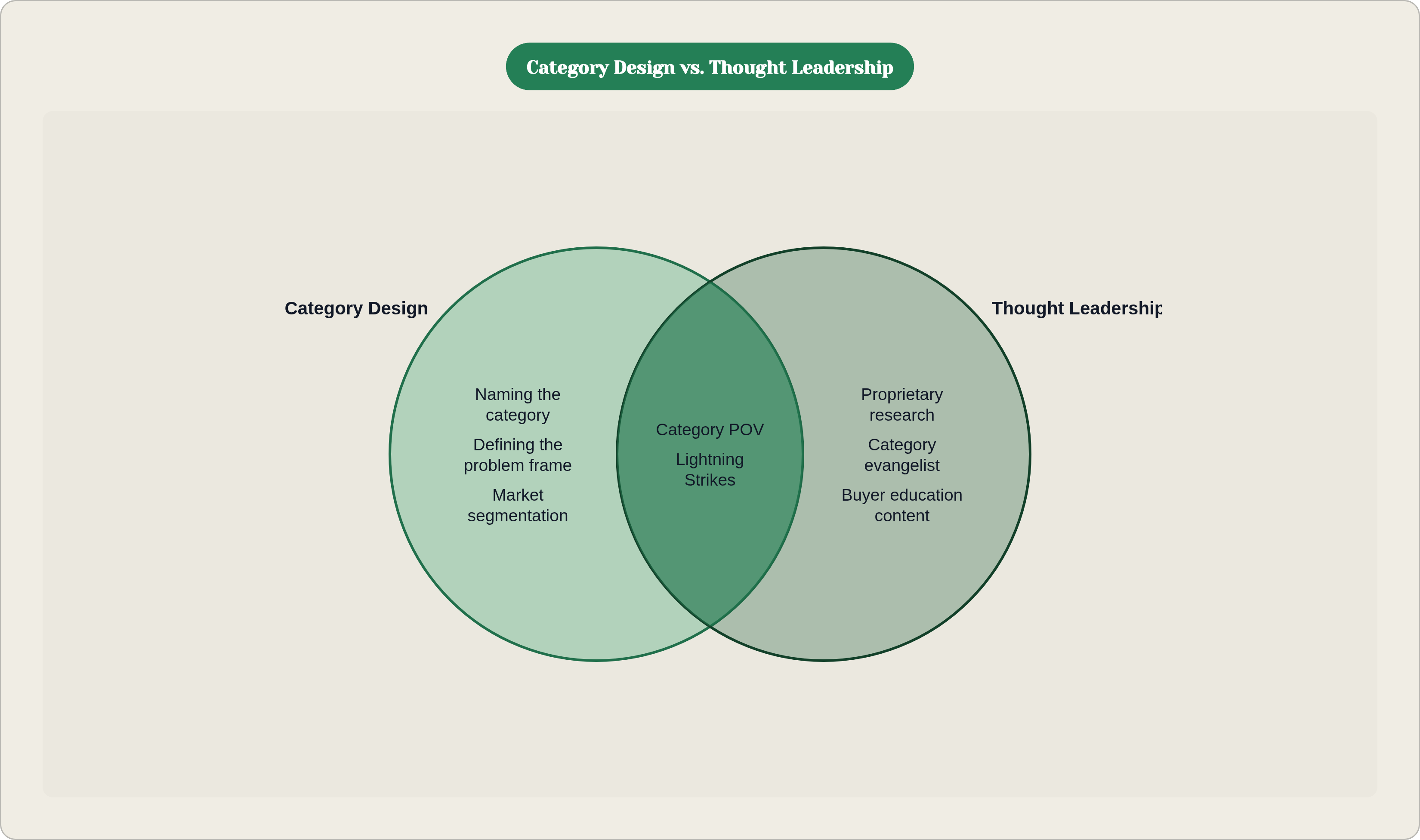
Category design sets the strategic destination: which problem to own, which new frame to establish, which buyers to move first. Thought leadership is how you actually travel that distance, moving buyers from unawareness to conviction through accumulated, structured exposure to a new way of seeing. Without category design, your thought leadership produces authority with no commercial direction. Without thought leadership, your category design produces a compelling internal strategy document that never reaches the people it needs to change.
One signal worth noting: in the Edelman-LinkedIn B2B Thought Leadership Impact Report, "being an active thought leader in the category" ranked among the top three purchase decision drivers, up significantly from prior years. The report draws on responses from nearly 3,500 management-level professionals across seven countries.
The Buyer Environment That Makes This Framework Urgent Now
The content problem is not volume. According to the Content Marketing Institute's annual B2B Content Marketing report, the vast majority of B2B companies use content marketing, while a small fraction describe their efforts as very successful. That gap has existed for years, and it's widening, because volume was never the constraint.
What changed is the cost structure of production. The majority of B2B marketers now use AI-generated content, according to the Content Marketing Institute, and the consequence isn't low quality; it's sameness. Undifferentiated insight at scale. Every competitor can produce a structurally sound, grammatically correct, thoroughly mediocre 2,000-word article in minutes. Generic information has lost its scarcity value entirely.
Meanwhile, the buyer has already moved. Per Gartner's research, B2B buyers complete a significant portion of the purchasing process before contacting a provider. By the time a salesperson reaches a prospect, the category frame in that buyer's mind is already established. Content built it. If your content didn't participate in building that frame, someone else's did.
Buying complexity amplifies the urgency further. Gartner research finds that the majority of B2B purchasing decisions now involve teams of six to ten stakeholders, each with different information needs and different levels of sophistication about the problem. Category thought leadership has to do its work across an entire buying committee, giving every person in that room a coherent, consistent, memorable understanding of (i) why the problem is real, (ii) why existing solutions fall short, and (iii) why the new category is the only logical answer. One great whitepaper aimed at the economic buyer doesn't accomplish that; a sustained, sequenced body of content does.
The quality gap is the actual opportunity. According to the Edelman-LinkedIn B2B Thought Leadership Impact Report, only about a quarter of B2B buyers believe the brands they engage with are producing genuinely good thought leadership. In a landscape saturated with adequate content, category-grade thinking creates immediate differentiation. For younger B2B buyers, including the generational cohorts now entering senior purchasing roles, the same report finds that thought leadership ranks among the top purchase decision drivers. That pattern will intensify. The companies building this infrastructure now are accumulating an advantage that compounds; the companies waiting are ceding ground they will struggle to recover.
What Thought Leadership at Category Scale Actually Does to Pipeline and Pricing
The Edelman-LinkedIn B2B Thought Leadership Impact Report, now in its sixth annual edition and drawing on responses from nearly 3,500 management-level professionals across seven countries, is the most rigorous ongoing benchmark for this question. The findings are worth examining closely.
Seventy-five percent of decision-makers report that a compelling thought leadership piece prompted them to research a product they weren't originally considering, per the Edelman-LinkedIn report. That's not brand reinforcement. That's category creation: surfacing a felt need that didn't exist in the buyer's mind before the content reached them. Of the buyers who went on to research an offering because of thought leadership, roughly 23% ultimately started doing business with that company, according to the same report.
The pricing power finding matters just as much. Sixty percent of decision-makers are willing to pay a premium to work with companies that demonstrate strong thought leadership, per the Edelman-LinkedIn report. Category kings don't compete on price because they've established the definition of the problem. When you own the frame, price comparison becomes structurally difficult. Buyers aren't choosing between two similar options at different price points; they're choosing between the solution and the absence of one.
Sales efficiency follows from the same logic. Ninety-five percent of hidden decision-makers (the people who influence purchasing decisions without participating in formal conversations with vendors) say thought leadership makes them more open to sales outreach, per the Edelman-LinkedIn report. Companies with active thought leaders see more qualified leads and higher close rates. The content pre-qualifies. By the time a prospect talks to your salesperson, the category POV has already done substantial persuasive work, which means your salesperson is closing rather than educating.
Nearly three-quarters of decision-makers now say thought leadership is a more trustworthy basis for assessing capabilities than traditional marketing materials, per the Edelman-LinkedIn report. Eighty-six percent said they'd be more likely to invite a company to bid on an RFP if that company consistently produced high-quality thought leadership, according to the same report.
One note on timeline: the first few months are foundation-building with minimal pipeline impact. Early qualified leads tend to emerge around months four through six. By the end of the first year, thought leadership typically ranks among the top lead sources, and year two produces compounding returns. These timelines are consistent with patterns reported by practitioners in the Edelman-LinkedIn report.
The Six-Step Architecture for Building a Category Through Thought Leadership
Each step here builds the foundation the next one requires. Skipping ahead produces the familiar failure pattern: a category name without a felt need, a POV without an audience, a launch without a frame.
Step 1: Expose the $0B Problem
The problem you're solving doesn't have a budget line yet, because buyers don't recognize it as a problem. They're absorbing the cost, the friction, or the risk without labeling it as such. The first job of category thought leadership is to make the invisible visible.
This is not about explaining your product. It's about creating the felt need your product answers. Content at this stage takes the form of diagnostic frameworks, provocative questions, and contrasts between how buyers currently operate and what becomes possible when the problem is addressed. The metric for success is recognition: buyers reading this content and thinking, "we do that, and I've never interrogated it."
Step 2: Define and Publish a Category Point of View
The category POV is not a blog post. It's the foundational document that names the problem, explains why existing solutions fall structurally short, and introduces the new category as the only coherent answer. Three elements are required: a problem buyers recognize once it's named, a solution that addresses it differently from existing alternatives, and a consistent educational framework that anchors the new frame in buyers' minds.
Every subsequent piece of content should derive from or reinforce this document. The POV is the gravitational center of the whole content architecture. Without it, your content is a collection of individual arguments rather than a cumulative case.
Step 3: Name the Category
The best category names describe something buyers are already doing or experiencing but haven't labeled. They tend to be (i) short, (ii) memorable, (iii) ownable, (iv) pronounceable, and (v) searchable. Generic terms that can't be defended produce no competitive moat. Jargon that won't stick produces confused buyers.
Naming is itself a thought leadership act. The company that names the category controls how every conversation about it begins. Competitors who lack their own name are forced to respond in your vocabulary, which means they're always playing in a frame you built. That asymmetry compounds over time.
Step 4: Recruit and Deploy a Category Evangelist
Every category needs a human voice. Typically this is the CEO or founder; sometimes it's the CMO or a named Chief Evangelist. The role is not to promote the product. It's to write, speak, podcast, and present relentlessly on the problem and the category, building the vocabulary that gradually becomes how the market talks about the space.
Proprietary language matters here in a specific way. The evangelist uses terms and frameworks original to the company, and as those terms spread, competitors find themselves sounding like they're speaking someone else's language. That's the moat. AI can produce structurally competent content; it cannot produce founder experience, real customer stories, or contrarian takes backed by evidence from actual deployments.
Step 5: Execute Lightning Strikes, Not Product Launches
A Lightning Strike is a coordinated, cross-functional campaign that forces the category into market consciousness at a specific moment in time. It's distinguished from a product launch by its focus: you're teaching the world about a problem, not announcing a feature.
This requires genuine organizational alignment. Marketing, sales, product, and leadership all speak the same category language simultaneously. The content outputs point at the category problem: (i) flagship research reports, (ii) event keynotes, (iii) media placements, (iv) analyst briefings. The company is the vehicle; the category is the message.
Step 6: Codify the Category Across the Whole Company
Category design isn't a marketing campaign. When it works, it can shift your product strategy, sales motion, pricing architecture, and organizational culture. Thought leadership at this stage reinforces the category internally as much as externally. Your onboarding materials, sales decks, and partner communications all use category language. New employees learn the POV as part of their orientation.
The mistake to avoid is measuring your success by market share in an existing category. The more relevant metrics for a new category are generally (i) POV adoption in the market, (ii) earned media mentions, (iii) analyst recognition, and (iv) concentration of market capitalization.
Why Starting With a Narrowly Defined Micro-Category Improves the Odds of Becoming the King of a Larger One
The instinct to define the category broadly is understandable and almost always wrong. A company with constrained resources that attempts to own a category at the industry level will be outspent and out-distributed before its POV can establish itself. Breadth, at the wrong stage, is a liability.
The better strategy is to define the category narrowly enough that domination is achievable with available resources, then expand. Research on category design patterns, as outlined in Play Bigger, suggests that successful mid-sized category designers frequently start with clearly focused micro-categories before broadening their claim. The discipline required to hold yourself to the narrow frame, even when the broader opportunity feels obvious and urgent, is harder than it sounds.
The thought leadership implication is direct. A narrow category produces a specific audience, a specific problem, and a specific body of evidence. Content built for that context is sharper, more credible, and more actionable than content aimed at a diffuse market. Broad-market claims require no proof; micro-category claims are falsifiable, which is precisely why they're persuasive when they hold up.
The compounding dynamic is what makes the sequencing work. Dominating a micro-category produces the case studies, the data, and the analyst attention that justify the expansion claim. When you move to claim a broader category, you arrive with proof, not just a POV. The new audience sees a track record; the old audience becomes your credibility base.
A practical diagnostic: can you describe the exact job title, company type, and specific pain point of the buyer you're trying to move first? If your answer requires more than two sentences, your category is likely too broad to build effective thought leadership around.
Proprietary Research as the Content Engine That Competitors Cannot Replicate
As AI reduces the marginal cost of generic content toward zero, differentiation shifts to owning unique insight: data no one else has, collected from an audience only you can access, interpreted through a POV only you hold. Opinion is replicable; unique data is not.
A competitor can respond to an argument. They cannot replicate your survey of 500 customers, your analysis of usage patterns across your platform, or your annual benchmark study that buyers have come to rely on. The value is in the underlying data, the methodology, and the interpretation. That combination takes relationships, infrastructure, and a specific vantage point that requires time to build.
Research published by the Content Marketing Institute and BuzzSumo finds that B2B content with original research receives substantially more engagement than opinion-based content.
At UserEvidence, a single proprietary research report generated 600 downloads in its first week and continued driving meaningful results a full year later, according to UserEvidence's published account of that campaign. One research investment, sustained distribution value over an extended period. That's the economic logic of proprietary data: expensive to produce once, cheap to distribute indefinitely.
The modular dividend amplifies the return further. A single high-quality research report produces raw material for a broad range of content formats: (i) data snapshots for LinkedIn, (ii) a webinar discussion, (iii) sales-enablement proof points, (iv) media pitches, and (v) searchable statistics that AI systems surface in response to buyer queries. The research is the anchor; everything else derives from it.
There's a specific reason this matters for category creation. Proprietary research that names the problem with data becomes the evidence base for the category POV. It converts the founder's claim into a market finding. "We believe buyers are absorbing this cost" is a positioning statement; "our research of 500 companies shows buyers are absorbing this cost at a measurable rate" is a category fact. The former invites skepticism; the latter invites citation. That difference determines whether your POV spreads or stalls.
How to Sequence Content by Where Buyers Are in Their Understanding of the Category
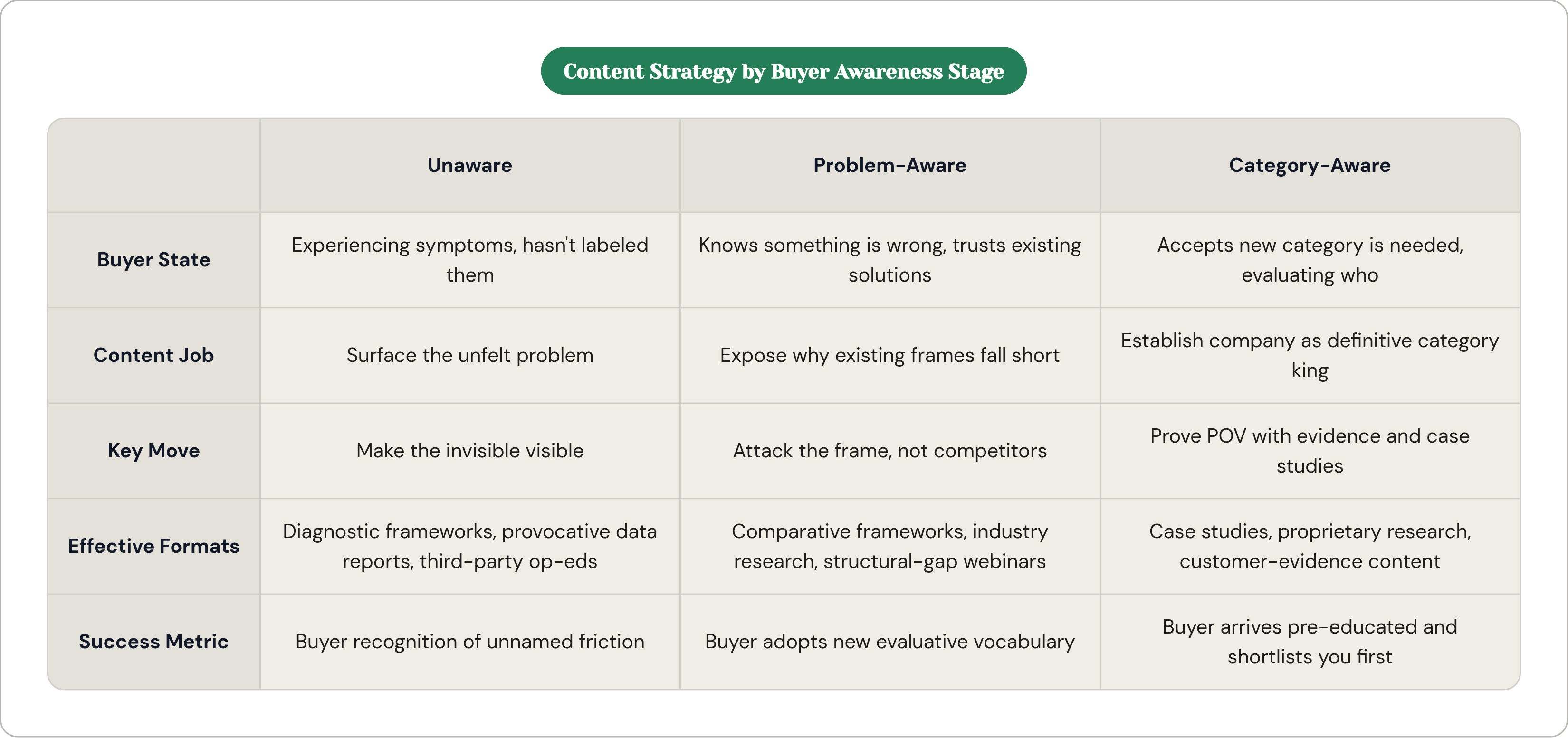
A buyer who is unaware of the problem needs fundamentally different content than a buyer who is evaluating solutions. Pushing conversion content at an unaware buyer doesn't accelerate the sale. It can produce confusion, or a false negative: the buyer encounters content that assumes a context they lack, concludes your company isn't relevant, and moves on.
Sequencing content by buyer awareness stage is the discipline that prevents this.
Stage One: Unaware
The unaware buyer doesn't recognize the problem the category solves. They are experiencing the symptoms without having labeled them, absorbing costs or inefficiencies they've normalized. The content job at this stage is to surface what they're carrying without knowing it.
This is not the place for product content or category content that assumes the problem is already recognized. The most effective formats here tend to be (i) provocative data reports that quantify a cost buyers haven't been tracking, (ii) diagnostic frameworks that help buyers audit their current approach, and (iii) "what if you're wrong about X" perspectives distributed in outlets buyers already read. Your category evangelist's op-eds, published in third-party venues with established trust, often do the heaviest work at this stage. Recognition is the goal: a buyer finishing the content and feeling a specific friction they hadn't previously named.
Stage Two: Problem-Aware
The problem-aware buyer recognizes that something is wrong but hasn't concluded that existing solutions are inadequate. They're evaluating whether the tools they already have, or the established categories adjacent to their problem, can be made to work. The content job here is to demonstrate why existing categories fall structurally short. Not because competitors are bad, but because the old frame doesn't fit the problem.
This distinction matters enormously. Attacking competitors is a positioning move; attacking the frame is a category move. The former invites defensive comparison; the latter creates a new evaluative lens. Comparative frameworks that show the gap between what existing solutions were designed to solve and what the actual problem requires are the most effective format here. Industry research with category-framing interpretation gives buyers a new vocabulary for articulating dissatisfaction they already feel. Webinars that walk through the structural gap, with real examples, convert problem awareness into category awareness.
Stage Three: Category-Aware
The category-aware buyer understands the problem and has accepted that a new category of solution is required. They're now evaluating who within that category to choose. The content job shifts to establishing your company as the definitive category king: (i) proof of POV through case studies, (ii) the proprietary research that anchors the category's evidence base, and (iii) customer-evidence content that makes the category real rather than theoretical.
At this stage, the compounding effect of earlier content investment becomes visible. Buyers who arrived at category awareness through your content generally arrive pre-educated, pre-convinced, and far more likely to shortlist you first.