Brand Advertising Products in Horizontal Marketplaces
Amazon and Walmart now dominate the advertising game with different rules than search and social.

Amazon and Walmart now run the advertising game that used to belong to Google and Facebook. That much is obvious if you've checked a Q3 earnings call lately. But the more interesting shift is structural: horizontal marketplaces play by different rules than search or social ever did. A vertical marketplace, say, a site that only sells running shoes, goes deep in one lane. Amazon and Walmart go wide across fifty lanes at once, selling everything to everyone, and that width changes how much reach a brand gets, how many competitors show up in the same auction, and how much of a brand's own identity survives the trip to a customer's cart.
Start with where U.S. shoppers actually spend money. Amazon holds 37.6% of ecommerce share in 2025, Walmart sits at 6.4%, eBay at 3.0%, and Apple and Target trail at 3.6% and 1.9%. That's the horizontal tier, a handful of platforms moving enormous volume across every category at once, and the reach is real in a way search and social were never built to offer. A brand selling kitchen gadgets can land in front of someone who came to Amazon for dog food and wandered off, catching intent nobody was actively looking to sell against.
That reach costs something, though, and the cost is baked right into the structure. A single Amazon category can carry hundreds or thousands of competing sellers, and once your product sits in a grid next to forty near-identical listings, standing out gets hard fast. Organic placement rarely gets seen at scale on its own anymore, so advertising works more like rent you pay just to exist in the results page. Intent on a marketplace runs purchase-stage almost by default, the auction happens at the SKU level, and the whole brand experience gets squeezed into whatever layout the platform hands you that quarter. So what does winning actually look like here? That's the question the rest of this piece tries to work through, section by section.
Why retail media has become the dominant advertising channel brands cannot ignore
Start with the number, because it's a big one. U.S. advertisers spent $60.32 billion on retail media in 2025, and eMarketer's December 2025 forecast puts that at $71.09 billion in 2026. Retail media grew 28% year-over-year in 2025, against 9% for search and 6% for social, and that gap keeps widening instead of closing, which is the part worth sitting with. Globally, retail media revenue in 2025 passed total TV spend, broadcast and streaming combined, a threshold that would have sounded far-fetched a decade ago.
Three things explain it. Marketplaces sit on first-party purchase and browsing data that doesn't need a third-party cookie to work. The attribution loop closes, so you can trace ad spend to an actual sale instead of a click that may or may not have gone anywhere. Third-party targeting keeps breaking down under privacy rules and browser changes, meanwhile, and retailer-owned data is one of the last signals left that's both large and dependable.
What does a 28% growth rate actually tell you, beyond the fact that it's big? It tells you that treating retail media as a test-budget line, something you dabble in with leftover quarterly spend, can already put you behind. The channel runs its own targeting logic, its own auction dynamics, its own measurement quirks, and ten years of running Google Ads doesn't transfer over automatically, no matter how good someone on your team is at it. U.S. retail media is projected to go from roughly $62 billion in 2025 to about $98 billion by 2028, a 17.2% compound annual growth rate. The shelf gets more crowded every year, not less, so the brands sorting out format strategy now are the ones with room to move by 2028.
How concentrated the retail media market actually is, and what that means for where budgets go

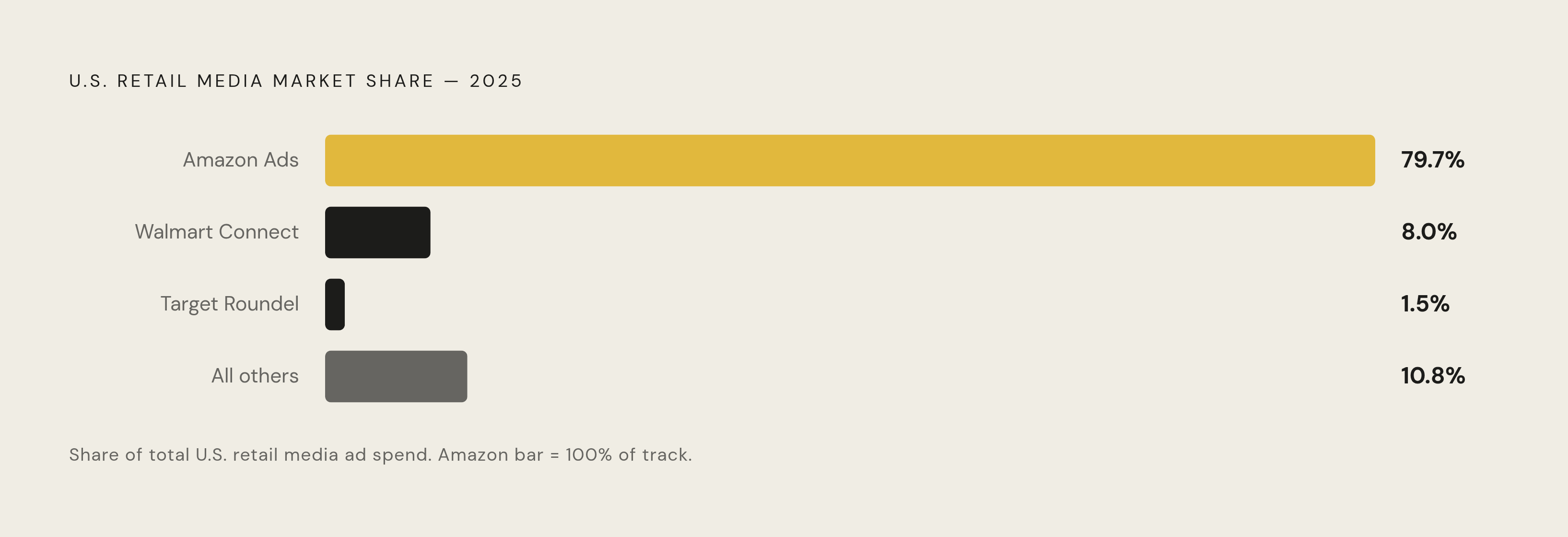
Amazon Ads holds 79.7% of the U.S. retail media market in 2025, with Walmart Connect at 8.0% and Target Roundel at 1.5%. Everyone else is splitting what's left, and what's left isn't much, worth sitting with for a second: nearly four out of every five retail media dollars in the country go to one company.
The gap isn't closing either. Amazon and Walmart together will capture 89% of incremental retail media spending in 2026, meaning $9.42 billion of the $10.53 billion in net-new dollars flows to just those two platforms. Every other retail media network eMarketer tracks is projected to hold flat or lose share through 2027. So when you're deciding whether to spread your budget across five platforms, the honest answer, for most categories, is generally no. Amazon is the main arena whether you like it or not, Walmart Connect is the one credible second stage with real scale, and its audience overlaps with Amazon's less than you might assume. Everything past those two is a niche bet, not a default line item.
Worth a mention: DoorDash and Instacart each generate close to $1 billion in annual U.S. ad revenue, pulling budget at the margins mostly from CPG and grocery brands. Real money, but a specialty consideration rather than a rewrite of the core plan. In practice, a retail media strategy is an Amazon strategy with a Walmart layer bolted on. Everything from here treats that as the working reality.
Amazon's ad format stack and how each format maps to a stage in the purchase journey

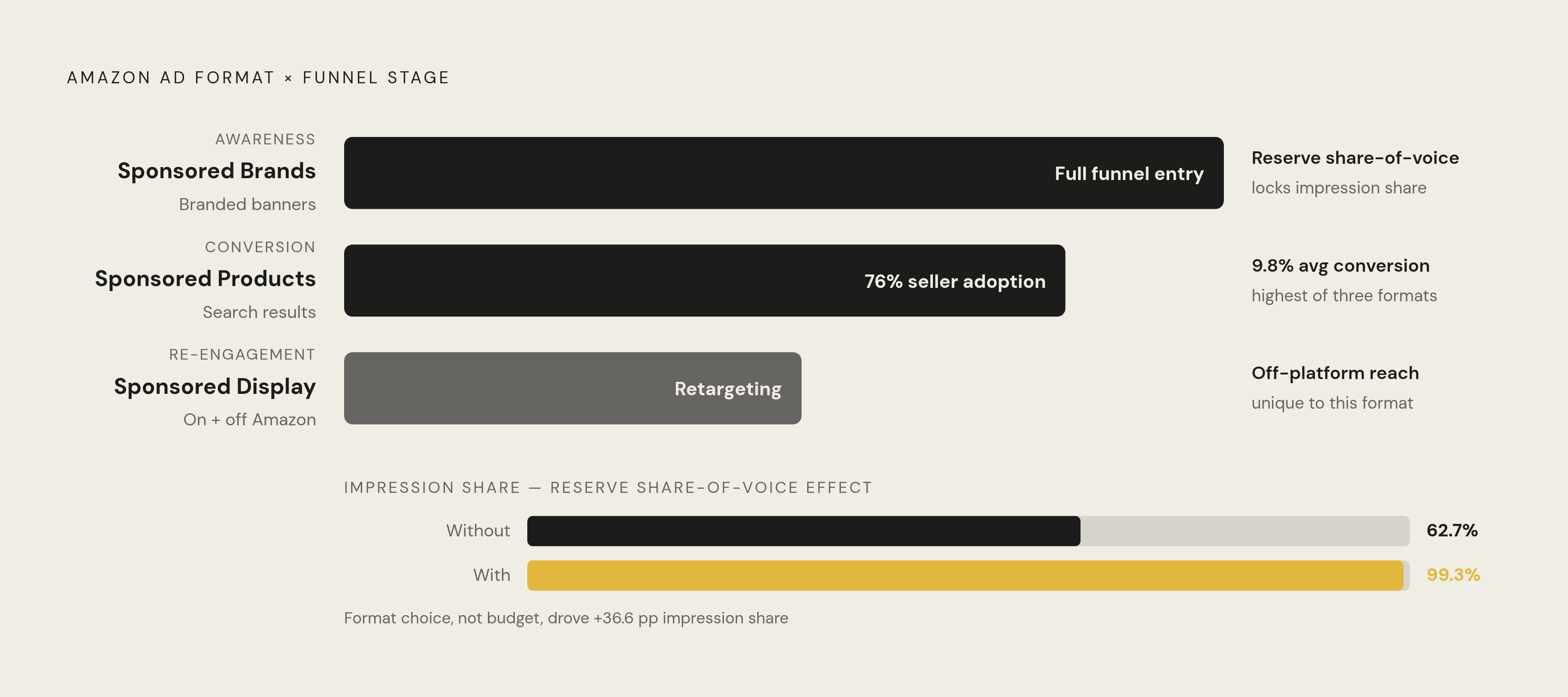
Amazon gives advertisers three main on-platform formats, and each one does a different job in the funnel. Treat them as interchangeable and a lot of budget just evaporates into the void, which is a more common mistake than it should be given how well-documented this stuff is.
Sponsored Products are the pay-per-click ads that show up in search results and on competitor product pages. This is the conversion-stage tool, the one closest to the register, and adoption jumped fast: 76% of Amazon sellers used Sponsored Products in 2025, up from 61% in 2024. These ads work well in practice too, with average conversion rate sitting at 9.8%, versus 3.2% for Google Shopping in comparable categories. That's a wide gap between a format built for someone already holding their wallet open and one built for someone still window shopping.
Sponsored Brands sit higher in the funnel. They're the branded banner units, logo, custom headline, a small lineup of products, and their job is awareness: proving a brand exists as a brand in an environment that otherwise flattens every listing into a price and a star rating. Sponsored Display handles re-engagement, retargeting shoppers on and off Amazon, and branded creative in those placements tends to outperform generic formats in ways that surprise advertisers who treat it as an afterthought.
Industry benchmarking from Pacvue puts average ACoS (advertising cost of sale) on Amazon at 22%, a useful gut check rather than a hard ceiling. Brands running only Sponsored Products are buying transactions one at a time, forever, and nothing compounds. Sponsored Brands and Display are what turn a marketplace presence into an actual position: one that gets cheaper to defend over time instead of more expensive.
One feature makes this point better than any theory could. Sponsored Brands' "reserve share of voice" tool moved top-of-search impression share from 62.7% to 99.3% for advertisers who used it, a 143% jump in click-attributed sales. That's a format mechanic doing more work than a simple budget increase ever could. Which format you choose, not just how much you spend, decides who gets seen.
Amazon's ad business also stretches off-platform now. In 2026, U.S. advertisers will spend $7.76 billion on retail media-powered social ads and $6.10 billion on retail-powered CTV, with Amazon's DSP and its Brand+ product carrying on-platform intent data out into those placements. The search box was never the whole story, just the part everybody learned first, because it's the easiest one to explain at a dinner party.
Amazon's AI-powered ad products and what they change about targeting and creative
Amazon launched two new products in late 2025, Brand+ and Performance+, both running on a predictive model called AdRelevance. The pitch is simple: instead of guessing who's likely to convert based on what someone typed into a search bar five seconds ago, AdRelevance tries to spot shoppers likely to convert over a longer stretch, based on modeled behavior instead of a single session.
That's a real shift in logic, not just a rebrand of old targeting with a shinier name. Traditional Sponsored Products targeting is keyword-driven and lives inside one session: you bid on "stainless steel water bottle" and hope whoever searches that phrase buys yours. Brand+ and Performance+ target against a probability score built from patterns across time, not a phrase typed into a box on a random Tuesday.
Amazon also rolled Sponsored Products prompts and Sponsored Brands prompts into open beta in November 2025: AI conversations built directly into live campaigns, letting advertisers adjust targeting and creative through plain language instead of digging through manual settings. Homepage Hero packages now offer full-screen, reel-style placements with share-of-voice buys ranging from a small slice up to full ownership, targeted against segments like entertainment enthusiasts, tech buyers, and families. That's a brand-building surface, distinct in purpose from a standard search ad.
Here's the catch, and it's a pretty important one. These tools lower the cost of precise targeting, but they don't write your ad for you, and they definitely don't decide what your brand stands for. The model chases conversion signals; it has no opinion on whether your headline is any good or whether your product photography looks like it was shot on a flip phone in 2011. Brands showing up with sharp creative and a clear sense of who they are get more out of AdRelevance than brands treating "turn the AI on" as a stand-in for actually having a strategy. The tool sharpens the aim, but where you point it is still your job.
Walmart Connect as a distinct strategic layer, not just a smaller Amazon
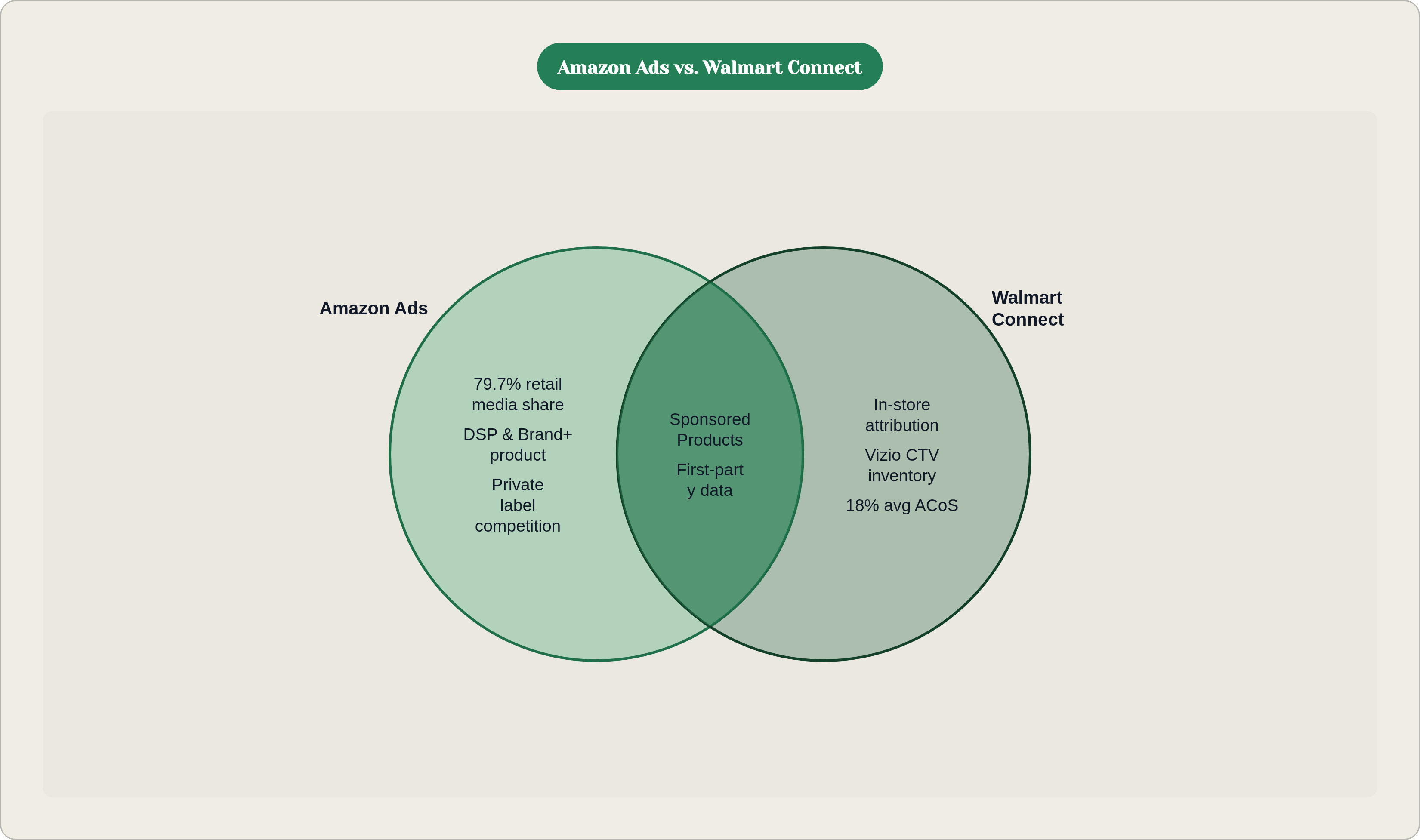
Walmart Connect's format menu looks familiar on paper: Sponsored Products, Sponsored Brands, Sponsored Videos, Onsite Display Ads, same names, roughly the same shapes. Treating Walmart Connect as a scaled-down Amazon misses what actually makes it worth its own line item in a media plan, though.
The real differentiator is Walmart's footprint across both online and in-store. Its first-party data spans online browsing and in-store purchase behavior, a combination Amazon just doesn't have at the same scale, because Amazon doesn't run thousands of physical stores. A meaningful share of Walmart shoppers research online, then walk into a store to buy, and closed-loop attribution on Walmart Connect actually catches that path. That's a data asset unique to a retailer with that kind of physical footprint, and no amount of extra Amazon spend replicates it.
There's an efficiency angle too. Average ACoS on Walmart Connect runs around 18%, against Amazon's 22%. Lower competition in a lot of categories means brands willing to build presence early get more for the same dollar. And with Vizio now under Walmart's roof, Walmart Connect can push brand advertising into CTV inventory, opening the platform even to brands that don't sell through Walmart at all but want a piece of its audience data.
One seller's case makes this concrete: an always-on Sponsored Products campaign on Walmart Connect contributed to an 87% year-over-year jump in GMV, driven by steady, always-on spend compounding over time rather than a holiday spike or a one-off promotion.
None of this means you necessarily need a Walmart budget, though. It's the right call for mass-market consumer goods, grocery-adjacent categories, or anywhere Walmart's physical footprint adds a layer to attribution Amazon can't offer. For a niche DTC skincare brand with no retail distribution, it might just be noise, and noise costs money too, which is easy to forget when a channel looks cheap on a CPM basis.
The brand dilution problem and how strong brands defend their identity inside a marketplace
Here's the part of marketplace advertising nobody puts on a slide. When your product sits in a grid next to forty similar listings, differentiation quietly collapses down to two variables: price and star rating. Whatever story your brand tells everywhere else, the marketplace doesn't automatically carry it over. It strips things down to a photo, a number, and a price tag, then lets the shopper decide in about four seconds flat.
This isn't just an aesthetic gripe about ugly product grids. Brand dilution drives real price sensitivity and eats into the margin premium brand equity is supposed to protect in the first place. Stack private label pressure on top of that: Amazon runs its own labels, AmazonBasics, Solimo, Happy Belly, Mama Bear, competing directly in categories where national brands used to have the shelf to themselves. Private label has been gaining ground on national brands across retail categories, a market-wide current that every brand selling on a marketplace is caught in whether it notices or not.
So what actually works against that current? Sponsored Brands units and Store pages matter here because they're one of the only surfaces where a brand can show a visual identity, a narrative, a full product range, instead of one isolated SKU floating among competitors. A+ Content deepens the product page past a bullet-point list, and used well, it shifts the comparison in a shopper's head from "which one's cheaper" to "which one seems better made." Brand Registry, Amazon's enrollment program for protecting trademarks and reporting counterfeits, unlocks those enhanced content tools, and at this point it's table stakes, not a nice extra. Consistent creative, same fonts, same colors, same voice across Sponsored Brands, Display, and anything running off-platform, builds recognition that outlasts any single campaign.
Underneath all of this sits a bigger point, and it's the one that ties the whole section together. Marketplace advertising and brand-building aren't separate jobs running on parallel tracks. The ad formats are the brand-building surfaces. Treat them purely as performance levers, optimizing only for clicks and immediate ROAS, and dilution is exactly what you get, because nobody else is protecting your identity for you. That part's on the brand alone, full stop.
Why measurement remains the hardest unsolved problem in retail media
Ask anyone running retail media budgets what keeps them up at night, and measurement comes up before anything else. Per Forrester's State of Retail Media 2025 research, 86% of commerce media decision-makers across North America and Europe call strengthening measurement and attribution a high or critical priority. That's close to universal agreement on a problem that's still, honestly, unsolved, which should tell you something about how hard it actually is.
Why so hard? A few reasons pile on top of each other. Each platform reports its own way: Amazon uses ACoS, Walmart runs its own ROAS calculation, and DSP metrics run on different denominators and attribution windows entirely, so comparing performance across platforms means comparing numbers that were never built to line up in the first place. The closed-loop attribution that makes retail media so appealing only closes the loop inside that one platform's walls; cross-channel lift, what your Amazon ads did for Walmart sales, or what your CTV spend did for either, stays mostly invisible. Brand-building formats, meanwhile, Sponsored Brands, Display, CTV, tend to produce effects that show up after the reporting window has already closed. A shopper who sees your Homepage Hero placement and buys two weeks later through a plain organic search will register in the dashboard as an organic conversion, with no credit given to the ad that planted the idea in the first place.
There's cross-channel evidence out there, just not from the platforms themselves, because why would Amazon go out of its way to measure something that happened off Amazon? A 2024 Nielsen study found brands running cross-channel campaigns saw a substantial jump in brand recall and a meaningful jump in purchase intent. Real lift, but it doesn't show up on an Amazon Ads dashboard.
The practical result is a quiet bias that builds over time: brands optimizing purely to in-platform ROAS underinvest in the awareness formats whose payoff never shows up in that same report. So what can you actually do about it? Set your measurement framework before the campaign launches, not after, once you're already scrambling to justify the spend to a nervous finance team. Define separate success metrics for each format type instead of forcing Sponsored Products, Sponsored Brands, and CTV through the same ROAS bar. Treat third-party measurement, Nielsen, Kantar, formal incrementality studies, as a required complement to platform reporting, not a line item you cut the first time budgets get tight.
The strategic logic that separates brands that compound their marketplace position from those that tread water
Retail media ROAS in the double- to quadruple-digit range, sometimes higher, is genuinely achievable, according to eMarketer's Jeremy Goldman. It tracks with deliberate format choices and a clear sense of audience logic more than with budget size alone, which is either reassuring or annoying depending on how big your budget is.
A pattern shows up once you line up everything covered so far. Brands that compound their position treat Sponsored Products as a conversion engine inside a bigger strategy. The fuller stack, Sponsored Brands, Display, off-platform extensions, is what builds the underlying position that makes Sponsored Products cheap and efficient in the first place. These brands use share-of-voice tools on purpose instead of by accident. Remember that reserve share of voice feature pushing impression share from 62.7% to 99.3%? That's the return you get from actually reading the manual instead of turning campaigns on and hoping for the best.
They stay in the game year-round instead of spiking around Black Friday and going dark the rest of the calendar. The Walmart Connect case with 87% GMV growth came from steady, always-on presence, not a seasonal burst. They carry one coherent identity across every surface Amazon and Walmart hand them, Stores, A+ Content, Sponsored Brands creative, because nobody's coming to protect brand equity for them, and that job belongs to the brand alone. And they measure by funnel stage instead of leaning on one blanket metric, using incrementality thinking to catch the systematic underinvestment in brand-building that pure ROAS chasing tends to produce.
None of it requires a secret playbook, honestly. Show up consistently across the whole format stack instead of just the one channel already paying off, and give it more than a week to prove out. The brands treading water are the ones bidding on keywords and calling it a strategy. The ones actually compounding are running the full stack on purpose, willing to wait a little longer for the number that actually matters.
Notes
- https://advertising.amazon.com/library/guides/sponsored-brands-what-to-know
Provided background on Amazon Sponsored Brands format mechanics, including awareness-stage positioning and creative options like logo and custom headline.
- https://advertising.amazon.com/library/guides/sponsored-products-best-practices
Provided context on Sponsored Products as a conversion-stage pay-per-click format appearing in search results and on competitor product pages.
Every new piece from marketplace crunch, as it's published.
Follow