Horizontal Marketplace Category Expansion Sequencing
The order you add categories matters more than how many you add.
Horizontal marketplace expansion is a sequencing problem, and most operators solve it backwards. They bolt on categories to chase demand, then act surprised when liquidity gets thin and trust starts to wobble. What actually matters is the order categories get touched in, and whether each new one earns the right to the next one.
The instinct makes sense on paper. A marketplace gets traction in one category, and someone in a strategy meeting says "if we did this well with sneakers, imagine electronics too." But spreading fixed liquidity across more categories doesn't multiply your match rate; it divides it. A buyer hunting for a used lawnmower doesn't care that you now also sell vintage watches. She cares whether there's a seller nearby who actually has a lawnmower and will ship it. Add categories faster than trust and fulfillment can absorb them, and you get a platform that's technically bigger and worse at the one thing it used to be good at.
There's a principle that floats around brand circles: a larger brand running five sales channels can net less profit than a smaller brand running two channels well. Same market, wildly different discipline. The multi-channel brand looks great in a pitch deck, while the focused brand is the one actually paying rent. What follows is an attempt to work out why that gap exists, category by category, gate by gate, using Amazon, eBay, and Walmart as the receipts.
What horizontal expansion actually means and what makes sequencing the central variable
Horizontal marketplaces win on distribution and habit, not specialization. They need a taxonomy that scales, moderation that doesn't fall over under volume, and search that handles a screwdriver query and a sweater query with equal competence. Vertical marketplaces get to specialize, and that focus is its own moat. Horizontal platforms give up focus for reach, so they usually start with thin margins and bet on scale to fatten them up later.
That fattening-up follows a fairly fixed order: liquidity first, match quality second, trust systems third, revenue expansion dead last. Skip a step and the whole stack wobbles. Sequencing isn't a tactic sitting underneath the strategy; it is the strategy. Get the order right and each category makes the next one cheaper to launch, since a well-run launch lowers acquisition cost for whatever comes after it, drags trust into unfamiliar territory, and reuses operational muscle you already built the hard way.
Two versions of this problem exist. There's platform-level sequencing: a marketplace like Amazon or eBay deciding what category opens next. And there's seller-level sequencing: a brand deciding whether Walmart or TikTok Shop comes next. Different actors, same logic underneath, and the same mistakes get made at both levels with strange regularity.
How Amazon built its sequencing logic, category by category, from 1995 to the present
Jeff Bezos reportedly looked at 20 product categories before landing on books, and the reasoning still holds up decades later: massive worldwide demand, low unit price, a SKU count no physical store could ever stock, a format nobody needs to try on, and shipping logistics already built for small rectangular things. By the end of 1996, Amazon had crossed $15 million in sales selling exactly one category, modest for a company that would eventually touch dozens.
What happened next wasn't random. In 1998, Amazon added music and DVDs, which used almost the identical logistics footprint as books: same shelving, same catalog structure, same fragile-but-not-that-fragile packaging problem. 1999 brought home improvement, software, video games, and gifts. A wider net, but still close enough to the existing playbook that nobody had to reinvent much. Then in 2000, Amazon launched Marketplace, letting third-party sellers list inventory Amazon never had to touch or warehouse itself. That single decision might be the hinge of the whole company; it let categories multiply without the balance sheet multiplying alongside them.
By 2002, apparel and office products showed up, and apparel in particular brought real headaches that earlier categories hadn't required Amazon to solve. 2003 brought health and personal care, gourmet food, and sporting goods, categories with perishability and supply chain wrinkles that would've been reckless to take on in year one. Amazon could handle that complexity because the earlier waves had already stress-tested the infrastructure underneath. Grocery came much later, with the Whole Foods deal in 2017 marking a major milestone more than two decades after the first book shipped. That gap isn't an oversight. Grocery needs a level of logistics maturity that took Amazon the better part of two decades to approach, a strange thing to say about a company most people assume was born knowing how to ship everything.
The pattern shows up well past retail categories too: build a capability internally, eat the cost of getting it right, then eventually sell that capability back out as a service. Fulfillment by Amazon, AWS, Amazon Advertising, all children of the same instinct. Amazon followed an internal logic rather than executing some grand plan sketched on a whiteboard in 1994, and that logic is a far more useful thing to copy than any roadmap. Roadmaps expire, but logic sticks around longer than anyone plans for.
What eBay's growth from 10 categories to more than 22,000 reveals about community-driven sequencing
eBay's expansion was pull-driven: the community showed the platform where demand wanted to go next, and eBay followed. That dynamic starts with Beanie Babies, of all things. Collectibles buyers are high-intent by nature; nobody wanders into a Beanie Baby auction by accident. Because every new seller who showed up added real selection for buyers who were already there and already looking, the category grew the platform's value instead of watering it down.
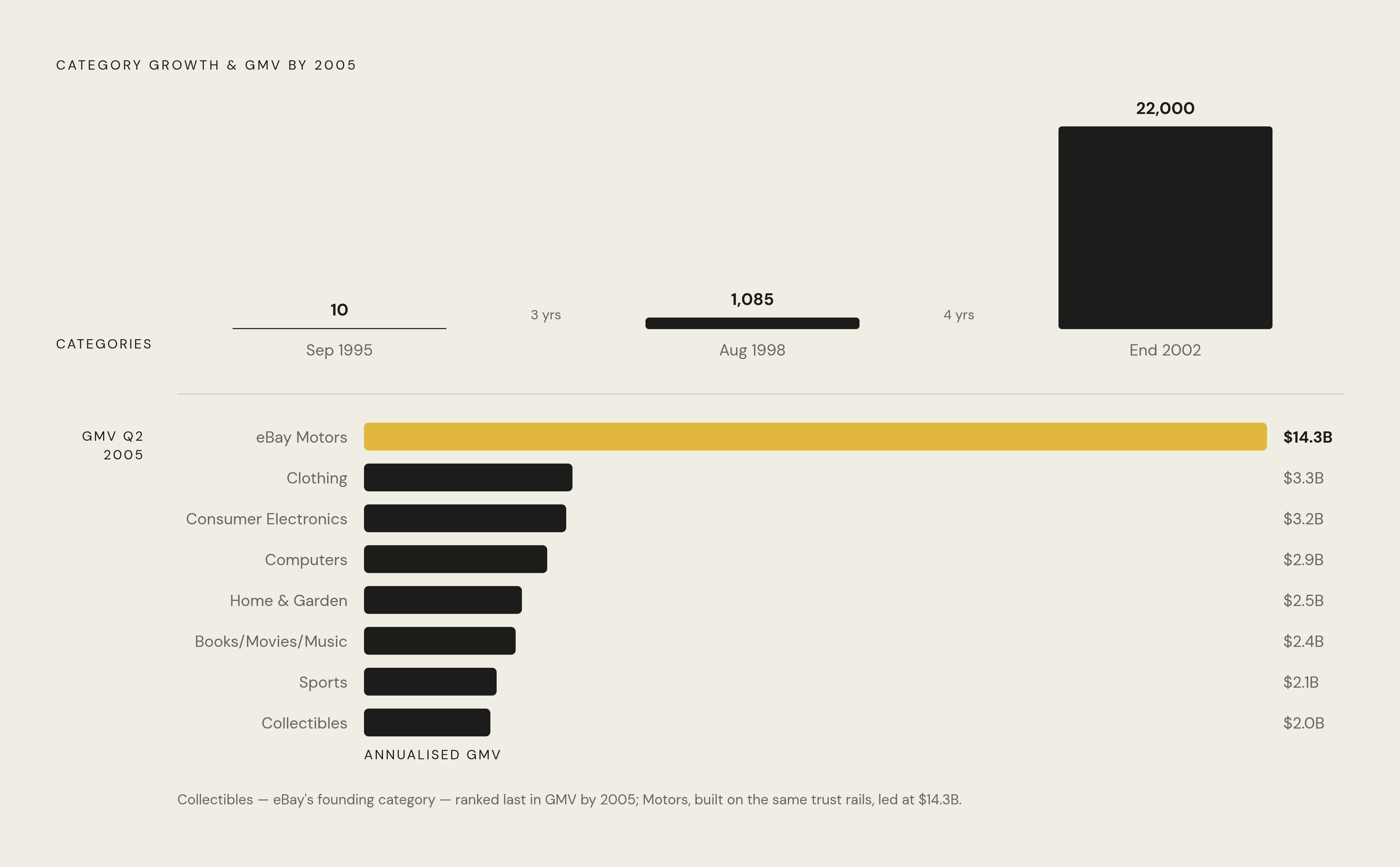
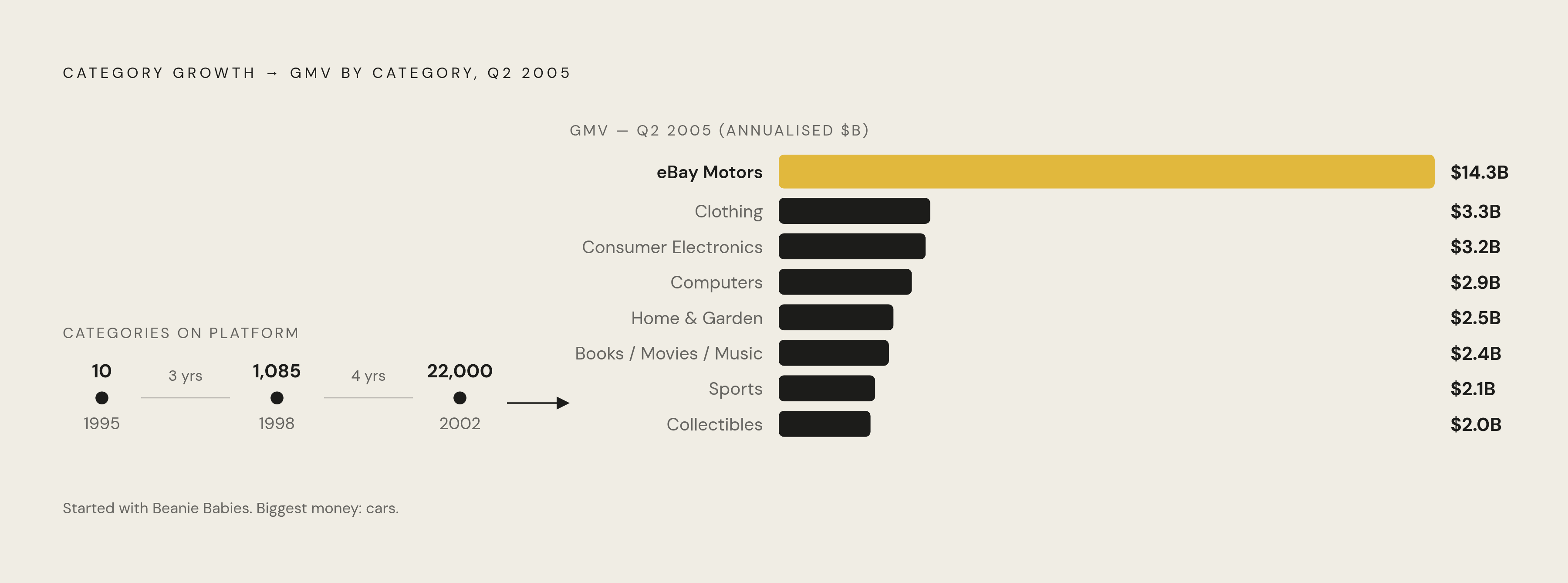
The category count tells its own story. eBay launched in September 1995 with 10 categories. By August 1998, that number had grown past 1,085, and by the end of 2002, it had crossed 22,000, a curve driven almost entirely by third-party sellers bringing their own supply rather than eBay stocking anything itself.
Now look at where the money actually ended up. By the second quarter of 2005, eBay Motors was the single largest category by annualized gross merchandise volume, at $14.3 billion. Clothing and accessories came in at $3.3 billion, consumer electronics at $3.2 billion, computers at $2.9 billion, home and garden at $2.5 billion, books and movies and music combined at $2.4 billion, sports at $2.1 billion. Collectibles, the category that started this whole thing, sat at $2.0 billion, near the bottom of the pack. A platform built on plush toys ended up making its biggest money selling cars. Stuffed animals and Honda Civics, it turns out, run on the same trust rails once you build them right.
eBay Motors arriving as a major revenue category made sense only after the platform had built up its trust infrastructure across lower-stakes categories first. A used-car transaction from a stranger on the internet depends on a platform that has already demonstrated, in categories with far less at stake, that it handles disputes reliably.
Heading into 2010, eBay's stated strategy leaned on the same idea: improve the buyer and seller experience, extend into new formats, categories, and geographies. Sequencing stayed the explicit lever even once the company was mature. Line up the two models and you get a clean contrast. Amazon's sequencing was push-driven, building capability internally then deploying it outward, while eBay's was pull-driven, letting its own buyers and sellers show it where demand wanted to go next. Different mechanisms, same discipline underneath, and both produced dominance that lasted decades.
The four-stage framework that governs when and how to add a new category
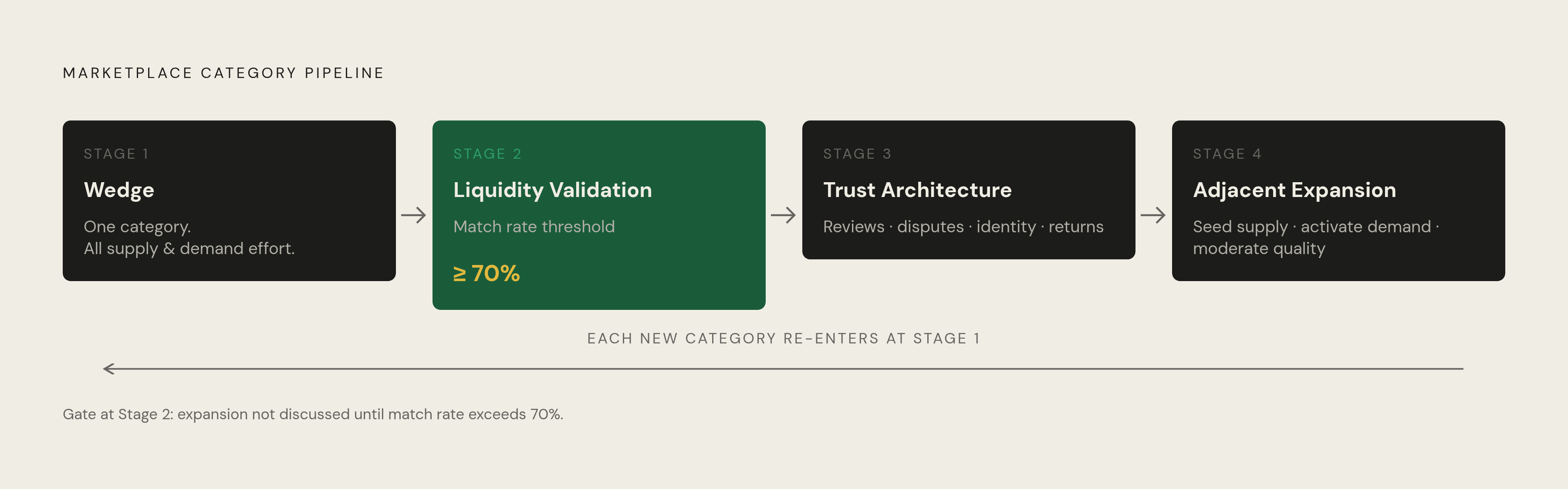
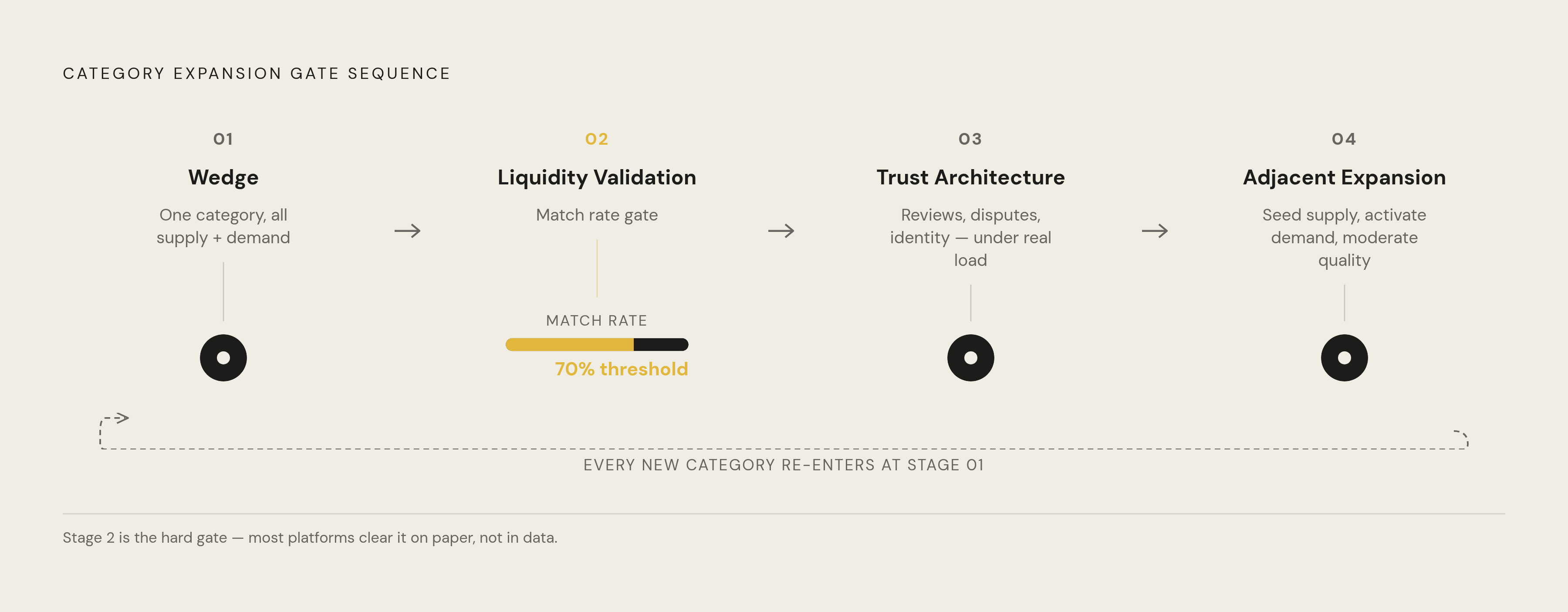
Start with the wedge. Put everything, all your supply effort and demand effort, into one category or one geography instead of spreading thin. A dense, liquid wedge beats a broad, shallow footprint almost every time, because density is what actually creates network effects. Nobody trusts a marketplace with 40 categories and real depth in zero of them.
Next comes liquidity validation, and this is where a lot of platforms lie to themselves. Liquidity gets measured through match rate: the share of the time a buyer actually finds a seller and completes a transaction, not how many items sit in the catalog. Industry analysis puts the useful threshold above 70% before expansion is even worth discussing. A platform can list ten thousand items and still be pre-liquidity if almost nobody's transacting.
After that, trust architecture has to get built before anyone cranks up the take rate. Reviews, dispute resolution, identity checks, return policy: all of it needs to be stress-tested under real load before monetization gets aggressive. If you bolt trust systems on after churn has already started, you'll often find that repair takes far longer than prevention would have.
Last is adjacent category expansion, run off an actual playbook rather than improvised each time, covering (i) how supply gets seeded, (ii) how demand gets activated, and (iii) how quality gets moderated, all documented and repeated. Once density and trust are real, something shifts. Acquisition costs drop, retention climbs, and competitors find the momentum nearly impossible to copy on a shorter timeline.
None of this is a ladder you climb once and forget about. It's a loop: every new category re-enters at the wedge stage and has to earn its way through all four gates again before you move on to the next one.
Three operational gates that must clear before any new category launch
First gate: margin. If a new category or channel drags contribution margin below roughly 20% once you account for realistic ad spend, you're running a vanity project, not a business line. That 20% is a floor, not a stretch goal you'll grow into eventually, and treating it like one means you end up subsidizing a channel that was never going to pay for itself.
Second gate: operations. Can your current inventory and fulfillment setup absorb a new demand stream without your hero SKUs in existing categories going out of stock? Adding a category before ops can carry the weight doesn't just fail to generate new revenue; it breaks the categories that were already working fine, which is a bad trade once you sit with it for more than five seconds.
Third gate: stability in your primary channel. Inconsistent inventory, a customer service backlog nobody's clearing, listing assets that look different depending on which channel you're staring at: any one of these means expansion multiplies your existing headaches instead of adding revenue on top of them.
Clear all three and a rough timeline holds up most of the time: most brands hit breakeven on a new marketplace within four to six months, assuming real inventory depth, listings that are genuinely optimized, and an ad ramp that's steady instead of sporadic. Launching multiple markets at once generally needs 12 to 18 months of runway sitting in the bank; if you don't have that runway, you're often better off sequencing one channel at a time instead of pretending you can run three launches simultaneously. Building a marketplace MVP typically takes 10 to 16 weeks industry-wide, and brands that respect that window tend to outperform the ones that rush the door open early.
These gates run in sequence, not in parallel. Passing the margin gate while ops are still shaky is still a failed gate, and there's no partial credit for showing up to two out of three.
How to determine which adjacent category to enter next, and in what order
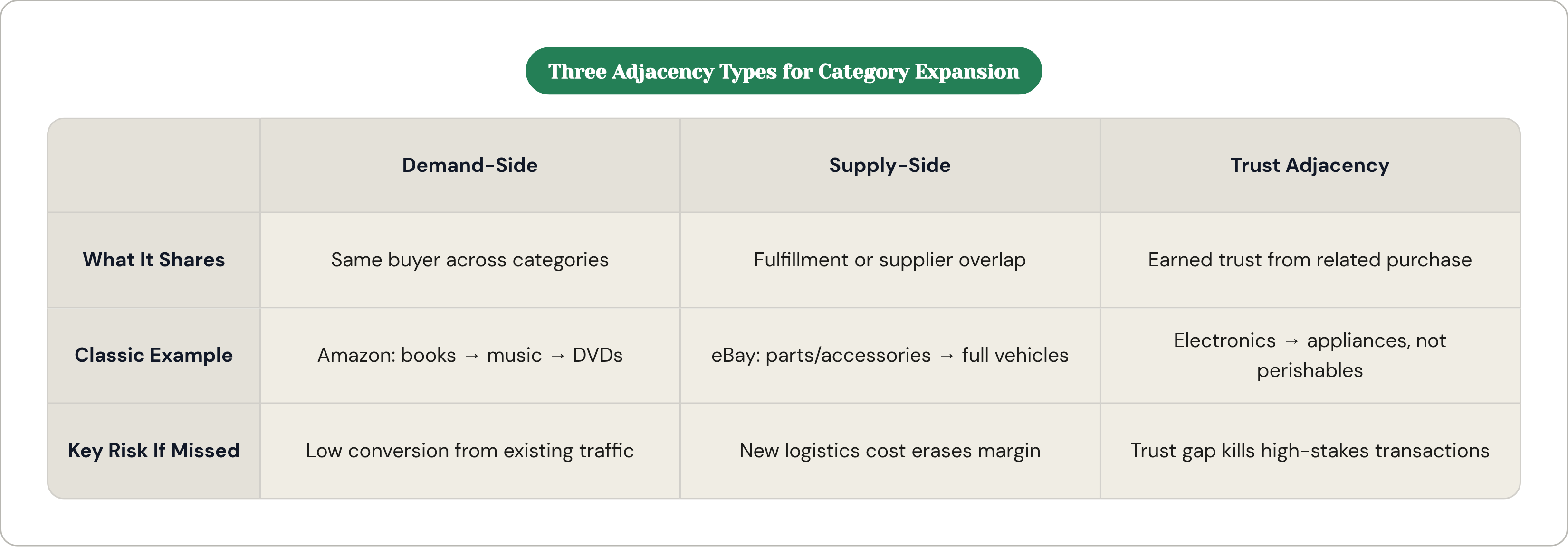
Adjacency comes in three flavors, and mixing them up is an easy way to launch the right category at the wrong time, or the wrong category at what felt like the right time: (i) demand-side adjacency, where categories share the same buyers; (ii) supply-side adjacency, where categories share fulfillment or supplier relationships; and (iii) trust adjacency, where a buyer who trusts you for electronics is more likely to trust you for appliances than, say, fresh seafood shipped overnight in a box.
Amazon's early move from books to music to DVDs checked demand-side and supply-side boxes at the same time: the same media-buying customer and a logistics footprint that translated naturally across all three formats. eBay Motors might be the cleanest supply-side example around, since vehicle parts and accessories built up trust well before full vehicle listings arrived, and that trust carried straight into much higher-stakes transactions.
If you're a platform operator picking the next category, a few things tend to hold up in practice. Start where your existing buyers already show intent; cross-category search data is often the clearest signal you'll get. Favor categories where third-party sellers bring their own inventory, so your capital isn't the thing at risk. And hold off on categories that need brand-new trust infrastructure, perishables, luxury authentication, and age-restricted goods, until what you've already built has survived real pressure.
If you're a seller picking a channel, the logic runs parallel but plays out differently. Walmart Marketplace tends to be the default second channel for repeat-purchase, commodity-adjacent goods: home items, grocery, health, household essentials. Walmart Marketplace has been growing rapidly, with seller counts and product volume both expanding sharply in recent years. TikTok Shop, on the other hand, suits products that are discovery-driven, visually demonstrable, and impulse-priced, but it runs on a completely different motion built around content and creators instead of search. You generally need a content engine already running before that channel is worth touching, otherwise you're essentially throwing product into a river and hoping something bites.
The filter underneath all of it stays the same: the right next category shares the most infrastructure with what already works, asks for the fewest brand-new trust investments, and lines up with buyer intent data you already have sitting in front of you.
Third-party sellers as the structural mechanism for expanding category breadth without inventory risk
Third-party sellers let a platform grow category breadth faster than owned-inventory economics could ever allow on its own. It's the mechanism that made both Amazon Marketplace and eBay's category explosion possible in the first place, and it's still the mechanism doing the heavy lifting today.
Walmart is running this playbook live right now, and the numbers back it up. The company crossed 200,000 active marketplace sellers for the first time in mid-2025. In just the first five months of 2025, 44,000 new sellers joined, versus 59,000 for all of 2024 combined, an acceleration rather than a steady climb; do the math and five months nearly matched twelve. Walmart.com now lists more than 420 million products, and 95% of them come from third-party marketplace sellers rather than Walmart's own inventory. CEO Doug McMillon reported marketplace sales growing 32% year over year in a recent quarter, growth coming from third-party category expansion, not Walmart stocking more shelves itself.
At Walmart's 2024 Marketplace Seller Summit, the company tied category expansion directly to its platform strategy, framing multichannel fulfillment tools and seller onboarding as the engine behind that broader assortment. Tesco offers a similar case: through its partnership with Marketplacer, Tesco extended its assortment well past groceries into home appliances and other non-grocery categories, using marketplace infrastructure to reach adjacencies it never could've staffed or stocked on its own.
But the risk underneath this growth is real. Quality and trust get harder to hold steady as seller count climbs into the hundreds of thousands. Moderation and policy systems need to scale ahead of onboarding, not scramble to catch up after things get messy, and stage three's trust requirement doesn't quietly excuse itself from the room just because the growth chart looks great on a slide.
How Walmart's live category expansion program shows the framework working at platform scale in 2025
Walmart's sequence, laid out plainly, looks like this: dominate physical retail in grocery and household essentials, extend that same catalog online, open marketplace expansion into adjacent categories like electronics, apparel, and home goods through third-party sellers, then layer multichannel fulfillment on top as the next capability. Each step builds on the last instead of skipping ahead to look impressive on an earnings call.
That jump from 59,000 new sellers across all of 2024 to 44,000 in the first five months of 2025 alone says something specific: this is a platform that already cleared its operational gates and moved into the repeating-loop phase, where each new category re-enters at the wedge stage and moves faster because the infrastructure underneath is already proven out.
Mexico is functioning as a live stress test for the same logic internationally, with marketplace sales growing 32% in a recent quarter there too, essentially applying the U.S. build as a template instead of reinventing sequencing from scratch. What that trajectory shows is that the underlying order, liquidity first, then trust, then breadth, then revenue, doesn't get disrupted by scale. If anything, scale reinforces it, since each category added on stable ground compounds faster than the one before it did.
Where does Walmart still run into friction? Roughly where you'd expect. Categories that need genuinely new trust infrastructure, luxury goods, perishable delivery, age-restricted products, get approached later and more cautiously. That's exactly what the trust-architecture stage would predict, and there's something satisfying about watching the theory and the earnings report actually agree for once.
The validation loop that decides whether to hold, accelerate, or pull back after each category addition
Every category addition is a hypothesis, not a commitment, and treating it like a permanent fixture is how platforms end up stuck running categories that never should've launched. The framework only compounds if you check each stage before the next one starts, and that check should run through a handful of concrete signals rather than gut feel or whoever's loudest in the Monday meeting.
A category has cleared when (i) match rate hits or clears that 70% threshold, meaning buyers are reliably finding sellers instead of browsing and bouncing; (ii) contribution margin holds above the 20% floor once ad spend has normalized, rather than looking artificially healthy during a launch promo; and (iii) review scores and fulfillment metrics in your existing stable categories show no sign of slipping, that stability tells you whether ops can actually carry the extra weight.
Holding steady instead of accelerating tends to make sense when (i) match rate sits below threshold, meaning supply exists but transactions just aren't forming, a clear sign the category is pre-liquidity no matter how full your listings page looks; (ii) customer service backlogs in the new category keep growing instead of shrinking, signaling that your trust architecture is under real strain; or (iii) hero SKUs in existing categories start showing stockout patterns, meaning the ops gate never actually held in the first place.
Then there's the pull-back signal: the margin gate got crossed, match rate is still flat after a full ad ramp cycle has run its course, and the category simply isn't adjacent enough to benefit from trust built elsewhere on your platform. Building brand-new trust infrastructure from scratch can cost more than whatever opportunity the category was chasing to begin with. You're often better off admitting that early and redirecting the effort than feeding a category that was never going to compound on its own, no matter how appealing it looked on the original slide deck.
Notes
- https://www.thinknectar.com/blog/step-by-step-marketplace-expansion-a-practical-guide-en
Supplied the 20% contribution margin floor and the four-to-six month breakeven timeline cited in the operational gates section.
- https://www.strategicaileader.com/marketplace-growth-strategy-liquidity-trust-and-revenue-expansion/
Provided the 70% match-rate threshold used as the liquidity validation benchmark in the four-stage framework.
- https://itoaction.com/2-brand-strategy-examples-of-new-category-expansion/
Supported the observation that a focused brand running fewer channels often outperforms a larger brand spread across many channels.
- https://quartr.com/insights/company-research/amazon-from-books-to-everything
Provided the detail on the Whole Foods acquisition in 2017 as a milestone in Amazon's grocery category expansion.
Every new piece from marketplace crunch, as it's published.
Follow