How Horizontal Marketplaces Compete Against Amazon
Frustrated Amazon sellers and fee pressure offer smaller marketplaces their real opening.
Amazon controls something like 37.8% of U.S. e-commerce, nearly six times Walmart's share, and that gap looks so lopsided that the natural question is why anyone still bothers competing in horizontal marketplaces at all. The answer is that the surviving competitors stopped trying to out-Amazon Amazon years ago. They picked specific, narrow terrain, fee structures, physical stores, weird inventory, and dug in there instead.
The real Amazon moat runs deeper than the market share number. Underneath it sits Prime's 250 million members worldwide, a fulfillment network built over two decades, and an advertising business that feeds off the other two and grows them in turn. Even more telling is who actually sells the stuff. Third-party sellers account for roughly 62% of units sold and about 69% of Amazon's total GMV, which means Amazon functions less like a retailer with a website and more like a landlord with a very large mall. That structure has a soft spot, and it's where this whole piece starts.
The fee structure that makes Amazon's seller base restless and competitors' opening real
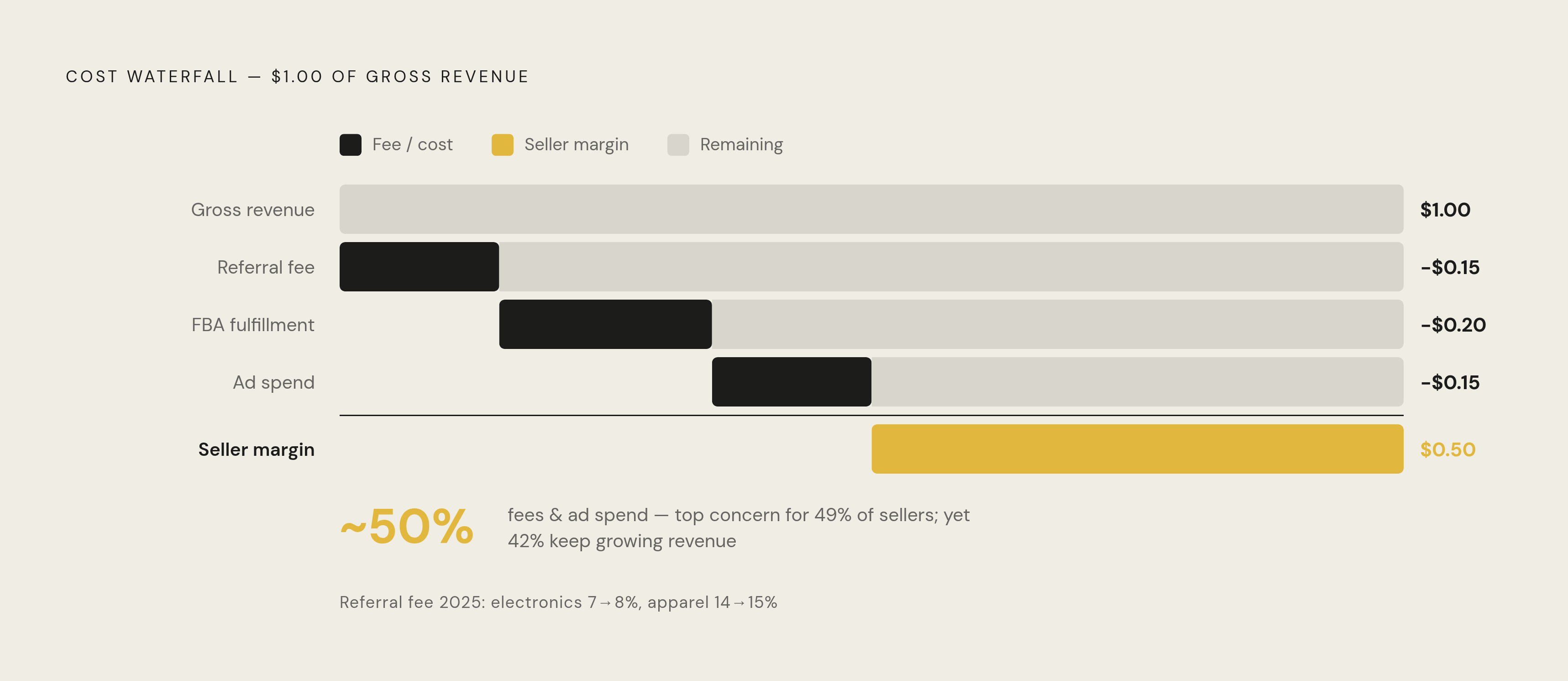
Here's a genuinely strange fact. Marketplace Pulse's 2026 Seller Index found that 49% of Amazon sellers name marketplace fees as their top margin concern, and in the same survey, 42% say they're actively growing their Amazon revenue anyway. Read that twice. Nearly half the sellers are annoyed at the toll booth, and nearly half are also pressing the gas pedal harder. That combination reads less like confusion and more like captivity.
Amazon holds around 36% of U.S. e-commerce and something like 70% of marketplace commerce specifically, so sellers stay for the same reason a shop stays on the only street with foot traffic, even as rent climbs. And the rent has climbed. Fees plus ad spend can eat up roughly half a seller's revenue on a typical sale, according to Modern Retail. Referral fees ticked up again in 2025 across several categories: (i) electronics went from 7% to 8%, (ii) apparel from 14% to 15%, and (iii) parts of beauty and home improvement faced further increases on top of that.
Then there's the part that makes sellers feel like they're being hunted rather than hosted. Amazon plays two roles at once, marketplace referee and marketplace player, selling its own private-label goods on the same shelf as the merchants paying it rent. One seller described watching a nearly identical Amazon-branded version of their product appear overnight, priced 20% lower, costing them 60% of their sales in the process. Whether or not that's the norm, it's the story every third-party seller has heard, and it's the story that makes the whole arrangement feel less like a partnership and more like a landlord who also happens to run a competing bakery in the space next door.
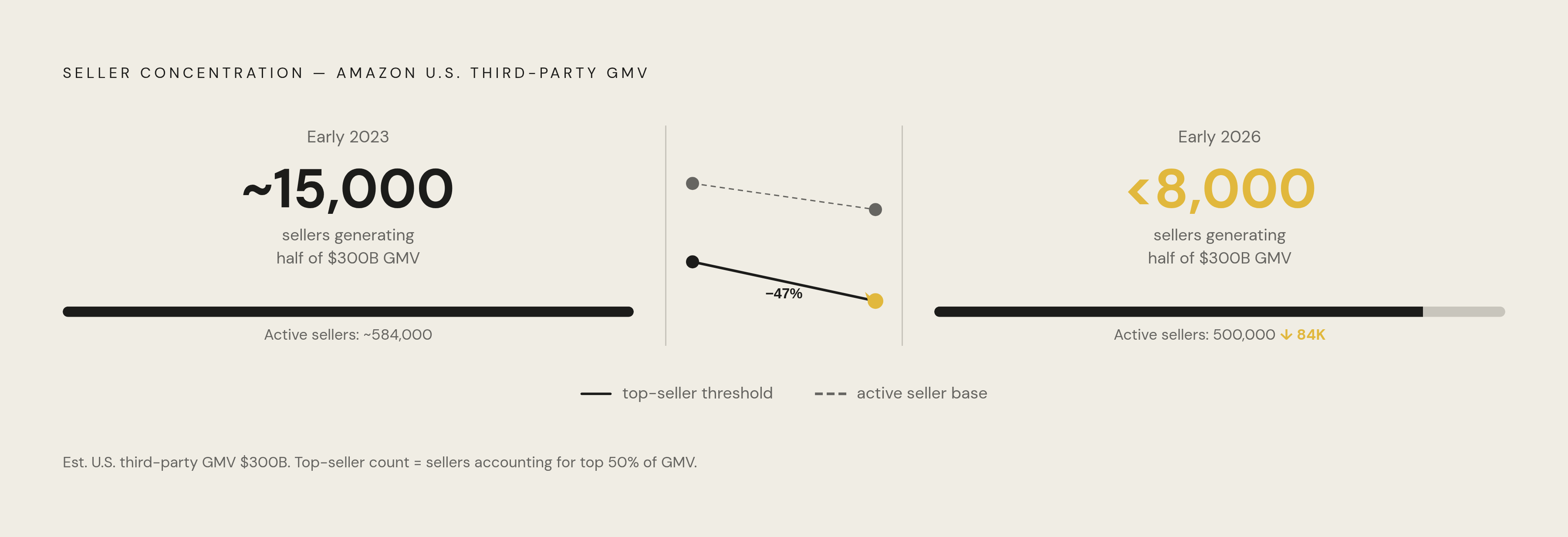
The seller base itself is shrinking and concentrating at the same time, which is an odd combination worth sitting with. Fewer than 8,000 sellers now generate half of Amazon's estimated $300 billion in U.S. third-party GMV, down from about 15,000 sellers holding that position less than three years earlier, per Marketplace Pulse. Active seller count overall dropped from 584,000 in January 2025 to 500,000 by March 2026. Fewer sellers, more concentrated among the biggest players; the smaller ones are either getting squeezed out or squeezed up.
That squeeze is the opening. A shrinking, frustrated seller base is a recruitment pool, and any competitor who can offer plainer fee math or fewer conflicts of interest has an actual pitch, not just a marketing slogan.
How Walmart uses physical infrastructure to compete on fulfillment reach rather than catalog breadth
The revenue numbers alone should embarrass anyone who still calls Walmart a legacy retailer playing defense. Amazon posted $716.9 billion in total revenue in 2025; Walmart came in at $713.2 billion. That's the tightest that gap has ever been, and it grew out of Walmart leaning into what its stores already were, rather than chasing Amazon's model.
It happened because Walmart bet its stores were an asset, not a liability. More than thousands of U.S. locations put the vast majority of Americans within 10 miles of a Walmart, a density Amazon spent years and untold billions trying to approximate through warehouse construction alone. Walmart has steadily lowered the cost of store-to-home delivery by spreading it across a growing customer base that was already walking through the door for groceries. Amazon, starting from a warehouse-only footprint, had to build that density from scratch, which is a much more expensive way to arrive at the same place.
The marketplace side is growing fast enough to matter on its own: (i) over 150,000 third-party sellers, (ii) more than 120 million monthly visitors, and (iii) online sales near $150 billion for fiscal 2026, up more than 20% year over year. Walmart Fulfillment Services was built in direct response to seller complaints about Amazon's FBA model, with simpler pricing and none of the long-term storage penalties that have become a running grievance among Amazon sellers.
Then there's GoLocal, which is the part of this story that reads almost like a punchline: Walmart, the company famous for selling you a 12-pack of paper towels, now sells its delivery trucks as a service to other retailers. GoLocal completes deliveries from more than 5,000 business locations for partners including Home Depot, 1-800 Flowers, and Sur La Table. Walmart treated logistics itself as a product worth charging for, rather than mere internal plumbing.
Prime Day is the clearest proof that attention isn't Amazon's alone to keep. When Amazon's web traffic jumped sharply during Prime Day 2025 compared with the prior 21 days, Walmart, Target, Best Buy, and Temu all posted their own double-digit traffic increases in the same window, according to Similarweb. Amazon lit the flare, and everyone else's stores got busier too.
None of this makes Walmart's model bulletproof. It still competes mostly on price and convenience, and as its own marketplace scales, its fee advantage over Amazon will likely narrow the way every cost advantage narrows once the operation gets big enough to need its own margin protection.
How eBay survives by owning the inventory categories Amazon can't commoditize
eBay took the opposite approach from Walmart: instead of matching Amazon's physical reach, it walked away from the categories where Amazon wins by default. A large and growing share of eBay's GMV now comes from non-new inventory: used goods, one-of-a-kind items, refurbished electronics, collectibles, luxury resale. These are categories where the buyer cares about condition and provenance more than whether it arrives Tuesday or Wednesday.
This is less eBay retreating from competition than eBay picking a fight Amazon's own strengths make it bad at. A warehouse optimized for pallets of identical new merchandise is the wrong tool for a single 1974 baseball card or a used guitar with a story attached. eBay's billions of live listings represent a kind of inventory depth that resists exactly the kind of standardization Amazon's fulfillment machine is built for.
Five focus categories, among them (i) fashion, (ii) collectibles, and (iii) auto parts and accessories, each cleared billions in global GMV in 2025, while eBay's overall GMV grew about 6% to tens of billions globally, per Digital Commerce 360. Focus categories alongside the C2C business and recommerce represented a large and growing portion of total GMV, and domestic U.S. GMV grew meaningfully, carried by collectibles, auto parts, fashion, and refurbished goods.
The advertising number is worth pausing on: eBay's ad revenue has grown at a strong double-digit pace year over year. eBay earns that money by helping sellers get noticed, a meaningfully different relationship with sellers than the fee-driven one Amazon runs.
The Depop acquisition extends this logic toward a younger crowd and a more social, scroll-and-discover shopping format. Depop brings a built-in community eBay never quite grew organically. eBay Live, meanwhile, has seen rapid GMV growth year over year, which suggests livestream selling fits naturally with categories where trust and discovery matter more than price-matching.
The lesson sits right there in the numbers: eBay's moat is that its best categories need a human eye, a seller's judgment call, and a buyer willing to trust both. Amazon's advantages simply don't transfer to a product that can't be shelved, scanned, and shipped like a can of soup.
What the Temu and Shein episode reveals about regulatory exposure as a competitive dimension
Temu's rise looked, for a while, like proof that a horizontal marketplace could out-Amazon Amazon on price alone. It became one of the most-visited e-commerce platforms in the world by selling goods shipped directly from Chinese manufacturers at prices that seemed to defy basic shipping economics. Those prices rested on the de minimis exemption, which let small packages enter the U.S. duty-free, more policy quirk than supply chain innovation, and policy quirks have an expiration date nobody puts on the label.
The date arrived in early May 2025, when the de minimis exemption for Chinese shipments was eliminated. The effect was immediate: Temu's U.S. user activity fell sharply in the weeks after the policy change took effect. Then the exemption was broadened to cover shipments from every country, closing off whatever arbitrage room was left for anyone trying the same playbook.
Here's the thing worth sitting with: a pricing advantage built on a loophole functions more like a countdown timer than a strategy. Walmart's store network and eBay's inventory categories survive a change in tariff policy because neither one depends on tariff policy in the first place. Temu's core pitch did, and when the exemption closed, so did most of the gap between its prices and everyone else's.
The takeaway, if you're running or evaluating a horizontal marketplace, is that the dimensions worth building on are the ones regulators generally can't switch off overnight: (i) seller economics, (ii) fulfillment reach, (iii) category trust. A regulatory accident might get you a fast few years, but building a durable moat takes something sturdier.
The competitive dimensions that actually hold — and what they have in common
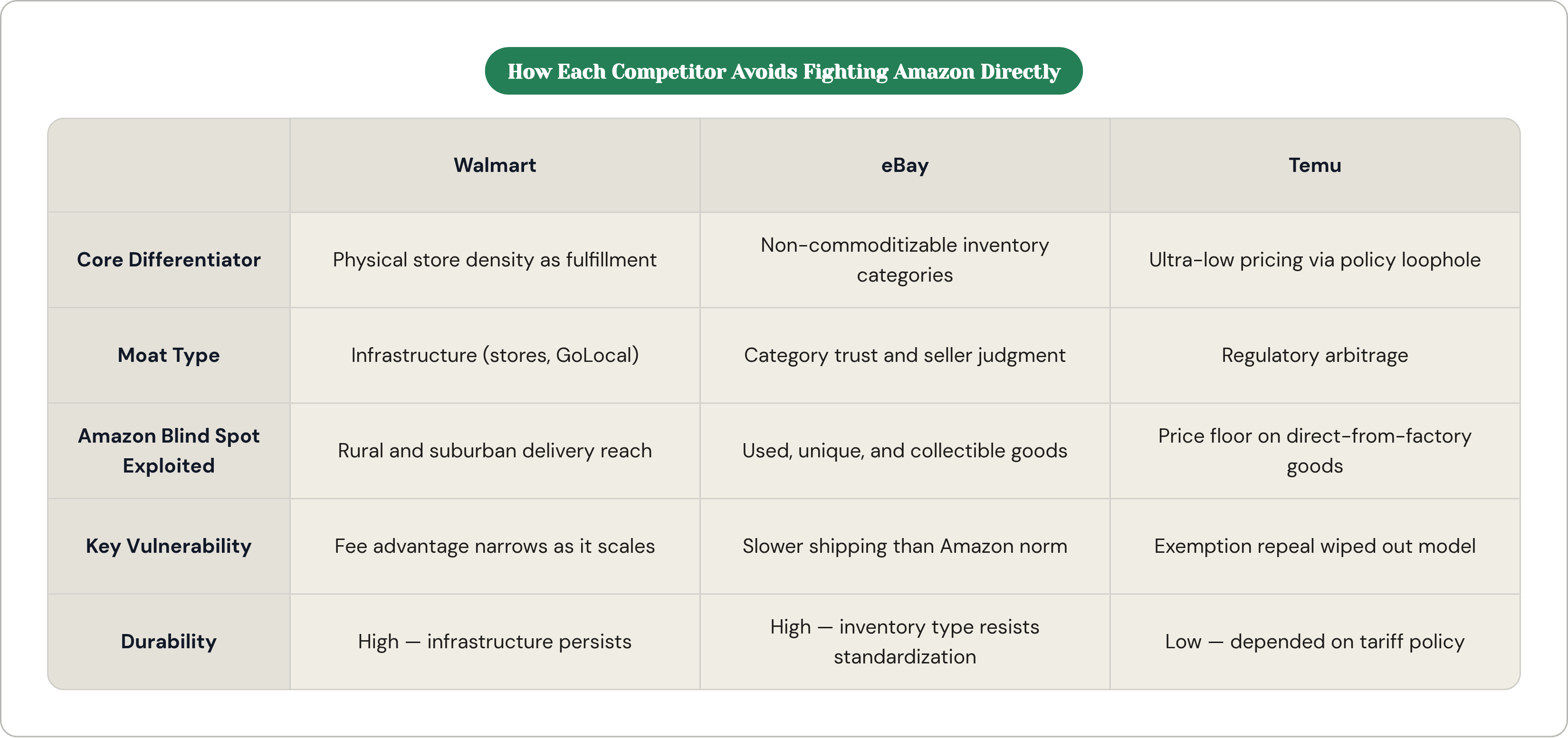
Line up Walmart, eBay, and Temu's cautionary tale side by side, and a pattern shows up almost immediately. Every strategy that's held up picks a spot where Amazon's scale becomes a blind spot instead of an advantage, rather than trying to beat Amazon at being Amazon.
Four dimensions keep surfacing across these cases. Fulfillment reach into places Amazon's network doesn't serve well, which is Walmart's suburban and rural store density doing double duty as a delivery hub. Seller economics: lower fees, simpler rules, fewer conflicts of interest, aimed straight at the sellers Amazon's own fee structure is pushing toward the door. Inventory that resists being turned into a commodity, used goods, one-offs, collectibles, where a warehouse-first model is simply the wrong shape for the problem. And ecosystem lock-in through community or format, the kind eBay Live and Depop are chasing, where buyers show up for the experience and not just the price tag.
The strategies that don't hold are the ones that try to fight Amazon on its own turf: matching its catalog size, matching its shipping speed without owning a comparable physical network, or riding a regulatory gap that anyone with a customs form can close.
There's a recruitment angle sitting underneath all of this that you can easily miss if you only look at market share charts. Active Amazon sellers dropped from 584,000 to 500,000 in fourteen months, and fee pressure is climbing at the same time. That's a growing pool of merchants actively looking for somewhere else to sell, and if you can offer genuinely simpler economics, you have a real shot at catching them through math a seller can verify on their own spreadsheet.
Worth being precise about one thing: none of this is a story about niche marketplaces retreating into a corner. Walmart, eBay, and even Temu before its business model hit a wall are broad, horizontal platforms. What separates the ones still standing from the one that got hollowed out by a tariff change is whether they picked a dimension solid enough to build a business on, or borrowed one that was never really theirs.
So the useful question, whether you're running one of these marketplaces or selling through one, is which specific thing you can be good enough at that a buyer, or a seller, chooses you on purpose, not because Amazon happened to be down that day.
Notes
- https://goaura.com/blog/top-amazon-competitors
Supplied the 2025 total revenue figures for both Amazon and Walmart used to illustrate how close the two companies have become.
- https://amzprep.com/top-amazon-competitors/
Provided the Walmart Marketplace figures for third-party seller count and monthly visitor numbers.
- https://www.digitalcommerce360.com/2026/05/07/ecommerce-trends-how-online-retailers-compete-against-amazon/amp/
Provided eBay's GMV growth figure and focus category performance data cited in the eBay section.
- https://www.modernretail.co/operations/how-walmart-is-building-its-last-mile-delivery-service-golocal-to-compete-with-amazon/
Provided details on Walmart's GoLocal delivery service, including its partner businesses and the number of locations it serves.
Every new piece from marketplace crunch, as it's published.
Follow