Supplier Acquisition Costs in Horizontal Marketplace Scaling
Why supplier costs spike differently at each stage of horizontal marketplace growth.
Supplier acquisition costs change shape entirely as a horizontal marketplace grows. What costs $150 to fix in stage one becomes a far costlier problem in stage three, and the channel that worked at launch stops working the moment you bolt on a fifth category.
Horizontal marketplaces sell breadth. Etsy sells far more than candles, Amazon sells far more than books, and the pitch to buyers is always some version of "come here for everything." Great story for demand. On the supply side, it's a headache, because breadth means you're not an expert in any one thing, and suppliers figure that out fast.
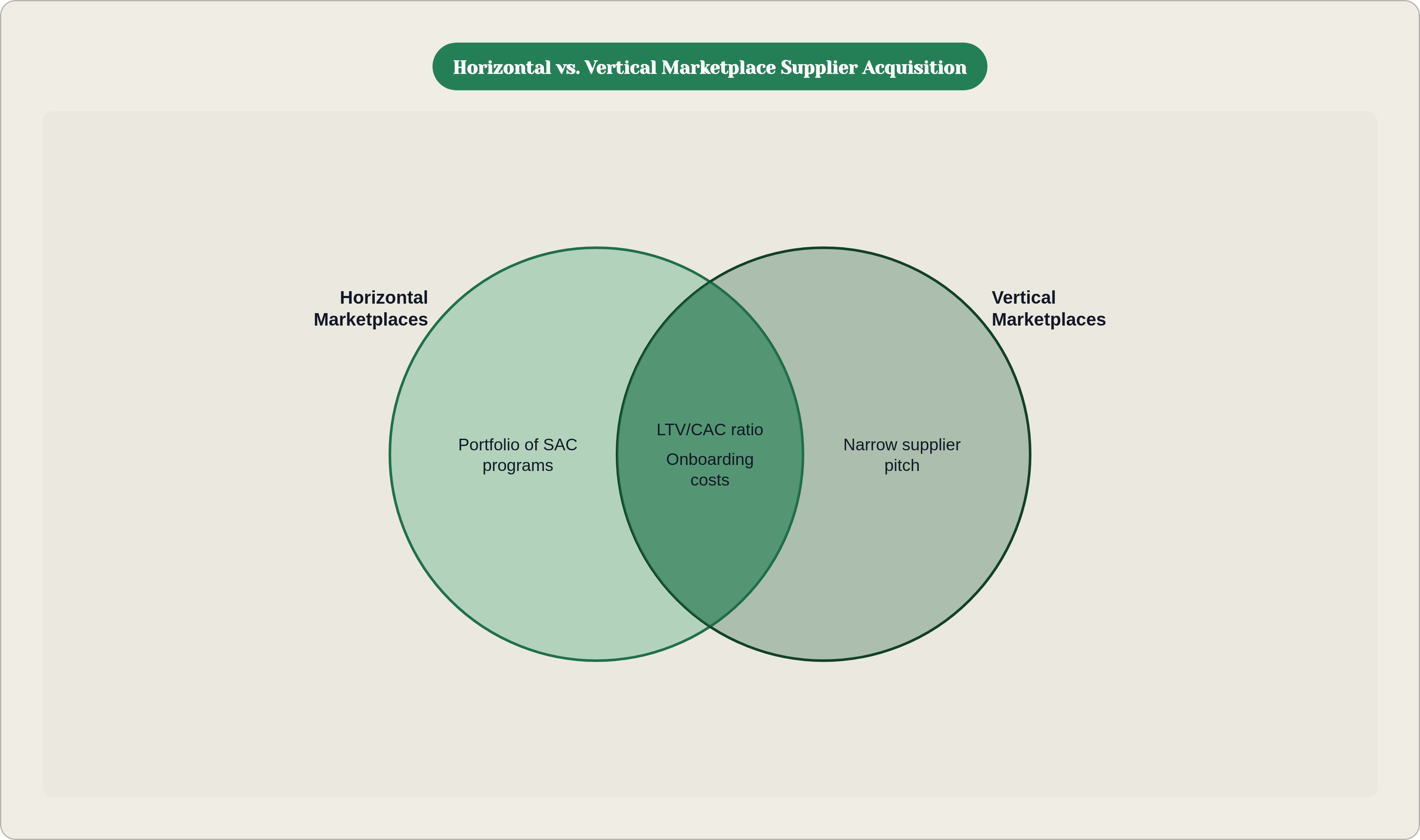
Vertical marketplaces get the easier road. A platform built only for freight logistics, or only for wedding photographers, can pre-negotiate compliance, build category-specific vetting, and hand suppliers a pitch so narrow it almost writes itself: reach buyers who need exactly what you make, through workflows built only for you. Horizontal platforms carry a weaker pitch by comparison. Theirs defaults to "reach more buyers," which is true and also thin, and thin pitches convert worse and cost more to close. Add in low barriers to entry, meaning a horizontal platform fights new entrants on price and product at once, and suppliers know exactly how much leverage they hold. So horizontal operators end up running what's really a portfolio of separate supplier programs, one per category, each with its own channels and incentives and trust signals. It looks less like one company and more like ten small shops sharing a login page.
Before going further, the terms need pinning down. Supplier acquisition cost (SAC) is all the marketing and operational spend to attract and sign up sellers, divided by the sellers you actually land. It looks like buyer CAC on paper, but the two behave differently, and treating them the same is one of the more common mistakes I've watched operators make. In one representative marketplace startup model, buyer CAC sits around $30 while seller CAC runs closer to $150, a 5x gap. That gap isn't random. Sellers face higher switching costs and carry more strategic weight, so they cost more to land.
How the chicken-and-egg problem shapes supplier acquisition spending before the platform has scale
Every marketplace operator learns to live with this loop: no selection means no buyers, and no buyers means no reason for a supplier to bother listing. Horizontal platforms hit this fresh every time they open a new category, because a buyer base built on furniture tells a plumbing-supply vendor exactly nothing about actual demand.
Early on, subsidizing supply beats subsidizing demand. Ask who's taking on more risk and the reasoning falls into place: suppliers commit inventory, time, and reputation to a platform with zero track record, while buyers just click a link. The math favors paying suppliers to show up first.
Operators lean on a handful of well-worn plays. Direct financial subsidy is the Uber move, guaranteeing drivers an hourly rate no matter how many rides show up, or the ClassPass move, paying gyms upfront before a single member walks in. Single-player mode means building something useful to suppliers on its own, a scheduling tool, an inventory tracker, so they adopt it before the marketplace side even matters. Supply seeding means pre-building listings before suppliers show up: Thumbtack built out skeletal listings across roughly 1,000 categories at its U.S. launch, so professionals could just claim a profile that already existed. Then there's the one nobody likes to say out loud, sometimes called a vampire attack: find suppliers already active on a competitor's platform and pull them over, turning someone else's hard-won liquidity into your own pipeline. Aggressive, sure. Also common enough that pretending otherwise would be dishonest.
What ties these together is discipline. Subsidies need an end date and a condition attached, tied to actual listings or completed orders, rather than a signature on a sign-up form. Paying suppliers indefinitely just to exist on the platform builds a cost center with no return attached. And because horizontal platforms hit this chicken-and-egg wall with every new category, the cost never stays a one-time launch expense. It comes back, baked into the model, every time the platform decides to grow sideways instead of down.
What onboarding actually costs once a supplier has been recruited
Onboarding is typically the largest and most underestimated component of supplier acquisition cost. Most people treat SAC as a marketing line item, but that view misses the bigger piece: onboarding is often the largest chunk of the true cost, and plenty of SAC math quietly leaves it out, which understates the real number by a lot.
The spread here is wide enough to be almost funny. Manual onboarding in enterprise or compliance-heavy settings can run up to $35,000 per supplier. Automate it and that number can drop to $2,400 or less, a tenfold difference. A separate estimate, citing Kodiak Hub's 2023 figures, puts average manual onboarding closer to $700 to $1,000 per supplier, with automation cutting 60 to 80% off that. These numbers don't really fight each other; they just reflect how differently "onboarding" gets defined depending on the industry and how much compliance weight it's carrying.
Cost isn't the only variable doing damage. Timing matters just as much. More than 80% of companies only find supplier risks after onboarding wraps up, so expensive surprises show up late, and often. Onboarding that drags past 14 days raises churn risk in a way that quietly wrecks the lifetime value math that justified the spend in the first place. Walmart Marketplace is a useful counterexample: it got seller onboarding under two weeks for most U.S.-based businesses, and that speed gets cited as a direct driver behind its 40% year-over-year seller growth. Speed is its own acquisition channel, it turns out, whether or not anyone budgets for it that way.
For horizontal platforms this gets messier by category. Compliance rules for a food and beverage seller look nothing like the integration requirements for an electronics vendor, so one standard onboarding flow just doesn't hold up once you're running across a handful of unrelated verticals.
How rising acquisition channel costs are compressing the economics of horizontal supplier recruitment
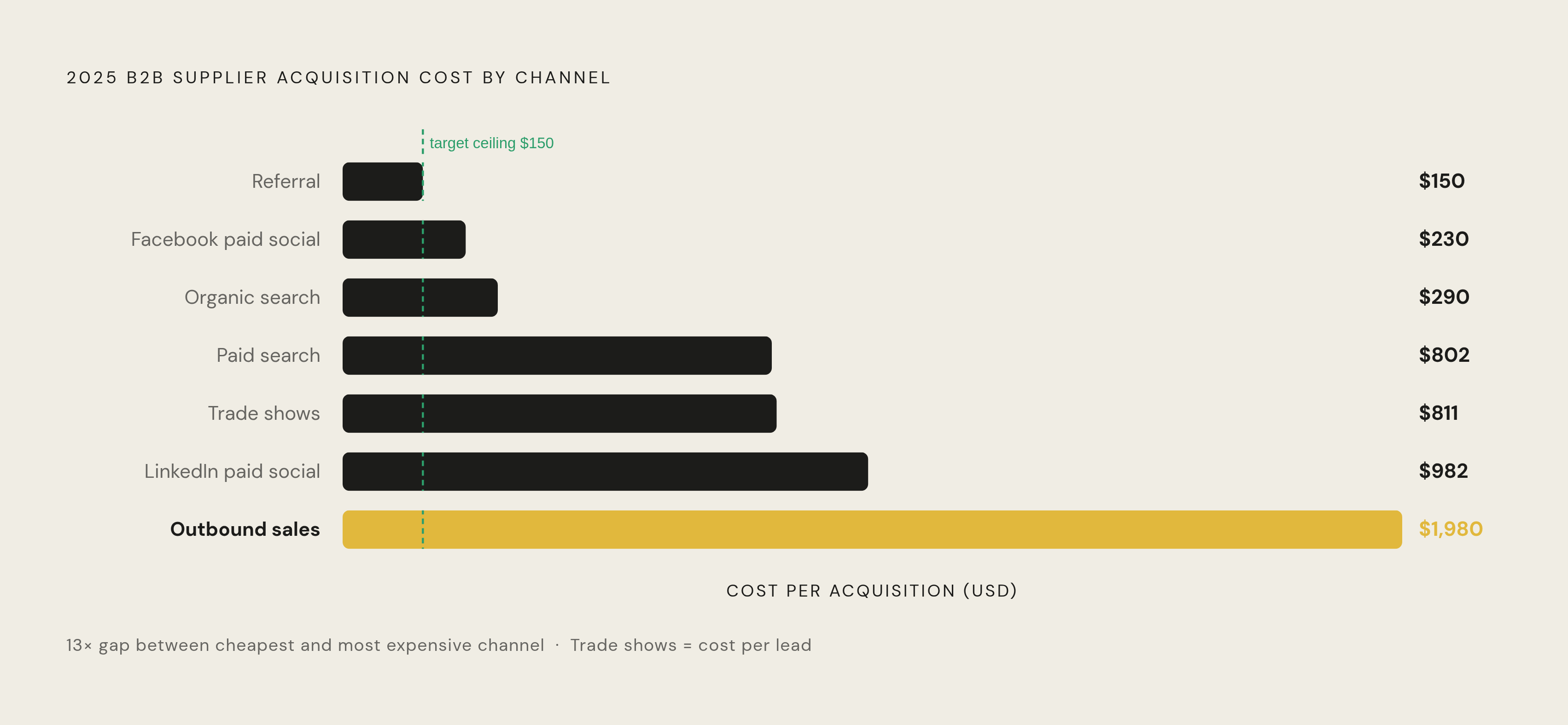
The whole industry has gotten pricier to play in. Customer acquisition costs have climbed 222% over the past eight years, driven by tougher competition, pricier digital ads, and buyer (and seller) journeys that keep adding steps. Between 2023 and 2025 alone, CAC jumped 40 to 60% across channels. It's the speed of that climb, more than the total, that should worry anyone planning a multi-year category rollout.
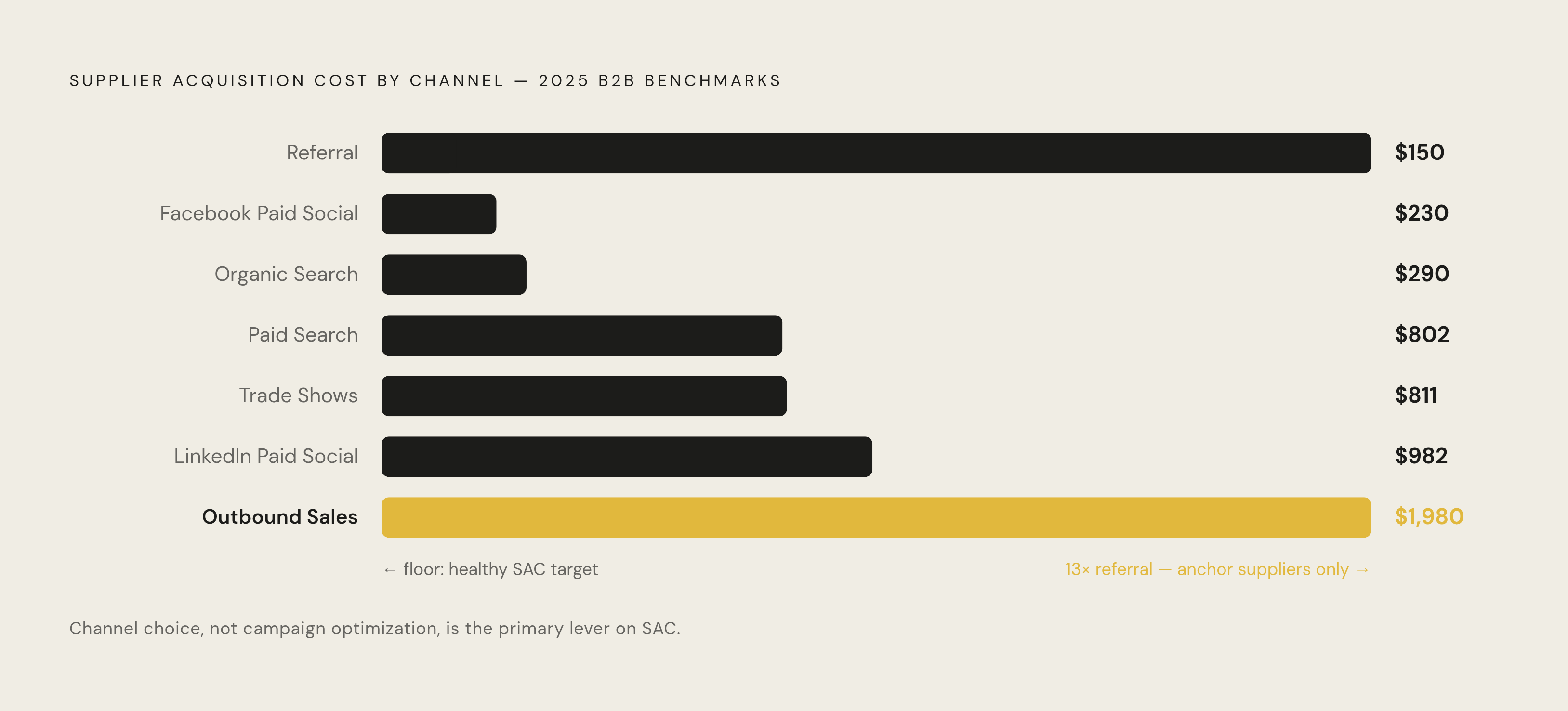
The 2025 B2B channel numbers get specific fast. Referral programs sit at the bottom, around $150 in CAC, which also happens to be roughly the ceiling a healthy seller CAC ratio should target. Organic search runs about $290, though it demands real upfront work before it pays off. Paid social splits wide depending on platform: Facebook comes in around $230, LinkedIn closer to $982, the latter relevant if you're chasing professional or B2B suppliers specifically. Paid search in a B2B context averages $802. Outbound sales tops the list at $1,980, which makes sense once you realize it's the tool for landing anchor suppliers whose presence can unlock an entire category by itself. Trade shows carry the highest cost per lead at $811, but they're doing a different job entirely: building relationships that no banner ad or LinkedIn message can fake.
Every channel eventually hits a ceiling. Paid social and paid search audiences saturate. Organic and referral scale better long-term but demand patience and early spend that doesn't pay off right away. For a horizontal platform this gets harder still, because supplier audiences split apart by category: a channel that works great for recruiting boutique jewelry makers does nothing for industrial parts distributors. One channel strategy can't cover a fragmented base, so blended SAC climbs the more categories you bolt on.
How the LTV/CAC ratio reveals whether a horizontal platform's supplier acquisition engine is structurally sound
The LTV/CAC ratio is the clearest signal of whether a horizontal platform's supplier acquisition engine is structurally sustainable or quietly burning value. Supplier LTV runs higher than buyer LTV in most cases, since one supplier can sit inside hundreds of transactions where a single buyer might only make a handful of purchases. But that higher ceiling comes with more swing too, especially across categories, which makes horizontal platforms genuinely tricky to size up at the aggregate level.
An LTV to CAC ratio under 2:1 is a warning sign: the acquisition engine burns more value than it creates. Get to 3:1 or better and you've got something that actually scales. The ratio is also touchy about onboarding delays; push onboarding past that 14-day mark and you compress early LTV before the supplier's even started generating GMV, so the spend is sunk while the return hasn't started.
Horizontal platforms trip into a specific modeling trap here. A supplier selling electronics generates wildly different lifetime value than one selling handmade crafts, and blending both into one platform-wide LTV number hides which categories are actually worth recruiting into. Running the ratio per category, not per platform, fixes this. A marketplace that looks perfectly healthy in aggregate might just be quietly using its profitable core categories to cross-subsidize a handful of expensive, low-return ones. If you track seller CAC separately from buyer CAC, and build LTV models category by category, you get to make real calls about where the next dollar goes. If you don't, you're flying on a blended average, and a blended average tends to look fine right up until it doesn't.
Where network effects actually reduce supplier acquisition costs — and where they don't
Network effects can meaningfully lower supplier acquisition costs, but only within the specific category and geography where density has been built. The promise is simple enough: hit critical mass and new supplier acquisition starts partly paying for itself. Liquidity pulls suppliers in on its own, word-of-mouth takes over from paid channels, and the platform's own name becomes a recruiter. Without that flywheel, growth stays flat and expensive, and each new supplier costs roughly the same to land as the last one no matter how big the platform gets.
Amazon's third-party seller base is the textbook endpoint. Around 1.9 million active sellers globally in 2025, generating roughly $575 billion in third-party GMV. That's a self-reinforcing base a new entrant genuinely cannot buy their way into replicating through paid channels alone, no matter the ad budget thrown at it.
Network effects don't solve everything, though, and horizontal operators tend to overestimate how far the effect stretches. In on-demand service categories, once response times cross some "good enough" line, throwing more supply at the problem stops mattering much, and a smaller competitor can match perceived quality without matching supplier count. Liquidity built in apparel doesn't automatically carry over to home goods either; a platform dominant in one category still eats the full cold-start acquisition cost entering an adjacent one. Geographic network effects stay stubbornly local, too. Density in Austin does nothing for launch costs in Denver.
OfferUp is worth studying here: the company spent roughly two years building out just the Seattle market before expanding anywhere else, keeping the geography narrow on purpose so interaction density could actually take hold. The temptation for horizontal platforms is to expand categories and geographies at the same time, because it looks like faster growth on a slide deck. That move keeps network effects from forming in the first place, and it's a big reason blended SAC stays stubbornly high for platforms that spread themselves thin too early.
How supplier acquisition cost structure changes at each horizontal scaling stage
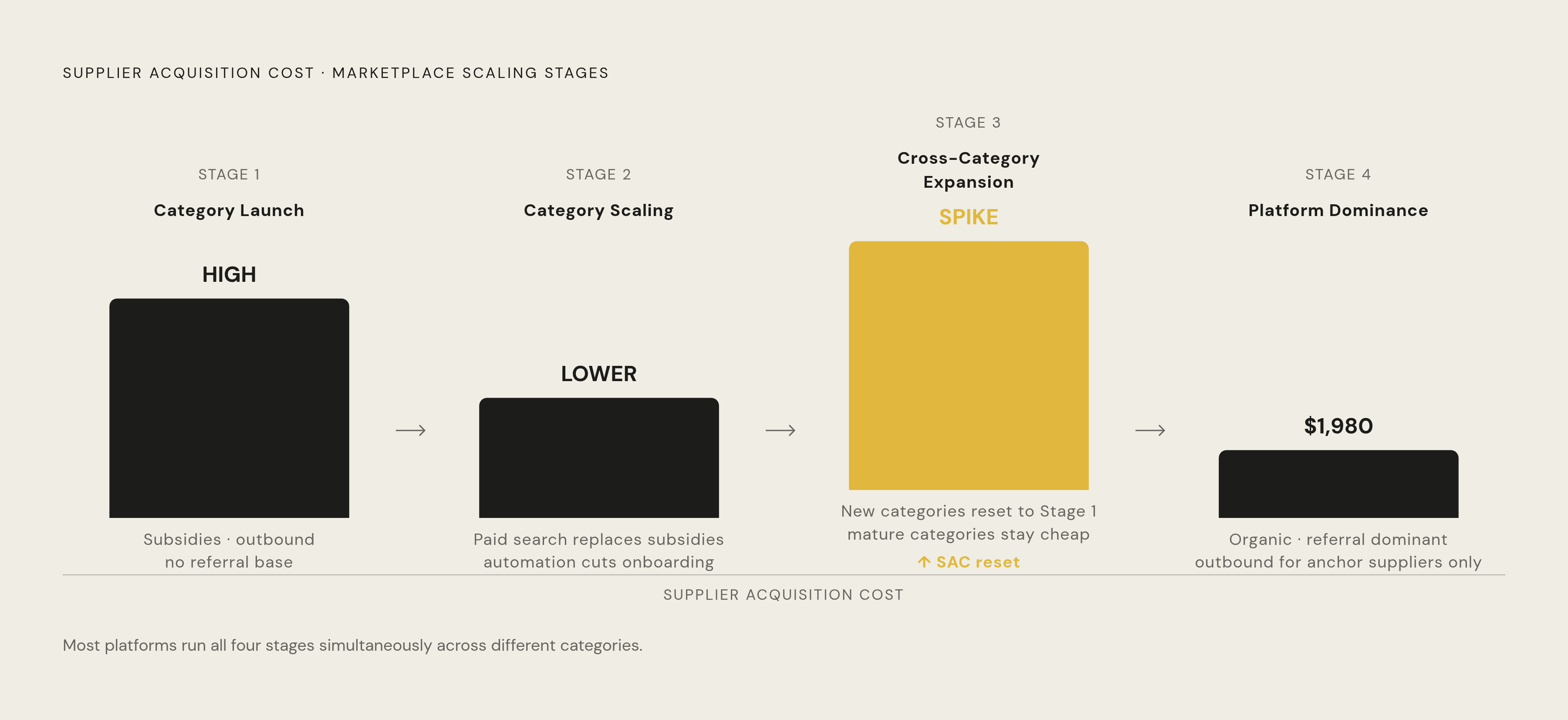
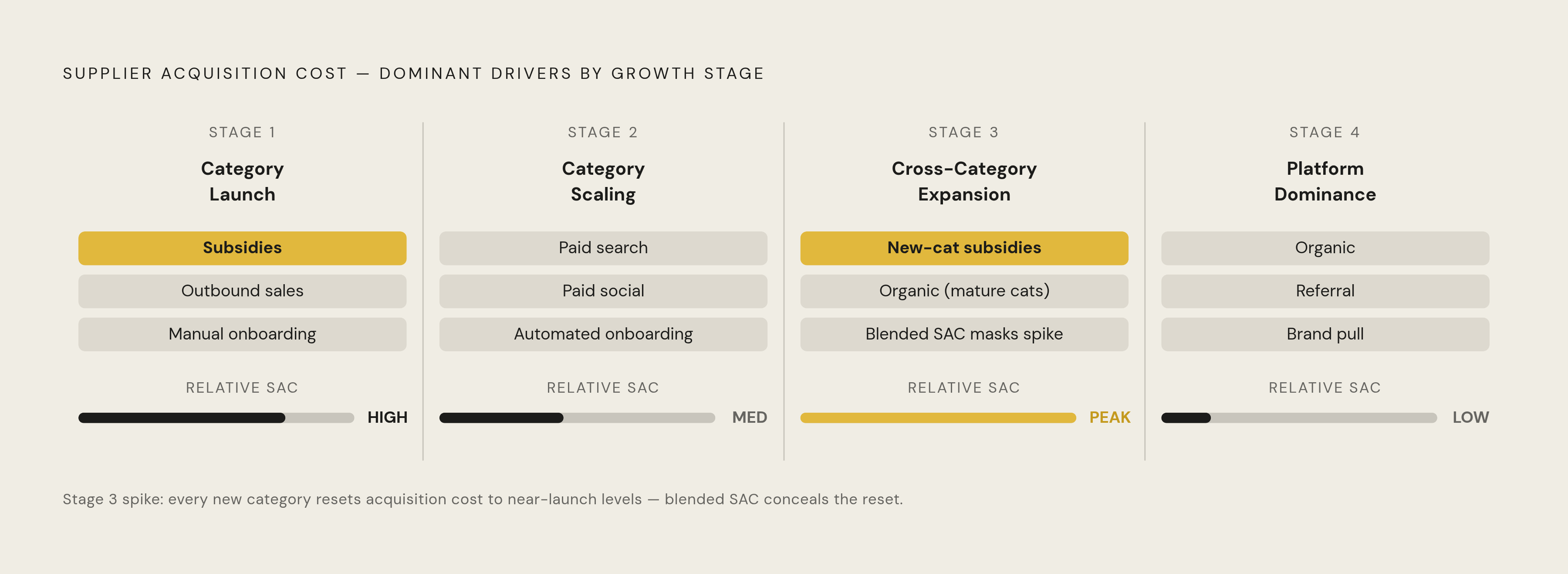
Four rough phases, each with its own cost shape. Most horizontal platforms are running several of them at once without quite admitting it to themselves.
Stage one, category launch: SAC leans hard on subsidies and outbound sales, because you're paying suppliers to override their own risk aversion. Referral and organic channels barely register since there's no base yet to refer from. Onboarding runs expensive because nothing's standardized yet.
Stage two, category scaling: paid channels like search and social start replacing direct subsidies. Onboarding automation kicks in and starts trimming the operational half of SAC. Real transaction data finally makes LTV modeling possible instead of guesswork. The main risk here is impatience: opening the next category before the current one has actually crossed its network-effect threshold.
Stage three, cross-category expansion: SAC spikes again, but only in the new category, resetting almost to stage-one conditions there, even as mature categories keep enjoying cheaper organic acquisition. This is the messiest stage, since the platform is running acquisition programs at wildly different levels of maturity all at once.
Stage four, platform dominance: organic and referral carry most of the weight, outbound gets reserved for the rare anchor supplier worth the $1,980 price tag, and the brand itself starts working as an acquisition asset. This stage only shows up, though, in categories where density got built on purpose, not rushed.
The complication for horizontal platforms is that they're rarely sitting in just one stage. They're in all four at once, spread across categories, and a single blended SAC number hides that completely, so budget gets handed out as if every category were equally mature when they clearly aren't. Marketplaces made up 62% of global retail e-commerce sales in 2024, which says something about how crowded this game already is; the window to reach stage four in any given category keeps narrowing as more operators chase the same pool of suppliers. Operators who map their category portfolio against these four stages, and spend accordingly, tend to beat the ones running one strategy across the whole platform.
What content and go-to-market infrastructure reduces supplier acquisition costs structurally rather than tactically
The most durable reductions in supplier acquisition cost come from structural infrastructure, (i) referral programs, (ii) organic content, and (iii) clear onboarding documentation, not from tactical campaign adjustments. Two kinds of improvement exist here, and they're not the same thing. Tactical work, tweaking ad copy, adjusting bids, testing subject lines, shaves a bit off SAC at the margins. Structural work runs deeper: it comes from building things that get cheaper to run per additional supplier, month over month, without anyone touching them again.
Referral programs are the clearest example, sitting at that $150 CAC floor across 2025 B2B benchmarks, because trust already exists between an active supplier and whoever they're referring. Build referral mechanics into the onboarding flow from day one and you've made a durable investment, worth far more than a campaign that runs for a quarter and gets switched off.
Content works the same way, just slower to pay off. Organic search CAC runs around $290, cheaper than most paid options though not all: Facebook's paid social actually beats it at $230. The upfront work of building supplier-facing content, category guides, plain explanations of seller economics, clear onboarding documentation, is something most horizontal platforms underinvest in, because all the attention goes to buyer-side growth instead. A well-ranked guide explaining how to sell in a specific category can become a lead source that keeps generating inbound supplier interest at close to zero marginal cost, long after anyone last touched the original draft.
The content that actually converts suppliers centers on the economic case, (i) real demand signals in that category, (ii) buyer intent data, and (iii) honest GMV expectations, ahead of any tour of the dashboard. Onboarding documentation deserves the same care, because clear step-by-step instructions cut support tickets, shrink time-to-active, and protect early LTV, which loops right back to the ratio that decides whether the whole acquisition spend was worth it in the first place.
Producing this kind of content across a dozen fragmented supplier segments at once is less about writing one good guide and more about doing it again and again without the quality falling apart by category five. That's an operations problem as much as a writing one, and it's usually where horizontal platforms quietly give up and let the content go stale.
Notes
- https://clearomni.com/blog/how-to-scale-a-multi-vendor-marketplace-proven-growth-strategies
Provided the 40–60% CAC increase figure across channels between 2023 and 2025, and the 62% global retail e-commerce marketplace share figure for 2024.
- https://www.phoenixstrategy.group/blog/cac-benchmarks-by-channel-2025
Supplied the 2025 B2B channel-level CAC benchmarks used throughout the article, including figures for organic search, Facebook, LinkedIn, paid search, and outbound sales.
- https://genesysgrowth.com/blog/customer-acquisition-cost-benchmarks-for-marketing-leaders
Provided the $811 cost-per-lead figure for trade shows cited in the channel benchmarks section.
- https://www.gtm8020.com/blog/customer-acquisition-cost-statistics
Provided the statistic that customer acquisition costs have risen 222% over the past eight years.
Every new piece from marketplace crunch, as it's published.
Follow