Content Marketing for B2B SaaS Marketplaces
B2B buyers build vendor shortlists before sales ever enters the conversation.

Here is a number that should reorganize how SaaS marketing teams think about their entire content operation: 92% of B2B buyers only purchase from vendors already on their Day-1 shortlist, according to Wynter's State of B2B SaaS Brand Marketing report. Not the shortlist formed after a sales call. The one formed before the buyer ever speaks to a rep, before they fill out a demo request form, before they have even articulated the problem internally in any formal way. And 81% of B2B buyers select their preferred vendor before speaking with sales at all.
The shortlist is built from ambient information. Organic search, review platforms, peer communities, and, increasingly, AI-generated answers. Getting on that list is the whole game. Everything else, the nurture sequences, the demo calls, the proposal process, is executed on a playing field that was defined weeks or months earlier by the content a buyer encountered when they were barely paying attention.
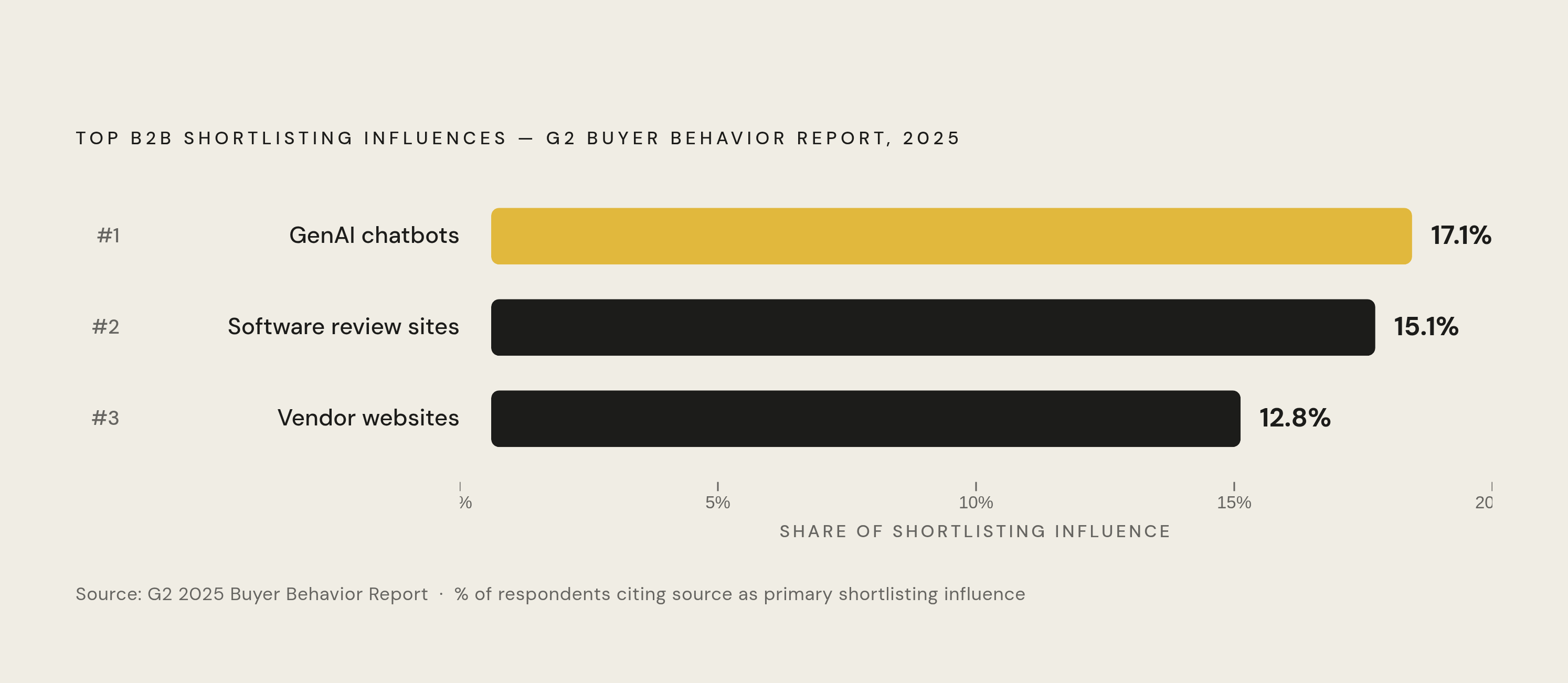
What makes this more urgent is where shortlist formation is now happening. G2's 2025 Buyer Behavior Report found that GenAI chatbots are the number-one source influencing B2B vendor shortlisting at 17.1%, ahead of software review sites at 15.1% and vendor websites at 12.8%. A brand that has invested heavily in its website while neglecting its review platform presence, its organic search authority, and its visibility in AI-indexed content is not just underperforming. It is being filtered out before the conversation starts.
Most SaaS content calendars are built around nurturing known prospects. That is the wrong frame. The real job is building brand authority across the channels that shape shortlist formation before buyers formally begin their search. The funnel starts earlier, and it is considerably wider, than pipeline-focused content planning typically acknowledges.
Segmenting the Audience Before Planning a Single Piece of Content
Multi-stakeholder deals are not a nuance of B2B SaaS buying; they are the defining structural feature. Technical evaluators, economic buyers, and end users each arrive at a piece of content with different concerns, different vocabularies, and different definitions of what a credible answer looks like. One content strategy cannot serve all three simultaneously, and the attempt to do so usually produces content that serves none of them well enough to matter.
Technical evaluators, typically developers, IT leads, or security architects, need API documentation, integration guides, security whitepapers, and feature comparisons detailed enough to survive actual scrutiny. They are looking for evidence the product works as advertised and will not create problems downstream. Marketing copy written for a general audience is nearly invisible to them. They scroll past it looking for the thing that answers the specific question they came with.
Economic buyers, CFOs and budget-holding VPs, need ROI calculators, business case templates, total cost of ownership analysis, and case studies that lead with hard numbers. They are not evaluating the product; they are evaluating the business case for buying it. Their job is to defend the expenditure to someone above them, so the content that actually serves them is content that gives them the ammunition to do that.
End users, the practitioners who will live inside the product daily, need how-to content, use case walkthroughs, and concrete proof that the product fits their actual workflow. They want to know whether this tool makes their specific Tuesday afternoon easier or harder. Generic benefit statements do not answer it.
Segmentation at this level is also behavioral and intent-based. Where a buyer searches reveals their role and their stage. A developer inside a technical documentation forum is in a different mode than a CFO scanning a comparison page. What they search for, whether it is integration keywords, pricing comparisons, or competitor alternatives, signals the specific concern they are trying to resolve in that moment.
The practical output of segmentation is a content matrix that maps audience against job-to-be-done against funnel stage before any format or channel decisions are made. Producing content for a generic "B2B decision-maker" is the most common and most costly failure mode in SaaS content strategy. Generic content addresses no one's concern specifically enough to move them forward.
Building the Funnel from the Bottom Up
Conventional wisdom says start at the top: educate the market, build awareness, let buyers filter down. For a well-funded brand in a nascent category, that logic holds. For the majority of B2B SaaS companies operating in mature, contested markets with rising acquisition costs, it is an expensive way to delay revenue.
Start with bottom-of-funnel infrastructure instead. Demo pages, comparison guides positioned against specific competitors, ROI calculators, pricing explainers, use-case pages targeting high-intent search terms. These are the pages that convert. Buyers who land on them are already in solution-seeking mode; they have done the problem recognition work independently. The content's job is not to educate them that a problem exists. It is to make the case that this product solves it better than the alternatives. Building this infrastructure first means the brand has a functioning conversion engine before it spends resources on awareness.
Middle-funnel content comes next: case studies, feature deep-dives, implementation guides, webinars. These handle objections and build confidence for buyers already in active evaluation. They do not drive discovery; they close the gap between interest and commitment.
Top-of-funnel content, category education, thought leadership, original research, comes last. Not because it matters less strategically, but because it compounds over time and requires the conversion infrastructure to already be in place to deliver measurable return. Publishing a widely read thought leadership piece to an audience that then lands on an unconvincing product page is a pipeline leak, not a funnel.
Use-case pages are among the most consistently underutilized bottom-funnel assets in SaaS. The key is targeting what a buyer is trying to accomplish, not just what the product does. A page optimized for "how to identify who visits your website" reaches a buyer at the precise moment of active problem-solving, not during a general category exploration. That distinction determines whether the page converts.
Keyword strategy mirrors this logic. Product-category keywords establish what the software does. Competitor comparison keywords address why a buyer should choose this vendor over a named alternative. Integration and use-case keywords answer how the product fits into an existing workflow. Traditional keyword research tends to surface high-volume educational terms while missing the lower-volume, higher-intent product-specific queries that actually drive pipeline. Spending the content budget on the former while neglecting the latter is a resource allocation problem that quietly compounds.
The Content Formats That Move B2B SaaS Buyers at Each Stage
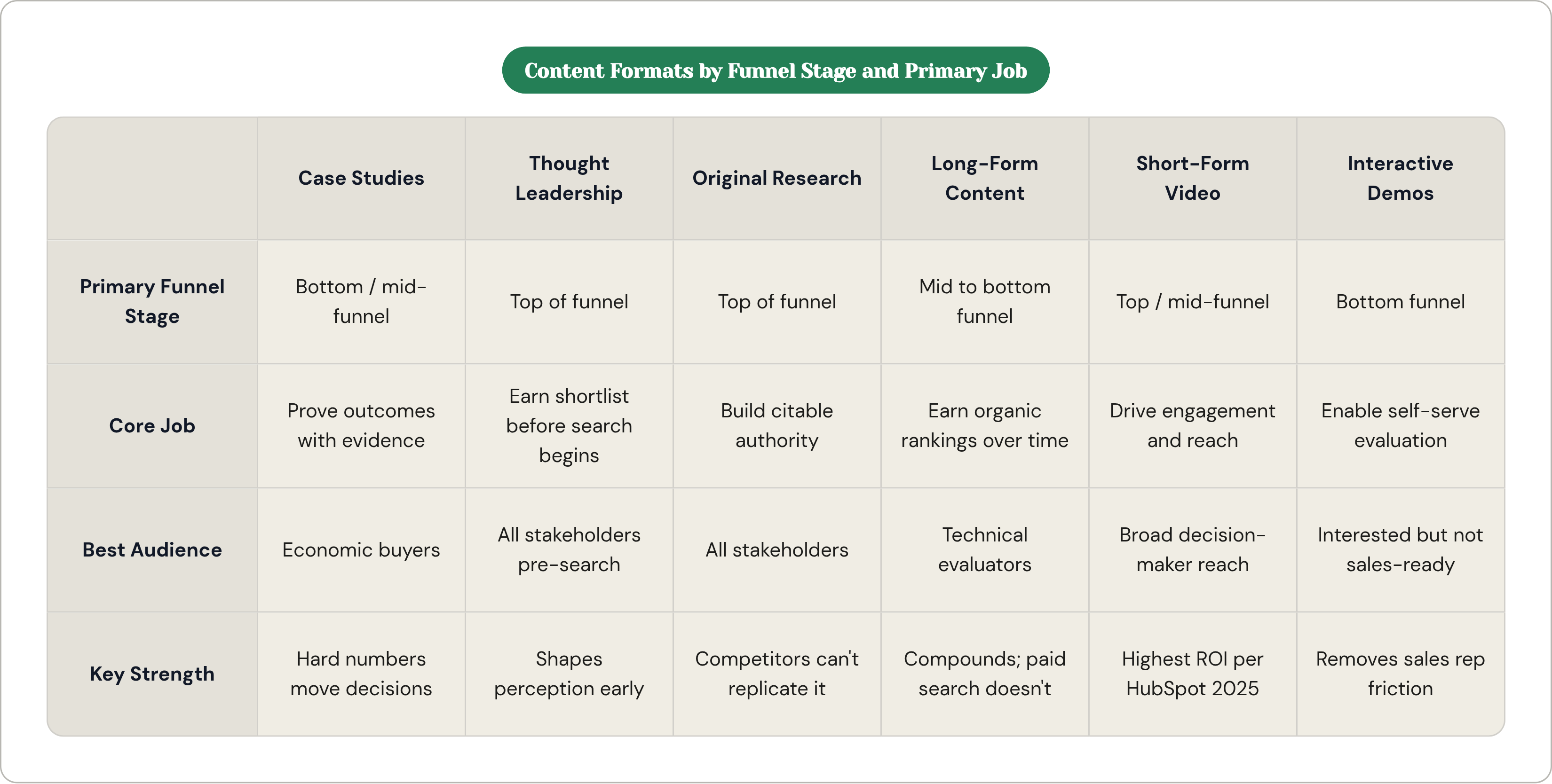
No single format does all the work. The question is not which format is best in the abstract but which format is best equipped to do a specific job at a specific stage for a specific audience segment.
Case Studies
Case studies are a widely used format in B2B SaaS conversion. According to the Content Marketing Institute's B2B Content Marketing report, 49% of B2B content marketers say case studies are very effective at generating sales, compared to 20% for general website content and 10% for blog posts. The structure that earns that performance names the problem, identifies the stakeholder who owned it, maps the implementation path, and leads with a measurable outcome.
Video case studies combine the reach of short-form video with the proof value of the written format. As a pairing, they outperform either in isolation, particularly for buyers in active evaluation who are consuming content across multiple sessions and devices.
Thought Leadership
Thought leadership is the primary vehicle for earning shortlist position before buyers begin active search, which is precisely when those shortlists form. According to the Edelman and LinkedIn 2025 B2B Thought Leadership Impact Report, 64% of B2B buyers favor thought leadership over promotional content when assessing vendors, and 55% say it has significantly influenced their purchasing decisions.
A common failure mode is producing industry summaries without a distinct point of view. Effective thought leadership takes a specific, defensible position on a question the audience is already grappling with. It should be possible for a reader to disagree with it. If no one could reasonably push back, it is not a point of view.
Original Research
Original research turns a brand into the primary source others cite. Proprietary data, whether it is benchmarks, survey results, or usage analysis derived from the brand's own product, cannot be replicated by a competitor. That is a durable competitive advantage in a content environment where most categories are being steadily commoditized by AI-generated synthesis. The citations and backlinks that accumulate around original research are a compounding asset, not a one-time traffic spike.
Long-Form Written Content
Long-form content earns organic rankings over time and appreciates in ways paid acquisition does not. According to Ahrefs' analysis of SEO ROI across client campaigns, long-form content generates substantially more traffic in months seven through twelve than it did in months one through six. Paid search stops the moment spend stops. A well-ranked post does not. Some content automation platforms are built around that compounding logic, handling drafting and publishing alongside performance monitoring.
Short-Form Video
According to a 2025 State of Marketing Report, 49% of marketers report the highest ROI from short-form video formats. For B2B SaaS, the relevant applications are LinkedIn clips, product demo excerpts, and customer story snippets rather than production-heavy brand films. Short-form video and long-form written content are complements, not substitutes. Video drives engagement at the top and middle of the funnel; long-form earns the organic rankings. Running both simultaneously, with video directing viewers toward written assets, outperforms choosing between them.
Interactive Demos and Tools
The majority of site visitors are not ready to schedule a live demo. Interactive experiences, ROI calculators, product configurators, self-guided product tours, let buyers advance their own evaluation on their own timeline without requiring a sales rep's involvement. These formats address a specific, common friction point: the buyer who is genuinely interested but not yet ready to talk to anyone.
Webinars
Webinars generate leads at a fraction of the cost of in-person events. Their effectiveness is directly correlated with specificity. A webinar tied to a concrete use case or a named problem performs considerably better than a general product tour because the audience self-selects for relevance before the session even begins. The more precisely scoped the topic, the more pre-qualified the room.
Where to Distribute: Channels That Reach B2B SaaS Buyers Where Decisions Are Forming
Organic Search
According to BrightEdge's channel share research, organic search generates 44.6% of all B2B revenue, making it the largest single revenue channel in the category. Content marketing generates roughly three dollars for every one dollar invested, compared to $1.80 for paid advertising, and compounds over time rather than resetting with each budget cycle.
Volume matters, but only when each piece targets a specific intent. Publishing for volume without targeting produces activity without accumulation.
LinkedIn is the primary B2B distribution channel, offering unmatched access to decision-makers through organic content, paid targeting, and direct engagement. According to the Content Marketing Institute's B2B Content Marketing report, 84% of B2B marketers say it delivers the best value of any platform. It is also the most widely used video marketing platform among B2B marketers, at 70% adoption, surpassing YouTube.
Founder-Led Content
Buyers are increasingly skeptical of polished corporate marketing. Perspective-driven content from founders or named executives earns more engagement than brand-produced content. A person with a name and a face and a discernible point of view is harder to dismiss than a brand account posting on a schedule.
Adam Robinson built two B2B SaaS companies past $30 million ARR each using LinkedIn as his primary user acquisition channel through personal founder content, without a substantial paid advertising infrastructure beneath it. Brands whose leaders are willing to hold a distinct point of view in public can pursue a similar approach. The ones whose senior voices get filtered through a brand committee face a structural disadvantage in doing so, because the committee optimizes for inoffensiveness, and inoffensiveness does not earn attention.
Peer Communities and Dark Social
A meaningful share of software buyers use Reddit to research products, specifically to find information on pricing, integrations, and real-world limitations that vendor websites do not disclose. Private Slack groups, Discord servers, and niche professional communities are where many final buying decisions get validated. Brands cannot directly control these spaces, and attempts to do so typically backfire.
The play is indirect: produce content worth sharing, ensure review platform presence gives community members something credible to link to, and participate as a genuine contributor rather than a promotional entity. Influence in dark social is earned through reputation, not budget.
Email converts well for B2B SaaS nurture sequences. Its highest-value use is nurturing leads already in the pipeline with stage-specific content, not cold prospecting. An email to a buyer who has already engaged with a case study and attended a webinar is doing categorically different work than an email to someone who has never heard of the product. Sequence design matters as much as content quality, and most sequences are designed once and left to run well past the point of relevance.
Content Repurposing as a Distribution Multiplier
A single original research report becomes blog summaries, LinkedIn infographics, short video clips, and email sequences. The core insight stays the same; the format adapts to each channel's native behavior. For teams operating under budget constraints, repurposing is one of the highest-leverage activities available. It is a resource decision, not a quality compromise.
There is also a sales velocity dimension worth noting. According to Gartner's 2024 B2B Buyer Survey, buyers who engage with educational content earlier in their journey move through evaluation stages more quickly. Distribution is not just an awareness metric; it is a lever on pipeline speed.
Software Review Platforms as a Content and Discoverability Channel
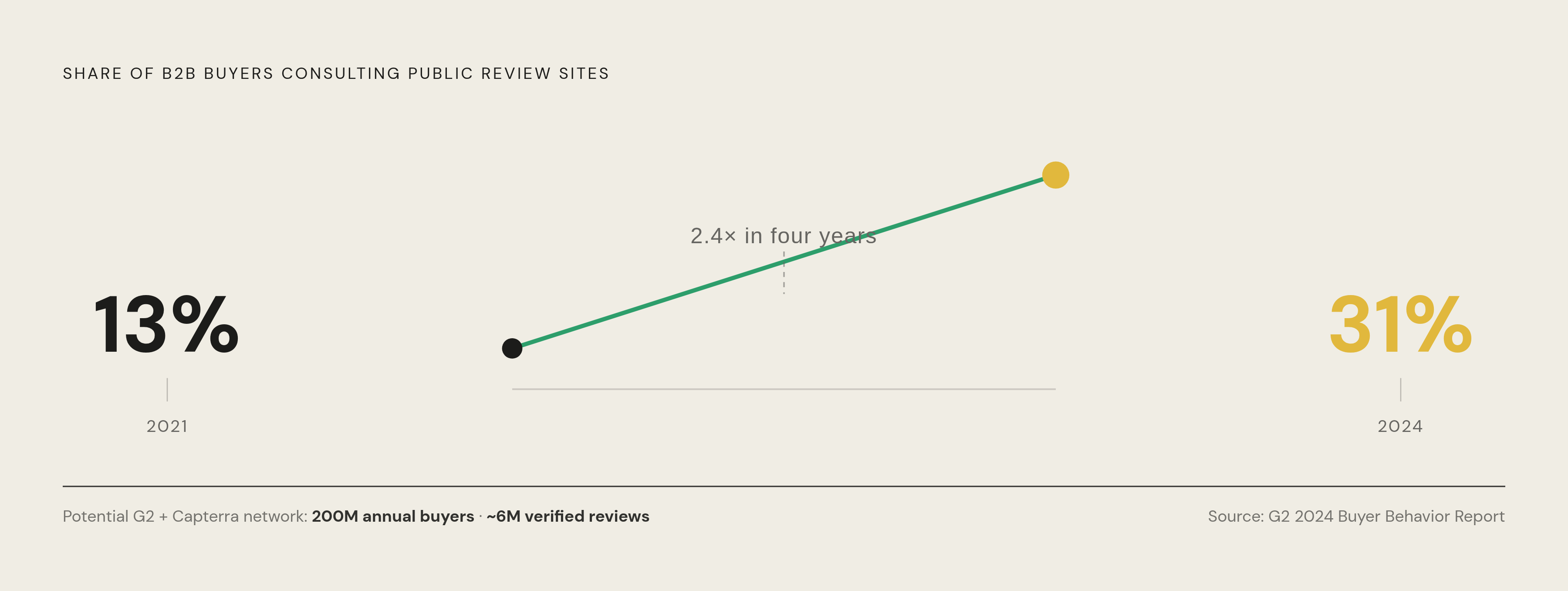
Review platforms are not a supplementary channel. They are infrastructure. According to G2's 2024 Buyer Behavior Report, public product review sites were the single most consulted information source for B2B software buyers in 2024, referenced by 31% of buyers during purchasing, up from 13% in 2021. A brand with a weak or incomplete profile on these platforms is losing deals that never appear in its pipeline, because the elimination happened before the brand was ever aware of the opportunity.
G2 draws more than 60 million annual visitors and operates a grid ranking system with strong bottom-funnel intent signals. G2 announced an acquisition of Capterra, Software Advice, and GetApp from Gartner; if completed, that would create a network reaching more than 200 million annual software buyers with nearly 6 million verified reviews. Any SaaS content strategy that does not account for that consolidation of buyer attention explicitly is already behind.
TrustRadius, with more than 12 million annual visitors, is particularly influential in enterprise evaluation cycles. Its reviews average 400 words, reflecting a more analytically rigorous buyer cohort. The depth of review content on that platform is a proxy for the depth of the evaluation process it is supporting.
Profile optimization on these platforms is a content discipline in its own right. Category placement, profile completeness, screenshot quality, feature tagging, pricing data, review freshness: these all affect whether a buyer sees the listing, clicks on it, and adds the vendor to a shortlist. They are not passive variables. They are decisions a marketing team makes, or quietly defaults on.
With 57% of B2B buyers planning to increase software spend in 2025, according to G2's 2025 Buyer Behavior Report, the market is not contracting. But it is consolidating around the vendors who show up consistently, credibly, and early across every surface where buyers form their opinions. The brands treating review platforms as a passive byproduct of customer success work, rather than as an active content and discoverability channel, are ceding ground to competitors who have already figured out where the shortlist actually gets built.