B2B SaaS Marketing Strategy for Marketplace Startups
Winning B2B marketplaces prioritize liquidity milestones over vanity metrics.

The competitive environment for marketplace startups has compressed dramatically, and the companies that don't understand what they're competing against in 2025 are going to get sorted out quickly. Five years ago, fewer than 100 B2B marketplaces operated globally. That number has grown past 750. Undifferentiated GTM isn't just inefficient anymore; it gets punished fast by better-capitalized competitors who have already solved the problems you're still diagnosing.
Median growth rates for private B2B SaaS companies slipped from 30% to 25% in 2024, and the share of companies reporting flat or negative growth climbed alongside that. Investors know these numbers. Enterprise buyers know these numbers, even if they can't cite them. The market's tolerance for "we're figuring it out" has shortened considerably.
Here's what makes the top of the distribution genuinely interesting: it moved in the opposite direction. Top-quartile growth rates for sub-$1M ARR startups hit 300% year-over-year. That cohort isn't converging toward the median. It's pulling away from it. And the explanation isn't better product or better funding. It's GTM sequencing, specifically how cleanly those companies resolved their liquidity problem in the earliest months. [Source needed for these growth rate figures.]
One structural reality that gets overlooked: a substantial portion of B2B marketplace supply-side participants are small businesses. Marketplace startups that treat supply-side recruitment as a calibrated SMB marketing challenge, rather than a pure sales motion, are engaging with that structural reality. The ones treating it as enterprise sales are consistently slower to onboard supply and slower to reach the density they need.
The frame that actually matters for 2025: success for a marketplace startup is not MQL volume or website traffic. It is liquidity milestones. First transaction. First repeat transaction. First vertical where supply density is high enough that buyers have a genuine choice. Those milestones determine whether network effects activate at all. Everything else is a leading indicator at best, and a vanity metric at worst.
Sequencing the cold-start: which side to acquire first and why the answer isn't always supply
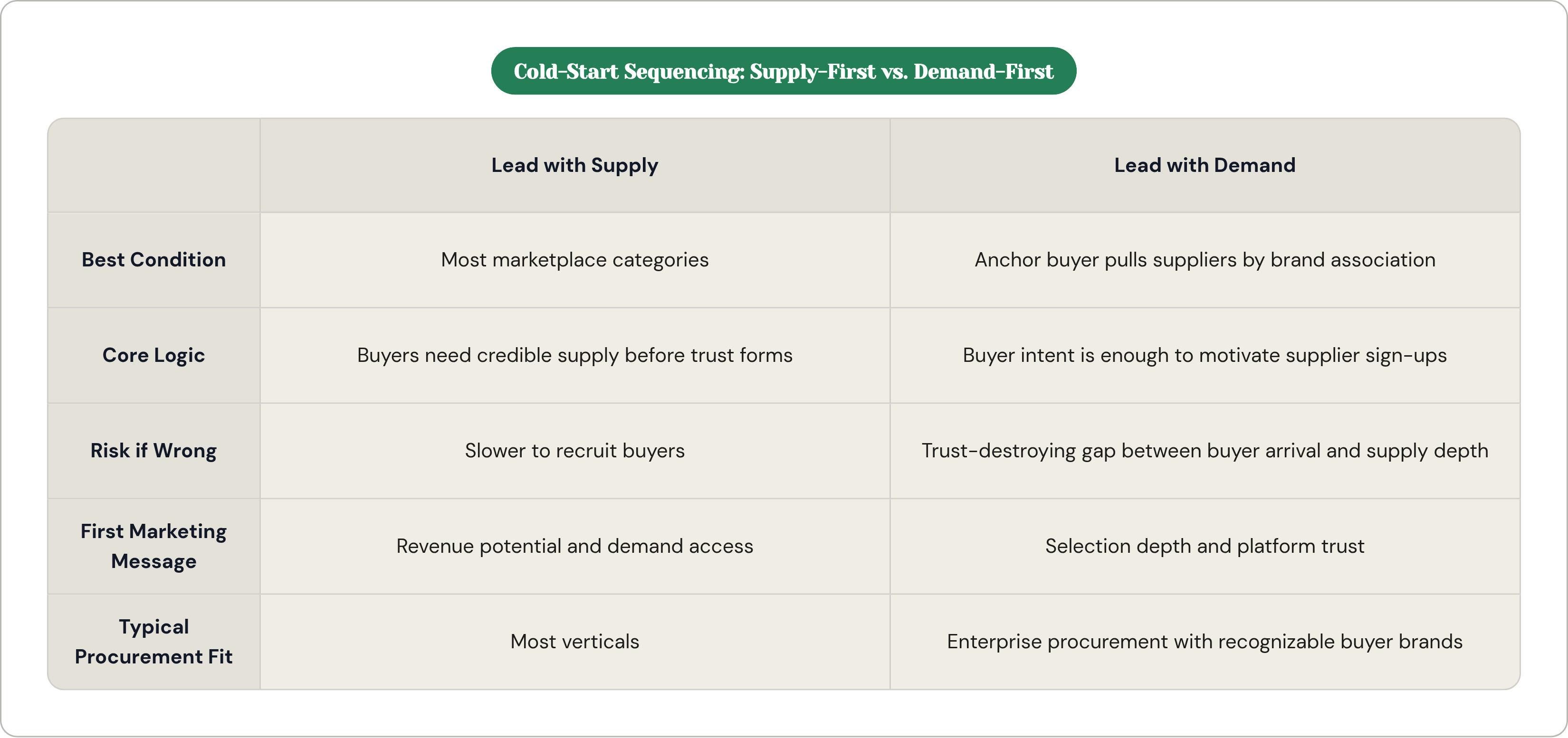
Build supply first. That's the conventional wisdom, and it's right most of the time. Providers have a stronger financial incentive to join before liquidity exists because they're joining for access to future demand, not current transaction volume. An empty marketplace on the buyer side is tolerable. A marketplace with eager buyers and no one to serve them is a trust-destroying event that is very hard to recover from. Early supply depth is the credibility signal that makes buyer recruitment possible at all.
However, there are specific conditions where leading with demand is the smarter call. If one well-known anchor buyer can pull in multiple suppliers by association alone, that buyer is a marketing asset before they're a customer. In procurement marketplaces serving enterprise buyers, the buyer's brand recognition can generate inbound supplier interest more efficiently than any outbound campaign you could run. Landing the anchor buyer first creates a pull effect on supply recruitment that compounds. When supply-side recruitment costs in a given category are low, or when suppliers are motivated enough that demonstrated buyer intent is all they need to join, subsidizing early buyer acquisition is the faster path.
The sequencing decision has downstream consequences most early teams underestimate. It determines which audience gets the first dollar of paid spend, which search terms get the first content asset, which list gets the first outbound sequence. In a procurement marketplace context, the right sequence usually looks like this: run supplier onboarding campaigns first, leading with the quality of the buyer base being built; activate buyer-facing messaging once supply depth can hold scrutiny. Supplier campaigns emphasize access to demand and revenue potential. Buyer campaigns emphasize selection depth, competitive terms, and platform trust signals. These are not variations on a single message. They are separate arguments built for audiences with different motivations and different objections.
There's a third path worth understanding: solve one side's problem so thoroughly that the other side comes inbound. A marketplace that makes suppliers meaningfully more efficient at running their business, independent of marketplace transaction volume, gives suppliers a reason to join and stay active during the illiquid early period. When that operational value is strong enough, the marketplace earns time to build demand-side volume without hemorrhaging supply-side participants to disillusionment. This is a deliberate cold-start mitigation strategy, not an accident, and it requires product investment up front but buys runway that purely acquisition-oriented cold-start strategies don't have.
Building the foundation: content, SEO, and inbound before liquidity exists
Content and inbound infrastructure are the right early foundation for a marketplace startup precisely because of what a pre-liquidity marketplace lacks. Transaction volume is low or zero. Case studies don't exist. Social proof is thin. Content and SEO let you establish category authority before transaction volume can speak for you, and they create separate tracks for two audiences with distinct search intent without doubling the budget, because the targeting happens at the content level.
The search surface is changing in ways that directly affect this strategy. More than half of B2B SaaS companies plan to increase Answer Engine Optimization investment in 2025, compared to roughly 14% planning increases for traditional SEO. [Source needed for these figures.] Buyers and suppliers are increasingly getting answers from AI-synthesized responses before they ever reach a website. Suppliers want to understand how to grow their business in a given category and whether this platform can credibly help them do that. Buyers want to compare vendors, verify supply depth, and assess platform risk before committing procurement spend. So those are different questions, answered in different places, requiring different content investments.
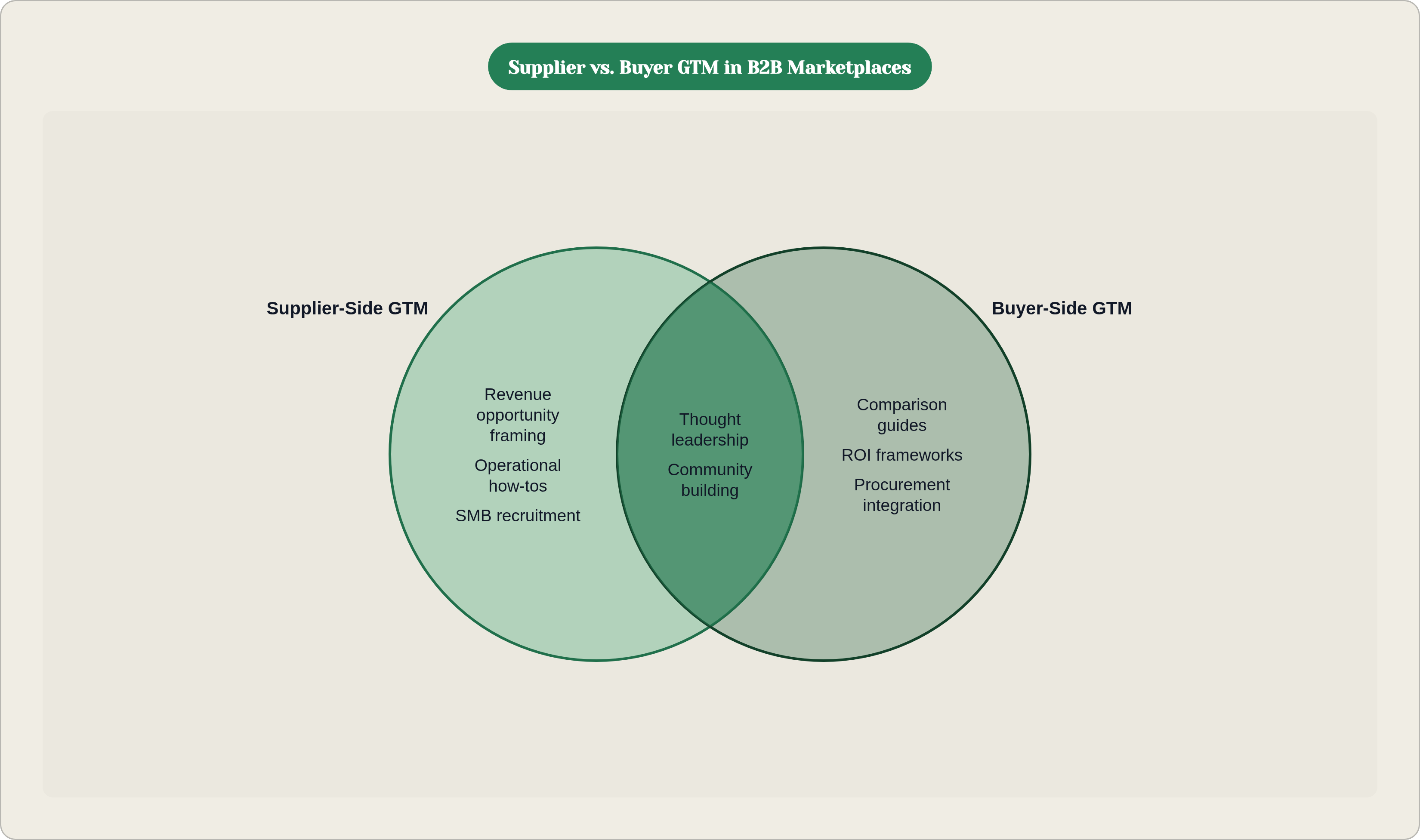
Two distinct content tracks follow naturally from this. Supplier-facing content covers operational how-tos, revenue opportunity framing, and category growth data. It reduces friction for joining before liquidity is proven by giving suppliers useful information regardless of whether they transact immediately. Buyer-facing content includes comparison guides, use-case scenarios, and ROI frameworks that build trust in a platform that doesn't yet have volume-based case studies to prove itself.
Content built during the cold-start phase pays forward into every subsequent growth stage. When liquidity eventually generates genuine proof points, those assets sit on top of an existing authority foundation. Marketplaces that wait until they have liquidity to start content begin from zero authority, competing against incumbents who have been accumulating domain relevance for years.
Thought leadership occupies a specific role here. For a new marketplace without a transaction track record, it is one of the few available substitutes for the credibility that history would otherwise provide. The 2024 Edelman-LinkedIn B2B Thought Leadership Impact Report found that 65% of decision-makers say high-quality thought leadership strengthens brand reputation, and 55% are willing to pay a premium to work with organizations that produce it. After all, for a marketplace in the illiquid early period, thought leadership is a credibility bridge that doesn't require you to have already earned the thing you're trying to earn.
Outbound sequencing: when cold email and ABM earn their place in the early marketplace stack
Outbound isn't the dominant channel in B2B SaaS GTM, but it has a clear place in the stack. For marketplace startups, it earns that place in specific, bounded use cases, not as the primary growth engine. The teams that treat outbound as their core strategy at the cold-start stage are typically the ones who run out of runway before they build anything that compounds.
The two cases where outbound genuinely fits the cold-start: supply recruitment and anchor buyer acquisition. If you need 50 qualified suppliers in a specific vertical before buyer acquisition can begin with any credibility, cold outbound to a curated list in that vertical is simply faster than waiting for inbound to build. Similarly, landing one high-profile enterprise buyer can justify a fully personalized outbound sequence. The network-effect value of a single anchor account can justify investment levels that would be difficult to rationalize for a standard prospect of equivalent ACV.
The mechanics of outbound have changed materially, however. Average reply rates on cold email dropped from 6.8% in 2024 to 5.8% in 2025. [Source needed for these figures.] Email filters are more aggressive, inboxes are more crowded, and buyers have less patience for generic outreach. Timeline-based hooks, which connect outreach to something timely and concrete in the recipient's world, consistently outperform traditional problem-statement-led openers.
ABM belongs in the early marketplace stack as a stage-appropriate tool, not an always-on motion. It makes sense when one enterprise account represents what smaller deals would take a month to accumulate, or when landing a specific logo creates supply-side pull by association. The critical context for 2025: a majority of B2B buyers report they had already decided on a preferred vendor before engaging a sales representative. [Source needed for this figure.] So ABM must reach target accounts during the research phase that precedes any outbound contact. For high-ACV marketplace deals, the ABM motion blends naturally with thought leadership and community presence, making the effective point of first contact a familiar name from a channel the buyer already trusts.
Outbound is a scalpel for specific acquisition objectives. Instead of using it as the primary means of building marketplace liquidity, before any inbound infrastructure is in place, treat it as an expensive, non-compounding tool best reserved for targeted, high-value acquisition objectives.
How product-led growth works differently when the product is a two-sided market
More than half of B2B SaaS companies report a PLG motion, and the majority of those plan to increase investment in it. [Source needed for this figure.] A marketplace startup that ignores PLG is starting at a structural disadvantage. However, applying a standard PLG playbook to a two-sided marketplace without modification is a fast way to produce metrics that look fine and a business that doesn't work.
The complication is structural. Standard PLG assumes one user type who experiences product value quickly upon sign-up. Marketplaces have two user types, and the value each experiences depends on the other side being present and active. A supplier who joins a self-serve marketplace with no active buyers doesn't experience the product's core value proposition. The "aha moment" is transactional, not feature-based; it cannot be manufactured by a clever onboarding flow. So early PLG for marketplace startups must be designed around pre-seeded supply density or simulated demand. Removing friction from account creation is necessary but nowhere near sufficient.
Self-serve capability is still a meaningful lever within this. Research on B2B SaaS companies consistently finds meaningful performance gains during the initial transition from zero self-serve revenue to even modest self-serve ARR. The goal is to make that first inflection point happen as early as possible, because the behavioral signals it generates are what the rest of the GTM motion runs on.
Product Qualified Leads are underused in this context. Companies using PQL frameworks see higher conversion rates than those without them, yet only about a quarter of PLG companies use PQL frameworks at all. [Source needed for these figures.] For a marketplace, PQLs have a two-sided structure: supplier PQLs (such as first listing posted, first inquiry responded to, and first availability marked) and buyer PQLs (such as first search conducted, first shortlist created, and first vendor contacted). Each signals different intent and triggers a different intervention. Treating all sign-ups as equivalent is leaving conversion on the table.
Many B2B buyers want to explore the product before a demo but expect a human conversation before signing an annual contract. The practical standard for marketplace startups is a hybrid model: use PLG to generate sign-ups and behavioral signals from both sides, then use sales to close the anchor accounts that actually seed liquidity in each vertical. After all, waiting for a purely self-serve motion to build liquidity is rarely viable when the core value of the platform depends on network density that takes time and deliberate effort to accumulate.
Using ecosystem and partner channels to accelerate both sides of the marketplace simultaneously
Marketplaces are ecosystem plays at their structural core. They aggregate supply and demand within a defined category and create value precisely because they sit at the intersection of multiple parties. The GTM strategy should exploit that structural characteristic, not default to building every acquisition channel from scratch as if the marketplace were a point solution.
Integration capability consistently ranks as a top buying consideration across software categories. Buyers aren't evaluating platforms in isolation; they're evaluating how a platform fits into the operational stack they already use. Marketplace startups that treat integration roadmap decisions as pure engineering questions are leaving meaningful distribution on the table, because integration decisions are simultaneously GTM decisions, and making them without revenue and marketing leadership in the room is a mistake that compounds over time.
Ecosystem-influenced deals close more often than cold-direct outreach, close faster, and carry higher average contract values. [Source needed for this claim.] Partner-sourced revenue has grown to represent more than a quarter of total revenue across B2B SaaS, reflecting the structural advantage of reaching buyers through channels they already trust. [Source needed for this figure.]
The particular value of ecosystem channels for a marketplace is that they can accelerate both sides simultaneously, which is rare among GTM channels. A marketplace that integrates into tools suppliers already use (accounting platforms, CRMs, project management software) removes the switching cost that would otherwise prevent supply-side sign-ups. The supplier doesn't have to change behavior; the marketplace appears inside the workflow they already have. A marketplace that integrates into buyer procurement systems appears at the precise moment of purchasing intent, rather than requiring buyers to remember the platform and navigate to it separately.
Shopify's app ecosystem drove a portion of new merchant growth by effectively turning partner applications into a supply-side recruitment channel. Salesforce AppExchange data shows that customers using multiple integrated applications demonstrate higher retention rates, establishing that integration density functions as a retention lever, not only an acquisition one. Both examples point to the same principle: integrations don't just help with acquisition; they deepen engagement in ways that reduce churn across both sides of the marketplace.
Community as a liquidity multiplier once the marketplace has initial traction
Community does not solve the cold-start problem. Attempting to build it before initial liquidity exists is a distraction and a resource drain. A community is a multiplier, and multipliers only work when there is something to multiply.
Once a marketplace has meaningful transaction volume within at least one vertical, something happens that no paid channel can replicate. Suppliers start sharing operational knowledge with other suppliers, which raises the quality of the supply side and makes the platform more attractive to buyers. Buyers compare notes on vendor performance and sourcing strategies, which deepens their engagement and raises switching costs organically. Both behaviors reduce churn and increase transaction frequency without requiring incremental marketing spend.
The trust dynamic here matters in a specific way. In B2B purchasing, peer validation carries more weight than vendor claims. A community where buyers openly discuss their experiences creates social proof that is qualitatively different from a case study the marketplace itself produced. It's unscripted, specific, and perceived as credible in ways that marketing-produced content cannot replicate.
Community also creates a second layer of network effects on top of the transaction-based network effect the marketplace is already building. A supplier who participates actively in the community, contributing expertise and building visibility among buyers, has a reason to stay on the platform even during periods of lower transaction volume. That retention behavior, rooted in community rather than pure transactional value, can stabilize the supply side during category-level downturns or competitive pressure.
The sequencing discipline matters here as much as it does anywhere else. Launching a community feature or a Slack group before either side has genuine peer relationships on the platform creates an empty room, and an empty room is worse than no community at all. It signals low adoption to every new participant who joins. The right trigger for community investment is the point at which enough suppliers and buyers have completed enough transactions that they have something real to say to each other. At that point, community stops being a vanity project and starts functioning as a durable retention mechanism that gets more valuable the longer the marketplace compounds.