Demand Generation Playbooks for Horizontal Marketplace Brands
How to balance supply and demand growth across categories.

Horizontal marketplaces are platforms that connect buyers and sellers across many unrelated categories: Amazon, eBay, Alibaba, Craigslist. None of them own inventory, none of them serve a single vertical, and all of them face a demand generation problem that standard playbooks were never built to solve. This piece breaks down what that problem actually looks like and what a structured approach to it does differently.
Compare that to a vertical marketplace like StockX, TaskRabbit, or StubHub, and the distinction gets clearer fast. StockX sells sneakers, then trading cards, then collectibles, but it started narrow and stayed disciplined about what it added. Craigslist, on the other hand, will let you buy a couch, find a roommate, and sell your car in the same afternoon. The generalist model is the whole product; the marketplace itself is what's for sale, alongside any one category within it.
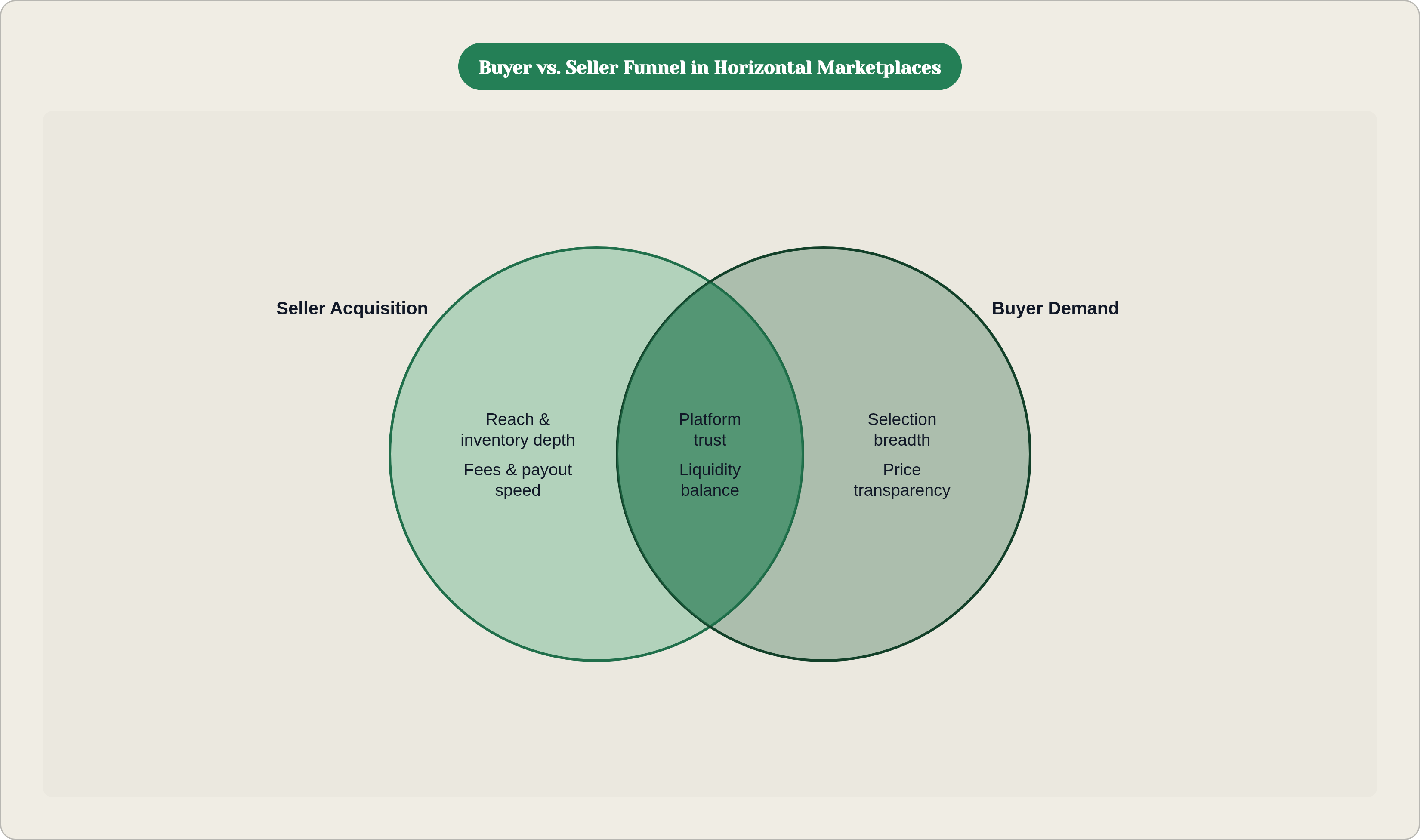
The prize for pulling this off is enormous. The top 100 global marketplaces were projected to hit $3.832 trillion in GMV by the end of 2024, which explains why founders keep attempting the horizontal model even though the failure rate is brutal. A horizontal marketplace has to run two demand generation funnels at once, in multiple categories, and each funnel's health depends entirely on the other one. A B2C brand acquires one type of customer. A SaaS company sells to one type of buyer. A horizontal marketplace has to grow supply and demand simultaneously, with messaging that can't be identical on both sides, and its real success metric leans toward liquidity, meaning the odds that a buyer finds what they want and a seller actually makes money, rather than cost per acquisition. What follows is a sequenced playbook for that problem, starting from zero and working up to scale.
Why liquidity, not traffic, is the real output a horizontal marketplace's demand generation must produce
There's a line that gets repeated in marketplace investing circles until it sounds like a cliché, but it holds up: the marketplace itself depends on liquidity to function as a product at all. Liquidity just means two things happening reliably: a buyer finds what they're looking for, and a seller makes a sale. That's it. No fancier definition needed.
Without liquidity, your marketing spend produces churn with extra steps rather than growth. You pay to bring someone to the platform, they show up, they find an empty shelf or a seller with zero buyers, and they leave and probably don't come back. You paid for that.
The balance problem cuts both ways. Too much supply, and sellers sit around with no buyers, get frustrated, and quit posting. Too much demand, and buyers hit stockouts, search results come up empty, and they bounce to a competitor. Either imbalance kills the network effect before it has a chance to compound, and once a user churns out of distrust in the platform's depth, they're expensive to win back, if you can win them back at all.
So what does this mean for how you actually measure a campaign? Traffic numbers, impressions, even conversion rates function mainly as proxies. They tell you people showed up and maybe clicked something. The real signal is whether matched transactions, completed ones, are climbing on both sides of the platform at the same time. If your paid search campaign brought in 10,000 buyer sessions last month but matched transactions in that category didn't move, you didn't generate demand. You generated a bounce rate with a marketing budget attached to it.
Reframe the job this way: demand generation for a horizontal marketplace centers on keeping the platform in balance while both sides grow, more than on simply getting users. That's a much harder, much less glamorous job than "get more traffic," and it's why so many teams get this wrong.
How to sequence supply and demand acquisition when you're starting from zero
Day one of a horizontal marketplace is a chicken-and-egg problem. Buyers won't show up without sellers. Sellers won't post without buyer activity. And on day one, you have neither.
Looking back at how eBay, Craigslist, and Amazon actually got off the ground, an analysis from Lenny's Newsletter found one thread running through all three: supply came first, every time, before brand-building or buyer acquisition got any real budget. The logic isn't complicated once you see it. You can't market "find anything here" if there's nothing there. So you build inventory depth first, quietly, then you turn on the demand engine once there's something worth finding.
This isn't gospel and there are exceptions, but it's the dominant view among people who've actually run a cold start rather than just theorized about one. And there's a hard constraint that reinforces it: trying to reach liquidity across every category at once, everywhere, almost always burns through capital before it produces results. Thumbtack raised $699 million across nine funding rounds to fund a broad horizontal push. Most companies don't have $699 million lying around, and honestly, most shouldn't try to replicate that approach even if they did.
The practical alternative is constraint. Pick one city, one category, or one dense cluster of users, and get that slice to liquidity before you touch anything else. This does three things at once: it proves out your unit economics before you scale spend, it gives you a repeatable playbook for the next city or category, and it turns your first sellers into advocates who help you launch the next market. StockX is the clean example of what this looks like done right. It didn't launch as a horizontal platform. It went deep on sneakers first, got that market to genuine liquidity, and only then expanded into streetwear, collectibles, and trading cards. Horizontal breadth was the reward for narrow depth, following the strategy rather than starting it.
Building two separate messaging architectures, one for supply acquisition, one for demand growth
Here's a failure mode I've watched play out more times than I'd like to admit: a team writes one set of messaging meant to work for both sellers and buyers, and it ends up too vague to motivate either one. If you can't give a specific, distinct answer to "why should a seller list here" and "why should a buyer shop here," your positioning is doing nothing for anybody.
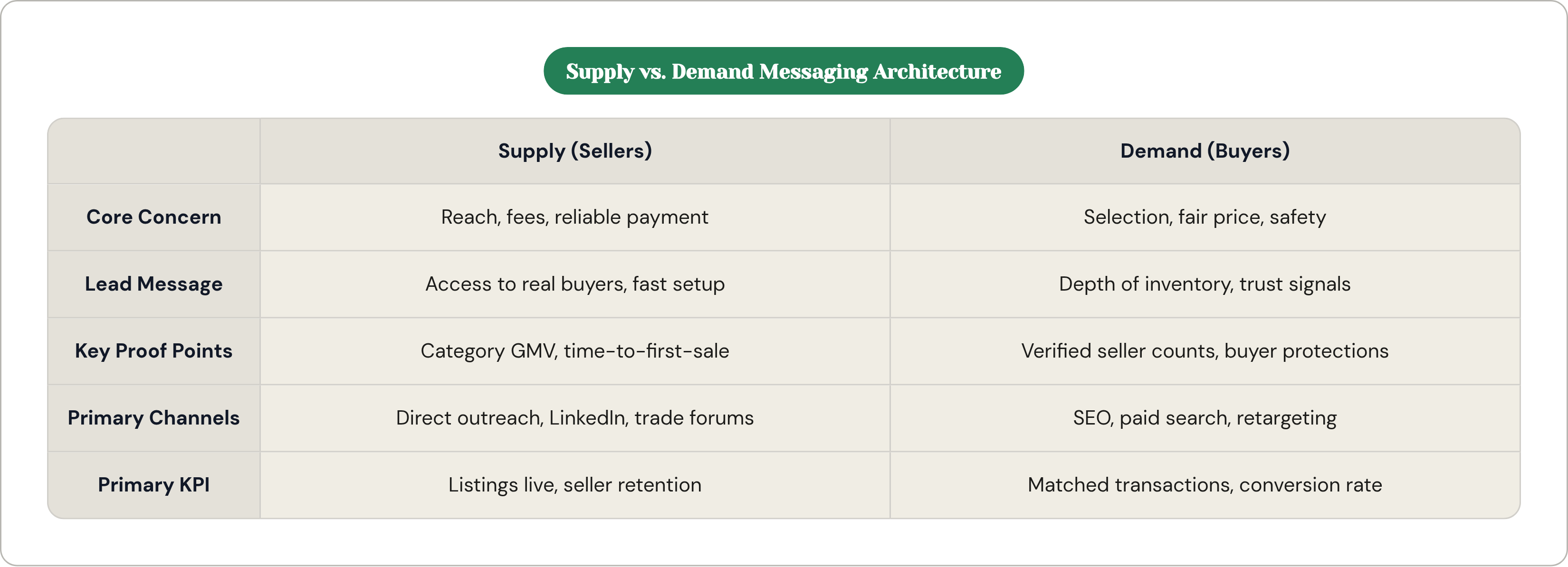
Sellers are running a cost-benefit calculation. They care about reach, transaction fees, how reliably they get paid, and whether this platform actually fits their category. Messaging aimed at them should lead with access to real buyers, how fast setup takes, and proof the platform actually moves inventory in their specific niche, more than the platform overall. The strongest proof points here are category-level GMV numbers, seller success stories with real names attached, and time-to-first-sale benchmarks. Channel-wise, this messaging tends to land better through direct outreach, LinkedIn, seller forums, and trade publications specific to that vertical, more than broad paid social.
Buyers are solving a different problem entirely: (i) will they find what they need, (ii) is the price fair, and (iii) is this transaction safe? Messaging here should lead with selection depth, price transparency, and trust signals like reviews, guarantees, and clear return policies. Proof points shift to category breadth, verified seller counts, and buyer protection terms. This is where SEO, paid search, social proof, and retargeting do the heavy lifting.
There's a shared layer underneath both architectures, though, and it's the brand itself. Both sides need to believe the platform is legitimate, growing, and worth trusting, even while the specific pitch to each side diverges completely. In practice, this means running (i) two separate campaign briefs, (ii) two sets of KPIs, and (iii) two editorial calendars, one per side, and reviewing them together regularly so you can see if one side is starving while the other is fed.
Why SEO is a structural advantage for horizontal platforms, and how to build it around liquidity, not just traffic
A multi-category platform can rank for a genuinely enormous range of commercial search queries that no single-category retailer could ever touch. Zillow, Eventbrite, and Thumbtack all built serious organic search moats this way, according to Sharetribe Academy's research, by ranking for location-specific and time-specific queries at massive scale. The stronger move involves optimizing for categories, use cases, and geographic availability as structural assets, beyond optimizing individual product pages one by one.
Where this actually converts is intent. Someone searching "plumber near me" or "best moving company in Austin" is closer to a decision than someone searching "how do plumbing fixtures work." Sharetribe's research suggests high-intent phrases like these can convert 5 to 10 times better than informational queries, even though those informational queries pull more raw search volume. That's a strong argument for building out transactional and local-intent pages first, before you invest in awareness-stage blog content nobody's ready to act on yet.
There's a trap here worth naming directly. Platforms that invent a genuinely new behavior, Uber and Airbnb at launch being the textbook cases, can't lean on organic search because nobody's searching for a category that doesn't exist in anyone's head yet. Sharetribe's data shows roughly 90% of Uber's organic traffic still comes from branded search terms, people typing "Uber" itself, rather than "ride to airport." That's the ceiling for category-creators. Horizontal platforms solving a search demand that already exists, home services, local events, real estate, get to walk a much faster organic path because people are already typing the query into Google.
SEO also tells you something beyond traffic if you're paying attention: it's a liquidity signal. Well-built category pages show you exactly where buyer demand exists and where your supply hasn't caught up yet, which is a direct input into where your supply team should be recruiting next. And here's a subtle one worth sitting with: if a page is ranking well but not converting, that often points to a supply gap more than an SEO problem. The fix leans toward better inventory more than better copy. So your content calendar for buyer-facing pages should get built off keyword demand data, category by category, tracking what buyers are actually searching for rather than guessing at what they might care about.
How trust infrastructure functions as a demand generation lever, not just a retention safeguard
Your horizontal marketplace is asking strangers to transact with strangers, and that creates a wall of buyer uncertainty that no paid media budget can fully dissolve at the moment of decision. Trust infrastructure is the layer that converts traffic into transactions. Skip it, and your demand generation spend just produces window shoppers.
Reviews function as acquisition infrastructure, well beyond a nice-to-have feature tucked into the product roadmap. A 2024 survey from BrightLocal found roughly four in five consumers trust online reviews about as much as a personal recommendation from a friend. That makes review volume and review quality a first-party growth asset, not a customer service afterthought. For a horizontal platform specifically, this has to work at the seller level and category level, not just as one aggregate platform rating. A shiny 4.8-star overall score can mean very little to a buyer staring at a specific seller with zero reviews in the category they care about.
The failure case here is worth sitting with. Research from Harvard Business Review in 2023 found more than 70% of marketplaces that copied an existing model without building a distinct identity of their own failed within two years, largely because they recycled growth tactics that didn't actually fit their users. Beepi, the used-car marketplace, is the example cited in that research: well-funded, and it still collapsed, in part because it never built the trust infrastructure or the differentiated positioning it needed to survive.
The structural levers that build trust — (i) onboarding standards, (ii) seller eligibility requirements, (iii) performance thresholds, and (iv) ranking systems that surface quality automatically, carry real weight beyond a footnote in the product documentation. They're the evidence your marketing team needs to make any buyer-side claim credible. If you can't honestly say "every seller here meets this bar," then your trust messaging is hollow, and buyers figure that out fast, usually right after their first bad transaction.
Worth noting too: platforms like Etsy and Airbnb grew largely because their early users stuck around, told their friends, and generated social proof organically, more than by outspending everyone on acquisition. That argues for budgeting explicitly for retention content and trust-building touchpoints as part of your demand generation, rather than treating retention as a separate department's problem once your marketing team's done its job.
Channel allocation logic across the two funnels at different growth stages
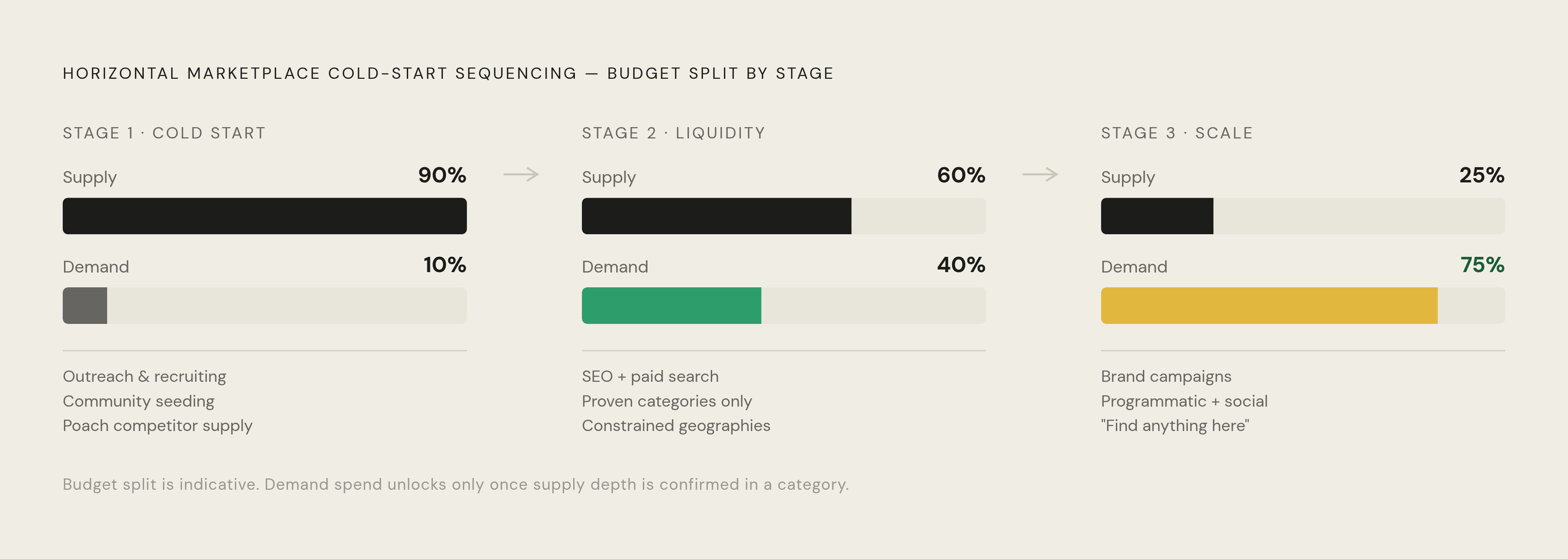
At cold start, nearly all your channel spend should point at supply. This usually means direct outreach and community seeding: find where your target sellers already hang out, whether that's (i) niche forums, (ii) trade groups, or (iii) a competitor's platform, and go recruit them directly. There's a specific version of this worth naming, sometimes called the vampire attack, where you deliberately pull sellers off an established platform. TaskRabbit and StubHub both built early supply this way, essentially unbundling pieces of Craigslist's seller base. Paid acquisition makes sense for supply at this stage. Paid acquisition for buyers before you've got supply depth mostly burns money on people who'll show up to an empty store.
Once you're in the liquidity-building stage, buyer-side channels start turning on, but they stay tightly scoped to whatever category or geography you constrained your launch to. SEO and content investment focus there. Paid search targets transactional intent, but only in the categories where you've actually proven supply depth, not the whole platform's breadth. Referral programs get seeded from your earliest successful transactions on both sides, because nothing sells a marketplace like a seller who already made money on it.
At scale, channels expand alongside your horizontal footprint. Brand campaigns finally become worth running, since a claim like "find anything here" only converts once it's actually true and you can back it up. Programmatic and social spend expand into new category audiences as you recruit supply in each new vertical, and category-specific content scales your SEO footprint right alongside it.
One structural constraint runs through all of this: horizontal markets can tend toward winner-take-all dynamics once an incumbent has real network effects locked in, and going head-to-head against that is often a losing bet for a challenger. Channel strategy for anyone entering a market with an established leader needs to aim at underserved segments or geographies the incumbent hasn't bothered with, more than fighting for the same demand the leader already owns.
Across every stage, the two-funnel structure means budget review has to happen regularly against actual platform balance data. If supply's outpacing demand in a category, the next dollar goes to buyer-side spend in that category. If demand's outpacing supply, the next dollar goes to supply recruitment, full stop, ahead of more buyer ads.
How to operationalize the playbook: the workflows and content systems that make dual-funnel execution sustainable
Here's the gap I see most often: a team understands everything above intellectually, nods along in the strategy meeting, and then goes back to producing single-funnel content anyway, because their workflows, calendars, and briefs were never built to hold two funnels at once. Understanding the problem and operationalizing the fix are two very different exercises.
A real dual-funnel content system needs a few specific things in place. Two editorial calendars running in parallel, one for supply acquisition content, one for buyer demand content, with a shared checkpoint where someone actually looks at both against current liquidity numbers. Brief templates that force clarity: every single campaign brief has to name which side of the platform it's serving, what stage of that side's funnel it's targeting, and which liquidity metric it's supposed to move. No more briefs that just say "drive awareness."
Content performance also needs to get tracked category by category, not just platform-wide. A platform-wide content report can look healthy while three specific verticals are quietly starving, and you won't catch that until it's already a liquidity problem showing up in churn data.
Speed matters more than people give it credit for here. In a market with an established incumbent, the window to recruit new supply in a category or capture buyer demand in a new city closes fast, faster than a typical six-week agency production cycle can keep up with. AI-assisted content production, paired with real editorial oversight rather than left to run unsupervised, can let category-specific content scale across your growing horizontal footprint without requiring headcount to grow in lockstep. But speed without a category-specific brief just produces generic content faster, and generic content doesn't move either side of the funnel. Strategy has to come first; the tooling just executes it quicker once the strategy's actually there.
The last piece worth naming is the loop this all creates. Reviews, seller spotlights, and transaction proof points that come out of real platform activity feed straight back into the buyer-side messaging architecture from earlier in this piece, which drives more matched transactions and produces more proof points. Once that loop is spinning on its own, your demand generation can start to look like the platform's own liquidity generating the case for itself, less like a department pushing a boulder uphill.
Notes
- https://www.lennysnewsletter.com/p/how-to-kickstart-and-scale-a-marketplace-9ee
Provided the analysis showing that supply-first sequencing was the common thread across how eBay, Craigslist, and Amazon handled cold-start growth.
- https://www.sharetribe.com/academy/marketplace-seo/
Provided data on high-intent search query conversion rates and the finding that roughly 90% of Uber's organic traffic comes from branded terms, used in the SEO section.
Every new piece from marketplace crunch, as it's published.
Follow