Vertical Marketplace vs Horizontal Marketplace Trade-offs
Choosing vertical focus trades growth ceiling for defensible moats.

The bet is about which trade-offs you can live with: audience breadth against depth, cheap acquisition against a moat that holds up over a decade. Get it wrong and no amount of product polish fixes it later, because by the time you notice, your early go-to-market choices and your first thousand listings have already answered the question for you.
What actually distinguishes a horizontal from a vertical marketplace
A horizontal marketplace serves the widest audience it can across categories that have nothing to do with each other. Think of it as the digital version of a shopping mall: you buy patio furniture, a phone charger, and dog food in the same checkout, and nobody blinks. A vertical marketplace picks one audience with one specific need and tunes every layer of the product around that single context: listings, filters, trust signals, pricing.
The split runs deeper than catalog size, though. Horizontal value comes from convenience and price comparison at scale; you show up not knowing exactly what you want, and the platform helps you find something close enough, fast. Vertical value comes from confidence and fit, the kind of expertise a generalist platform structurally can't fake. Amazon is the obvious horizontal reference point, while Vinted, built around secondhand fashion, is the vertical one. Same two-sided structure underneath, buyers and sellers, listings and payments, but the value each one delivers sits close to the opposite end of the spectrum from the other's.
Worth clearing up: vertical doesn't mean small. It means focused, and a focused category can still be enormous, covering areas like home goods, short-term rentals, and B2B wholesale. The line isn't fixed forever, either; plenty of platforms start vertical and widen once they've won a niche, and plenty of horizontal platforms carve out vertical sub-stores once they spot a niche worth serving well. The model you pick is a starting orientation, not a permanent commitment.
How horizontal scale works and what it costs to maintain it
The horizontal bet is simple to state: pile up enough supply and demand that your platform becomes the default first stop for almost any purchase. Amazon is the proof, having generated $847 billion in GMV in 2025, with 60% of its sales coming from independent sellers rather than Amazon's own inventory. That number is less a headline stat than a structural admission: the model working as designed also shows how dependent that scale becomes on a constant stream of outside sellers willing to list.
The advantages are real. Reach spans every demographic and category at once, and barriers for new sellers stay low since nobody needs specialized knowledge to list a product. Category expansion becomes a built-in growth lever, since you can bolt on a new vertical without rebuilding the platform from scratch. And because demand spreads across so many unrelated categories, a slump in one barely dents the whole.
But the costs pile up quietly, and they don't go away. Price competition among sellers stocking the same item grinds margins down over time; that's a structural feature of putting hundreds of sellers next to each other with nothing but price to tell them apart. Customer acquisition costs climb too, since marketing has to reach buyers with wildly different intents rather than one well-defined audience. Seller relationships stay thin and transactional, so a fee increase or an algorithm tweak can wreck an individual seller's business overnight, with no recourse. Buyer loyalty runs thin as well, because horizontal platforms are built to win the transaction rather than the relationship; a buyer might use the same platform for years without ever feeling loyal to any one seller on it.
Then there's the promotional treadmill. Getting seen in a catalog with millions of listings takes paid placement or algorithmic favor, and both get pricier as the catalog grows. The horizontal model is easy to seed, since anyone can list, and hard to stand out in, since everyone's selling roughly the same thing at roughly the same price. That trade-off is the whole game, and it doesn't ease up with scale, since more sellers just means more noise to cut through.
How vertical focus creates defensibility that horizontal platforms structurally can't offer
Here's the part most people underrate: focus works as its own kind of moat, one that Amazon-style platforms cannot buy their way into no matter how much capital they throw at it. Building for one audience means every decision compounds instead of getting diluted across unrelated use cases. Listings reflect the actual criteria that audience cares about, filters carry real signal instead of generic dropdown noise, and trust mechanisms get built around what that specific buyer needs to feel safe handing over money.
Domain expertise is the moat here. A team that's spent years inside one vertical picks up knowledge of regulations, buyer quirks, and supplier relationships that a horizontal competitor would need years to catch up on, if it bothered to try at all. StockX is the clean example: by focusing entirely on sneakers and collectibles, it built a platform no horizontal resale competitor could replicate after the fact. The result was $2.1 billion in GMV in 2025, in a category that barely existed as a formal market ten years earlier. That number says something specific: trust infrastructure can build a market almost from nothing.
Marketing gets more efficient too. A narrow focus means tighter targeting and higher conversion per dollar spent, since you're not trying to speak to five unrelated audiences with one ad. Word of mouth moves faster inside a niche as well, because early users tend to be enthusiasts who recruit their friends without being asked.
Pricing power follows from all of this, and this is where most operators talk themselves into the wrong strategy. Buyers in a vertical marketplace usually aren't hunting for the rock-bottom price; they're paying for confidence, fit, and access, and specialization is exactly what justifies charging for those things. Competing mainly on price is a horizontal game, and a vertical platform will generally lose it to whoever has lower overhead. Repeat behavior backs this up: verticals built around recurring needs, B2B wholesale, professional tools, secondhand fashion, produce long customer lifecycles. Etsy has reported that its app users carry 40% higher lifetime value than users who don't use the app, a decent signal of how much deeper engagement gets when a platform is built around one experience instead of everything at once.
Put together, that's a flywheel: expertise attracts the best sellers in the niche, better supply pulls in more buyers, richer data sharpens the experience further, and each turn makes it harder for a new entrant, or a horizontal giant with a passing interest, to dislodge what's already there.
The scale ceiling vertical marketplaces run into, and how the best ones have managed it
Every vertical marketplace eventually hits a growth ceiling, and the strongest operators plan for it before it arrives, not after. A vertical marketplace is bounded by definition, and once you've captured most of a niche, the organic growth curve from that core market flattens out. There's no getting around this; it's built into the choice to focus in the first place.
Concentration makes the ceiling worse. There's no backup revenue line if the primary category cools off, a regulatory shift in that one industry threatens the whole business at once rather than just a slice of it, and a technology shift, a new format, a new supply chain pattern, can make a vertical specialist obsolete faster than it would a horizontal platform with ten other categories to lean on while it adapts.
Here's where most founders get it wrong: they hit the ceiling and try to expand into "everything for everyone." That move usually kills a vertical business, because it throws away the exact focus that made the platform defensible in the first place. The strongest vertical operators diversify sideways instead. Etsy runs its core marketplace ($10.9 billion in GMS in 2024, 86.4% of the group's total) alongside Depop (about $788.9 million) and Reverb (about $917.9 million), and each stays a focused vertical in its own right rather than blending into one generalist platform. Faire went deeper into B2B wholesale instead, past $400 million in ARR, charging a 15% fee specifically on new buyer-seller connections, a fee structure that only makes sense because the specialization itself is what generates introductions worth paying for. A home goods specialist that stays in its lane can use that focus to build tooling and features tuned to a high-consideration purchase; scale comes from digging deeper into one category rather than spreading into new ones.
Laid side by side, those three examples point to the same underlying rule even though the businesses look nothing alike: each solved the ceiling by finding a second, or third, narrow thing to be excellent at, rather than by broadening out. The practical move for anyone building vertical: map out where growth goes after the core niche saturates, before you launch, not after growth stalls and the board starts asking questions. Adjacent categories, new geographies, supply-side services, a software layer sold to the sellers already on your platform, these sit closer at hand than a pivot to horizontal ever will.
The growth-speed trade-off: why horizontal marketplaces often scale faster early and vertical ones compound later
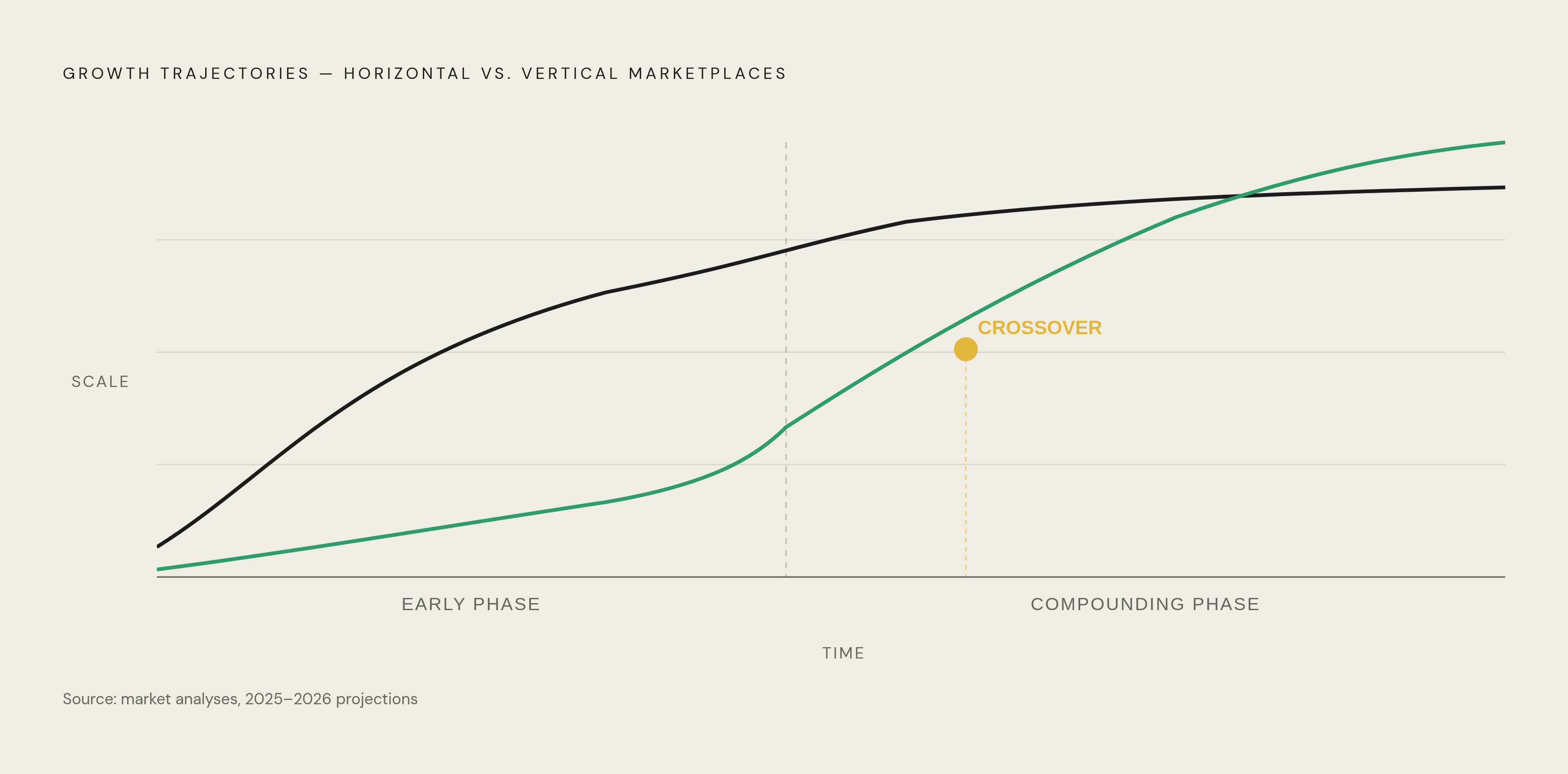
Horizontal platforms often get through the cold-start problem faster, and it's worth being honest about why. Broad category appeal means supply and demand get recruited from a dozen directions at once, and no single category has to hit critical mass before the flywheel turns. Amazon's early expansion from books into electronics, toys, and apparel shows this clearly: every new category added GMV and reinforced the "we have everything" promise that eventually locked customers in for good.
Vertical platforms face the opposite problem at the start. The audience is smaller by design, so both sellers and buyers need recruiting with precision, and early traction depends on actually being better for that specific audience, not just present in the market. There's no shortcut around that; showing up isn't enough when the audience already knows exactly what good looks like.
But the compounding reverses as time passes. Sellers on horizontal platforms list on several at once, Amazon, eBay, Walmart, whichever one takes their listing fee, because there's little to make them exclusive to any single one. Sellers and buyers on a vertical platform that's actually nailed the experience behave differently: once a platform becomes the default destination for a niche, users don't bother maintaining accounts across five specialty competitors the way they juggle multiple horizontal accounts out of habit.
That reversal is already showing up in growth data. Analyses heading into 2026 have vertical and niche marketplaces expanding faster than general marketplaces, which suggests the early speed advantage horizontal platforms enjoy is starting to trade places with the compounding advantage vertical platforms build later. It shows up in capital needs too: horizontal models generally need more money upfront to compete on breadth, while vertical models can often reach profitability inside a smaller, loyal segment first and expand from a position of strength rather than a burn rate.
The four contextual factors that should actually drive the model decision
This is a fit question, and fit depends on your specific category, audience, and team. Four questions do most of the work in answering it.
First: what does the purchase decision actually look like in your category? High-consideration, high-trust, domain-specific purchases, professional equipment, high-value collectibles, B2B wholesale, specialty apparel, favor vertical, because buyers are optimizing for confidence and fit rather than the cheapest option in three clicks. Low-consideration or impulse purchases favor horizontal, since convenience and assortment are what's actually driving the sale.
Second: does your audience have repeat needs and a long customer lifecycle? Recurring needs, restocking, seasonal replacement, subscription-like behavior, make the LTV advantage of a vertical platform decisive over time. One-off or rare purchases shrink that advantage considerably; if a buyer won't be back for years, horizontal reach can matter more than depth.
Third: how much real domain expertise can you build, and does it hold up against competition? Vertical models win when the founding team, or its early partners, bring genuine niche knowledge, regulatory fluency, supplier relationships, an intuitive read on buyer behavior, that a horizontal platform can't replicate at scale without years of catch-up. If that expertise gap is thin, or can be closed by a well-funded horizontal player with a focused subcategory push, the moat may not be much of a moat.
Fourth: what's the realistic ceiling on your total addressable market, and what's on the other side of it? Map the niche's limits before you commit money and time to it, and look for a natural next step, another geography, an adjacent buyer segment, a supply-side service, that keeps growth compounding once the core market's mostly won. If the niche is genuinely too small to reach workable GMV even with a healthy take rate, clever positioning is unlikely to rescue the unit economics.
One more thing worth flagging: the model choice comes first, and it shapes everything downstream, including how you market and what you say to attract both sides of the network. Get the model right, and the messaging has a shape to follow, while getting it wrong means no amount of clever copy fixes the foundation.
How marketplace operators should think about content and positioning differently depending on which model they've chosen
Horizontal operators run into a scattered content problem almost immediately. Messaging has to work across buyer intents that share nothing in common, which makes it hard to build one coherent brand story, or a content plan that builds on itself over time rather than starting over with every new category.
Vertical operators carry a structural edge here that's easy to underrate. Deep knowledge of one audience means every piece of content, category buying guides, trust-building editorial, seller spotlights, gets written for a reader who already has strong intent and real interest in the category. That also makes SEO winnable in a way it usually isn't for horizontal platforms: competing for specific, high-intent search terms inside a niche is often a far more realistic fight than trying to outrank Amazon or eBay on generic commerce terms. Community content, user reviews, seller stories, explainers on how authentication actually works, maps naturally onto the trust infrastructure a vertical platform is already built around.
Operators who treat content as something to bolt on after the marketplace is live tend to underestimate how much their model choice already decided the shape of their content strategy for them, a decision made the day they picked vertical or horizontal, whether they noticed it or not.
For both models, the operators building lasting brand equity, not just cranking out volume, treat content as a strategy problem first, ahead of a production problem. Horizontal operators who want to compete on brand, not just assortment and price, end up building vertical content sub-brands inside their own platform: dedicated editorial teams for specific categories that mimic the depth a true specialist would have. Vertical operators, who need to sound genuinely expert at a pace that keeps up with a growing marketplace, are increasingly turning to tools that pair AI-assisted writing with real editorial review and a consistent brand voice, so that depth can scale without requiring a full agency or an in-house content team to pull it off.
Every new piece from marketplace crunch, as it's published.
Follow