Horizontal Marketplace Business Model Fundamentals
Horizontal marketplaces succeed by solving the cold-start problem through category density.

Horizontal marketplaces now account for the majority of global online retail. That is not a trend; it is the settled architecture of digital commerce. And yet most writing about these platforms treats them as large catalogs with good logistics, which misses the point almost entirely. A horizontal marketplace is a structured economic system: it converts fragmented supply and fragmented demand into repeatable transactions through specific mechanisms, and whether it survives depends heavily on how well those mechanisms are designed. Think of it less like a store and more like a city — the value is not in any single building but in the infrastructure that lets strangers reliably do business with each other.
What Makes a Horizontal Marketplace Structurally Different from a Retailer or a Directory
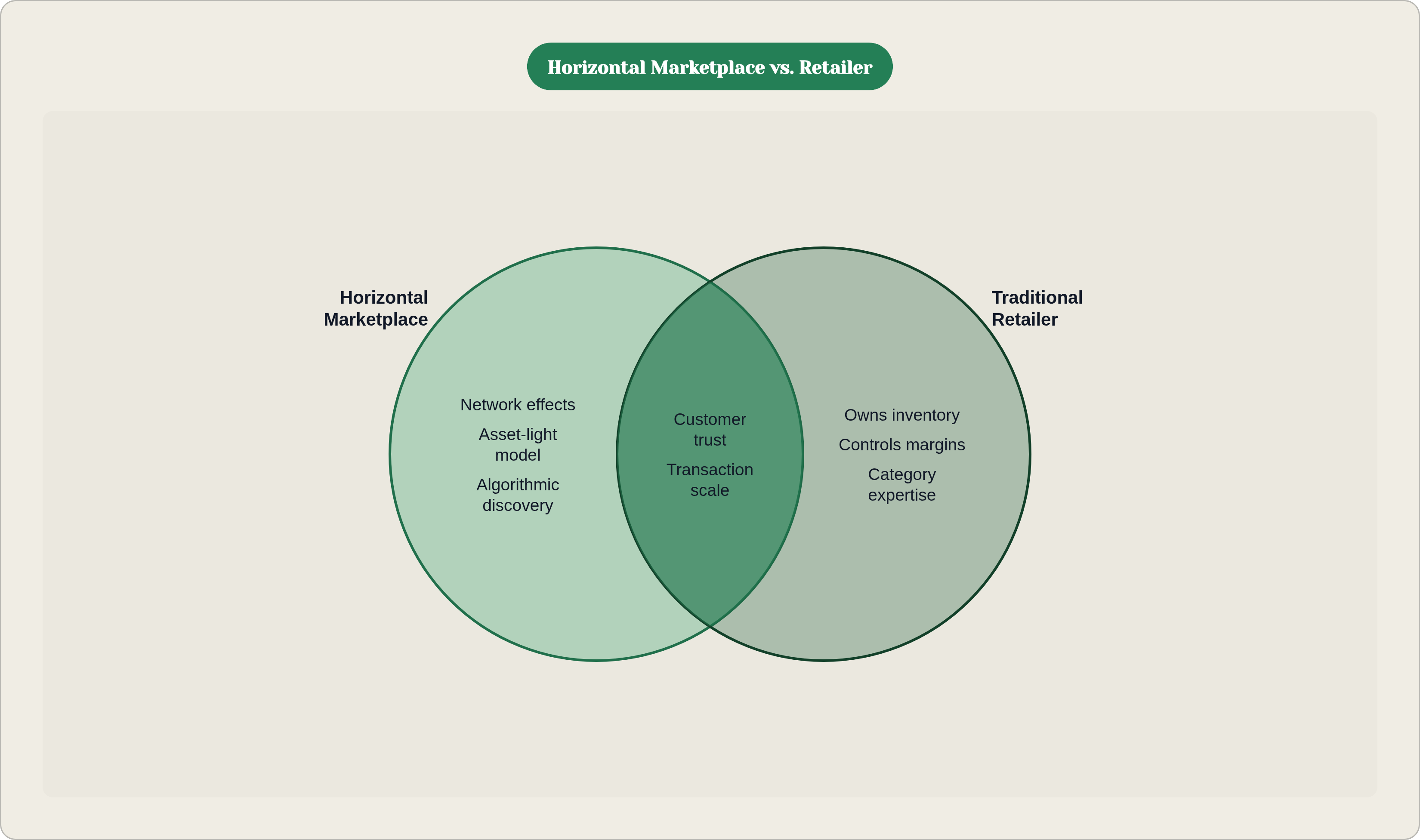
Start with what it is not. A retailer buys inventory, owns the customer relationship, and earns the margin between cost and price. A directory lists participants but mediates nothing. A horizontal marketplace does neither. It facilitates transactions between independent buyers and sellers, owns no inventory, and earns a share of the exchange.
Four structural pillars define the model. First, it is a multi-sided platform: multiple distinct user groups transact through it, and the platform's value to each group depends on the size and quality of the other. Second, it is asset-light: the value the platform creates lives in infrastructure, trust mechanisms, and discovery tools, not in physical goods. Third, it generates network effects, which means each additional participant makes the platform more useful to everyone already there. Fourth, it is technology-driven at the operational layer: search, payments, dispute resolution, and transaction management are automated at a scale no human workforce could replicate.
"Horizontal" is the strategic choice to expand across categories rather than go deep in one. That choice reshapes user behavior immediately. Buyers on a horizontal platform come for variety and convenience. They navigate by price comparison. They are more prone to impulse purchases. Discovery, therefore, is algorithmic by necessity: with a catalog spanning millions of SKUs across dozens of categories, human curation is not an option.
That last point has a financial corollary worth internalizing early. A brand selling its own product directly can capture margins upwards of 70 percent. A horizontal marketplace operator typically works within a 5 to 20 percent range. This is not a management failure. It is the structural consequence of facilitating other people's transactions rather than owning them. Why did the marketplace operator go broke? Because he kept making connections instead of keeping the goods — he was rich in bridges and poor in inventory.
How the Choice of Breadth Over Depth Reshapes Every System the Platform Has to Build
Breadth is not a categorization decision. It is a systems decision, and its effects compound through every operational layer the platform has to build.
Consider trust architecture. In a vertical marketplace, trust can be built around category-specific signals: certifications for medical equipment, provenance records for fine art, professional credentials for legal services. A horizontal marketplace cannot rely on any of those. It must build a trust system that generalizes across incompatible categories, which is a structurally harder problem. The same review framework that works for consumer electronics has to function for handmade ceramics, vintage clothing, and industrial fasteners. That tension rarely fully resolves.
Pricing and discovery present a similar challenge. Algorithmic search becomes the primary navigation tool at horizontal scale, which concentrates enormous power in the ranking system. That concentration creates incentives for sellers to game it. Every horizontal platform eventually becomes, in part, a contest between its ranking algorithm and the seller community trying to reverse-engineer it.
Support and dispute resolution compound the problem further. What counts as "as described" varies considerably between a used laptop and a hand-dyed textile. A generalist platform must arbitrate disputes across categories with different norms, different standards of quality, and different buyer expectations. The policies that work for one category actively fail in another.
Why exactly does the platform persist with breadth, given all of this? Because breadth also delivers structural advantages. Lower dependence on any single category reduces volatility. A downturn in consumer electronics does not threaten the platform if apparel, home goods, and sporting equipment are still transacting. The tradeoff is not fixable by better operations; it is intrinsic to the model, and the platforms that scale successfully are the ones that accept that reality rather than fight it.
Network Effects and Liquidity: The Two Forces That Determine Whether a Horizontal Marketplace Survives Its Early Years
Network effects are the durable competitive advantage of the marketplace model, but they are also the primary reason early-stage horizontal platforms fail. More sellers make the platform more valuable to buyers; more buyers make it more valuable to sellers. At scale, this loop is very difficult to break. But here is what the theory elides: network effects do not activate at founding. They activate after a threshold.
Before that threshold, every horizontal marketplace faces the cold-start problem. Without sellers, buyers have no reason to join. Without buyers, sellers have no reason to list. The platform is caught in a standoff with itself, and the horizontal format makes it worse. A vertical marketplace has to populate one supply pool before buyers find value. A horizontal marketplace has to populate many supply pools simultaneously, across categories with different seller profiles and different buyer behaviors, before any single one feels liquid. It is like trying to throw a party where the guests only show up if there are already guests — and you have booked twenty rooms at once.
Liquidity is the right metric here, not raw participant counts. Liquidity, in the marketplace sense, is the probability that a user who enters the platform actually completes a transaction. A platform can register millions of users and still have a liquidity problem if buyers cannot find what they want or if sellers cannot find buyers. The aggregate numbers obscure what is happening in each category at the unit level.
The tactical implication is one that successful platforms learned the hard way: density beats breadth at launch. Uber launched city by city. Airbnb focused on specific geographies and event-driven demand before expanding. DoorDash built neighborhood-level density before scaling markets. The same logic applies by category. It is better to be fully liquid in five categories than half-liquid in twenty.
Building that initial liquidity generally requires subsidizing one or both sides, which is a cost that must be planned for explicitly. The subsidy is not a temporary anomaly that disappears once the product is better; it is the price of overcoming the cold-start problem. Platforms that treat it as a bug rather than a feature of the early model tend to underfund it and stall.
A well-funded horizontal marketplace can acquire its way to liquidity faster. It can help. But money does not substitute for the behavioral reality that buyers need to trust the platform before they transact, and that trust accumulates through successful transactions, not through marketing spend.
How Horizontal Marketplaces Make Money, and How the Revenue Model Evolves as the Platform Matures
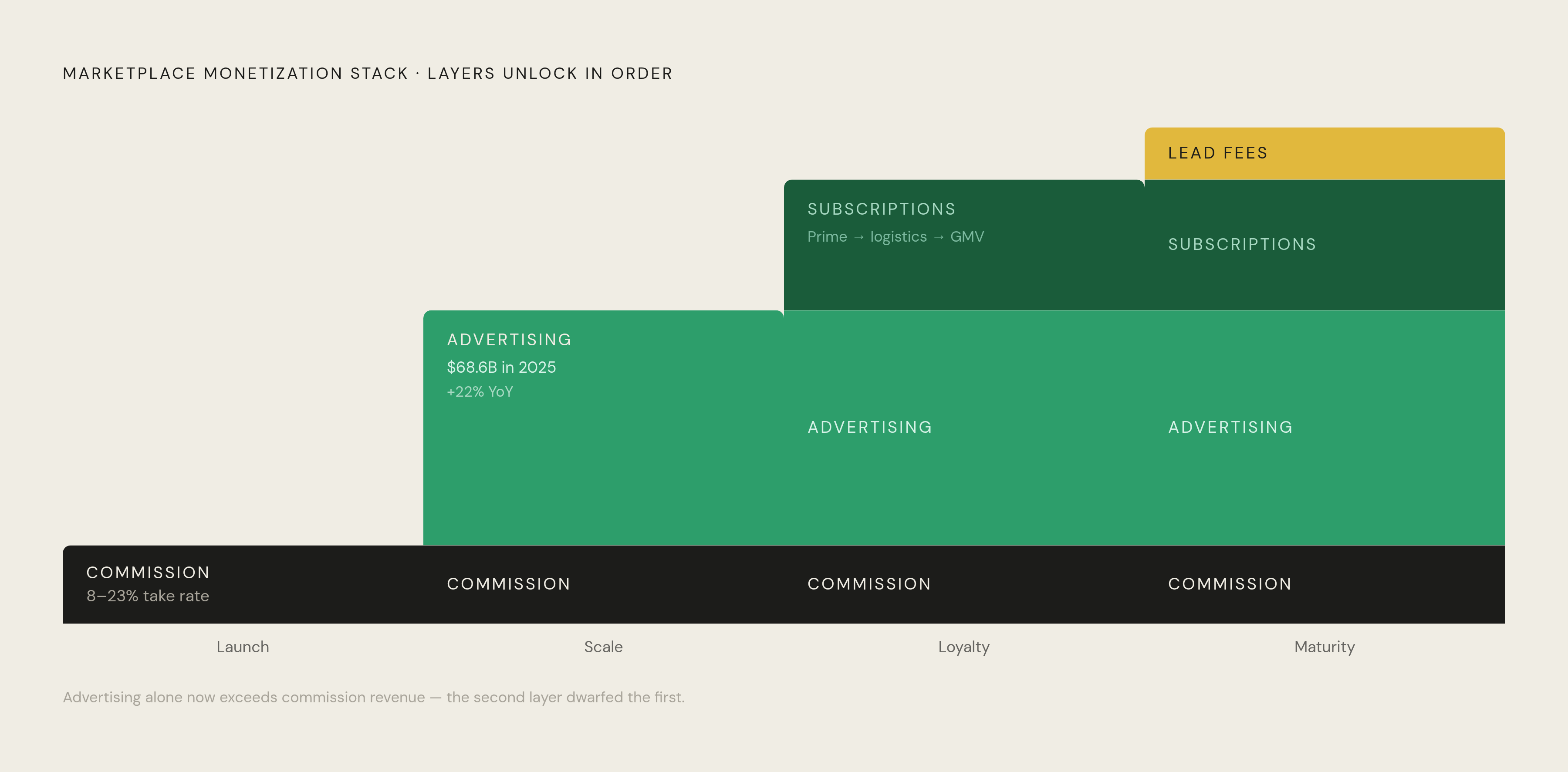
Horizontal marketplaces typically start with a single revenue stream and layer in additional monetization as the platform matures, each layer only possible because the previous one built sufficient scale. Commission, commonly called the take rate, is the natural starting point. The platform takes a percentage of each transaction completed through it. Rates vary considerably by category and product type. Amazon's referral fees typically run between 8 and 15 percent of sales depending on category. eBay's final value fee generally lands between 12.9 and 15 percent of the total sale amount plus a fixed transaction charge. Etsy charges a listing fee per item plus a transaction fee; its consolidated take rate reached approximately 23.3 percent in the first quarter of 2025, with guidance implying further expansion by year-end.
That range matters. A 23 percent take rate on handmade goods tells a different story about seller economics than a 10 percent rate on consumer electronics. The seller's margin structure in each category determines how much the platform can extract before supply attrition begins.
But commission is only the beginning of the mature revenue model. Advertising becomes the second major monetization layer, and at scale it dwarfs the original business. Amazon's advertising segment generated $68.6 billion in 2025, up 22 percent from the prior year. That is not a peripheral revenue line; it reflects the platform monetizing seller attention and buyer intent simultaneously. Once the audience is large enough, the platform can charge sellers not just to participate but to be seen.
Subscription layers add predictable recurring revenue on top. Amazon Prime is the canonical model: buyers pay for convenience and expedited access; sellers pay commission separately. The buyer subscription funds logistics improvements that make the platform more attractive, which drives more transactions, which increases commission revenue. The flywheel is deliberate.
Some platforms, particularly in services, use lead fees instead: a flat charge per qualified lead sent to a service provider, regardless of whether a transaction closes. The model works where transactions are high-value and complex enough that the platform cannot reasonably take a commission on the final amount.
The directional logic across all of these is consistent. Early-stage platforms subsidize both sides to build liquidity and charge minimally. Mature platforms charge for everything, including services that were previously offered free to attract supply. The ability to add monetization layers depends entirely on the leverage the platform has accumulated, which depends on whether it solved the liquidity problem first.
What Amazon's Numbers Reveal About How a Horizontal Marketplace Looks at Full Scale, and Where the Model Creates Friction
Amazon holds close to 40 percent of US ecommerce. It hosts approximately 1.9 million active third-party sellers out of roughly 9.7 million total registered accounts. That gap between registered and active is worth sitting with. It represents the attrition rate that the horizontal model produces: sellers who listed, found the economics difficult, and left. Or never seriously activated in the first place.
Third-party sellers accounted for 62 percent of paid units by late 2024 and roughly 69 percent of total marketplace GMV. Amazon's revenue from third-party seller services reached $172.2 billion in 2025, up 11 percent year over year. The implication is clear: Amazon is structurally more a services business for sellers than a retailer. The inventory it controls is now the smaller part of the story.
Seller economics inside that system are bifurcated in a way that matters for understanding the model. Fifty-eight percent of sellers achieve profitability within 12 months. Twenty-two percent have not become profitable. Seventy-five thousand sellers each exceeded a seven-figure threshold in sales in 2024. The distribution is not a bell curve; it is a power law, which is what network effects at scale produce.
New seller registrations fell to approximately 165,000 in 2025, the lowest annual figure in a decade and a 44 percent decline from the prior year. Rising advertising costs, higher platform fees, and intensifying competition among existing sellers are the primary drivers. That raises an important question: is declining registration a signal of market saturation, or is it a signal that the platform's terms have become unfavorable enough to deter entry?
Probably both. And that is the honest picture of what the model looks like when network effects have fully compounded. The platform is enormously valuable to buyers: low prices, fast delivery, wide selection, reliable trust mechanisms. For sellers, the calculus is more complicated. Advertising spend has become nearly mandatory for visibility. Take rates have expanded. Unit economics, for the median seller, are under sustained pressure. The platform's bargaining power grows as the marketplace matures, and sellers have limited options because the buyers are on Amazon.
This is not a pathology. It is what the model does when it works.
The Structural Limits of Breadth and Why Horizontal Marketplaces Face Persistent Pressure from Specialists
Breadth creates problems that scale does not fully solve.
Customer acquisition cost is structurally higher for a horizontal platform because marketing cannot be concentrated on a single industry's channels, communities, or keywords. The platform has to be legible to buyers of electronics, apparel, sporting goods, and furniture simultaneously, which diffuses the message and raises the cost of each incremental user.
At the product level, when the same SKU appears across dozens of sellers on a single results page, the platform becomes a commodity venue. Price is often the only differentiator, which compresses seller margins and trains buyers to expect low prices, which compresses margins further. The loop feeds itself.
Vertical entrants exploit exactly this. A specialist marketplace can offer deeper category expertise, better trust signals calibrated to that category's norms, lower noise in discovery, and higher-value relationships with buyers who are there for specific reasons. A handmade goods buyer on a specialist platform has a different relationship with the seller than a buyer who found the same item buried in a general search result. That relationship difference has economic consequences: higher conversion rates, higher repeat purchase rates, higher average order values.
It is also worth noting that the seller's customer relationship on a horizontal platform is consistently mediated and rarely owned outright. The platform controls the data, the communication channel, and the repeat purchase path. A seller with tens of thousands of satisfied Amazon customers does not have a customer list; they have transactions. The distinction becomes significant when the platform changes its terms, raises its fees, or suppresses their listing in favor of a competing product.
The horizontal operator's answer to all of this is, typically, scale-based. Lower per-unit infrastructure costs once volume is sufficient. Broader data advantages across categories. Cross-category bundling, Prime being the most developed example, that a vertical cannot replicate. These are real advantages, but they are not permanent solutions. They require continuous reinvestment to maintain, and they do nothing to reduce the operational complexity that breadth generates.
The question that any horizontal marketplace has to keep answering, at every stage of its development, is whether its scale advantages compound faster than its complexity costs. That answer depends on how well the platform manages the mechanisms this piece has examined: liquidity before breadth, trust architecture that generalizes without becoming meaningless, take rate discipline that extracts value without triggering supply attrition, and monetization layering that adds revenue without degrading the core transaction. Get those right, and the model is extraordinarily powerful. Get them wrong, and a large catalog is all you have.
Notes
- https://www.statista.com/statistics/259782/third-party-seller-share-of-amazon-platform/
Provided data on third-party seller share of Amazon's platform, supporting the article's claim that horizontal marketplaces account for the majority of global online retail.
- https://redstagfulfillment.com/how-many-third-party-sellers-are-on-amazon/
Supplied figures on Amazon's active and registered third-party sellers, referral fee ranges, and the number of sellers exceeding seven-figure sales.
Every new piece from marketplace crunch, as it's published.
Follow