Horizontal Marketplace Competitive Moats Beyond Scale
Data, trust, and finance—in that order—build the real moat.

Scale gets a horizontal marketplace to the starting line, nothing more. What actually builds a moat once liquidity kicks in are three things: proprietary data, trust infrastructure, and embedded finance, stacked in that order. Get the sequence backwards and you end up running a big business with no real defense, which happens to a lot of smart founders who really should've known better by now.
I used to assume, and I've heard plenty of founders assume the same, that once enough buyers and sellers show up, the flywheel spins on its own and the business defends itself. It's worth poking at that assumption, because the OECD's 2024 competition working paper argues scale and network effects create barriers to entry, but it's careful, pointedly so, to separate that claim from any assertion about durable competitive advantage. Regulators already treat scale as a baseline indicator of market power, and if the people whose entire job is worrying about monopolies assume you have an edge just from being big, being big can't also be the special ingredient.
So what does scale actually buy you? Mostly just entry, and not much else. A vertical specialist who's spent five years going deep on industrial fasteners or vintage synthesizers builds trust and product fit a horizontal player spread across a hundred categories hasn't earned in any single one of them, and breadth means thinner margins per category than a focused competitor who only has to be good at one thing. The attrition problem is close to a design feature, too: a marketplace optimized for one-off matching produces relationships that are low-value and low-loyalty almost by construction. Every vertical entrant competes on relevance, on knowing exactly what a wedding photographer or a used-forklift buyer actually needs, sometimes even without your selection. Selection rarely holds a customer on its own; relevance tends to do that work instead.
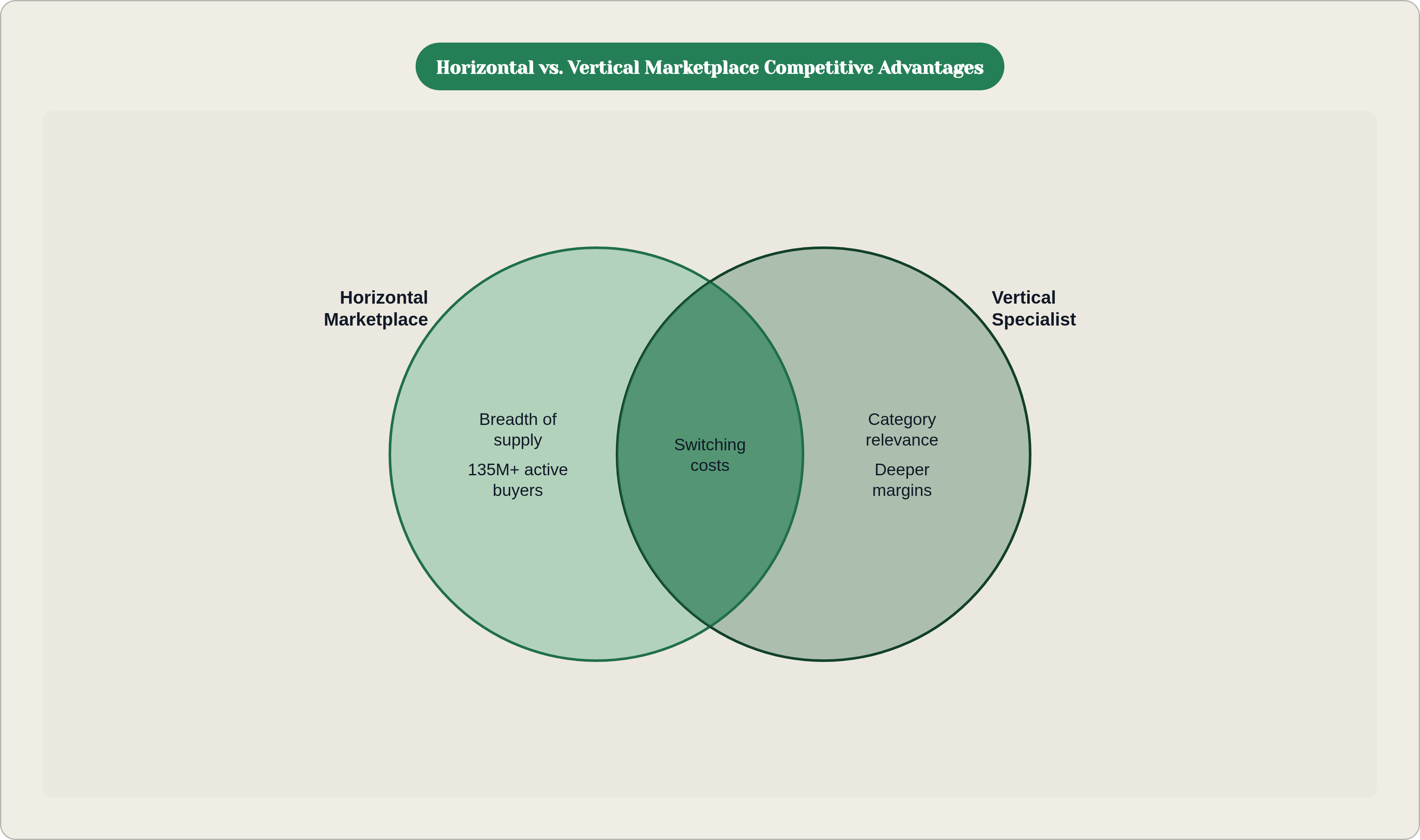
The moat vocabulary horizontal marketplace builders actually need
Morningstar's January 2025 white paper on economic moats lists five sources: network effects, switching costs, intangible assets (brand, IP, licenses), cost advantages, and efficient scale. Marketplace people talk about network effects endlessly, so that part's old news. What gets skipped is what's happened to intangible assets as a share of corporate value: they now make up 90% of the S&P 500's market value, up from 17% in 1975. Corporate worth used to mean factories and inventory; now it mostly means things you can't touch.
For a marketplace builder, that shift means the valuable stuff is increasingly invisible on a balance sheet. Reputation systems, behavioral datasets, seller relationships, payment rails: none of it shows up as a line item, but all of it is harder to copy than a product catalog. A vertical competitor can match your listings in a few months, but replicating a decade of transaction-level behavioral data, or a trusted identity layer built through years of dispute resolution, takes a lot longer, if it's even possible at all.
Here's how the three pieces fit together, roughly, once you sit with each one long enough to see the seams. Proprietary data works as (i) an intangible asset and (ii) a network-effect amplifier. Trust infrastructure is an intangible asset (brand and operational reputation) that also creates switching costs. Embedded finance is a switching cost plus a real cost advantage for the seller using it. Data informs trust, trust enables finance, finance generates more data, and that loop is the order that matters. Build it out of sequence and you get something thinner than the sum of its parts.
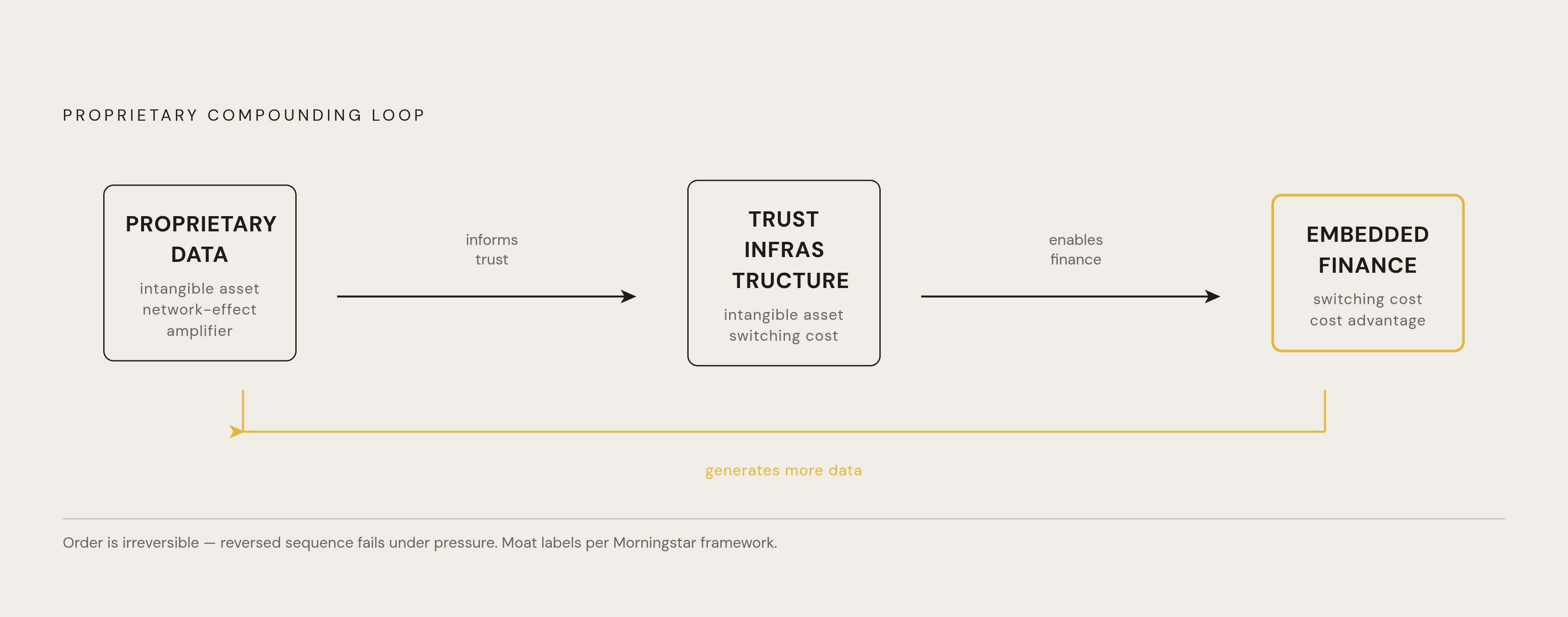
How proprietary transaction data becomes a compounding asset
Proprietary transaction data is a compounding asset because it improves with every interaction and is invisible to any competitor who doesn't operate on your rails. Every transaction on a horizontal marketplace throws off behavioral exhaust: search patterns, click sequences, purchase sequences, what got returned and why. No outside party sees any of that at the resolution you do, because it's happening on your rails, not theirs. That signal improves matching, demand forecasting, ad targeting, and fraud detection in ways that open a real, measurable gap between you and anyone without comparable data.
Amazon is the textbook case, and it's worth being specific instead of just gesturing at "Amazon is good at data." Its closed-loop system captures signals across search, product views, purchases, fulfillment, and ad response at a scale almost nobody else operates at. That data feeds an entirely separate, extremely profitable business: Amazon's advertising revenue hit $68.6 billion in 2025, up 22% from $56.2 billion in 2024, according to ecombrainly.com's reporting on the company's financials. Pile up enough commerce data and it can turn into a product you sell in its own right, separate from anything you were originally selling.
McKinsey's analysis lays out the flywheel underneath this pretty cleanly: personal data trains the model, the model profiles users to predict behavior, the model refines through experimentation, better predictions drive more ad revenue, and that revenue funds further model improvement. Each pass through the loop makes the data asset harder for a newcomer to catch up to, and the gap doesn't hold steady. Estimates put a competitor starting today somewhere around 18 to 36 months behind a platform already running this loop, and that gap can widen every cycle, whether you're watching the number or not.
Except a 2025 Marketing Science study found something that cuts against the whole logic above: some e-commerce platforms deliberately let third-party analytics tools access marketplace data, even though doing so weakens their own data moat. Usually it's to pull in more sellers faster, or to get ahead of regulatory pressure before it becomes mandatory anyway. That's a real trade-off, not a free lunch. Opening data up can speed supply-side growth in the short term at the cost of long-term defensibility. A 2022 arXiv survey of 180 data marketplace entities found platforms tend to protect their most valuable interaction data rather than share it, so openness and defensibility pull in opposite directions. A lot of founders quietly avoid choosing between them at all, which is itself a choice, just a slower and more expensive one to walk back from later.
AI changes the math here too. Feature parity is cheap now; anything visible in an app's interface gets copied fast, sometimes within a single product cycle. The moat increasingly lives at the data layer, where high-quality proprietary interaction data lets you improve matching, personalization, and fraud detection faster than any late entrant can replicate starting from zero, no matter how sharp their engineering team is.
Trust as structural infrastructure, not a feature to be shipped
Trust isn't something a well-funded competitor ships in a two-week sprint. It's a layered operational system, covering (i) identity verification, (ii) listing quality, (iii) review integrity, (iv) communications, (v) payments, and (vi) dispute resolution, and each layer breaks in its own particular way. A checkout flow can be copied over a weekend, but a decade of dispute resolutions that taught your trust and safety team what fraud actually looks like at your specific scale cannot.
Consumer behavior around trust has become measurable. Cisco's research, cited by hold.co, found 75% of consumers say they won't buy from organizations they don't trust. Salsify's 2025 report, cited by Practical Ecommerce, found 87% of shoppers have paid more for a product specifically because they trust the brand behind it. For a horizontal marketplace, those numbers cut deeper than they would for a single-category retailer, because breadth of supply means more anonymity, more room for bad actors, more categories where a buyer has no easy way to sanity-check a seller they've never heard of.
eBay is the clearest horizontal case study here, and the story is really about concentration rather than scale for its own sake. Its feedback-based reputation system, built up over decades of peer-to-peer transactions, pays off hardest in categories where supply is fragmented and hard to source: collectibles, motor parts, recommerce. Per Morningstar's April 2026 report, eBay has 135 million active buyers and 2.5 billion live listings, and its focus categories, enthusiast-led segments and recommerce, made up roughly two-thirds of gross merchandise volume in 2025, more than $50 billion, with recommerce alone exceeding 40% of total GMV. The moat concentrates exactly where peer verification and depth of supply matter more than speed or price, which happens to be exactly where a vertical competitor would struggle to build supply from scratch.
Trust is getting harder to fake now, which sounds backward until you sit with why. AI-generated reviews, synthetic listings, and automated outreach are flooding every platform with noise that has to be filtered by somebody, using something. If you've already built AI-assisted trust and safety systems, with your own proprietary training data and fraud-detection models tuned to your specific traffic, you're ahead on a piece of the trust layer that's attracting real strategic and financial investment, according to analysts tracking trust and safety platforms. Customers share more data and accept more automated decisions when they believe a platform is safe, and that loops straight back into feeding the data moat from the section above.
Regulation is shaping this too, whether platforms like it or not. The EU's Digital Services Act, fully enforceable since February 2024, requires very large online platforms to run content moderation, algorithmic transparency, and crisis response systems. Building that compliance infrastructure isn't cheap, and that's sort of the point of it existing in the first place. If you already built it, you have a meaningful head start over anyone trying to bolt it on later at the same scale.
How embedded finance turns the seller relationship into a switching cost
Start with the size of the thing, because it stopped being a rounding-error feature a while ago. The global embedded finance market hit $148 billion in 2025 and is projected to reach $197 billion in 2026, growing at roughly 31.5% a year according to Precedence Research, with some projections putting it at $588 billion by 2030 per Grand View Research. Narrow that to marketplaces specifically: the embedded finance for marketplaces segment was valued at $7.8 billion in 2025 and is projected to hit $29.4 billion by 2034, a 15.8% compound annual growth rate, per dataintelo.com. Numbers like that tell you embedded finance is becoming table stakes rather than a differentiator on its own, so the moat depends less on whether you offer it and more on how you built the plumbing underneath it.
Once a seller starts using marketplace-native working capital, payment processing, or insurance, their financial operations get woven into your data layer. Leaving isn't just a matter of moving listings to a competitor's site anymore; it means unwinding loan histories, payout schedules, tax reporting, and payment reconciliation, all at once, in the middle of running an actual business. Every additional financial service you add is another thread in that weave, and pulling threads out one at a time gets harder the longer a seller has stuck around.
There's an underwriting angle that makes this durable rather than just annoying to unwind. A platform that underwrites loans off its own proprietary transaction data, instead of reselling a partner bank's off-the-shelf product, prices risk more accurately than any outside lender who can't see real-time sales velocity, return rates, or seasonal swings in a seller's business. That's the common thread among companies that have made embedded finance actually work at scale: they use the behavioral and transaction data built up in the first moat layer to price financial products a competitor literally cannot match, because the competitor doesn't have the data to price it with in the first place.
Stack enough of this, financial services, logistics, advertising, on top of a marketplace, and the platform quietly stops being a sales channel and starts being infrastructure the seller's business runs on. At that point the switching cost is operational, not emotional; leaving means rebuilding an entire business stack, not just setting up a new storefront somewhere else. Amazon's third-party seller base shows how far this can go, with a large and growing share of unit sales flowing through sellers whose operations depend on commissions, fulfillment, advertising, and lending all piping through the same system.
One caution worth naming: embedded finance only holds up as a moat when it's built on top of the data and trust layers, not as a shortcut around them. If you bolt on financial products without the proprietary data to underwrite them accurately, you'll likely end up reselling commoditized credit at thin margins, which is still a real business, just a shallower one.
How the three moats reinforce each other over time
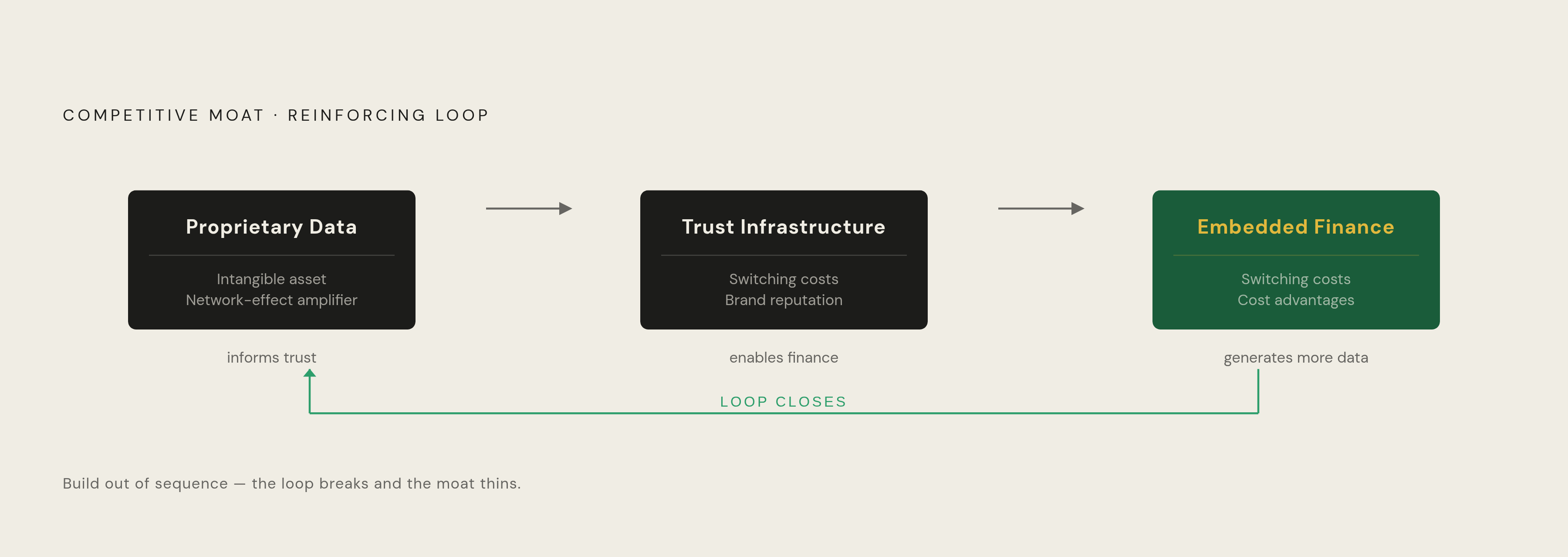
None of these three sits quietly next to the others. Each is simultaneously an output of the other two and an input back into them, which is the whole reason they compound instead of piling up side by side. Proprietary data sharpens the trust layer through better fraud detection, more accurate filtering of fake reviews, faster identity checks. A stronger trust layer makes buyers and sellers more willing to share data and accept automated decisions, deepening the data asset further, and platforms with deep trust and rich seller data underwrite financial products on better terms, making those products more attractive, which generates a whole new category of proprietary data (cash flow patterns, repayment behavior, inventory cycles) feeding straight back into the flywheel from the first section.
A vertical competitor can match your breadth in one category, given enough funding and patience. What it generally can't do is simultaneously replicate (i) years of cross-category behavioral data, (ii) a reputation system built on millions of verified feedback events, and (iii) a lending book underwritten on that same data, all at once, starting from zero. The OECD's framing is useful again here: these layers work as structural barriers to entry in the modern sense, not because any single one is unbeatable alone, but because they reinforce each other, and the cost of catching up rises every year the incumbent keeps operating.
Timing matters more than it looks like it should. That 18-to-36-month window before a data moat becomes genuinely hard to close means platforms that put off building these layers aren't just behind schedule; they fall further behind with every cycle the incumbent completes, because the incumbent's flywheel doesn't pause and wait for the latecomer to catch up.
Still, the compounding logic isn't bulletproof, and it's worth naming where it breaks, because this framework won't survive contact with reality unless you name the exceptions up front. Regulatory intervention that forces data sharing can degrade the data moat without touching trust or finance at all, opening a gap a vertical competitor could actually walk through. A high-profile fraud event or a review manipulation scandal can unwind seller confidence faster than financial switching costs can hold the relationship together. Embedded finance that isn't underwritten on real proprietary data turns into a margin-negative commodity service instead of a moat. Build these three out of order and you get something that looks like a moat on a slide deck, and folds the first time it's under real pressure.
What marketplace builders should prioritize at each stage of scale
In the early liquidity phase, the obvious priority is getting supply and demand into balance, and that's correct as far as it goes. But the data architecture decisions made in this phase quietly determine which moats are even available to you later. Capture behavioral signals at the transaction level from day one: what people searched for, what they skipped, what they came back to three times before finally buying. All of it matters nearly as much as the purchase itself, and treating it as an afterthought is how you end up rebuilding your data pipeline two years in, at three times the cost.
Trust and safety deserves early investment too, well before it feels urgent. Reputational damage from early fraud, or a wave of fake reviews that slips through before you're watching closely, can be disproportionately hard to undo later. Trust is cheap to lose and expensive to rebuild, and there's generally no version of that trade that runs the other way.
Once liquidity is established, sequence tends to matter more than any checklist. Close the data loop first: keep behavioral and transaction signals proprietary instead of letting them leak out to third-party analytics tools that can end up benefiting your competitors more than they benefit you. Only once that data foundation is solid does it generally make sense to layer trust infrastructure, and eventually embedded finance, on top of it, because each later moat depends on the data layer being real, not just present on a roadmap slide somewhere.
Scale is the deposit you put down before you're even allowed to start building a moat. What you build with it, and the order you build it in, can determine whether a vertical competitor with sharper category focus eats your lunch five years from now.
Notes
- https://www.vaneck.com/us/en/investments/morningstar-wide-moat-etf-moat/what-makes-a-moat-white-paper.pdf/
Provided the five-source moat taxonomy (network effects, switching costs, intangible assets, cost advantages, efficient scale) and the statistic that intangible assets now make up 90% of S&P 500 market value versus 17% in 1975.
- https://www.withkumo.com/blog/how-market-leaders-maintain-competitive-moats
Supplied the figures on intangible assets as a share of S&P 500 market value — 90% today versus 17% in 1975 — cited in the moat vocabulary section.
- https://www.morningstar.com/company-reports/1467264-focus-on-enthusiast-buyers-and-investments-in-advertising-fortify-ebays-moat
Provided specific eBay metrics — 135 million active buyers, 2.5 billion live listings, $50 billion GMV in focus categories, and recommerce exceeding 40% of total GMV — used in the trust infrastructure section.
Every new piece from marketplace crunch, as it's published.
Follow