Content Strategy for Horizontal Marketplace Brand Building
Trust beats traffic on horizontal marketplaces where choice paralysis matters more than discovery.

Horizontal marketplaces sell everything and specialize in nothing, which sounds like a strength until you realize it means the standard content playbook, rank for keywords, drive traffic, hope conversion follows, just builds a wider funnel over the same leaky bucket. Content on platforms like Amazon, eBay, Etsy, and AliExpress has to pull off three jobs simultaneously: build trust, cut down choice paralysis, and prove the platform actually understands what it's selling. Run the numbers below and you'll see why the old playbook stopped working somewhere around the time everyone else figured out how to buy traffic too.
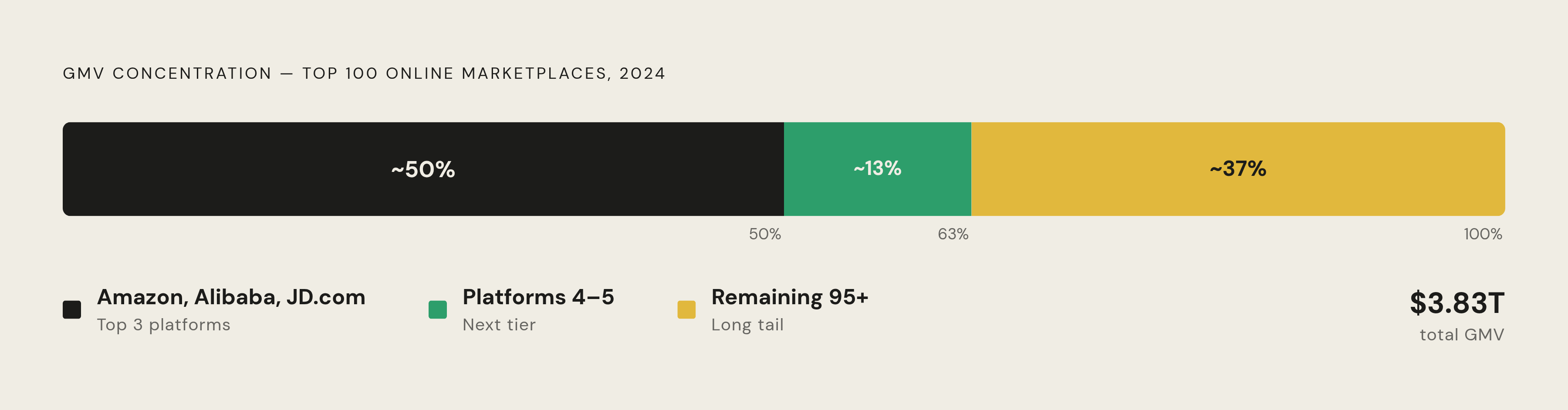
Marketplaces pulled in 67% of all B2C online retail spending in 2024, and the top 100 online marketplaces hit $3.832 trillion in GMV by year's end. Then you notice Amazon, Alibaba, and JD.com alone soak up an estimated 45 to 55% of that GMV, with the top five platforms combining for something like 60 to 65%. If you're not one of those five, you're fighting over the leftovers with a content strategy designed for an era when traffic was the scarce resource. Attention got cheap a while back, and trust is the thing nobody's cracked how to manufacture at scale, and that's really what this whole piece is circling.
How horizontal differentiation works and why it changes what content must do
Vertical marketplaces compete on depth. A platform selling only vintage watches or handmade ceramics wins by being the best at that one narrow thing: stack up quality and price until you're sitting at the top of an obvious pile. Horizontal marketplaces don't get that luxury. When two platforms offer roughly the same selection at roughly the same prices, the deciding factor stops being quality and starts being fit. Does this place feel like it's for me, or does it feel like a warehouse that happens to have a search bar?
That's horizontal differentiation, and it wrecks the instinct most growth teams reach for by default, which is out-executing the competition on some measurable axis. Quality isn't really what buyers are weighing here, so grinding harder on quality doesn't move the category the way it would in a vertical fight. Look at the history of most big brands and a pattern shows up: they launch on some technology or logistics edge, ride it until competitors catch up, then pivot hard into brand strategy because the original advantage stopped meaning anything. Amazon's edge drifted over time from low prices toward being the default answer to "where do I buy this," a trust question wearing a convenience costume.
So what does horizontal differentiation actually demand? Being the right fit for a specific kind of buyer, at scale, across categories that share nothing in common. That's a positioning problem, and positioning problems get solved with content built around three jobs: establish trust (why should I hand this unfamiliar site my card number), reduce choice paralysis (there are tens of thousands of options and I need somebody to narrow that down for me), and signal authority (does this platform actually know anything real about the thing I'm buying).
Traffic-first content assigns no meaning to what happens after someone lands on the page. It does nothing to lower friction at the exact second someone's deciding whether to trust you with eighty bucks. On a horizontal marketplace, that content is rarely written for just "the buyer." Treat it like it is, and the strategy quietly falls apart around month four, usually right when someone in a meeting asks why conversion hasn't moved despite the traffic chart looking great.
The two audiences every horizontal marketplace content strategy must serve — and why conflating them is costly
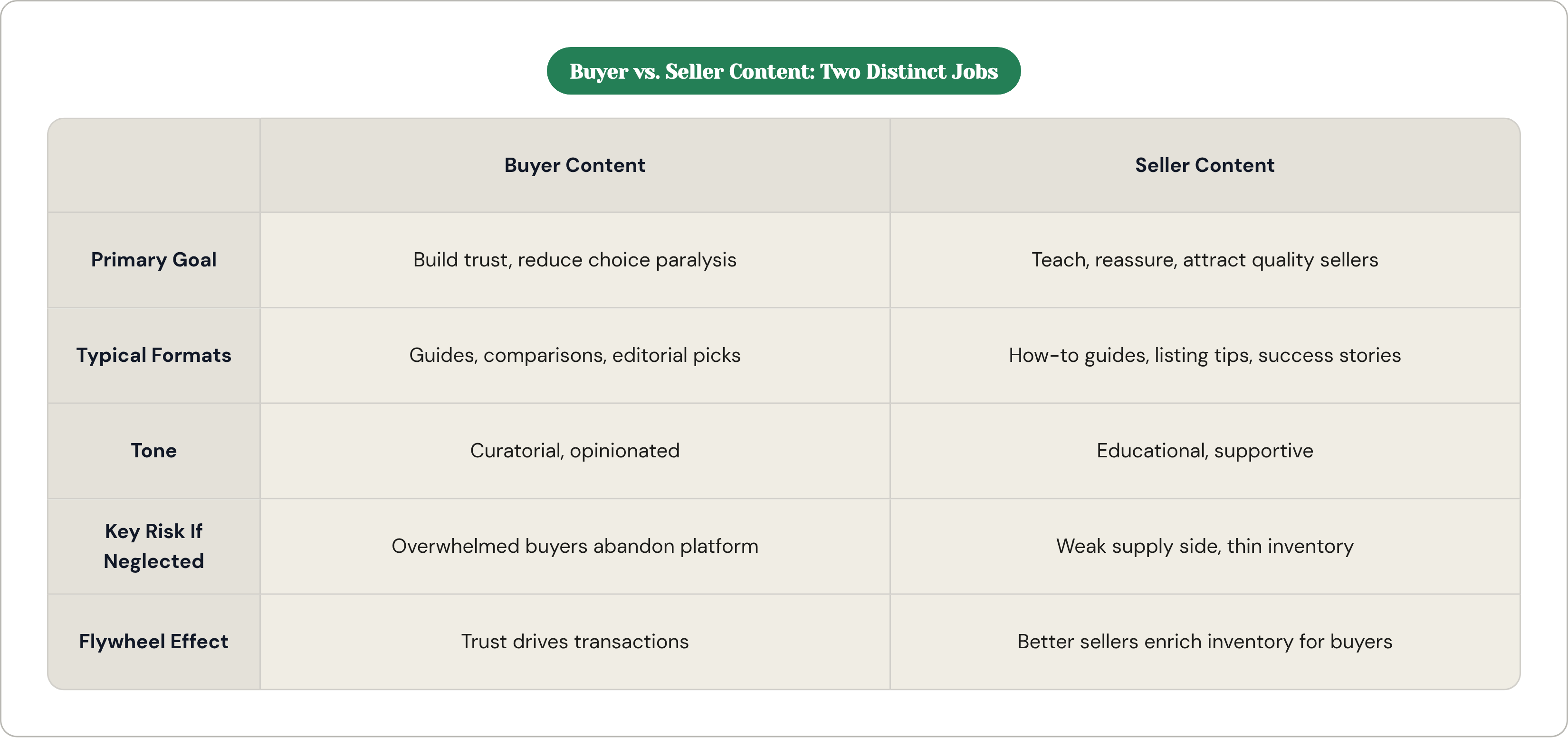
Traditional ecommerce talks to one audience. A horizontal marketplace has to talk to two at once, and they want almost opposite things from the same platform. Sellers won't list on a site with no buyers; buyers won't show up to a site with no listings. It's the classic cold-start problem, and before the flywheel has enough spin of its own, content is often the only lever a marketplace has left.
Here's where people trip. Generic "marketplace" messaging tries to speak to everyone and lands with no one; it's too vague to make a seller feel good about listing inventory, and too vague to make a buyer feel safe typing in a credit card number. Lean too hard into buyer content and you starve the supply side, ending up with a platform full of gift guides and nothing much to sell. Lean too hard into seller content and you build a platform nobody actually shops.
Treat these as two separate jobs with two distinct voices. Buyer content curates: guides, comparisons, editorial picks, the kind of thing that turns "there are tens of thousands of lamps on this site" into "here are the six that don't look terrible in a studio apartment." Seller content teaches and reassures, through how-to guides, listing optimization advice, and success stories proving the platform actually cares whether sellers make money.
Etsy's Seller Handbook is the example everyone in this space eventually points to, and it earns the reputation honestly. It frames branding and storytelling as tools for the seller's own success, which does double duty without ever announcing itself as a marketing trick. A seller who reads that content and tightens up their shop story is, almost by accident, producing better buyer-facing content too. The seller wins, the buyer benefits, and the platform gets two audiences served through one investment. Seller-success content attracts stronger sellers; stronger sellers mean richer inventory; richer inventory earns buyer trust; buyer trust drives transactions; transactions produce new success stories, and the loop keeps feeding itself. Skip this and you end up with two half-strategies that don't talk to each other, somehow landing worse off than if you'd just built one mediocre strategy and called it a day.
Trust as the brand asset horizontal marketplaces are actually competing for
Forter's 2024 report found consumers spend 51% more with retailers they trust, and trusted brands often command a 15 to 20% price premium over competitors selling the identical item. Worth sitting with for a second: trust functions as pricing power, an actual lever on the P&L.
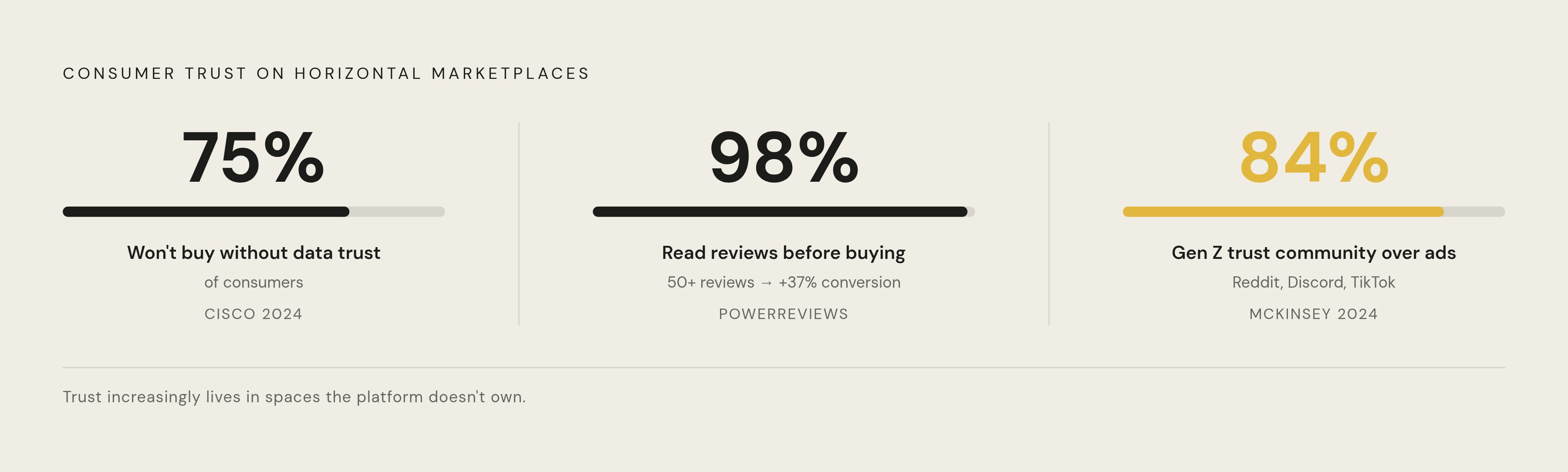
It's also a gate, and a strict one. Cisco's 2024 research found 75% of consumers won't buy from a company they don't trust with their data, and horizontal marketplaces have it worse than most, because they're asking for that trust across dozens of unrelated categories at once. The platform selling you a phone charger, a couch, and a birthday gift for your nephew is asking you to trust it three separate times in three separate contexts. None of those decisions carry over automatically to the next one.
Content has to build that trust on purpose, through editorial signals, visible proof, and a voice that doesn't wobble depending on which category you happen to be browsing. Reviews are the clearest case. According to PowerReviews, 98% of consumers read reviews when shopping online, and products with zero reviews convert 70% worse than products with even mixed reviews, while products with 50 or more reviews convert 37% better. BrightLocal's 2024 research found 79% of consumers trust online reviews about as much as a recommendation from someone they actually know: a stranger's three-paragraph rant about a garlic press carries roughly the same weight as your cousin's opinion. Review generation, display, and response need to run like an editorial operation, tended deliberately rather than left as a UI toggle somebody flipped on at launch and forgot about.
There's a second trust lever that gets less attention and probably deserves more: cultural authenticity. The 2025 Edelman Trust Barometer Special Report found 73% of people say their trust in a brand goes up when it authentically reflects today's culture, while only 27% trust brands that talk exclusively about their products. And here's a detail worth taking seriously, maybe the most important one in this whole section: McKinsey's 2024 report found 84% of Gen Z trust product reviews from niche online communities, Reddit threads, Discord servers, and TikTok creators more than they trust corporate advertising. Which means the trust a marketplace needs most isn't fully in the marketplace's control. It gets built in rooms the platform doesn't own, by people it doesn't employ, in language it didn't write. The question shifts from what to publish toward what you can make it possible for other people to say about you.
What a strategy-first content framework looks like for a horizontal marketplace
Strategy-first content starts from one specific question: what job is this piece doing for a buyer or seller, right now, at this exact moment in their decision? If you can't answer that before picking a topic or a format, you're producing volume without a clear job attached, and the gap between those two things shows up in the numbers eventually, usually later than you'd like.
Map that back to the three jobs above and you get three pillars, loosely speaking. Trust content handles transparency: how sellers get vetted, what happens to a buyer's data, the boring stuff made readable, which matters given that 75% figure from Cisco sitting there refusing to go away. Choice-reduction content is the editorial layer: gift guides, best-of roundups, comparison tools, category explainers, anything that turns an overwhelming catalog into a short list a person can actually hold in their head. Authority content is the platform's claim to know its categories at all: original research, trend reports, seller performance data, the kind of thing that makes a buyer think "okay, these people get it" instead of writing the platform off as an oversized listings page with a checkout button.
For marketplaces still working through a cold start, there's a sequencing argument worth making out loud: build the audience through guides, reviews, and comparisons before the transaction engine is fully stocked. Solve the research problem first, and the transaction problem tends to follow, because you've already earned the attention it needs to run on.
Evergreen content should carry more weight here than it would at a single-category brand, for an almost mechanical reason. A marketplace claiming authority across dozens of categories has to hold that authority in all of them at once, and evergreen educational content is what compounds while campaign content spikes and fades within a quarter. Seller success stories do more than recruit new sellers, too; when a buyer reads about someone who built a real business on the platform, they're seeing proof the ecosystem actually functions, which is a buyer-trust signal smuggled in through seller-facing content.
Voice is the hardest part of all this, and no amount of clever formatting fixes it. A platform selling everything risks standing for nothing, and a nice logo with the right fonts doesn't solve that problem, no matter what the brand deck says. A consistent editorial point of view helps: real opinions about what's worth buying, what's overrated, what a good seller actually looks like. Publishing cadence backs this up too; steady frequency compounds organic reach in a way sporadic bursts never manage, but only when the quality holds up. Frequency without a point of view is just noise on a schedule, and everyone can tell the difference eventually.
SEO architecture as brand infrastructure, not just a traffic lever
Here's a problem single-category brands rarely deal with: thin content at scale. When a marketplace onboards a new seller, that seller's product pages often ship with almost no unique copy, and Google treats those pages as low quality on sight. Multiply that by a few hundred thousand listings and you've built a structural SEO liability directly into the business model, before marketing even shows up to the meeting.
Duplicate metadata makes it worse. Five different sellers list the same item, five of them copy the same manufacturer description, and now the pages are competing with each other instead of with anyone outside the platform. Split content across seller subdomains or overly granular geographic categories and you fragment domain authority that should have been piling up in one place all along.
How a marketplace structures its content hierarchy carries brand weight before it's even a technical SEO decision. Category pages, built well, function as editorial as much as navigation. A well-built category page is often the first real encounter a buyer has with the platform's judgment, its taste, its opinion on what belongs together and why. That's brand-building carried out through information architecture.
The dual-audience problem shows up here too. Buyer-intent keywords (how to find, how to compare, how to choose) and seller-intent keywords (how to list, how to optimize, how to grow) need separate content tracks. Try to serve both on the same page and you rank for neither, because Google doesn't reward ambiguity any more than buyers do.
There's a newer wrinkle worth naming: AI search visibility. Marketplace SEO research from Journey has found that marketplaces optimized for AI-powered search see a real lift in traffic from those surfaces, and the mechanism rests on answering structured questions clearly enough that an AI system can lift the answer whole and hand it to someone who never even visits the site. Original research plays into this too. Proprietary data, seller trends, buyer behavior patterns, category growth numbers that only your platform could produce because only your platform has the transaction history, functions as a content asset competitors can't just copy and paste into their own blog. Original research has been shown to lift organic traffic substantially year over year in crowded categories, and for a horizontal marketplace it might be one of the only real moats content can build.
How UGC and community content function as brand-building systems at marketplace scale
Every transaction on a horizontal marketplace leaves behind a small trail of human behavior: a review, a photo, a comment, a question answered by another buyer instead of customer service. Surfaced well, that trail becomes some of the most credible content the platform owns, and it costs almost nothing to produce, since users make it for free while just going about the business of buying stuff and occasionally complaining about shipping times.
Three formats carry most of the weight here. Reviews and ratings are the base layer, and the case for those got made two sections ago. Seller stories humanize the supply side; a buyer who reads about the actual person behind a shop starts relating to the platform as a community instead of a catalog with a checkout page. Then there's the loosest bucket: wishlists, haul posts, social shares, the stuff buyers make on their own initiative that carries the brand into spaces the platform doesn't control and never will, no matter how many meetings get scheduled about it.
That loss of control is uncomfortable for anyone who likes tidy brand guidelines, and it's also central to why the effect works at all. Remember that 84% figure from McKinsey: Gen Z trusts niche community reviews over corporate advertising by a wide margin, and no amount of clever ad copy manufactures that same kind of trust from scratch. A platform can only create the conditions for authentic content to exist, then make sure it's findable once it does. That's the whole job, really.
There's a production-math problem UGC quietly solves too. No editorial team, however well staffed, can produce enough original content to meaningfully cover every category a horizontal marketplace touches; the math just doesn't work. UGC fills the authority gap the internal team physically cannot reach alone, which turns amplification into a strategy decision in its own right. What a platform chooses to surface, feature, or promote from its own community says exactly what it values, whether or not anyone on the team meant to say that out loud.
Skip this layer and you get a strange, hollow effect: a marketplace with glossy brand content and no visible community around it. That sends its own trust signal, and it isn't a flattering one.
Measuring whether content is doing brand work, not just generating traffic
Most content dashboards at marketplaces track traffic, keyword rankings, and conversion rates. None of that tells you whether the content is doing the trust-building, choice-reducing, authority-signaling work this piece keeps circling back to. You can hit every number on the dashboard and still be building a brand nobody particularly trusts, which is its own expensive kind of mistake, the kind that doesn't show up until a competitor eats your lunch two years later.
So what belongs next to those traffic numbers? Review volume and velocity by category, tracked over time, show whether trust signals are actually compounding or just sitting flat month over month. Branded search growth shows whether buyers are coming back with intent, typing your name because they meant to find you rather than stumbling in sideways through some unrelated keyword. Seller content engagement shows whether the education you're producing for sellers is landing or getting quietly ignored. Share of voice in category-level editorial, meaning whether anyone outside the platform actually cites you as an authority, shows whether the authority-building content works out in the wild and not just in an internal report nobody outside marketing ever opens.
The economics back this up, for what it's worth. Content marketing generates leads at roughly $47 apiece, against roughly $121 from paid advertising on average, and because content compounds while ads reset to zero the moment you stop paying, that gap widens the longer you stay invested. Segmentation adds another layer worth measuring on its own: segmented email campaigns can drive up to 760% more revenue than unsegmented sends, a number large enough to warrant double-checking against how bad most unsegmented blasts really are. For a marketplace juggling buyer and seller audiences at once, treating segmentation as a measured discipline rather than a nice-to-have is close to mandatory at this point.
The market has mostly made its decision already. HubSpot's State of Marketing Report for 2025 found more than 90% of marketers are maintaining or increasing content investment. Nobody's seriously debating whether content matters anymore. What's still unresolved is execution: whether that investment is strategy-first, built around the structural jobs of trust, choice reduction, and authority, or production-first, optimizing for volume and hoping meaning turns up somewhere in the pile.
Worth sitting with, even when strategy-first feels slower on a quarterly report: brand-building content doesn't reset when a campaign ends. A traffic campaign stops and the graph falls right back to where it started; a piece of content that earns real trust or answers a real question keeps earning, quietly raising the floor the next piece gets built on. Anyone with a budget and an ad account can buy traffic, but trust, once it actually starts compounding, is a lot harder to buy your way into, no matter how big the budget gets.
Notes
- https://www.journeyh.io/blog/marketing-marketplace-strategy
Provided findings on the traffic lift marketplaces see when content is optimized for AI-powered search.
- https://www.journeyh.io/blog/marketplace-marketing-strategy-a-comprehensive-guide-to-scaling-your-marketplace
Informed the discussion of the cold-start problem and using content as the primary lever before the marketplace flywheel gains momentum.
Every new piece from marketplace crunch, as it's published.
Follow