Seller Acquisition and Retention on Horizontal Platforms
When platforms separate acquiring sellers from keeping them, the churn treadmill spins faster.

Marketplaces went from 40% of global retail e-commerce a decade ago to 62% in 2024, a $2.4 trillion pool. B2B marketplace transaction volume hit $21.3 trillion that same year, 65% of all B2B e-commerce, and at that scale the seller side stops being a support function and turns into the actual product. This piece looks at what happens when platforms treat seller acquisition and seller retention like two separate jobs instead of one continuous problem. It doesn't go well, and I've watched it not go well from close enough range to know the pattern by heart. Platforms that sign up sellers once and call it done end up on a treadmill, forever replacing the ones who just quit and walked out the back.
The chicken-and-egg problem horizontal platforms face when building seller supply
Every two-sided marketplace hits the same wall eventually. No selection means no buyers, and no buyers means no sellers willing to stick around. Horizontal platforms get the worst version of this because there's no niche to hide behind while they figure it out. Etsy could lean on handmade goods and vintage buyers to get its first thousand sellers excited about showing up. A horizontal platform needs breadth on day one, and asking for that before there's any proof anyone's buying anything is a bit like asking someone to move into a neighborhood before the roads are paved.
Pour money into recruiting sellers before real demand exists, and here's what you get: sellers who list a few products, watch nothing sell for weeks, and leave loudly. Seller communities on Reddit and Facebook spread information quickly among members. A seller who joins, gets zero traction, and quits within a month tells four hundred people in a private Facebook group that the platform is dead on arrival. Some of them will believe him without ever trying it themselves, which is its own kind of unfair, but that's how word of mouth works when the mouth in question is angry.
Multi-homing makes the math worse, because most sellers already list on two, three, sometimes five platforms at once. Getting a seller's attention, their actual inventory, their real selling effort, is the real prize, and a seller who signs up but never routes meaningful stock to your platform isn't retained in any way that counts on a balance sheet. When both buyers and sellers are casually spread across five different apps, the only way to earn real first-choice loyalty is to pay for it, at least for a while.
Service marketplaces show a quieter version of the same problem, one dashboards are bad at catching: platform leakage. Buyer and seller find each other through the platform, then take the transaction off-platform to dodge fees. On a dashboard, this can look like healthy matching activity, plenty of connections made. In reality it's churn wearing a disguise, telling you the fee structure or trust layer wasn't strong enough to keep the deal where it belonged.
What seller population data from Amazon, Walmart, Etsy, and TikTok Shop reveals about acquisition dynamics
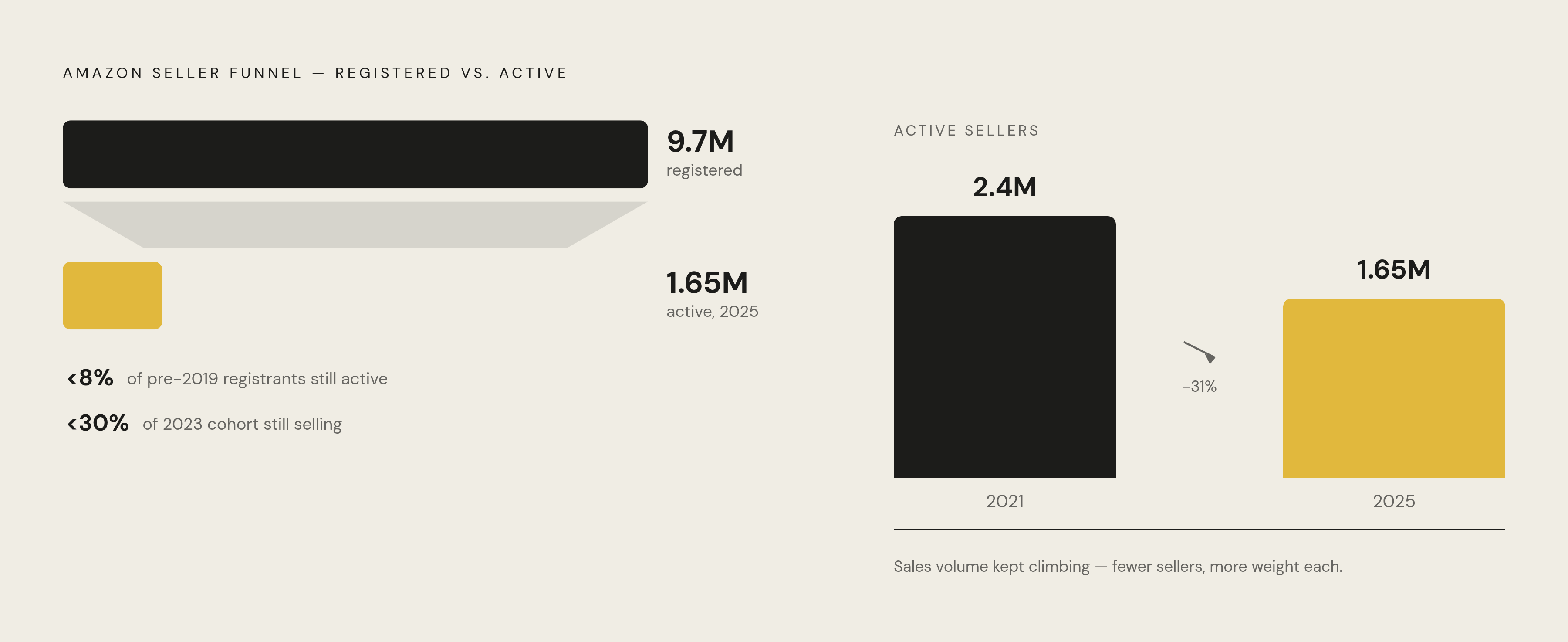
Amazon is the best place to watch this problem play out at full scale, partly because it's the benchmark everyone measures against and partly because it's a cautionary tale sitting in plain sight. The platform has 9.7 million registered sellers worldwide, but only about 2 million of them are active. Registration is cheap. Staying in business past year one is not, and the gap between those two numbers is basically the whole argument of this section in miniature.
More than 840,000 sellers joined Amazon in 2024, roughly 2,300 a day. Then 2025 showed up and the number cratered: only 165,000 new sellers registered, the lowest total in a decade, a 44% drop from the year before, while active sellers fell from 2.4 million in 2021 to 1.65 million by the end of 2025. Marketplace Pulse named this "The Great Compression," and the name fits: rising fees, climbing ad costs, tariffs, and a wave of Chinese sellers now making up 59.9% of new registrations (U.S. sellers dropped to 16.3%, down from 70.8% in 2016) are squeezing out anyone who can't run a genuinely tight margin.
Here's the twist though: the sellers who survived that squeeze are doing more business, not less. Traffic per active seller is up 31% since 2021, and sellers clearing $1 million a year grew from 60,000 to over 100,000 in the same stretch. Third-party sellers now generate 69% of Amazon's total sales volume, up from 60% in 2019. Amazon leans harder every year on a seller base that's shrinking underneath it. That's an odd position for a company this size to occupy, more dependent on fewer people every quarter that passes.
Walmart tells almost the opposite story. Walmart Marketplace crossed 200,000 active sellers by mid-2025, with 44,000 new sellers joining in just the first five months of the year, its fastest onboarding pace ever, and the platform grew 32% year over year. TikTok Shop posted $64.3 billion in global GMV in 2025, up 94% year over year, but that number hides a concentration problem underneath: more than half of U.S. TikTok Shops recorded no sales at all. Etsy, meanwhile, looks like the mature end of this spectrum. It has 9.1 million active sellers, 92 million active buyers, and an effective take rate that reached 21.4% in 2024, a reminder that fee structures tend to climb once a platform stops needing to win people over.
Pull back from any single platform and the pattern holds: registration counts are basically vanity numbers. The real supply, the kind that brings buyers back next month, is a smaller and much harder-won population than the homepage stats suggest.
How fee structures signal platform intent to prospective sellers
Before a seller lists a single product, they read the fee page, and that page makes a promise whether the platform means it to or not. Amazon's Professional Plan runs a monthly fee plus referral fees ranging from single to low-double-digit percentages depending on category. Stack in fulfillment, advertising, and storage costs, and the all-in take rate lands somewhere in the range of roughly half of revenue. That's a heavy number, and it tells a seller exactly what kind of relationship they're walking into before they've even walked in.
Walmart charges no monthly subscription fee at all, with referral fees running 6% to 15% by category, meaningfully lower than both Amazon and eBay in a lot of key categories. That's a recruiting pitch aimed squarely at sellers already tired of doing Amazon math on their own late at night. TikTok Shop's flat referral fee undercuts Amazon's category rates on paper, though affiliate commissions from creator-driven sales stack on top and can push the real cost well past the headline number. Etsy keeps things almost simple by comparison: a low single-digit percentage transaction fee plus a small per-item listing fee, straightforward enough for someone running twelve SKUs out of a garage to do the math in their head without a spreadsheet.
Fee transparency matters almost as much as the fee itself, maybe more. A seller who feels ambushed by a hidden cost doesn't just get annoyed; they lose trust, and trust is slow to rebuild once it cracks. Stack referral fees, fulfillment fees, ad spend, and return costs on top of each other, and the true economics of selling on a platform get genuinely hard to calculate by hand. That fog breeds resentment on platforms that have been around long enough to pile up complexity nobody bothered to clean up.
Who does a given fee structure actually pull in, and can that seller turn a real profit and stay past year one? A rock-bottom referral fee might attract high-volume sellers moving thousands of units a month, but it does nothing for the artisan selling forty handmade candles a week. Fee design isn't neutral. It quietly decides who shows up at the door before anyone even sends a welcome email.
Front-loaded incentive programs as a structured answer to early seller churn
The riskiest stretch of a seller's life on any platform is the gap between signing up and making a real sale. Every day that passes without revenue is a day closer to giving up, so the sensible move, purely on the economics, is to subsidize that window. If the seller eventually turns profitable, the subsidy pays for itself many times over, and if they don't, you've lost less than you would have chasing them with ads for another six months anyway.
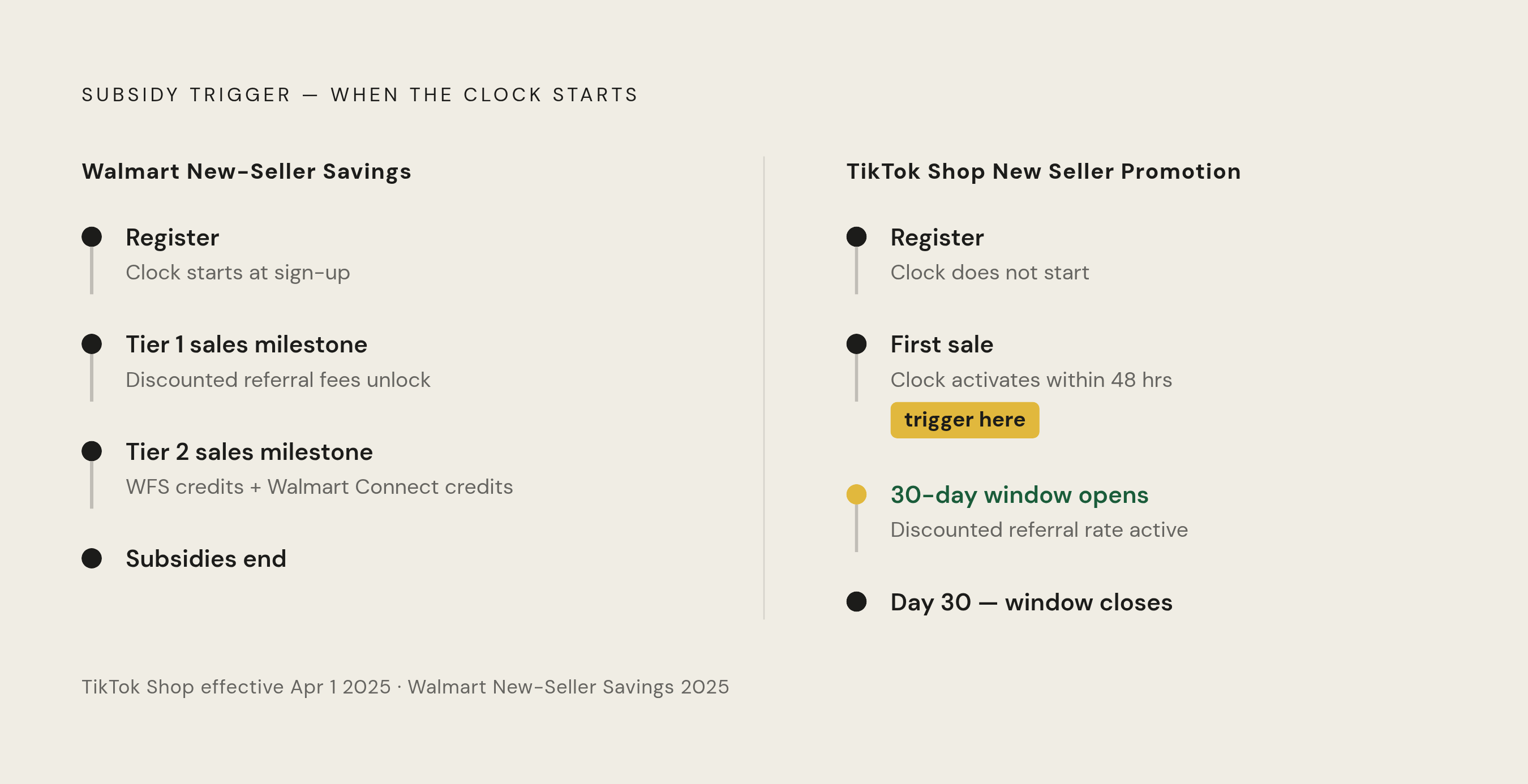
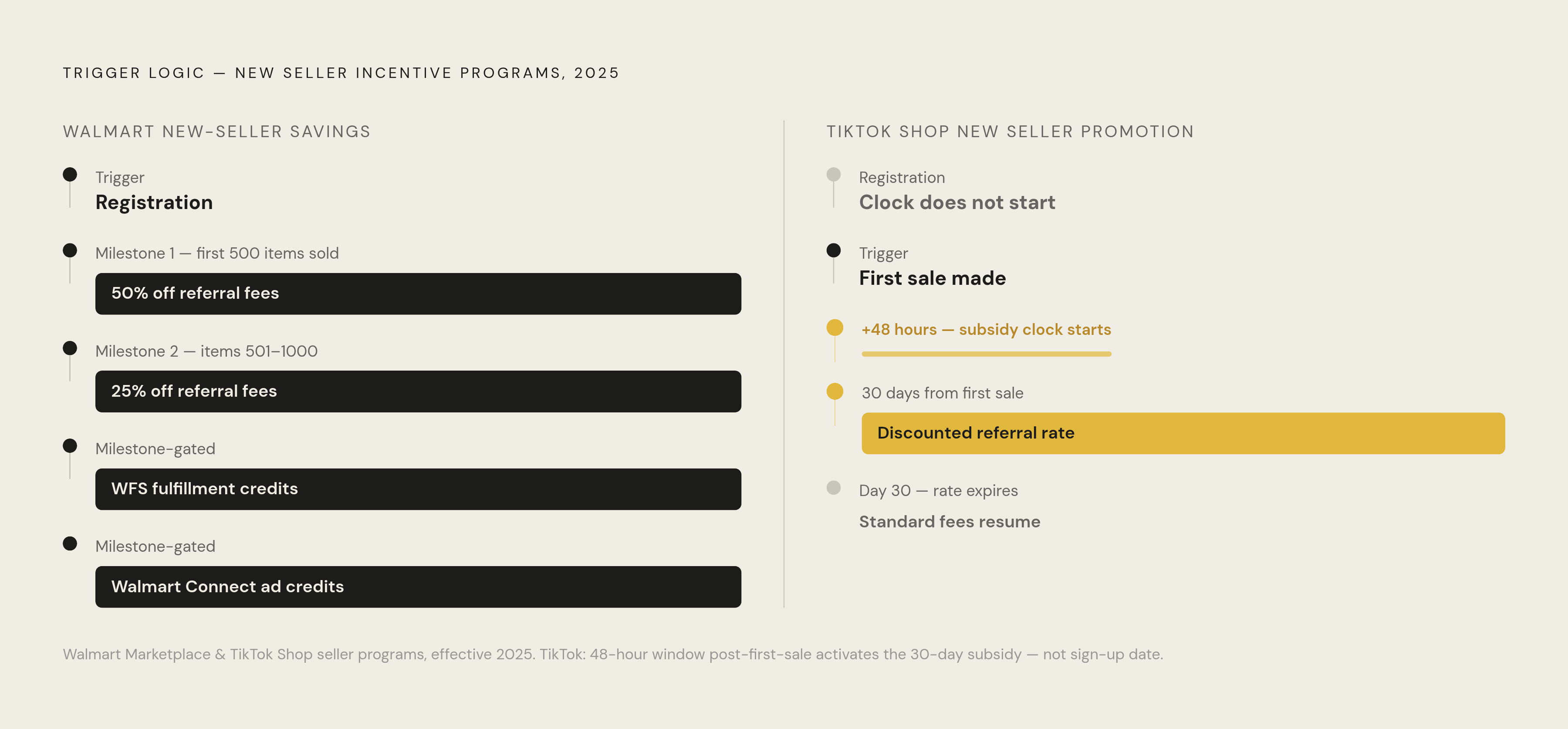
Walmart's New-Seller Savings program from 2025 is a good, detailed example of this in action. New sellers get a substantial discount on referral fees for their first tranche of sales, then a deeper discount on referral fees for sales in the next tier. On top of that, sellers can get meaningful Walmart Fulfillment Services credits and advertising credits for new Walmart Connect advertisers. A seller who hits a strong first-year sales figure has saved tens of thousands of dollars in referral fees alone, a number concrete enough to drop directly into a recruiting email without any spin needed. Notice the structure is milestone-gated rather than purely time-gated, too: sellers get rewarded for actually moving product, not just for showing up and existing on a server somewhere.
TikTok Shop's New Seller Promotion, effective April 1, 2025, runs on similar logic but with a sharper trigger: a discounted referral rate for 30 days, activated within 48 hours of the seller's first sale. The clock doesn't start on registration day. It starts the day the seller proves they can actually move a product, a deliberate choice that ties the subsidy to real momentum instead of the calendar.
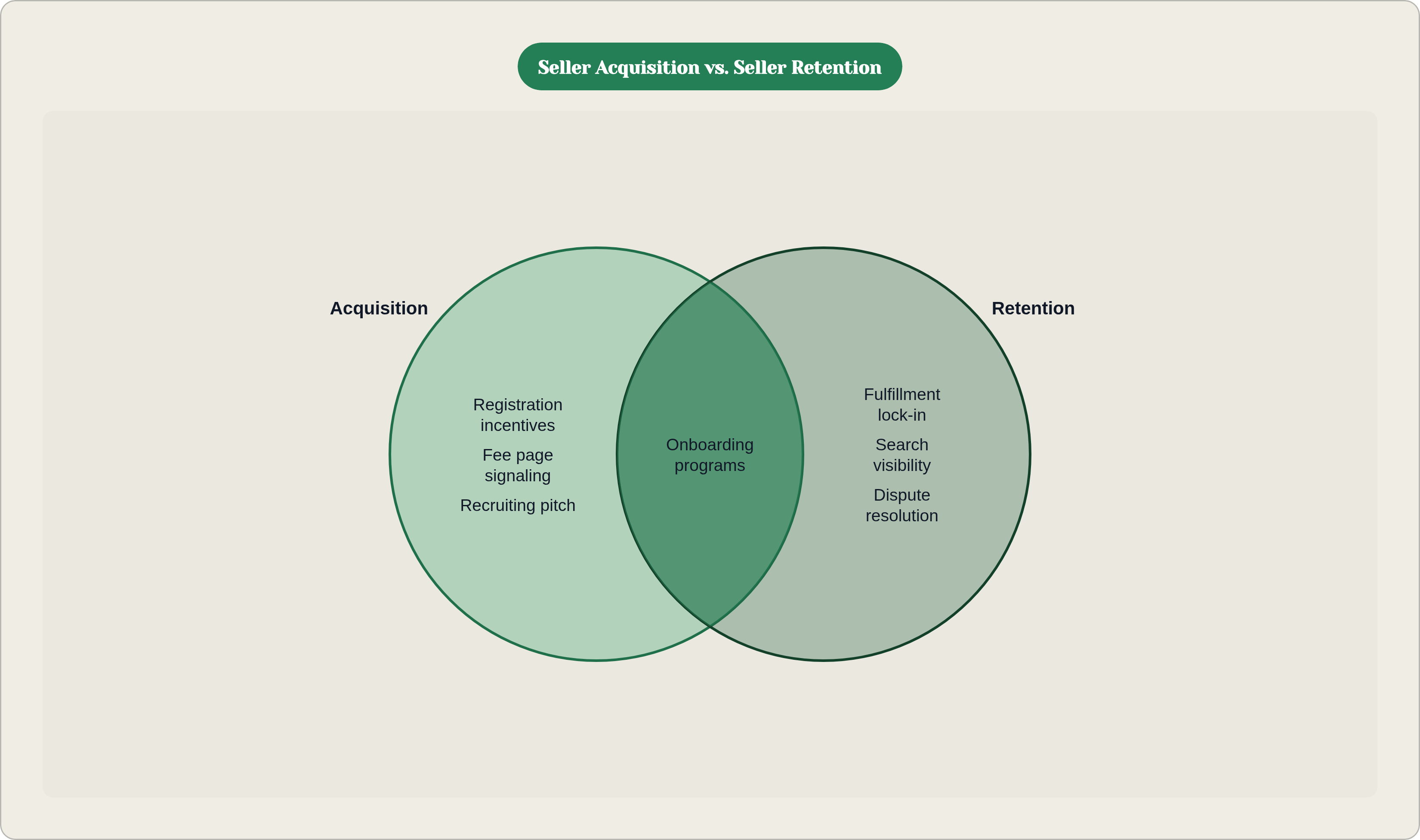
What these programs share is a willingness to eat some of the early-period risk that used to sit entirely on the seller's shoulders, and that's the right economic call when a productive seller's lifetime value justifies it. What they don't solve is getting someone through the door in a way that makes them want to stay past the discount window. Incentives get someone to walk in. Onboarding decides whether they walk back out.
Onboarding as the moment where acquisition either converts or collapses
Onboarding is where a lot of hopeful sellers quietly vanish. If someone doesn't see early traction, a first sale, a first review, some proof of real traffic, they rarely stick around long enough to become a meaningful part of the platform's supply. The goal is shrinking the time between signing up and making that first dollar down to as few days as humanly possible.
Every extra step between registration and revenue adds friction, and friction compounds fast. If your platform demands a complicated catalog upload, a slow verification process, or an opaque approval queue before a seller can list one product, you're filtering out exactly the sellers who might have stuck around under gentler conditions. That's a direct, measurable leak in your supply pipeline, not an abstract UX complaint.
Progressive onboarding is the fix that keeps showing up across the platforms that do this well: show a seller only what they need to make their first sale, and hold off on advertising dashboards, analytics tools, and fulfillment optimization until after they've felt some early success. Dump all that complexity on someone who hasn't earned a single sale yet, and the seller disengages, closes the tab, and doesn't come back. No follow-up email fixes that.
Documentation and seller education matter more here than most platforms give them credit for. A seller who actually understands how the search algorithm ranks listings, how the fee structure works, and how to build a decent product page from day one performs better and sticks around longer. That sounds obvious written out, and it gets skipped constantly in practice anyway. Managed onboarding, meaning real account managers, onboarding specialists, structured check-ins, helps most with the sellers still on the fence about whether any of this is worth their time. TikTok Shop's 60-day first-sale window built into its new-seller promotion is an honest admission that some sellers need extra runway. Sixty days with no sale is also a warning light on the dashboard somewhere, a sign onboarding is running slow in that window.
Fulfillment infrastructure as both an acquisition tool and a retention lock-in
Fulfillment by Amazon is the clearest example of infrastructure pulling double duty as a growth engine and a retention mechanism at once. A large majority of Amazon sellers use FBA for at least part of their inventory, and it's easy to see why: FBA solves three problems that block almost every new seller at once, Prime eligibility, competitiveness for the Buy Box, and the sheer logistics headache of shipping and returns. Amazon's own reporting shows FBA sellers post meaningfully higher average sales than merchant-fulfilled sellers, and that gap shows up in the numbers every time someone runs it.
The part that actually matters for retention comes next. Once a seller has moved inventory into FBA warehouses, built Prime-eligible listings, and wired their whole operation around Amazon's fulfillment workflow, leaving gets expensive in a way that has nothing to do with fees at all. They'd have to rebuild all of it somewhere else, from scratch, with new warehouses and new integrations, and most sellers simply won't bother. The switching cost alone could eat a year of margin.
Walmart is playing the exact same card in reverse with Walmart Fulfillment Services: two-day shipping, nationwide coverage, and pricing that goes head-to-head with FBA, minus some of Amazon's inventory penalties and without an IPI score hanging over sellers' heads. Walmart is using WFS to actively pull in Amazon sellers frustrated by fee complexity and inventory restrictions, and the WFS credits baked into the New-Seller Savings program is a direct, itemized offer to cover the cost of switching sides.
Fulfillment infrastructure creates a specific kind of seller, one whose commitment to a platform is structural rather than a matter of preference or a fee comparison spreadsheet. These sellers are generally among the sturdiest assets a horizontal platform can build, because they're locked in by operations, and operations don't change easily. Platforms without a serious fulfillment offering are stuck fighting over a smaller, more sophisticated slice of sellers, the ones running their own logistics, who also happen to be the sellers most likely to multi-home without loyalty to anyone.
Why seller churn on horizontal platforms is higher than it appears — and what actually drives it
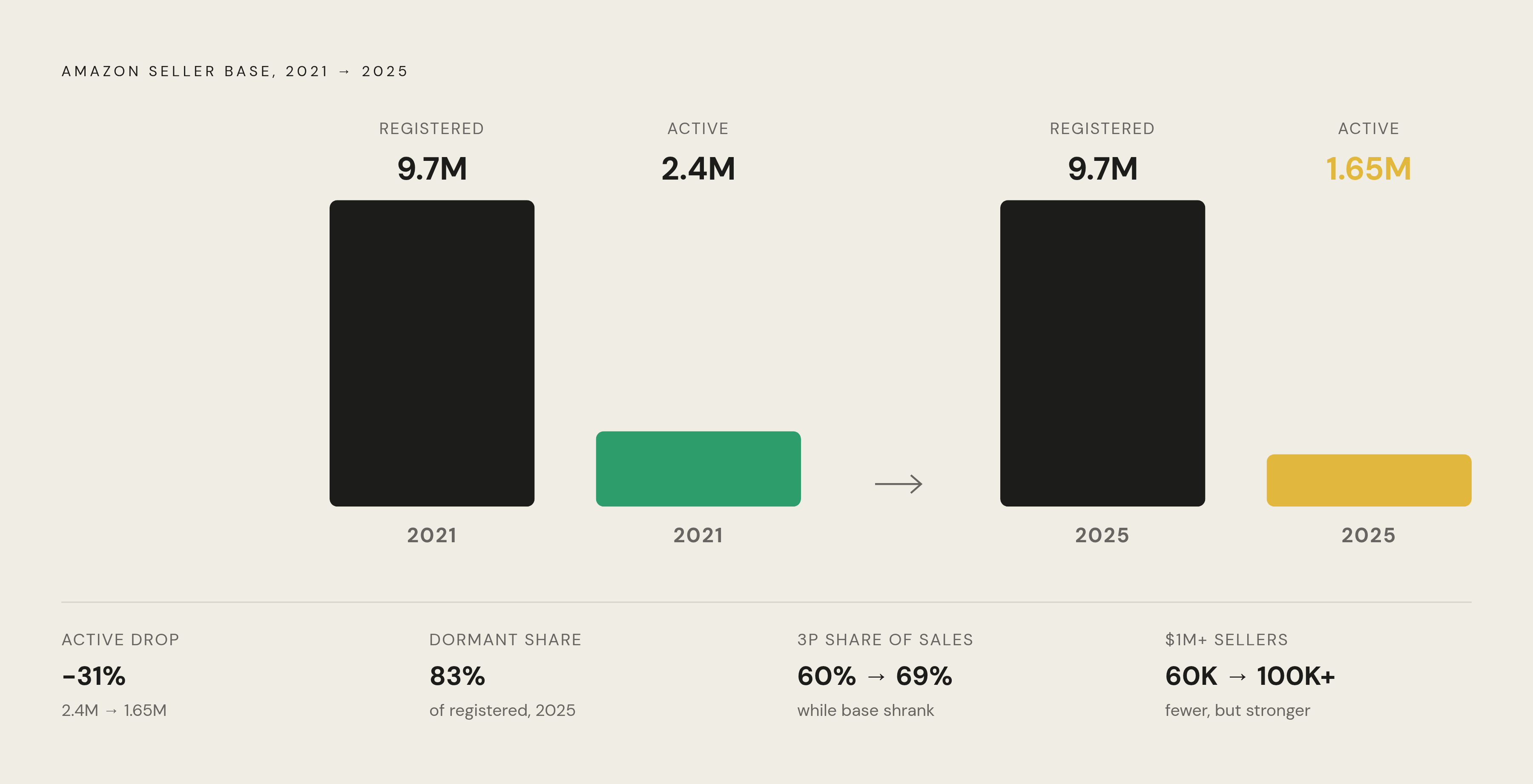
Look at the gap between Amazon's 9.7 million registered sellers and its 1.65 million active ones by the end of 2025, and you're looking at the accumulated weight of years of quiet churn. Fewer than 8% of accounts registered before 2019 are still active today, and fewer than 30% of sellers who registered in 2023 are still selling. That's the typical outcome for a seller who joins a horizontal platform and genuinely tries to make it work, and it's a rougher outcome than most new sellers walk in expecting.
Amazon's active seller count didn't just slow its growth, it fell, from 2.4 million in 2021 to 1.65 million by the end of 2025, during a stretch when the platform's total sales volume kept climbing anyway. Fewer sellers are carrying more weight. Whether that's sustainable, or whether Amazon is quietly concentrating risk into a shrinking group of increasingly critical accounts, remains an open question, and not one with a clean answer yet.
It helps to split structural churn from cyclical churn, because they call for different fixes and mixing them up wastes money. Structural churn comes from fee opacity, poor visibility in search rankings, unpredictable payout timing, and weak dispute-resolution tools. Cyclical churn, at least in 2025, comes from tariffs, rising ad costs, and price pressure from Chinese sellers now accounting for 59.9% of new Amazon registrations. Confuse the two, and you end up treating a structural wound with a temporary bandage, wondering months later why the bleeding never stopped.
According to Propel data, sellers cite low traffic and unclear incentives as the leading reasons for leaving, ahead of fees alone. A seller can fully understand and even accept your fee structure on paper, but if nobody's finding their listing, there's no real reason to stick around no matter how fair the take rate looks on a spreadsheet. Visibility functions as its own retention mechanism: sellers who get found tend to stay, and sellers who go invisible often leave, regardless of anything else you happen to get right.
TikTok Shop's concentration problem is the extreme version of this same story. More than half of U.S. TikTok Shops recorded no sales at all in 2025, a churn cohort large enough to put real pressure on seller sentiment even while the platform's headline GMV keeps climbing every quarter. Big top-line numbers hide a lot of quiet, unglamorous churn underneath them. The top-line number is rarely the whole story, and the seller base underneath it, the people actually deciding whether to stay or quit, usually is.
Notes
- https://clearomni.com/blog/how-to-scale-a-multi-vendor-marketplace-proven-growth-strategies
Provided the figures on marketplaces' share of global retail e-commerce growing from 40% to 62% and the $2.4 trillion pool.
- https://www.trypropel.ai/resources/blogs/how-to-increase-customer-retention-in-marketplaces
Provided the finding that sellers cite low traffic and unclear incentives as the leading reasons for leaving a platform.
- https://www.swell.is/content/b2b-marketplace-trends-shaping
Provided the B2B marketplace transaction volume figure of $21.3 trillion and the 65% share of all B2B e-commerce.
Every new piece from marketplace crunch, as it's published.
Follow