Thought Leadership Content Formats That Build Marketplace Authority
Earn buyer trust before the sale with formats that build lasting marketplace credibility.
Thought leadership content is not a lead-generation tool. Using that frame guarantees underinvestment in the work that actually moves buyers. The real function of thought leadership is simpler and more demanding: to be present, credible, and recognized before the buying window ever opens. Per LinkedIn's B2B Institute survey of more than 500 senior B2B buyers conducted in 2024, 81% said the product they eventually purchased was known to everyone in the buying group on Day One of the evaluation. Only 4% bought something known to just a few. That's not a nuance; it's a structural reality. The shortlist forms long before the RFP does. Your job is to be on it.
Most brands get this wrong in the same predictable way. They optimize content for conversion at the bottom of the funnel, targeting buyers who are already evaluating, while ignoring the far larger population who aren't yet in-market. At any given moment, roughly 95% of potential business clients are not actively seeking goods or services. Generic content, brand voice without human expertise, opinion without evidence, won't reach them in any meaningful way. The formats covered in this article earn authority because they reach buyers at different stages of pre-purchase awareness and signal credibility in distinct, replicable ways. They don't all work the same or do the same job. What follows is a map.
How Thought Leadership Actually Earns Authority: What the Research Says Buyers Value
The trust premium attached to thought leadership has grown substantially. According to the 2024 Edelman-LinkedIn B2B Thought Leadership Impact Report, 73% of decision-makers now say an organization's thought leadership is a more trustworthy basis for assessing capabilities than its traditional marketing materials. In 2019, that figure was closer to 59%. That's not a marginal shift; it reflects a fundamental change in how buyers calibrate credibility.
What they actually value is specific. The same research identifies original research as the most important trust signal, cited by 70% of buyers. Expert opinions follow at 64%, peer insights at 62%. The pattern is consistent: external proof and independent perspective, rather than brand claims.
The commercial implications of getting this right are significant. The 2024 Edelman-LinkedIn data shows that 86% of decision-makers say they'd be more likely to invite a company to bid on a project if it consistently produces high-quality thought leadership. Around 60% say strong thought leadership makes them more willing to pay a premium. And 70% of C-suite leaders report that a piece of thought leadership has at least occasionally led them to question an existing supplier relationship. That last figure deserves emphasis. Buyers aren't just evaluating new options; they're reassessing current ones.
There's also a negative corollary that most brands underweight. Poor thought leadership doesn't just fail to help; it actively damages consideration. A piece that reads like it was generated to fill a content calendar signals exactly that, and buyers notice. As AI-produced copy continues to flood every channel, the ability to surface genuine, named human expertise becomes harder to replicate and more valuable when authentic. That signal, real expertise from real people, is precisely what each of the formats below is designed to carry.
Original Research Reports: The Format That Creates the Most Durable Authority Asset
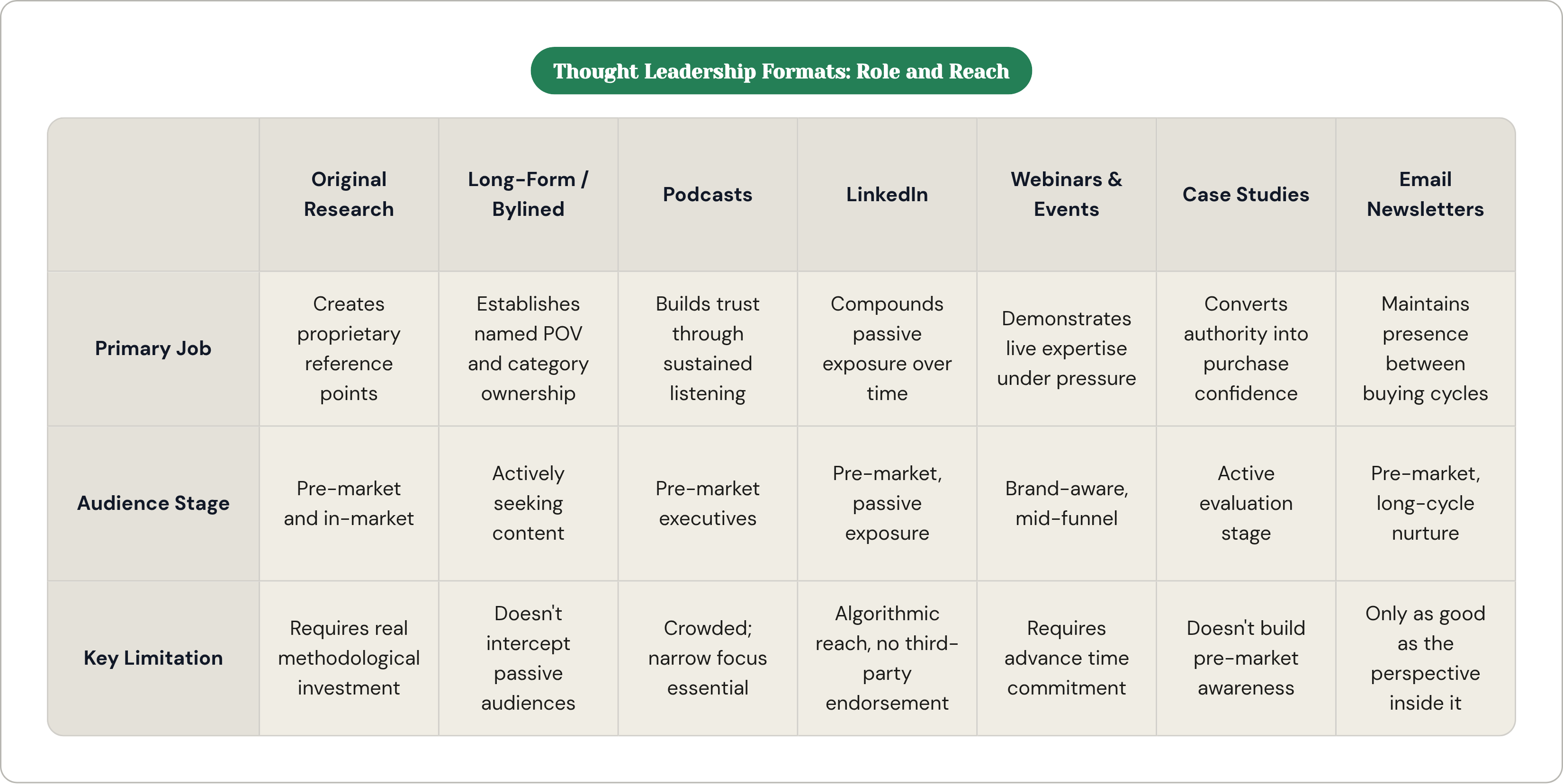
Original research earns the most durable authority because it creates proprietary data no competitor can replicate, making your content a reference point the market returns to repeatedly. That's the mechanical reason this format works, and it's worth stating plainly before discussing anything else.
IBM's annual research reports on business transformation and technology trends are consistently cited by global media and used by C-suite executives as decision-making resources. Microsoft's annual Work Trend Index, combining proprietary data from Microsoft's own tools with large-scale professional surveys, became a benchmark for HR and business leaders navigating hybrid work. Neither of those outcomes was accidental. Proprietary data plus real-world analytical insight makes content indispensable rather than merely interesting. That's a meaningful distinction.
The content multiplier effect is real. A single well-researched report can anchor an entire quarter's content strategy; repurposed into articles, infographics, webinar presentations, and social posts, it produces a consistent authority signal across multiple surfaces from a single investment. B2B content with original research receives 67% more engagement than opinion-based content, according to 2025 data from the Content Marketing Institute. And even as AI improves production efficiency across the board, the majority of marketers still identify original research as more valuable for trust and credibility than other content types.
What this format cannot do well is equally important to understand. Superficial surveys dressed up as research erode rather than build trust. Buyers and editors can identify thin methodology. The 2024 Edelman-LinkedIn data is clear: provocative opinion needs rigorous analysis underneath it to land as authority rather than noise. The bar is real investment in methodology and data collection. There is no shortcut around it.
Long-Form Articles and Bylined Opinion Pieces: How Sustained POV Earns Category Ownership
What separates genuine long-form thought leadership from an extended blog post is not word count. It's depth of analysis, named perspective, and a willingness to take positions your competitors won't. The goal isn't simplification; it's making the complex feel navigable while preserving its actual complexity. As Forbes noted in July 2025, B2B buyers aren't short on content; they're short on time and clarity. The best thought leadership earns attention by delivering utility, and utility at this level requires a real perspective, not a survey of safe observations.
The channel decision matters and deserves deliberate thought. A bylined article placed in a trade publication carries a specific kind of authority: an editor chose that perspective, which itself is a signal of external validation. LinkedIn and owned channels offer control and compounding reach, but they lack that third-party endorsement. The strongest programs combine both, placing original POV in publications with credibility in the relevant category, then amplifying and extending that thinking on LinkedIn and owned channels.
Opinion pieces do specific authority work that other formats don't. They signal that a real human being with genuine expertise sits behind the product, not just a marketing department. This is especially valuable for founders and senior leaders whose names can become associated with a category perspective over time. That association is a durable asset.
The consistency requirement is non-negotiable. A single well-placed article doesn't build authority. A sustained body of work on a defined territory does. Category ownership comes from repeatedly staking the same ground, refining the argument as conditions change, and being the voice buyers encounter whenever they explore the topic. That kind of presence isn't built in a quarter.
One honest limitation: this format reaches buyers who are already engaged enough to seek out the content. It doesn't intercept passive audiences. That's where the next format does different work.
Podcasts: The Format That Builds Trust Through Sustained Listening Attention
Podcasts build trust through sustained listening attention in a way no static format can match, and they deliver that trust directly to the senior executives who hold purchasing authority. According to Signal Hill Insights, 83% of senior executives listen to at least one podcast weekly, and they are twice as likely as the general population to listen for more than five hours per week.
The trust mechanism differs from reading in a specific way. When someone reads an article, they're engaging with edited, static text. When they listen to a podcast, they're spending extended, uninterrupted time with a person's voice, thinking, and responses. Seventy-one percent of podcast listeners say they typically listen to all or most of episodes they download, a depth of engagement no other content format reliably achieves. That sustained attention is the trust mechanism. You can't fake your way through 45 minutes the way you can optimize a headline.
Format choice shapes what gets built. One-on-one interviews are fastest for establishing rapport and trust between host and guest. Solo episodes are strongest for asserting categorical leadership and a singular point of view. Panel discussions featuring client executives tend to produce the highest lead quality; one professional services firm found that formats with client executives generated three times more qualified leads than celebrity interview formats.
The pipeline evidence is concrete. One SaaS firm targeting enterprise CTOs shifted its podcast strategy to hyper-specific technical topics its prospects actually faced. Within nine months, the show had driven $1.2 million in influenced pipeline, with 34% of deals including a podcast touchpoint in the buying journey.
The medium is crowded. Seventy-six percent of businesses launch podcasts for thought leadership purposes. The ones that build authority serve a narrow audience deeply rather than a broad audience shallowly. That distinction determines almost everything.
A final note on audience composition: 95% of what Edelman-LinkedIn calls "hidden decision-makers," the stakeholders not visible in early sales conversations, say thought leadership makes them more open to outreach. Podcasts are particularly effective at reaching these non-obvious stakeholders, precisely because they require no active search to consume.
LinkedIn as a Compounding Authority System, Not a Publishing Platform
LinkedIn surpassed 1.1 billion users globally by early 2025. It drives 80% of B2B social media leads. Those numbers are context, not conclusions. The more important figure is this: 52% of decision-makers and 54% of C-suite executives spend an hour or more per week reading thought leadership content on LinkedIn, according to the 2024 Edelman-LinkedIn report. They're already there. They're already reading.
What makes LinkedIn structurally different from other distribution channels is the compounding dynamic. A published article exists. A podcast episode publishes. LinkedIn accumulates. A consistent voice builds an audience that grows over time, making each new piece more effective than the last because the network effect amplifies reach with every post. Eighty-three percent of B2B marketers identify LinkedIn as their primary distribution channel, which means this is where the authority battle is being fought.
The people-over-brands principle is critical here. Posts from founders and senior leaders, POV articles from named executives, industry commentary from subject-matter experts: these build trust that brand accounts simply cannot replicate. The signal they send is the same one buyers are looking for: real human expertise sits behind this product. That makes individual executive presence a strategic asset, not a personal project or a vanity exercise.
Short-form video on LinkedIn is growing at 1.6 times the rate of all other content types on professional networks, according to Oktopost's 2025 B2B analysis. The platform is shifting toward formats that combine the intimacy of podcasts with the distribution reach of text. That's worth building toward now.
What LinkedIn does that no other format does: it's where buyers encounter your thinking without seeking it. Passive exposure, accumulated over months and years, is precisely what builds Day One recognition. Seven in ten decision-makers report thinking more positively about organizations that consistently produce high-quality thought leadership. LinkedIn is the primary surface where that consistency gets demonstrated.
Webinars and Live Events: When Real-Time Interaction Accelerates Trust Faster Than Static Content
Webinars do something static content cannot. They unpack complex ideas in real time, respond to actual buyer questions, and demonstrate expertise under conditions that can't be prepared in advance. The interactivity is itself the signal. Buyers watch how a company thinks, not just what it has already decided to show them.
The engagement data points to a persistent gap in how most B2B marketers operate. Seventy-eight percent say interactive and experiential content increases repeat engagement, yet only 33% regularly build it into their campaigns, according to TopRank Marketing's 2026 research. That gap is an opportunity. Most competitors aren't doing this consistently, which means the bar for standing out is lower than it should be.
The case for in-person deserves more weight than it typically gets. Ninety-three percent of senior-level business managers believe face-to-face meetings improve their ability to close deals. And the signal of digital content saturation is real: 69% of people report feeling overwhelmed by digital content. In-person events can create a qualitatively different kind of memory and relationship, one that screen-based content rarely replicates.
The roundtable format functions as a multiplier. A small, curated executive roundtable generates relationship depth and content simultaneously. A single event can produce an insights paper, a LinkedIn Live session, several written articles, and a social post series. Participants become co-creators of the authority signal rather than passive attendees; that shifts the dynamic significantly and extends the reach of the event well beyond its original audience.
One honest limitation: webinars and events require a buyer to commit time in advance. They work best with buyers who are already aware of the brand. This makes them a mid-funnel complement to the passive-reach formats, not a replacement for them.
Case Studies: The Format That Converts Existing Authority Into Purchase Confidence
Case studies convert existing authority into purchase confidence by giving every stakeholder in the buying group a shared, verifiable proof point. Enterprise purchases involve multiple stakeholders who haven't all been exposed to the same thought leadership, and case studies create a reference point that travels through the buying group without the vendor present. Four in five buyers say case studies are key to their buying research. Their function is to convert abstract value propositions into tangible proof that can be verified, discussed, and validated internally.
In the context of a thought leadership program, case studies play a specific and irreplaceable role. A brand with strong thought leadership but no proof of delivery leaves buyers with trust in the ideas and uncertainty about execution. Those are not the same thing. A compelling body of insight without demonstrated application still leaves a gap at the moment of decision.
What case studies signal that thought leadership content alone cannot: the expertise demonstrated in articles, reports, and podcasts has been applied and produced results for real clients in recognizable situations. This is the transition from "they understand the problem" to "they can actually solve it." That transition is what case studies accomplish, and nothing else does it as directly.
The risk of omitting them is concrete. Among buyers conducting active research, the absence of case studies is a disqualifying gap. Even a program with genuine thought leadership credibility can lose ground at the evaluation stage if it cannot provide this form of proof. Case studies don't build authority in the pre-market phase; they protect it when the market finally opens.
Email Newsletters: Maintaining Authority Presence Between Buying Cycles
Email newsletters maintain authority presence between buying cycles by creating the continuous cadence that episodic formats cannot. Most other formats covered here are episodic, a report publishes once, a podcast episode airs, a webinar happens on a Tuesday, but newsletters solve a structural problem: the 95% of buyers who aren't in-market at any given moment still need to encounter your thinking regularly enough that when they do enter the market, you're already on the shortlist.
The opt-in signal changes the quality of the relationship. A subscriber list is an audience that chose to keep hearing from you; that's different in kind from algorithmic reach or paid distribution. These are buyers who have self-identified as interested. They're not stumbling across your content; they're expecting it.
What newsletters do well is maintenance. They sustain presence during the long stretches between active buying cycles, delivering consistent reminders of perspective and expertise without requiring the audience to seek anything out. A newsletter can surface new research, extend a point made in a recent article, preview an upcoming webinar, or simply reinforce the category positioning your other formats have established.
What makes a newsletter worth subscribing to is the same thing that makes any thought leadership worth consuming: a genuine perspective that delivers something the reader couldn't easily find elsewhere. A digest of industry news fails that test. Synthesized analysis, original takes, and proprietary insight pass it. The format is the container; the thing that fills it still has to earn its place.
Across all the formats in this article, that's the consistent finding. The format shapes how authority is built and when it lands. But the underlying requirement never changes: real expertise, expressed clearly, delivered with enough consistency to become recognizable before the buyer ever picks up the phone. That consistency problem is the hardest part of any thought leadership program to sustain.