Brand Building for Horizontal Marketplaces at Scale
Platforms win by building buyer trust faster than sellers can establish direct relationships.
Building a brand inside a horizontal marketplace comes down to one thing: trust. When supply is infinite and categories don't overlap (batteries next to bicycles next to bath towels), a platform can't win on product alone. It wins, if it wins at all, by getting buyers to trust the marketplace more than they trust any single seller inside it. I've spent a fair amount of time picking apart how the big players pulled this off, and I've landed on some opinions worth arguing about.
Horizontal marketplaces like Amazon, eBay, Alibaba, and Walmart Marketplace serve buyers and sellers across categories that have nothing to do with each other, which separates them from a vertical marketplace built around one sector. And because these platforms are two-sided, the standard brand playbook, written for a single funnel with a single audience, doesn't map onto them cleanly. You're building loyalty with buyers and sellers at the same time, often while their incentives pull in opposite directions. Marketplaces made up the majority of global retail e-commerce sales last year, which means brand decisions made at this scale don't stay small. They compound instead. When a buyer can reach nearly any seller through nearly any platform, what actually keeps them loyal to the platform instead of the person selling the thing?
How the cold start problem shapes early brand identity
Every marketplace starts with the same dumb standoff. No sellers means no buyers, no buyers means no sellers, and most marketplaces die right here because neither side wants to go first. I've sat through founder pitches that dance around this problem for an hour and still land back at the same wall.
That standoff is a brand problem wearing a disguise. The first thing a marketplace ever promises is liquidity: you will find what you're looking for here. That promise only sounds credible once supply and demand have already partly clicked into place. Say it too early and nobody buys it, literally.
Two moves tend to work. Single-player mode gives real value to one side before promising any kind of match; a tool that gives sellers a working storefront before a single buyer shows up, for instance. Niche-first picks a narrow segment and makes the platform obviously better for that small group before going wide. Etsy built density with handmade goods sellers first and let the reputation travel outward on its own, which costs a lot less than trying to be everything to everyone on day one.
Both approaches let the brand get built by delivery instead of declared by a slogan. A marketplace's identity in its early days gets set almost entirely by how consistent and how good that first cohort's experience is. No ad campaign fixes a bad first thousand transactions.
Whichever categories, sellers, and buyers solved cold start become the founding myth, whether anyone planned it that way or not. Amazon started as a bookstore, then built enough infrastructure that "everything store" became true, then obvious, then so ordinary that nobody remembers it was ever a claim at all.
Why network effects are a brand asset and a brand liability at the same time
Network effects are supposed to be the good part. More sellers pull in more buyers, more buyers pull in more sellers, and eventually the platform's name starts meaning "the market" instead of "a market." At that point the brand doesn't need to convince anyone it exists; it just needs to be the best version of something everyone already assumes is there.
Run the same physics backward and the liability shows up fast. Every seller interaction is a brand interaction whether the platform wants it to be or not. The platform doesn't make the counterfeit sunglasses, doesn't write the fake five-star review, doesn't run the shady service listing, and buyers blame the platform anyway. That's how attribution works when the entire pitch is "we made this easy and safe." Underinvest in trust infrastructure, and platform value erodes at close to the same pace network growth built it, just with enough lag that nobody connects the dots until it's already a real mess.
So network effects cut both ways. Scale doesn't discriminate between the good multiplier and the bad one; it amplifies whichever one happens to be running that quarter.
You can build a decade of goodwill and lose a meaningful chunk of it over one viral thread about a counterfeit charger that caught fire. That asymmetry is the whole game.
Trust as the only brand currency that works across undifferentiated categories
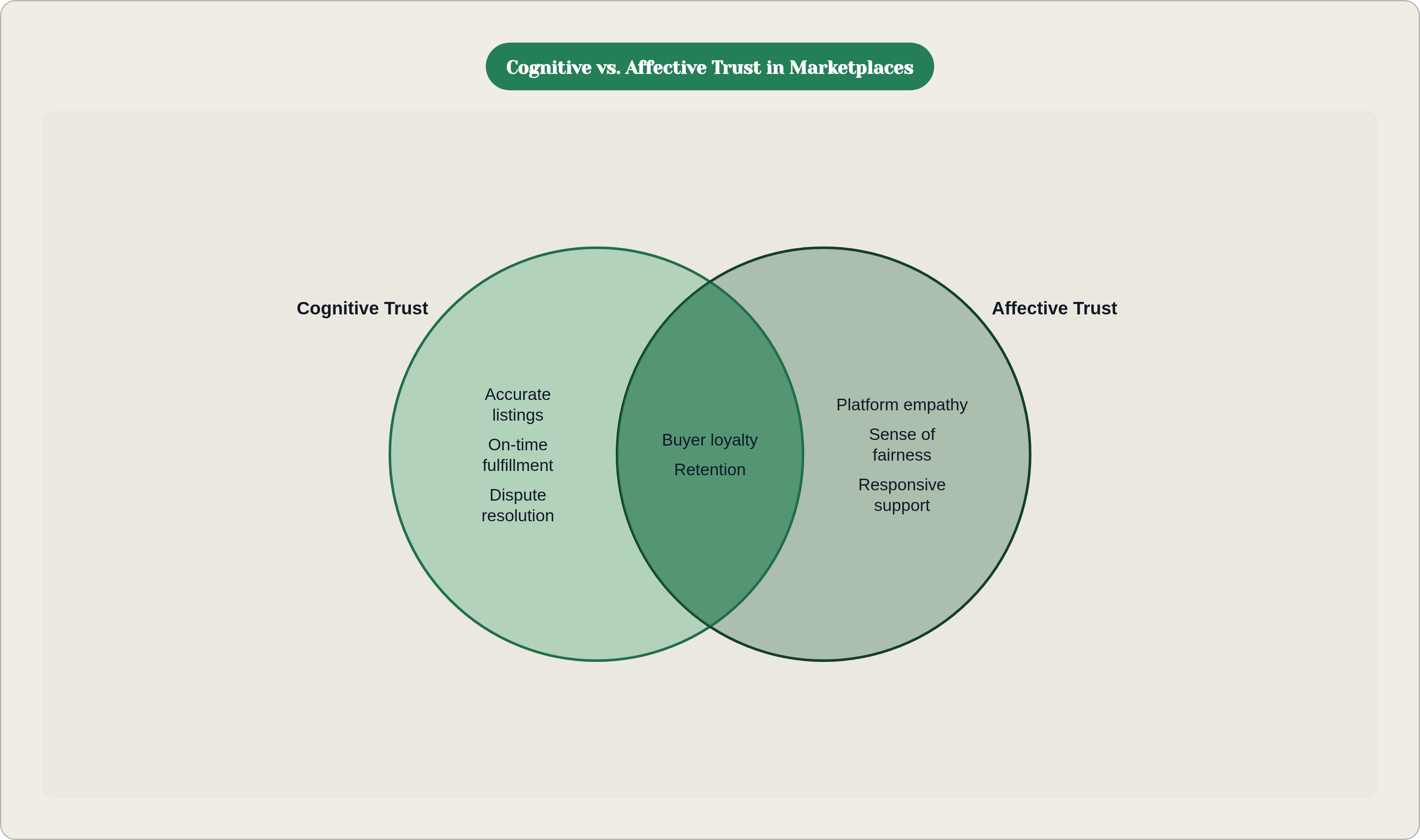
At Amazon-level breadth, category expertise wins you nothing. Nobody thinks of Amazon as the batteries brand or the bath towel brand, since its catalog spans both and neither. Curation only goes so far once the catalog runs into the hundreds of millions of items. The one lever that works across every category at once is trust, and trust splits into two things that share a single name.
Cognitive trust is the rational half: are listings accurate, does fulfillment happen on schedule, does the dispute process resolve things competently when something breaks. Affective trust is the emotional half: does this platform seem to care whether you get a good outcome, is it responsive, does it seem to share your sense of what's fair. You need both. Cognitive trust without the affective half gets you transactional loyalty, the kind that evaporates the second a competitor undercuts price by two dollars. Affective trust without cognitive backing gets you goodwill that one bad delivery wipes out completely.
Edelman's trust research found that most consumers need to trust a brand before they'll keep buying from it, and a majority say they've switched loyalties because a brand's real experience didn't match what it promised. That gap is where marketplace brands crack most often. Customers who report high trust in a brand are dramatically more likely to buy again, which sounds obvious until you try to build the systems that actually earn it.
For a horizontal marketplace, this math compounds in a way it never does for a single-category retailer. Every dollar spent on trust infrastructure, better dispute resolution, cleaner return policies, faster response times, pays off across a dozen verticals at once. A single-category retailer never gets that kind of leverage on the same dollar; it's stuck buying trust one aisle at a time.
The disintermediation threat and why platform value must outrun seller relationships
Here's the math every marketplace eventually runs into. A buyer transacts with the same seller enough times and starts wondering, reasonably, why they're still going through the platform at all. Meanwhile the seller is staring at the take rate on their invoice and asking the same question from the other side. That's disintermediation, and it builds quietly the moment repeat transactions start happening, whether anyone at headquarters notices or not.
It gets triggered by a specific combination: buyers perceive the platform price as inflated relative to going direct, sellers have accumulated enough buyer data to build their own relationship, and the platform isn't adding anything new to that particular transaction anymore. Line up all three and the platform is just an expensive middleman with good branding.
The defense has to be structural. The platform has to make the actual transaction, the trust signals, payment protection, shipping tracking, review history, dispute process, meaningfully better than anything a direct relationship could replicate. Network effects only concentrate value for the platform as long as that value keeps justifying the cut it takes off the top.
There's a mirror version of this on the seller side, too. Sellers pushed into brutal price competition, sometimes squeezed by the very platform they depend on, start hedging by building brand equity off-platform: their own social following, their own site, their own email list. That accelerates disintermediation from both directions at once. Brand strategy has two jobs here: making buyers feel like the platform is the relationship rather than a hallway leading toward the seller, and making sellers feel like the platform amplifies their brand rather than grinding it into a commodity SKU.
How brand consistency operates as a governance problem at marketplace scale
Almost no brands manage to stay consistent across every product and channel they touch, and that's true of ordinary single-brand companies with one marketing team and one style guide sitting in a shared drive somewhere. Now multiply that problem by thousands of independent seller storefronts, each with its own photography, its own tone, its own idea of what a good product description looks like. Listing pages for the same category of product often read as though they were written by entirely different companies, because they were.
This isn't cosmetic. Consistent presentation correlates directly with visibility and revenue growth, and at marketplace scale that shows up in whether the platform feels coherent or feels fragmented and oversized. Seller storefronts, listings, reviews, ads, and the platform's own interface are all brand touchpoints, and the platform directly controls maybe one of those.
Plenty of companies have brand guidelines written down somewhere. Far fewer actually enforce them. For a marketplace, enforcement means seller policy, listing standards, and active content moderation rather than internal style compliance, which is a much messier and more expensive job than updating a document nobody reads.
This is where user-generated content stops being decorative and starts holding real weight. Reviews, ratings, buyer photos: the platform can't personally vouch for every transaction happening on it, so it builds systems that let verified buyer experience do the vouching instead. It's a workaround born of necessity, outsourcing trust-signaling to the crowd because the alternative doesn't scale past a certain size. Brand governance at this level ends up being a product and policy function as much as a marketing one. The marketing team writes the tone guide, but trust and safety is the team that actually makes anyone follow it.
Amazon's approach to building brand through infrastructure rather than advertising
Amazon is the closest thing to a full-scale test case here, mostly because it's the only platform that's reached structural dominance across enough categories, geographies, and seller types to actually stress-test these ideas instead of just theorizing about them.
Three disciplines carry most of the weight. Prime is the first: a membership program that quietly reframes buyer identity from "someone who shops on Amazon sometimes" into "a Prime member," which is affective trust wrapped inside a subscription fee. Fulfillment is the second, and it's easy to underrate because it looks like logistics rather than brand work. But fast, consistent delivery is the operational proof of the platform's central claim: you'll get what you ordered when it says you will. Reviews are the third. The review system hands the trust-signaling job to verified buyers instead of Amazon's own marketing department, so cognitive trust gets delegated outward at a scale no internal team could ever staff up to match.
Put those three together and you get a brand with customer loyalty scores in world-class territory, built almost entirely through repeated reliable transactions rather than campaigns running ahead of what delivery could support. The brand equity came from consistency compounding over two decades, not from a clever tagline someone workshopped in a conference room.
Amazon hasn't fully resolved the seller-side tension; it manages it, which is a different and much less satisfying thing. Sellers face real commoditization pressure, private label competition from Amazon's own products, and the ongoing weirdness of buy box dynamics that can make a seller's own brand feel secondary to Amazon's algorithm. Even the most successful horizontal marketplace on earth hasn't made that conflict disappear. It's gotten good enough at trust-building that the conflict doesn't undermine the buyer relationship most of the time, and that turns out to be a much harder bar to clear than it sounds.
Building brand awareness at scale without diluting platform identity
Awareness at horizontal scale carries a strange requirement. The platform has to stay top of mind across dozens of unrelated categories at once, which means the recall has to attach to the experience of using the platform, not to whatever specific product a buyer happened to search for that afternoon.
A lot of that recall comes from the transaction itself rather than a paid ad. The delivery box sitting on your porch is doing brand work whether anyone budgeted for it or not. And the payoff for deliberate awareness investment is real. Small lifts in brand awareness tend to translate into real sales gains, and against a market this size, even a small percentage swing isn't a rounding error. It's a business unit.
Channel choice matters too. Video dominates for a reason: it communicates platform-level qualities like breadth and reliability in ways that pitching one specific product never quite manages. Content marketing plays a different role, positioning the platform as a resource a buyer returns to for guidance rather than just a place to check out. Marketplaces have gone from a minority share of global e-commerce to the majority over the past decade, a shift big enough that it's changed how seriously CMOs treat longer-horizon brand investment instead of pure performance marketing.
There's a discipline question buried in here, though. Campaigns that lead with "everything, all in one place" risk reinforcing the exact commoditization dynamic the brand is trying to escape. Breadth-first messaging can undercut the sense of relationship the brand needs buyers to feel. Campaigns that lead with trust claims, along the lines of "you can count on us to get this right," build the one asset the platform actually owns outright. A seller can undercut your price tomorrow morning, but they can't undercut your reputation nearly as fast.
What systematic horizontal marketplace brand-building looks like in practice
Trust and identity get built directly into how the platform functions, rather than sitting as values a marketing team writes on a slide nobody reads twice. Picture it stacked bottom to top.
The liquidity layer comes first: enough real supply and demand density that the platform's core promise, you'll find what you need here, is actually true before anyone starts marketing it. The trust infrastructure layer sits above that: review systems, dispute resolution, payment protection, seller standards, the mechanics that let cognitive trust scale without a human checking every transaction by hand. Above that sits consistency governance: seller policies, listing standards, tone guidelines that get enforced instead of published and forgotten in a shared drive somewhere. And on top, the awareness layer, campaigns that lead with platform-level trust instead of category breadth, compounding whatever the layers underneath have already built.
None of this works without deciding, early and on purpose, which buyers, which sellers, which categories the platform is willing to stake its reputation on. Breadth without that kind of prioritization just produces a brand that means everything and therefore nothing in particular. A store that sells anything to anyone tends to stand for none of it in particular, and I say that as someone who has genuinely lost an afternoon trying to figure out why a marketplace search for "phone case" returned a space heater. I still don't have an answer. I do have the space heater.
For marketing teams running this day to day, the practical test is whether output stays on-brand across wildly different product lines at speed: an editorial voice that holds together whether the copy is about power tools or throw pillows. That consistency operates as a governance layer itself, working through the content calendar instead of a policy document.
The competitive dynamic underneath all of it doesn't change much no matter how big the platform gets. The marketplace that gets buyers to trust the platform more than any individual seller wins the retention side, while the one that gets sellers to feel amplified rather than commoditized wins the supply side. Brand strategy is the one lever that can move both numbers at once, which is probably why it's so hard to get right and so expensive to get wrong.
Notes
- https://clearomni.com/blog/how-to-scale-a-multi-vendor-marketplace-proven-growth-strategies
Supplied the statistic that marketplaces accounted for the majority of global retail e-commerce sales.
Every new piece from marketplace crunch, as it's published.
Follow