Content Strategy for Horizontal Marketplace Organic Growth
Narrow your content focus first, then let category depth build your search authority.

Horizontal marketplaces face a strange content problem. Their breadth is supposed to be the advantage, yet that same breadth is precisely what makes building organic search authority so difficult. This piece is an attempt to work through that contradiction, because the instinct most content teams reach for first, covering everything, is also the instinct most likely to produce mediocre results at scale.
To understand the stakes, consider the definition. A horizontal marketplace is one platform, many unrelated categories, one unified buyer and seller base. No one launched horizontal from day one and survived at scale. Amazon started with books. eBay started with collectibles. The category breadth came later, earned through trust and transaction volume built in a narrow vertical first. That origin story matters, because it tells you something about how authority actually accretes: slowly, in layers, from depth outward.
The content paradox is this: breadth creates an enormous addressable market for organic search, but it also means no natural topical authority. Google cannot easily assign expertise to a platform that claims to know everything about everything. A single-brand eCommerce site can own a niche. A horizontal marketplace must own dozens simultaneously, which is a fundamentally different problem and requires a fundamentally different strategy.
Organic Traffic Is Worth the Trouble, and Paid Alone Will Break You
There is a distinction worth drawing early, because it shapes everything that follows. When sellers on Amazon or eBay talk about organic ranking, they mean visibility inside those platforms' own search results. Advertising spend on those platforms demonstrably lifts that internal organic ranking, which creates a feedback loop that is increasingly difficult and expensive to escape. That is a real problem, but it is not the problem this piece is solving for.
The problem here is the second one: how does a marketplace build its own search-engine presence, earn traffic from Google directly, and reduce its dependence on paid acquisition at the platform level?
Organic visitors cost a fraction of paid traffic to acquire. They convert at meaningfully higher rates. And content investment compounds; paid spend stops the moment the budget does. For a two-sided marketplace managing both supply and demand acquisition costs simultaneously, this asymmetry is not a minor optimization. It is a structural advantage that separates platforms that can grow sustainably from those that are essentially renting their audience from ad networks quarter by quarter.
That raises a question, though. If the economic logic is so clear, why do so many marketplaces remain heavily dependent on paid? The straightforward answer is that organic takes longer, the results are harder to attribute in the short term, and the internal political case for content investment is harder to make when a paid campaign can show results in a week. Understanding that friction is the first step to overcoming it.
One Platform, Two Very Different Audiences
The chicken-and-egg problem is the defining operational challenge of every marketplace. Buyers come for selection; sellers come for buyers. Without both sides, neither side joins. Content is one of the few levers capable of moving both sides simultaneously, which makes it unusually high-leverage, but only if the strategy is structured to address both explicitly.
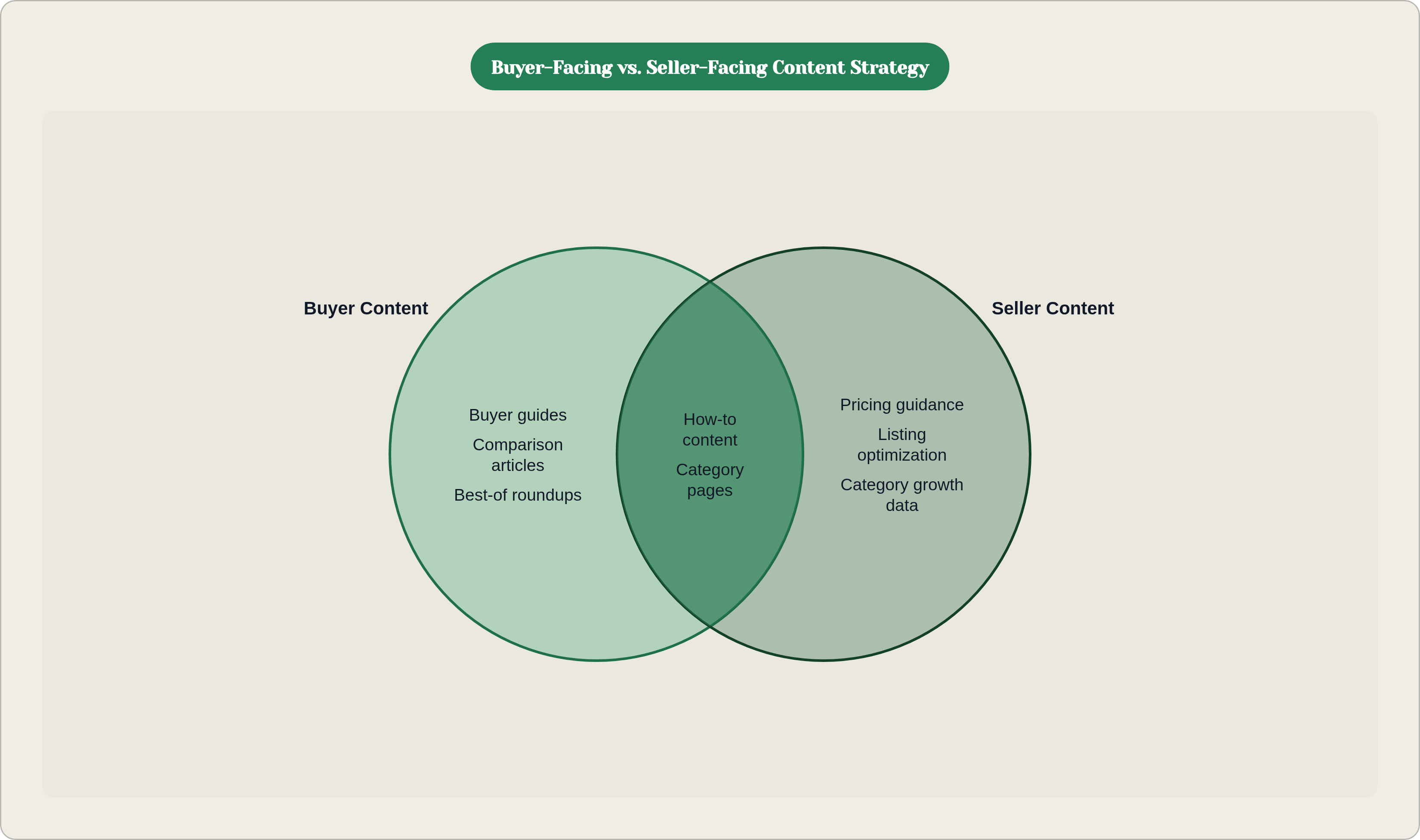
Buyer-facing content serves a different function than most marketplaces initially assume. The instinct is to push transactional content: product listings, category pages, promotional copy. But buyers are not always ready to transact. They are comparing, learning, and evaluating. Content that captures research-stage intent, a buyer's guide to home espresso machines or a comparison of electric cargo bikes by use case, reaches users before a transaction is on the table and builds trust before it needs to be earned in a checkout flow.
Seller-facing content is where most marketplace content strategies have a blind spot. Sellers are also searching. They are looking for where to list, how to price, what categories are growing, how to write a listing that converts. A marketplace that answers those questions through content earns supply-side discovery organically, reduces onboarding support burden, and, crucially, improves listing quality across its catalog. Better listings are better for buyers and better for SEO. The content investment on the seller side pays out on the buyer side, which is exactly the kind of leverage a two-sided platform should be looking for.
Zillow demonstrated this logic before it was a transaction platform. It built an audience of homeowners and buyers through free home valuation tools, solving the research problem first and the transaction problem second. Hipcamp attracted campers with public land information before it opened to private hosts. Both earned trust from one side of the market before they needed it from the other. The strategic implication for you is that content planning requires two editorial roadmaps that occasionally intersect, not one generic blog trying to serve everyone equally.
The Technical Problems That Only Appear at Scale
A horizontal marketplace generates more dynamic pages than almost any other site type: listing pages, vendor pages, faceted filter combinations, location variants, user-generated content at volume. Each of these is a legitimate content surface. Collectively, they create technical SEO challenges that a single-brand retailer rarely encounters.
Crawl budget is the first one. Search engines allocate a finite number of crawls to any given site. When a marketplace generates thousands of low-value or near-duplicate pages, crawlers spend their allocation on those pages instead of the canonical, high-authority ones that actually deserve to rank. The result is poor indexing of the pages that matter most.
Keyword cannibalization is the second. Multiple pages targeting the same query compete against each other internally, suppressing all of them. This is especially common in horizontal marketplaces where category pages, subcategory pages, filtered pages, and editorial content can all accidentally target the same search intent.
Thin inventory pages are the third, and the most consequential. Category or listing pages with sparse product data, no reviews, and duplicated metadata signal low quality to Google's helpful content systems. The mistake most marketplaces make is scaling page count before scaling page quality, launching thousands of category pages without unique value signals, which leads to poor indexing and, eventually, algorithmic suppression.
On a horizontal marketplace, a category page that ranks poorly is simultaneously a content problem and a crawl architecture problem. Those two problems cannot be solved in separate silos. Technical SEO and editorial strategy must operate from the same framework, because the failure modes are entangled.
Programmatic SEO Is the Engine, Not the Shortcut
The core logic of programmatic SEO for a marketplace is almost elegant in its simplicity: the platform's product database is already a dataset capable of generating optimized pages at scale. The question is whether those pages provide real utility or just template repetition.
Platforms that win at long-tail organic search, Amazon, Wayfair, Zappos, TripAdvisor, rank for enormous query volumes because they built systems connecting structured data to optimized page templates. What they also did, and this is the part that gets glossed over, is invest heavily in the data enrichment that makes each page meaningfully different from the others.
Carousell, the Singapore-based marketplace, offers a useful model. Its category and subcategory pages combine dynamic listing data with location-specific signals, reflecting actual current inventory, pricing trends, and popular items in a given category and market. The result is real utility, not filler. That distinction matters enormously to search algorithms that have become increasingly sophisticated at identifying which pages serve users and which are thin approximations of pages that do.
Five page types scale with catalog depth in different ways. Product pages are the baseline. Category and collection pages are the highest-leverage SEO surface for most marketplaces, worth disproportionate investment. Faceted filter pages, by color, condition, price range, location, represent queries users are actually running and are chronically underoptimized. Brand and seller pages capture navigational queries. Comparison and best-of pages bridge research intent and transaction intent in ways that category pages cannot.
What separates pages that rank from pages Google quietly ignores comes down to three things. First, dataset enrichment: each page needs genuinely distinct data points, not just name, price, and image. Second, unique signals: review aggregates, seller reputation, price history, availability trends, data the platform owns and third-party publishers cannot replicate. Third, structural freshness: pages that update with real inventory signal relevance to crawlers in ways that static pages cannot.
The editorial consequence of programmatic SEO is underappreciated. It shifts the writer's job from producing individual pages to designing the content rules and data standards that govern thousands of pages. That is a fundamentally different skill set, and teams that treat it as execution work rather than strategic work tend to produce the thin-content outcomes they were trying to avoid.
User-Generated Content as a Compounding Asset
A marketplace with active buyers and sellers generates reviews, questions, answers, photos, and descriptions continuously. This is content a standalone brand or editorial team cannot replicate at the same volume or authenticity. And it compounds.
Reviews add keyword-rich, naturally written text to listing and category pages without editorial labor. Questions and answers surface long-tail queries the content team would never have thought to target. Fresh UGC signals to crawlers that a page is actively used. And review volume correlates with ranking; listings with substantial review counts consistently outperform thin ones in organic placement.
The flywheel is real: organic traffic generates buyers, buyers generate reviews, reviews improve rankings, rankings generate more traffic. UGC is simultaneously an input to and an output of organic growth.
The marketplaces that systematically design the prompts, the display logic, and the placement of user content gain a compounding advantage over those that treat it as ambient. Glossier built a substantial community around user content without heavy paid acquisition. Airbnb embedded authentic storytelling from hosts and guests into its organic presence. Neither treated UGC as something that happened to the platform. They designed systems that made it flow reliably and land where it had maximum impact.
For content teams, the practical implication is this: the job is not to produce UGC. It is to design the systems that make UGC productive.
Editorial Content Builds the Authority That Programmatic Cannot
Search behavior has shifted. Users increasingly search to compare, learn, and evaluate before they are ready to transact. A marketplace that only serves transactional intent misses a large portion of the research journey and cedes that authority to whichever publisher or platform fills the gap.
The "media then marketplace" model addresses this directly: become the most useful information source in a category first, convert readers into buyers second. Shopify and Amazon have both deployed sustained editorial content, guides, learning hubs, category explainers, to keep users within their ecosystems and build domain authority signals that lift the whole site.
High-leverage editorial formats for a horizontal marketplace are not mysterious. Buyer guides address category-specific research intent and funnel readers toward the platform's own listings. Comparison articles meet users in the middle of a decision. Best-of roundups are high-intent, high-competition, and appropriate when the platform has genuine selection depth to back up the recommendation. How-to content is particularly efficient because it serves both buyers and sellers, doubling as supply-side content without requiring separate production.
Category page optimization deserves the most sustained editorial attention. A well-structured, content-rich category page captures both navigational and informational queries simultaneously. It is the single highest-leverage editorial surface on most horizontal marketplaces, and it is frequently treated as a template problem rather than a content problem.
Editorial content earns links, builds domain authority, and compounds over time. Not because blogs are inherently valuable, but because well-targeted, high-quality editorial content earns the kind of third-party citation and inbound linking that programmatic pages rarely generate on their own. The challenge for you is that editorial resources are finite, which brings us to the hardest strategic question.
Where to Go Deep, Where to Go Programmatic, and How to Decide
This is the framework question, and it is where most horizontal marketplace content strategies either succeed or fall apart. The tension is real: editorial depth builds authority but does not scale; programmatic breadth scales but does not build authority on its own. A horizontal marketplace needs both, deployed in the right places.
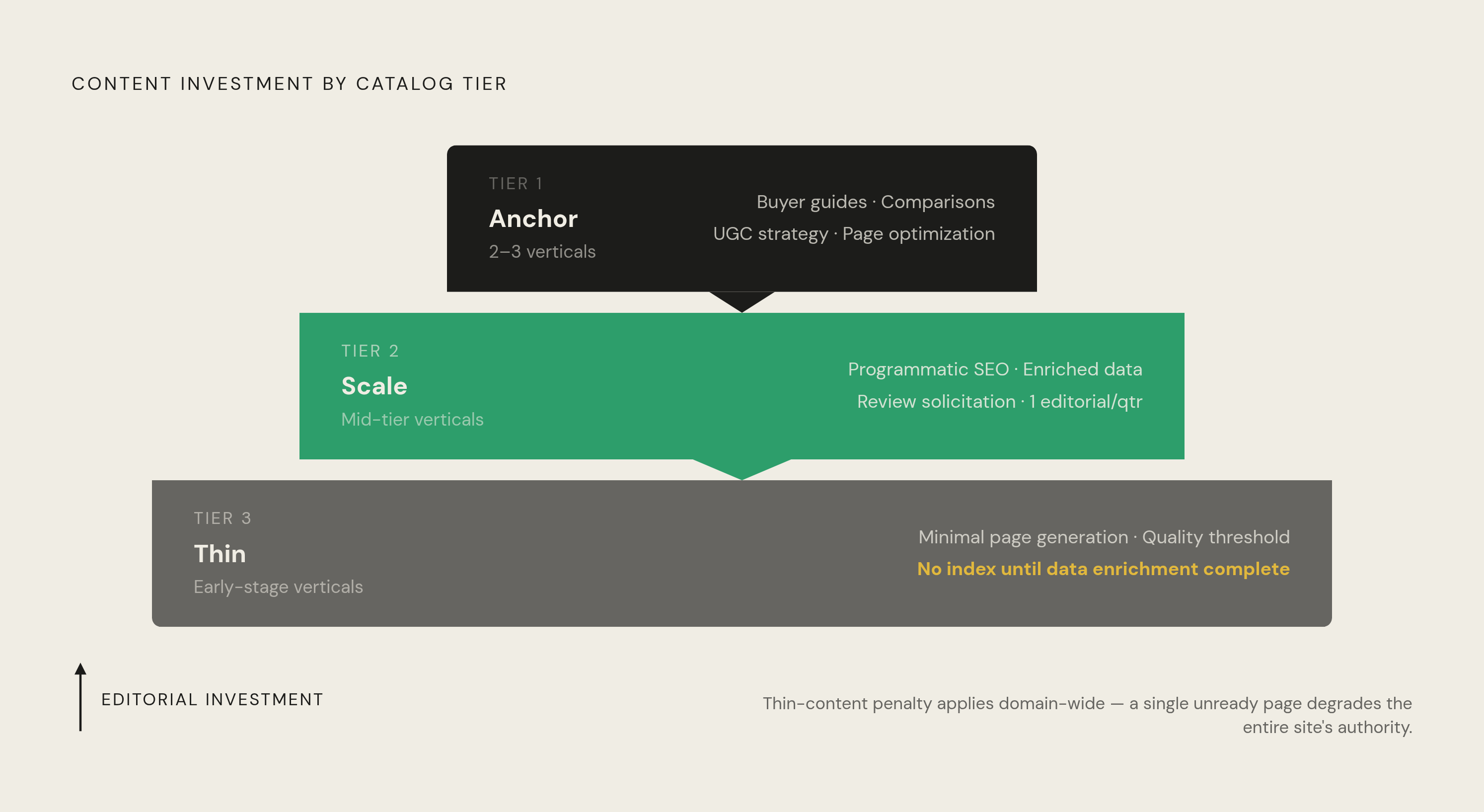
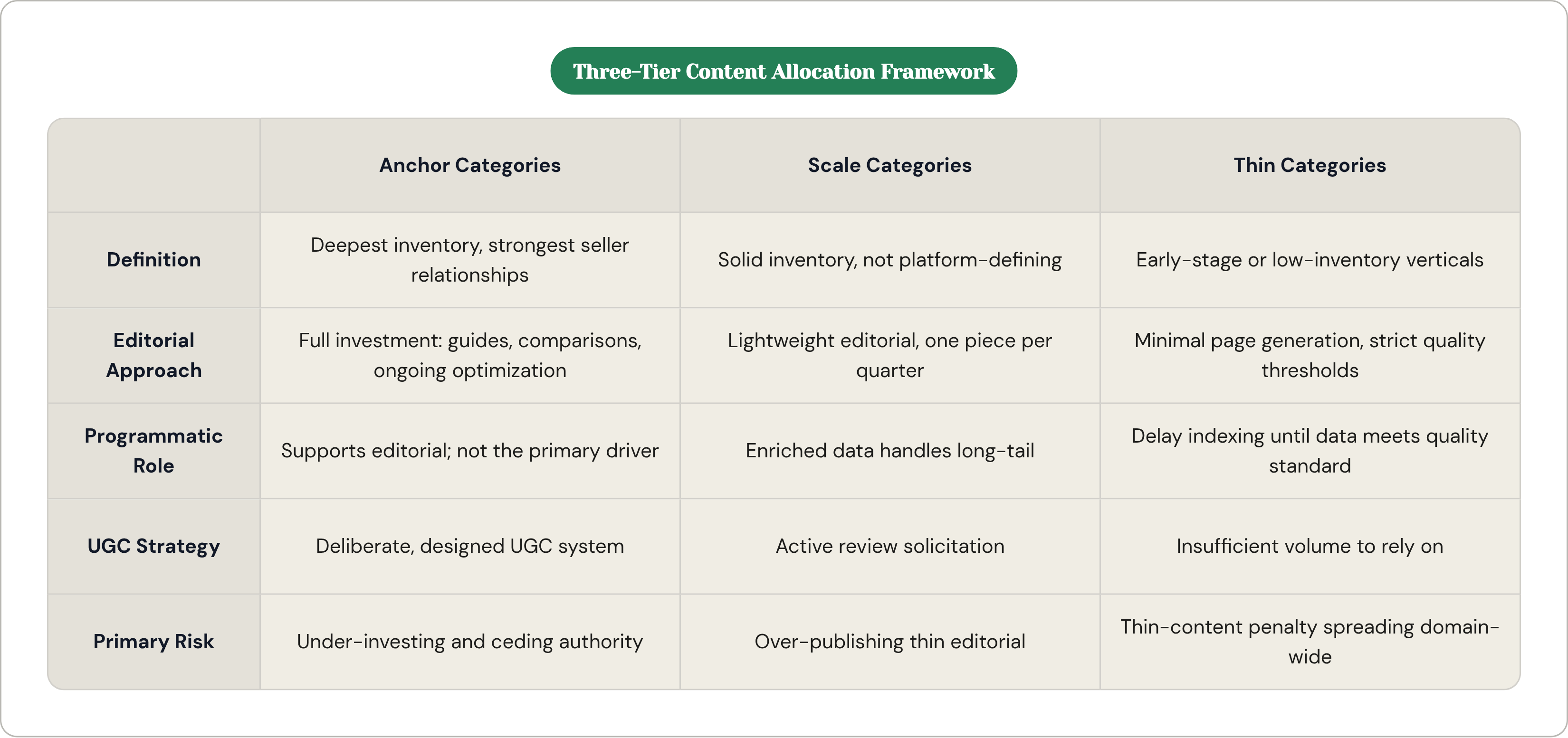
The allocation framework I have seen work in practice divides your catalog into three tiers.
Anchor categories are the two or three verticals where the platform has the deepest inventory, the strongest seller relationships, and the most defensible differentiation. These get full editorial investment: buyer guides, comparison content, a deliberate UGC strategy, and category page optimization treated as ongoing editorial work, not a one-time build. This is where the platform earns its reputation.
Scale categories are mid-tier verticals with solid inventory but not platform-defining depth. Programmatic SEO with enriched data handles the long-tail here. Review solicitation keeps UGC flowing. Lightweight editorial support, one well-targeted piece per quarter rather than a sustained publishing cadence, provides enough authority signal to lift the programmatic pages without overwhelming the team.
Thin categories are early-stage or low-inventory verticals. Your instinct may be to generate pages immediately and capture whatever traffic exists. Resist it. Use minimal page generation with strict quality thresholds, and do not index until data enrichment meets a defined standard. The thin-content penalty is a real cost, and it applies across the domain, not just to the offending pages.
Three signals identify anchor categories. First, search volume versus current organic share: where is the gap between what buyers are searching and what the platform currently ranks for? Second, seller density: categories with more active, high-quality sellers generate better UGC and listing quality naturally, which makes editorial investment compound faster. Third, competitive white space: where are generic results or weak incumbents still dominating queries the platform can credibly own?
The sequencing principle matters as much as the allocation: solve research intent before transaction intent. Build the guide, the comparison, the how-to before expecting the category page to convert at scale. Trust has to precede transaction.
One underutilized advantage here is proprietary data. Your marketplace holds pricing trends, demand signals, search behavior, and seller performance data that no third-party publisher can access. Surfacing that data through trend reports, category benchmarks, or buyer behavior summaries creates content assets that are uncopyable. That is a durable competitive advantage in a content landscape where everything else can eventually be approximated.
Generative AI Search Is Changing What "Ranking" Even Means
A growing share of search traffic now flows through AI-powered tools rather than traditional results pages. Zero-click behavior has increased sharply as AI Overviews surface answers directly, without requiring a user to click through to a source. That changes the goal of content, at least partially.
Ranking on a results page is no longer the only form of organic visibility worth optimizing for. Being cited as a source in an AI-generated answer is an emerging category of organic reach, and it operates by different rules.
A large majority of AI citations come from earned media: coverage, links, references from third-party sources, rather than owned content or paid placements. That means the content strategy that earns citations in AI answers looks less like a high-volume publishing operation and more like the kind of authoritative, well-sourced, genuinely useful content that earns links from credible publishers.
For horizontal marketplaces specifically, the proprietary data content described above, the trend reports, the category benchmarks, the buyer behavior summaries, is well-positioned to earn AI citations. Unique data that answers a question no one else can answer is precisely what AI systems are trained to surface when it is available.
The foundational work does not change much regardless of how quickly AI search accelerates. Content that is useful, well-structured, and backed by unique data performs well in traditional search and is positioned well for AI citation. The marketplaces that will struggle are those that built their organic strategy around volume and template repetition, because those pages provide nothing that an AI system needs to cite.
A horizontal marketplace's breadth is a genuine advantage, but only if it is organized into depth. Depth in anchor categories. Depth in data enrichment. Depth in the systems that make UGC flow. Depth in the editorial decisions about where to invest and where to let programmatic carry the weight. Covering the right things, in the right order, at the right level of investment, is the only version of this strategy that actually compounds.
Notes
- https://seobaby.co/blog/how-to-grow-organic-traffic-online-marketplaces
Supported the framing of how a marketplace builds its own search-engine presence and earns traffic from Google directly.
- https://www.airops.com/blog/organic-traffic-in-2024-key-insights-for-marketers-to-stay-ahead-in-2025
Provided the basis for the claim that organic visitors convert at meaningfully higher rates than paid traffic.
- https://www.getpassionfruit.com/blog/programmatic-seo-traffic-cliff-guide
Informed the discussion of thin-content risks and the traffic consequences of scaling page count before page quality in programmatic SEO.
- https://seomatic.ai/blog/programmatic-seo-for-ecommerce
Supported the explanation of how marketplaces use structured product data to generate optimized pages at scale, including the five page types discussed.
Every new piece from marketplace crunch, as it's published.
Follow