Product Marketplace Inventory Models Compared
Who owns inventory determines capital needs, risk exposure, and operational control.
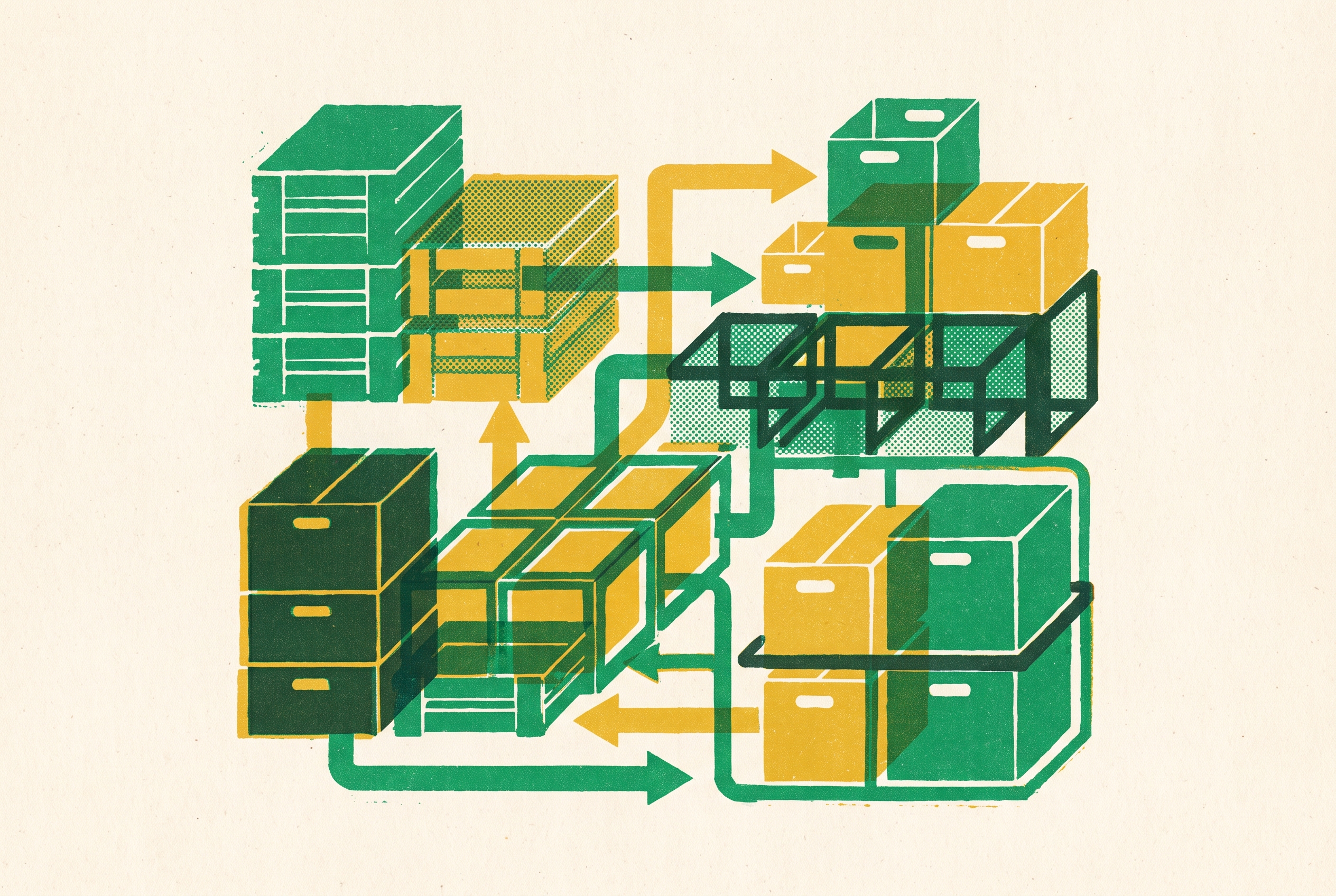
Three models dominate how goods move from supplier to customer online: the inventory model, the marketplace model, and dropshipping. The distinction that matters most between them has nothing to do with branding, checkout design, or even which platform a business chooses. It comes down to who holds title to the goods and who absorbs the consequences when something goes wrong.
In the inventory model, often called 1P, the operator buys stock outright. Capital goes out the door before a single sale happens, and every unit that doesn't sell is a loss the operator carries alone. In the marketplace model, or 3P, the operator never takes ownership of the goods at all. Sellers list their own inventory, the platform collects referral and fulfillment fees, and the risk of unsold or misrepresented stock stays distributed across a network of sellers rather than concentrated on one balance sheet. Dropshipping sits in between: the retailer is the seller of record and sets the price the customer pays, but a supplier holds the physical goods and ships them. The retailer inherits some of the risk profile of both other models without fully matching either.
None of this is a matter of taste or operational preference. It's the variable that determines how much capital a business needs before it can open its doors, what kind of infrastructure it has to build to keep its catalog accurate, and which failures are going to land on its doorstep when a supplier or a warehouse falls short. Every comparison that follows, capital cost, control, scalability, risk exposure, traces back to this single fact about who owns the stock.
What the inventory-based model costs in capital and control
Owning inventory buys an operator the highest level of control available in e-commerce: control over quality, over branding, over how a product looks and behaves when it reaches a customer. That control costs working capital and absorbed risk, not a line item that shows up neatly on an invoice.
Operators who purchase, store, and ship their own stock carry the full cost of procurement upfront, plus ongoing carrying costs for holding that inventory, plus full liability for any returns that come back. Industry analysis puts carrying costs alone at roughly 20 to 30 percent of inventory value per year, a recurring drag that exists whether or not the goods ever sell. Demand forecasting accuracy matters more under this model than under any other, because both overstock and understock land entirely on the operator, with no supplier network to absorb or dilute the impact. The IHL Group's 2026 Inventory Distortion Study frames the global cost of combined overstocks and understocks as large enough that inventory accuracy is a financial imperative, not an operational nicety, for anyone holding stock. The same study identifies the 2025 tariff whipsaw as a case where external shocks generated an entirely new category of overstock loss, one that no amount of supply-side discipline could have prevented, because the shock invalidated the demand assumptions the inventory plan was built on in the first place.
The margin math compounds the capital problem instead of offsetting it. Selling under the 1P model on Amazon means selling to the platform at a wholesale discount, with co-op marketing fees deducted automatically on top of that discount, so the operator gives up margin before fulfillment costs even enter the picture. Payment terms make the cash position worse still: 1P vendors typically wait on payment cycles considerably longer than what 3P sellers experience, which ties up capital that could otherwise be reinvested in the business.
None of this means the inventory model is a poor choice. It means the control it offers, tighter quality assurance, a consistent brand experience, predictable availability, and forecasting built on a single system of record, comes at a real and recurring cost that a marketplace seller or dropshipper simply does not carry in the same form. That trade-off is the foundation the rest of this comparison rests on.
How the 3P marketplace model shifts risk
The marketplace model's appeal follows directly from the cost structure just described. A platform operating as a marketplace can grow its catalog and its revenue by onboarding more sellers rather than by purchasing more stock, which decouples growth from capital in a way the inventory model never allows.
That decoupling changes what the organization inside the platform actually does. Buying teams that once selected and purchased stock instead curate and vet third-party sellers. Merchandisers stop managing owned inventory and start optimizing digital shelf space, deciding which listings get visibility rather than which products get warehouse space. This is an organizational transformation, not a lighter version of the same job with different software, and platforms that treat it as a simple technology swap tend to underestimate how different the required skills, incentives, and daily rhythms actually are. On the capital side, investment shifts away from physical goods and toward technology, seller acquisition, and the trust infrastructure that keeps a marketplace credible, while inventory risk itself scatters across the individual sellers who hold the stock.
Sellers operating inside a marketplace keep control over their own retail pricing and typically earn a better margin than they would under a 1P wholesale arrangement, but that advantage comes with new costs of its own: referral fees, fulfillment fees where applicable, and a dependency on account health metrics, since the algorithm can decide whether a listing reaches buyers at all. That margin advantage narrows considerably in low-price categories, where fulfillment fees eat up a large share of the retail price and create a structural ceiling sellers in those categories have to plan around from the start.
B&Q, the UK home improvement retailer, illustrates what the marketplace model can achieve at scale. First Friday's analysis found that all but a small fraction of B&Q's lamp category came from third-party sellers, giving the retailer broad catalog depth in that category with almost no inventory risk and no cannibalization of its own-stocked ranges. That's the upside case for the model working as designed.
The upside doesn't erase a genuine cost on the trust side. Third-party sellers lack the implicit credibility that comes from a product being sold directly by the platform itself, and they have to actively manage seller feedback scores, account health metrics, and product reviews, all of which carry algorithmic weight that a 1P vendor never has to think about in the same way. That trust cost is the strongest argument against treating the marketplace model as a simple upgrade over owning inventory: it trades one kind of risk (capital, carrying cost, forecasting error) for another kind of risk (algorithmic visibility, reputational fragility) instead of eliminating risk.
Where dropshipping fits between those two models
Dropshipping gets described casually as a simpler form of marketplace selling, but the two are structurally distinct arrangements with different answers to the basic question of who owns what. In dropshipping, the retailer is the seller of record and controls pricing and the customer relationship, while a supplier holds and ships the physical goods.
Several distinctions separate this arrangement from the 3P marketplace model. The retailer in a dropship arrangement controls the brand experience and sets prices across the whole catalog, whereas in a marketplace, each individual seller controls their own listing and sets their own price. The customer relationship in dropshipping belongs entirely to the retailer, while in a marketplace, the platform's own trust and reputation are part of what the customer is buying alongside the product itself. Branding and customer experience consistency in dropshipping are decisions the retailer makes centrally, while in a marketplace those qualities vary seller by seller across the catalog.
This arrangement gives the retailer more control over brand presentation and margin than a marketplace operator typically has over any single listing, but the retailer still absorbs every customer-facing failure that originates with a supplier. Stock outages, late shipments, and a supplier that simply stops responding all become the retailer's problem to resolve, even though the retailer never controlled the warehouse, the systems, or the process that produced the failure. VTEX's analysis frames this as a spectrum rather than a binary: dropshipping functions as an entry-level form of third-party fulfillment, while the marketplace model represents a more advanced structure, one with greater scalability and profitability potential but one that demands more sophisticated operational infrastructure to manage an entire network of sellers rather than a handful of suppliers.
Dropshipping carries a liability: the retailer answers for failures in a supply chain it does not control. Because the retailer doesn't control the supplier's warehouse, systems, or internal processes, any failure on the supplier's end becomes a customer-facing failure the retailer has to answer for, without the internal levers needed to prevent it from happening again. That structural gap, control over the customer relationship without control over fulfillment, sets up the operational failure modes the next section addresses directly.
Why marketplace and dropship failure modes are predictable
Stale inventory feeds, oversells caused by delayed syncing, orphaned orders, and suppliers who stop responding are the norm in marketplace or dropship operations. They're the predictable output of managing a network of suppliers using infrastructure that was designed for a single warehouse.
The root cause is a shift in what counts as a source of truth. In a single-tenant retail operation, the operator's own system is authoritative because the operator controls everything that system measures. In a marketplace or dropship model, inventory accuracy depends on real-time information flowing in from suppliers the operator has no direct control over. Each supplier runs its own warehouse, its own systems, and its own fulfillment process, so presenting customers with one coherent, accurate catalog requires orchestrating visibility across a distributed network rather than simply tracking stock the operator already owns.
Customers have no visibility into which supplier is behind a given order, and they have no reason to care. They transacted with the retailer's storefront, and they hold the retailer to the service level that storefront promised. When a supplier fails to ship on time or ships the wrong item, the customer experience that suffers belongs to the retailer regardless of where the fault actually originated.
One technical failure mode makes this concrete. Digital Applied's 2026 decision matrix documents that Shopify's inventory webhook does not fire on every change to stock levels: only movements into the "available" and "on-hand" states trigger the webhook, while movements into committed, reserved, damaged, safety stock, and quality control states happen silently. Any operator building a multi-channel sync system on webhooks alone will accumulate structural drift between what the system believes is true and what's actually true in the warehouse, simply because a whole category of inventory movement never generates a signal. This is a design characteristic that any operator running a multi-supplier catalog has to architect around deliberately, not a bug Shopify can patch away, typically by layering a polling reconciliation process and idempotency controls on top of the webhook-driven events that do fire.
Industry-wide accuracy figures reveal the scale of this problem. The average U.S. retailer's inventory accuracy runs well below what top performers achieve, and that gap widens further in multi-supplier operations, where the operator never has direct control over the stock counts sitting upstream. The failure modes that plague marketplace and dropship operations are a structural consequence, not a sign of poor execution by any one operator. They're the structural consequence of applying single-warehouse assumptions to a problem that no longer has a single warehouse at its center.
Operational infrastructure for a marketplace or dropship operation in 2026
Given those failure modes, the infrastructure requirements for running a marketplace or dropship operation follow logically rather than aspirationally. Real-time API-driven inventory sync, automated order routing, and supplier SLA monitoring are what separate an operation that functions from one that slowly erodes customer trust order by order.
Real-time sync has become the baseline expectation rather than a premium feature. Carro's 2026 marketplace inventory management guide states that nightly CSV batch updates no longer work as an operating model for any marketplace processing meaningful order volume.
Order routing has to account for supplier, SKU, and service-level agreement simultaneously, because a routing rule built for a single warehouse simply breaks once orders need to be directed to the correct supplier across a distributed network. Supplier SLA monitoring matters in this environment because, without systematic scoring and clear escalation triggers, supplier ghosting and late fulfillment accumulate quietly until they appear all at once as a wave of customer complaints.
The right architecture scales with channel count. A single storefront needs no sync layer. Two to three channels can typically be managed through a master-store hub approach. Four to six channels justify a dedicated inventory management system, since retailers running that many disconnected systems can lose an estimated 5 to 15 percent of revenue annually to inventory fragmentation. Operations spanning POS, marketplace, and wholesale channels need middleware with explicit conflict resolution logic built in.
Catalog management itself looks different under a marketplace structure than under centralized inventory ownership, because supplier data arrives in fragmented formats and has to be normalized before it can appear to customers as one coherent catalog. Purpose-built platforms have emerged to handle exactly this problem. Carro, for instance, manages supplier onboarding, real-time catalog sync, automated order routing, and fulfillment tracking from a single operational layer, addressing the structural requirements above as a dedicated solution rather than a patchwork of general-purpose tools stitched together after the fact.
Amazon's forced migration of 1P vendors as evidence of the structural shift
Amazon's termination of thousands of Vendor Central accounts offers the clearest real-world evidence that these structural economics are reshaping even the largest marketplace in the world. Rosetta Brands reports the terminations targeted smaller 1P suppliers, EU-based businesses under a specified revenue threshold and US-based suppliers below an annual revenue threshold, with the most recent wave giving affected vendors a termination date of August 2, 2026.
Amazon's own incentives explain the move. Its 1P retail operation carries inventory risk, price-matching obligations, warehousing costs, and return liability on every unit it purchases wholesale, while its 3P marketplace earns referral fees, fulfillment fees, and advertising revenue, touching inventory only when a seller opts into Fulfillment by Amazon and not at all when a seller fulfills orders independently. That asymmetry makes the 3P model structurally more profitable for the platform itself, independent of what happens to any individual vendor caught in the transition. Feedvisor's 2026 analysis shows the 3P marketplace now accounts for the majority of paid units sold on Amazon, a proportion that reflects a deliberate strategic rebalancing rather than organic growth in third-party selling.
The transition is not free for the vendors being pushed into it. Former 1P vendors moving to 3P are encountering a measurably harder environment around chargebacks, with an uptick in ASN, prep, and PO-on-time chargebacks reported in 2026 and fewer disputes resolved in the vendor's favor. Sellers who built their contribution margin models on older chargeback rates are now running thinner margins than they planned for, a genuine operational cost of the shift rather than a footnote to it. Amazon's case shows the structural argument playing out at the scale of the world's largest marketplace: the economics favor facilitating transactions over holding inventory, and the vendors caught in that transition bear real, quantifiable friction as they adjust.
Why most established operators run hybrid models
1P vendors typically face payment cycles far longer than 3P sellers, tying up cash that could otherwise be reinvested, a factor established operators weigh when deciding how to structure inventory across 1P and 3P. They combine models, matching inventory structure to the specific characteristics of individual SKUs and categories rather than picking one framework and applying it uniformly across an entire catalog.
On Amazon, that often means holding core, high-velocity SKUs under direct control while using third-party sellers to extend into long-tail categories where forecasting is harder and the cost of a wrong inventory bet is higher. A retailer like B&Q applying the marketplace model to its lamp category while retaining direct control over higher-margin or higher-turnover product lines is an example of this logic in action, not an exception to it. The reasoning follows directly from everything established above: inventory ownership buys control and demands capital, marketplace participation buys scale and distributes risk, and dropshipping buys flexibility while exposing the retailer to failures it cannot directly prevent. No single model wins across every category, every price point, and every supplier relationship a catalog contains. The operators managing this well are the ones treating inventory structure as a variable to be set deliberately, SKU by SKU, rather than a single decision made once and left unexamined as the business grows around it.
Notes
- How to Manage Inventory on a Marketplace in 2026?
Provided the claim that nightly CSV batch updates no longer work for marketplaces processing meaningful order volume, and the description of Carro's platform capabilities for supplier onboarding, catalog sync, and order routing.
- Multichannel Inventory Sync 2026: A Decision Matrix
Provided the 20–30% annual carrying cost figure, the Shopify webhook gap detail, the industry inventory accuracy gap, the 5–15% revenue loss estimate from inventory fragmentation, and the multi-channel architecture framework.
- Amazon 1P vs 3P: Key Differences for Sellers (2026)
Provided the statistic that the 3P marketplace now accounts for the majority of paid units sold on Amazon, cited as evidence of deliberate strategic rebalancing.
- Marketplace vs Dropship: Smarter Retail Strategies - First Friday
Provided the B&Q lamp category example showing that nearly all of its lamp listings came from third-party sellers, illustrating the marketplace model's catalog depth with minimal inventory risk.
Every new piece from marketplace crunch, as it's published.
Follow