Resale and Recommerce Marketplace Business Models
Mainstream brands now see resale as core strategy, not a bargain bin afterthought.
Recommerce has moved well past the bargain bin once frequented only by thrifty shoppers. It now sits at the core of modern retail, backed by figures that are difficult to dispute. In 2024, about 68% of younger consumers purchased pre-owned items, with almost half reporting they browsed resale options before turning to full-price alternatives. This single finding overturns the long-held retail belief that pre-owned purchases represent merely a concession made when budgets are tight.
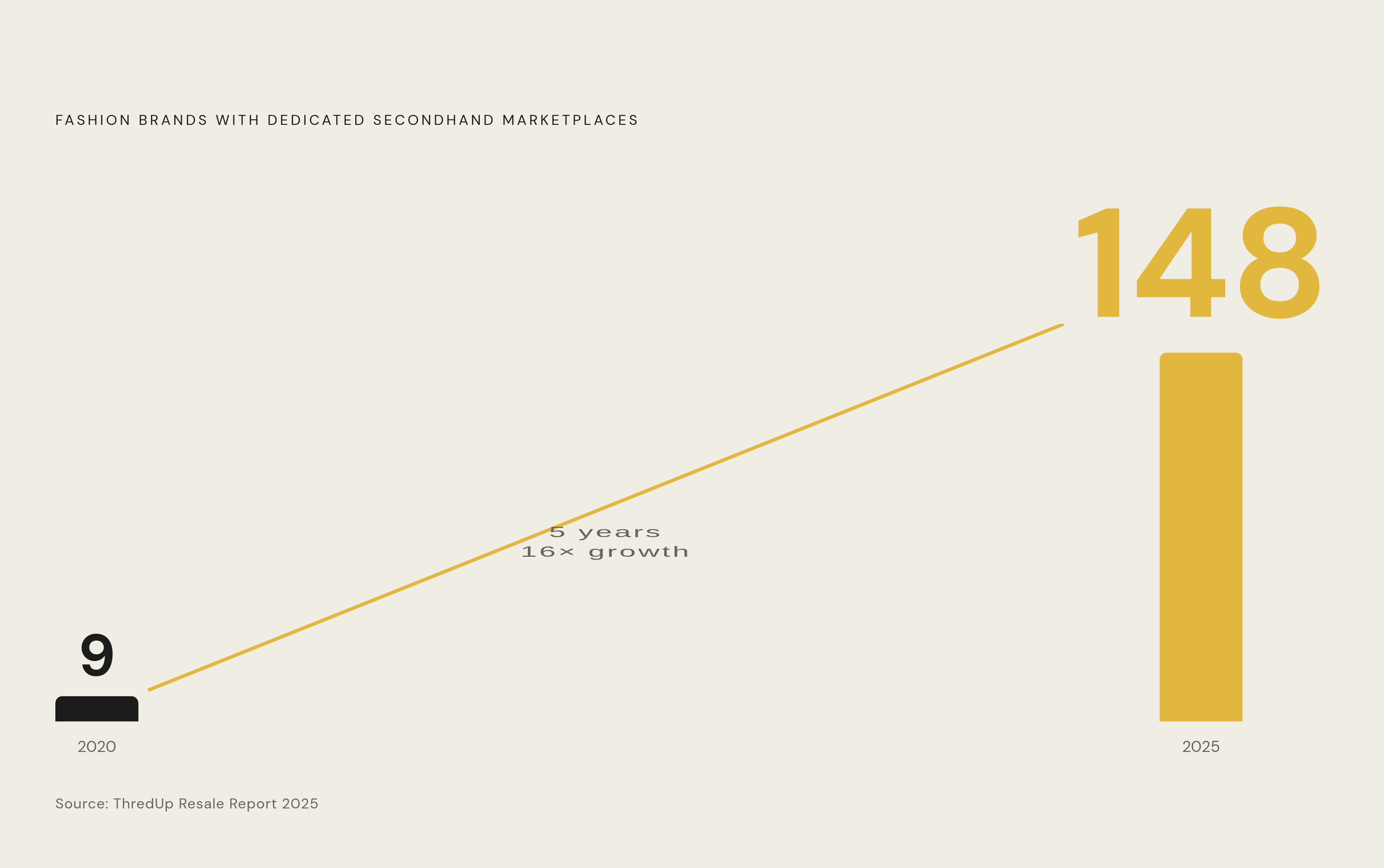
Financial strain is part of the story, yet platforms had already normalized this behavior through their architecture. Features such as identity verification, purchaser safeguards, indexed stock, and polished storefronts made buying used goods feel indistinguishable from standard online shopping. Brands paid attention. By 2025, the number of fashion labels operating dedicated secondhand marketplaces reached 148, up from a mere nine in 2020. Not one company or another trying it out as an afterthought. That shift amounts to a near-total reversal: resale went from cannibalization worry to a lever brands wield for loyalty, returns handling, and revenue simultaneously. eBay and Zalando, along with H&M, make recommerce core to business, while IKEA has resale and buy-back pilots running in several markets. The broader re-commerce market has grown steadily year over year and is projected to keep expanding at a consistent pace through the end of the decade, a trajectory that points to durable infrastructure rather than a passing enthusiasm.
At this size, using "recommerce" loosely has become a problem. Lumping it all into a single model pushes brands to carry over lessons that do not apply.
Treating recommerce as a single category is a strategic mistake
People use "recommerce" to describe businesses that have almost nothing in common operationally. A marketplace funded by seller commissions operates on distinct financial mechanics compared to one levying buyer safeguards, while both contrast greatly with firms taking physical possession of all goods they flip. Conflating such approaches, or assuming triumph in one guarantees it elsewhere, dooms the majority of resale ventures.
Vinted shows this concretely. Listing costs sellers nothing on the platform, while buyers pay a protection fee. This pricing decision is fundamental. It shapes which party Vinted considers its real customer, the conduct it incentivizes, and its method for creating liquidity from the start, because easy listing attracts supply, and that supply attracts buyers. A trade-in program serves a different goal entirely: it secures loyalty and lifecycle control rather than marketplace liquidity, with inventory risks and operational demands that differ fundamentally from peer-to-peer platforms. Choosing an approach for its trendiness instead of its fit with the actual business need is what most often causes recommerce projects to falter or be quietly discontinued.
How peer-to-peer marketplaces make money
No model is more capital-efficient to launch than peer-to-peer marketplaces, and none is harder to maintain. The platform doesn't touch inventory. It connects buyer and seller, providing payments, the trust layer, and buyer protection, then charges a fee from the buyer, the seller, or both. eBay, Vinted, Poshmark, and Depop (which eBay folded in after acquiring it during July 2026) fall under this category, yet each extracts revenue its own way and serves a separate customer.
Vinted's approach illustrates the model at its most deliberate. Eliminating seller commissions removes friction for the people supplying inventory, which increases supply, which in turn draws buyers, and the buyer protection fee funds the whole arrangement. The revenue results back up the strategy: Vinted generated 813 million euros in 2024, with sharp year-over-year growth. But liquidity built in one market does not automatically travel to another, a fact Vinted's own leadership has acknowledged. A data-infrastructure approach the company has taken reduces listing friction and enforces brand presentation standards simultaneously. That is a notable admission from a platform this successful, and it underscores the model's core fragility: value depends entirely on having enough active buyers and sellers transacting at once, and that density has to be rebuilt from scratch in every new geography.
P2P marketplaces have figured out that liquidity by itself can't anchor premium categories. eBay's Authenticity Guarantee covers jewelry, watches, handbags, apparel, sneakers, and coins because costly items move to whichever platform will vouch for them, and without verification, a P2P listing loses that business to authenticated competitors. Instead of recruiting fresh people, platforms expand what current members can sell: Vinted added electronics, household goods, toys, reading material, and video games to its lineup, and that category push defines P2P growth broadly. The structural threat is platform substitution: brands that build resale channels of their own take back the inventory that made marketplaces valuable.
What managed and consignment marketplaces trade away for trust
Managed and consignment marketplaces close the trust gap that P2P platforms cannot fully close on their own, and they pay for it with a cost structure that punishes scale rather than rewarding it. ThredUp and The RealReal take goods in on consignment or buy them outright, then authenticate, grade, photograph, price, and fulfill every item from their own warehouses. Vestiaire Collective and The RealReal lean on in-house experts to verify branded fashion and accessories, and that verification makes the secondhand luxury segment work; the segment is sizable and grows faster than primary luxury sales, a pace that would not hold without credible authentication behind it.
ThredUp’s accounts spell out the price of earning that trust. Its SEC filing says losses from continuing operations narrowed sharply in 2025 versus 2024, although ThredUp continues to project more losses. Since each resale piece is unique, the company must handle pricing, stock control, and fulfillment differently from a mass seller of new products. Every piece still needs individual intake, checks, cleaning, authentication, photos, and a listing, with the work weighing on margins even when reported gross margin appears healthy. Investors still lack proof that any listed resale-only operator can grow large enough for this model to sustain itself.
The clearest effort to close that gap comes from software. AI image recognition lets Refurbed and Back Market spot cosmetic flaws in devices almost instantly, holding grading accuracy steady, and their pricing algorithms follow supply and demand while conditions change. Among current moves in managed marketplaces, this stands out as the one most likely to transform the segment's economics, since it targets the labor cost head-on rather than routing around it.
How brand-operated resale programs differ from marketplaces
When a brand manages resale in-house, the aim is to retain its bond with buyers, along with the pricing leverage that bond carries, throughout a product's full lifecycle. Liquidity and trust are not what this aim pursues, and success here gets measured by a separate set of yardsticks.
Running a branded resale channel gives shoppers an incentive to come back, issues them credit for fresh purchases, absorbs returned and surplus inventory before it becomes a pure loss, and retains those buyers within the company’s own ecosystem instead of ceding sales to secondhand marketplaces like Vinted or eBay. Patagonia’s Worn Wear accepted over 137,000 traded items during 2025, with nearly half arriving via warranty claims and returns. Anything still wearable gets cleaned, fixed through repair, and sold again via Worn Wear; pieces that cannot be fixed head into recycling, so the setup works as a complete take-back system instead of an add-on sitting next to the main business. REI’s Re/Supply moved substantially greater volumes of secondhand outdoor equipment during 2024 compared with 2019, an expansion proving the program is fully established rather than experimental. Members receive store credit, and the items they turn in get checked, cleaned, and sold at lower prices.
IKEA's Preowned program takes a more infrastructural approach. Customers list used IKEA furniture directly on a branded marketplace, and the system automatically attaches official product images, dimensions, assembly manuals, and care instructions. As of 2025 the program remained a pilot running in Madrid and Oslo since 2024, with no confirmed U.S. rollout, and the program has not scaled beyond that. What all three examples share is an inventory advantage no open marketplace can match: the brand already knows what the product is, has the official specs on file, and can enforce its own quality standard, which lowers the per-item cost of processing compared to a managed marketplace sorting through inventory of unknown origin and condition. None of that removes the operational burden. Executives who treat resale as a marketing gesture, without building the service infrastructure to back it, invite chaos once volume arrives; every item is unique, so customer support becomes a front-line function the moment condition disputes become routine.
What B2B resale enablers do
Dedicated B2B firms focused on secondhand trade have emerged since most labels cannot manage large-scale resale operations internally. Platforms such as Reflaunt alongside FAUME deliver return logistics, item evaluation, automated pricing, and branded storefronts so companies can host resale under their own name without building those tools in-house.
The model is straightforward: shoppers still deal with the brand, while operations sit with the enabler underneath. It gives brands a quicker, lower-cost route into recommerce. For many smaller brands, the approach may be the only workable way in because their resale volumes would not warrant building a Patagonia-scale setup from zero. Putting an enabler in charge of operations can also cost the brand direct claim over data and decision rights, even though those are core promises of a brand-run program. The real limits on the brand’s retained control come from the contract, not the sales materials.
Croissant takes this idea further by guaranteeing what an item will resell for when it is first bought. This makes what something will fetch later part of choosing to buy it in the first place, so people weigh resale before they ever consider sending something back or swapping it out, and it broadens the enabler idea by building recommerce into the sale itself instead of the return.
How regulation is changing recommerce cost structures
New EU rules due in 2026 are making recommerce mandatory infrastructure, not an optional sales play, for brands entering European markets, reshaping each model's build-or-buy decision. Under the EU Right to Repair rule, in force July 31, 2026, manufacturers and retailers must add a 12-month warranty when customers opt to repair rather than replace, with more spare parts available and easier electronics and appliance repair access. EU regulation now turns reverse logistics into a compliance function, which has to be in place even for brands with no plans to operate resale commercially.
EU Ecodesign policy raises the bar further. From July 2026 onward, larger firms may not discard unsold textile stock, leaving brands to build practical paths for secondhand sales, repairs, and material recovery instead of standing still. Digital Product Passports also require brands to record what products contain, how they can be fixed, and what should happen after use across different goods categories. When designed well, the same compliance systems can supply the product information needed to lower the cost of brand-run resale programs.
After the initial sale, today’s authentication signals mostly lapse, so high-risk resale transactions have little left to check against, a weakness Newswire calls the "Passport Gap". Digital Product Passports offer the clearest regulatory path for narrowing that gap, provided brands shape them around resale from the outset instead of using them merely to tick a compliance box. Tariffs exert a different kind of pressure: as China duties climb and de minimis treatment disappears, new products become more expensive, strengthening resale in every model, with the biggest upside for curated resale platforms and brand-run programs that source inventory domestically. For companies that have already set up trade-in reverse logistics, meeting the new rules costs less than it does for late starters, and the resale model they choose now has regulatory consequences.
Matching model to problem: how to choose the right recommerce structure
Choosing a resale structure depends on the specific issue a company or marketplace aims to resolve, rather than which approach earns the most favorable press coverage. Sellers pursuing quick capital turnover without heavy inventory should examine P2P frameworks, yet must recognize from the start that brands recovering their pre-owned sales avenues pose a genuine displacement threat. Companies targeting premium, verification-dependent segments require the credibility systems of a curated platform, yet must realistically weigh the staffing expenses and profit squeeze that large-scale operators still haven't fully resolved.
A brand short on volume and cash for recommerce should turn to B2B enablers and platforms that help brands start resale programs from existing infrastructure, as running resale widely needs operational capacity most brands lack.
Notes
- Resale Market: Business Models - Full List (matrixify) – New Market Pitch
Provided the figure of 813 million euros in Vinted's 2024 revenue cited in the peer-to-peer marketplaces section.
- 153 Fashion Brands Now Run Recommerce Platforms. ...
Supplied the data on the number of fashion brands operating dedicated secondhand marketplaces, rising from nine in 2020 to 148 by 2025.
- 2026 Resale Market and Consumer Trend Report | ThredUp
Provided the statistic that 68% of younger consumers purchased pre-owned items in 2024, and that nearly half browsed resale before full-price options.
Every new piece from marketplace crunch, as it's published.
Follow