Category Expansion Strategy for Horizontal Marketplaces
Sequencing beats opportunism when horizontal marketplaces expand into new categories.
Marketplace expansion isn't a growth-hacking exercise where you throw categories at the wall and see what sticks. The winners, Amazon chief among them, sequence their expansion: they read demand before they chase it, they check whether sellers can actually support a category before they open it, and they favor categories that sit close to what they already do well. The losers expand because a category looks big on a slide deck or because a board wants a bigger topline number, and they end up diluting the thing that made the platform work. What follows is a walk through how that sequencing actually happens, category by category, decision by decision.
The structural context: how large horizontal marketplaces actually are, and why the model is accelerating
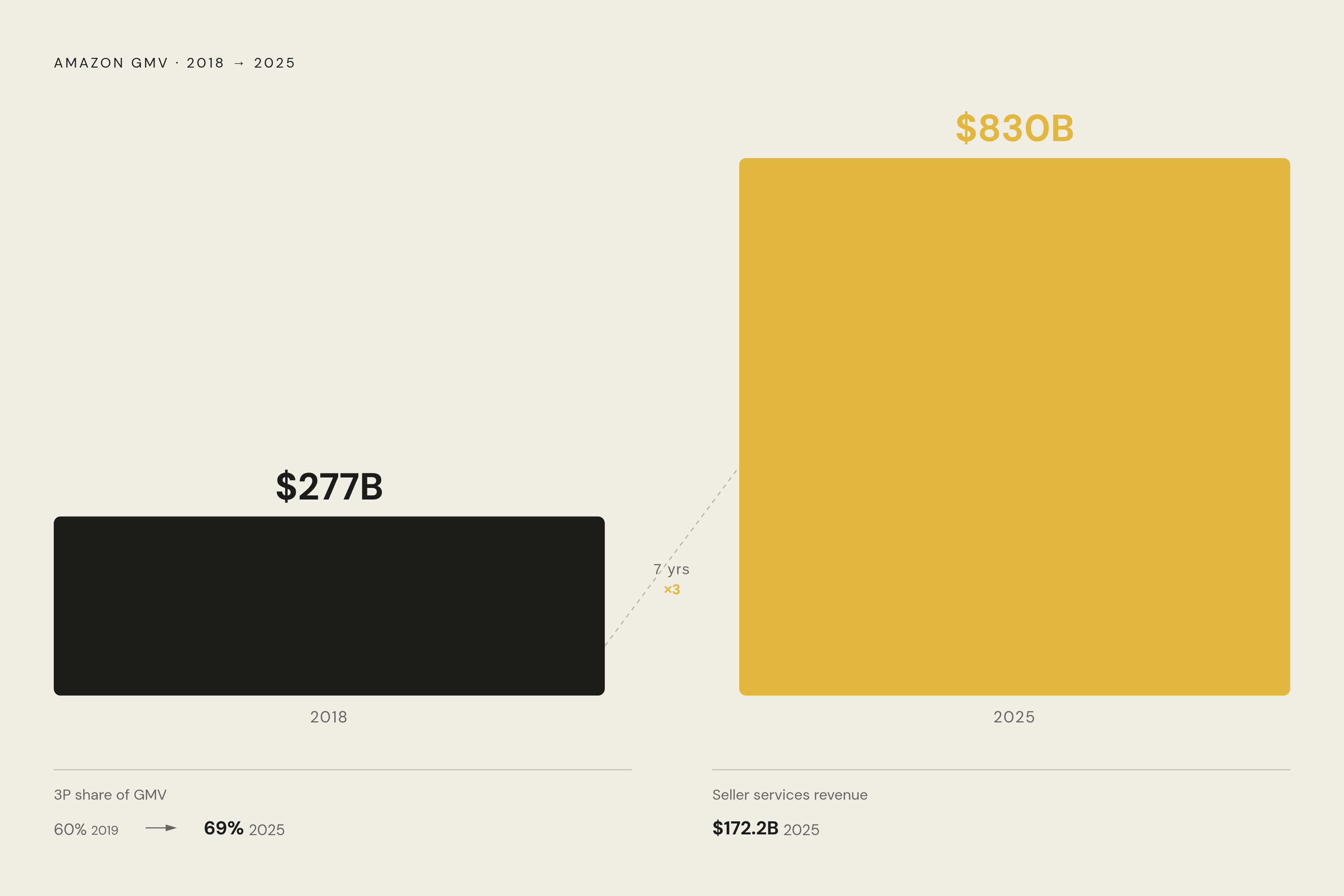
Start with a number, because it sets the stakes. Amazon and its third-party sellers moved $830 billion in gross merchandise value in 2025. Seven years earlier, that figure sat at $277 billion. That's not steady growth, that's tripling, and it happened while Amazon kept adding categories, sellers, and countries at the same time. If you want a picture of what mature, compounded horizontal expansion looks like, that's it.
It's not a one-company story anymore either. Marketplaces made up 63.5% of total online retail in the B2C space by 2024, according to Forrester's Online Marketplace Tracker. For most of online retail, the marketplace isn't a side channel anymore; it's the main event. Zoom out further and the top 100 global marketplaces are projected to move $3.9 trillion in third-party GMV in 2025, most of it flowing through horizontal platforms, meaning ones that sell across many unrelated categories instead of going deep in one.
This model has also jumped the fence into companies that were never born digital. Best Buy relaunched its marketplace to include musical instruments and sports gear and doubled its online inventory without adding a single unit of physical stock. Macy's marketplace grew from roughly 400 brands at launch to well over a thousand by early 2023. Bloomingdale's, Lowe's, Kohl's, and Target Plus are all running some version of the same play, none of them born as marketplaces, all of them building one on top of what they already had.
Why now, and why so fast? Third-party expansion is capital-light: sellers carry the inventory risk, operators collect commission and control the traffic, and a new category gets tested without buying a single pallet. When trying something new costs almost nothing, the temptation is to try everything. Which is exactly why choosing well matters more, not less, once the old brake, the cost of getting it wrong, stops doing the work for you.
Amazon's sequenced expansion: why books were the right first category and what that choice unlocked
Jeff Bezos didn't pick books because he loved reading, or at least that's not the whole story. He picked books because there were over 3 million titles in print at the time, more than any physical bookstore could ever hold on its shelves. That gap between what a store could stock and what a warehouse wired to the internet could offer was the wedge. Think of it as a library up against a corner shop: one has a building, the other has a catalog, and the catalog wins on selection every single time.
Books were also logistically boring, in the best way. High SKU count, low complexity, and a product that never varies: a copy of a book is identical whether it ships out of Seattle or gets pulled off a shelf in Ohio. That consistency let Amazon prove out its whole premise, that people would buy things sight-unseen off a website and trust a truck to deliver them, without also having to solve fragile packaging, size variability, or spoilage all at once. The first category doesn't need to be the biggest earner. It needs to validate the idea cheaply and build plumbing that every category afterward gets to reuse for free.
That's exactly what happened. Once books worked, Bezos had a list, and it wasn't random: music, then DVDs, then electronics, then toys, each one riding rails already laid down for books. What books actually proved wasn't "people like books." It proved customers would trust an online purchase and a delivery truck, that search and discovery could work at scale, that returns and support could run without a storefront, and that enough traffic was showing up to make the next category worth a third-party seller's time.
Then the dot-com crash hit in 2000 and 2001, and this part tends to get cut from the highlight reel. Existential pressure has a way of forcing discipline. Amazon couldn't add categories opportunistically anymore; survival forced the company to formalize a repeatable model instead of winging it. That model got a name later, the flywheel, and it's worth treating as a mechanism rather than a slogan someone put on a slide.
The flywheel as a sequencing mechanism, not just a growth metaphor
Everyone's heard the flywheel pitch by now, but the mechanics still tell you something specific about sequencing that's easy to miss on a skim. Lower prices bring more traffic. More traffic attracts more sellers. More sellers mean wider selection. Wider selection improves the customer experience. A better experience, at scale, lowers the cost structure. Lower costs let you cut prices again. Around it goes.
What turns this into a sequencing tool rather than a growth fable is what happens when a new category drops into an already-spinning wheel. It doesn't start from zero. It inherits traffic that already exists, trust that's already been earned, logistics that are already built. It gets a running start instead of a cold one.
The clearest accelerant here is the third-party marketplace, launched in 2000. Third-party sales went from under 3% of units sold in 1999 to roughly 58% by 2020. Today third-party sellers account for around 69% of total marketplace GMV, up from 60% in 2019. The seller-services business built around that, Fulfillment by Amazon, commissions, advertising, brought in $172.2 billion in revenue in 2025, up 11% year over year. FBA specifically is what made expansion self-reinforcing: sellers get warehousing and shipping without building their own, Amazon gets wider selection without taking on inventory risk, and the flywheel keeps turning without anyone at headquarters personally negotiating every new category into existence.
Here's the discipline the flywheel actually enforces, and it's easy to miss if you're only staring at the growth curve: you cannot expand faster than the wheel can absorb. A category bolted on before traffic, trust, and logistics are in place doesn't get a running start; it gets dragged along behind the wheel and drains momentum instead of adding it. Recruiting a thousand sellers into a category nobody asked for isn't expansion. It's clutter.
Reading demand signals: how marketplace operators identify which category to enter next
So how do you actually figure out what comes next? Not by staring at search volume in isolation, and not by sizing the category in the abstract. The real signal is structural: does your existing audience's behavior already show it wants something the platform doesn't currently sell?
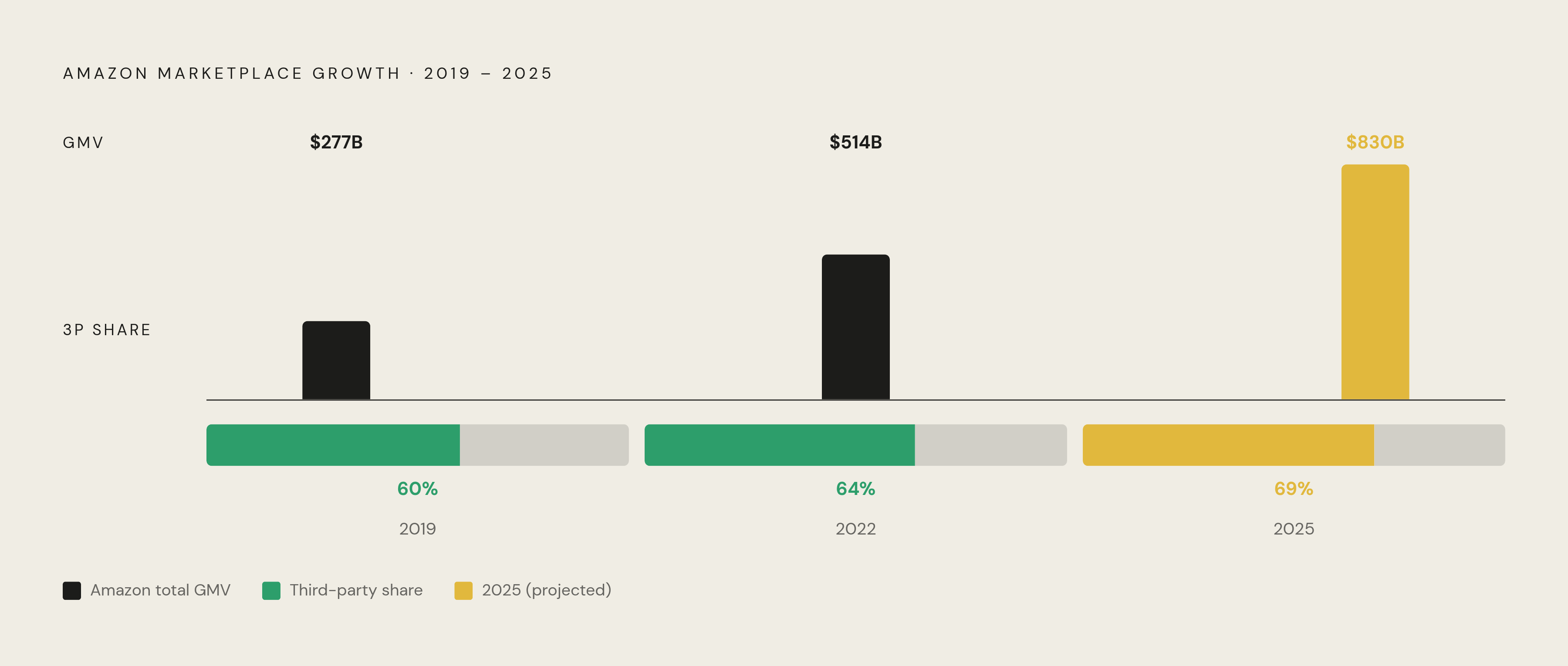
Three signals do most of the heavy lifting. Cross-category search leakage is the bluntest: customers typing in queries for products the platform simply doesn't carry. Basket adjacency is subtler and shows up when customers are already buying two things together that straddle a category line the marketplace hasn't crossed yet, telling you the buying occasion exists even if the SKU doesn't. Off-platform traffic loss, a customer starting a search on your site and finishing the purchase somewhere else, shows the marketplace where it's losing customers to competitors.
Walmart's 2024 Seller Summit is a decent live example of an operator reading these signals before pulling any triggers. The event centered on category expansion, multichannel fulfillment, and seller-scale tools, including cash advances up to $5 million for qualified sellers. That's a company checking what buyers wanted against what sellers could actually support, in that order, before flipping the switch on anything new.
Someone will inevitably argue that a large addressable market in an adjacent category should be green light enough on its own. It isn't. Market size tells you a category is worth something to somebody; it says nothing about whether your customers, specifically, are already primed to buy it from you. Retailer-built marketplaces have a real edge here over pure-play platforms: Best Buy, Target, and Lowe's already sit on purchase-intent data from their core categories, giving them a window into buyer behavior before they've opened a single new one.
Shein's push into daily necessities, consumer electronics, tools, and pet supplies is the alternative case worth studying. There wasn't a clean demand signal pulling Shein's fashion-first audience into pet supplies; it was a supply-side push, sellers and inventory arriving in categories where Shein had zero brand credibility to make the pitch land. More on what happened to that bet later.
Supply-side readiness: the constraint that demand signals alone cannot answer
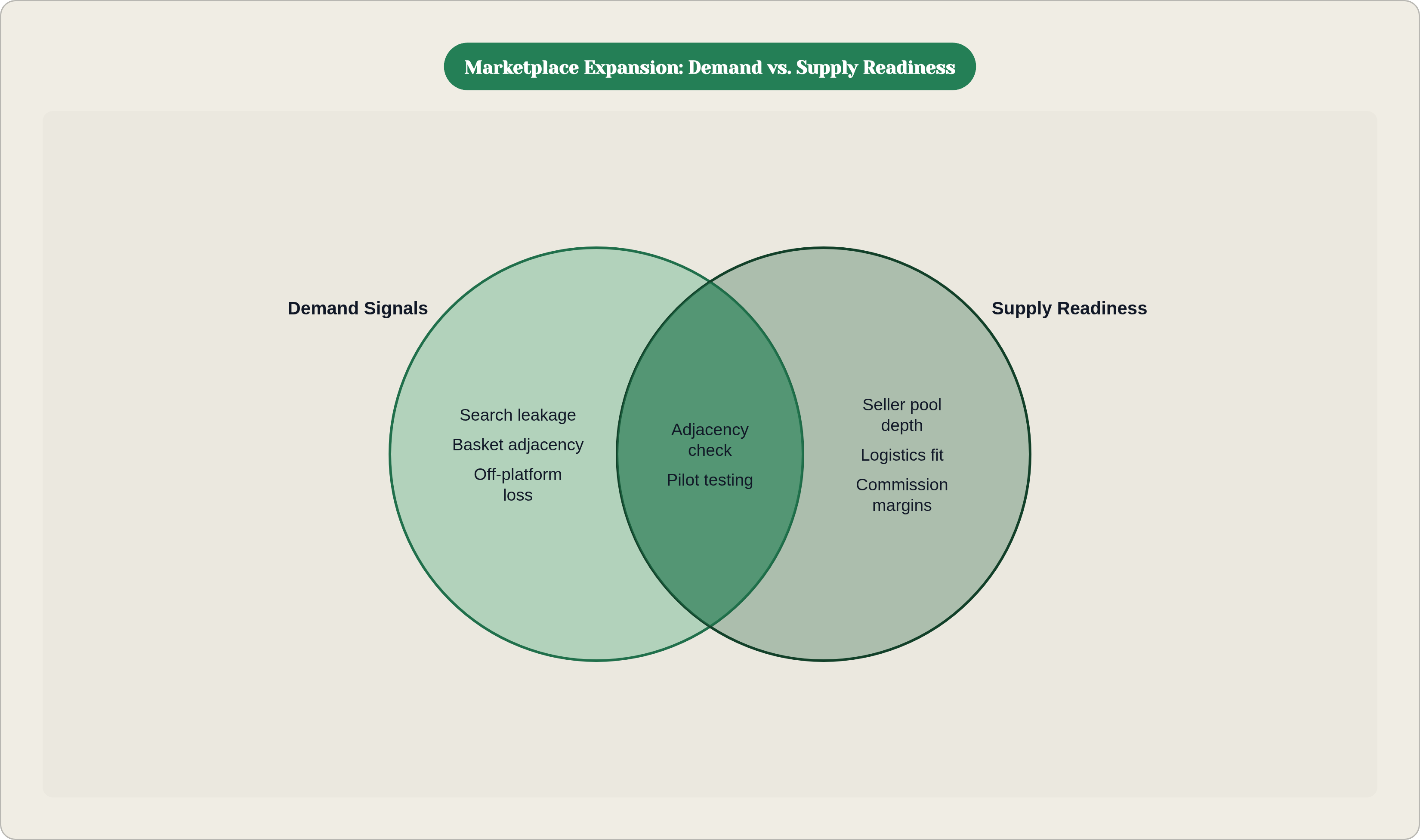
Demand signals answer one question: do people want this? They leave a second question completely untouched: can you actually deliver it well? That's supply-side readiness, and it comes down to three things, enough qualified sellers, logistics that fit the category, and trust signals specific to that category, all needing to exist before a single buyer ever sees the listing.
Third-party selling lowers the bar here, but it doesn't remove it; it just relocates it. Sellers carrying the inventory risk means the platform doesn't need warehouse capital to test something new, fine. But seller quality still needs vetting, onboarding still has friction, and category-specific compliance, safety certifications for kids' toys, return norms for apparel, pricing norms for electronics, still needs building before a buyer's experience is protected. The capital problem gets solved. The operational problem just changes shape and moves to a different part of the organization.
Temu sits at nearly the opposite end of the spectrum from where Shein landed. Backed by Pinduoduo's network of more than 12 million manufacturers, Temu had supply infrastructure sitting in place before it went hunting for demand. Sourcing straight from manufacturers cut costs by 15 to 20%, which funded the aggressive pricing across its sprawling assortment. That's supply-side speed done right, insofar as the infrastructure came first. But speed on supply without differentiation on demand carries its own risk: Temu, Shein, and TikTok Shop overlap heavily on SKUs, and yet each still ends up leading in a different lane, Temu in small electronics and auto parts, Shein in apparel, TikTok Shop in beauty. Even the most horizontal players alive end up with supply-side concentrations that trace straight back to whatever their actual edge is.
In practice, checking supply-side readiness comes down to a short list of blunt questions: (i) Is there a deep enough seller pool in the target category to make selection feel real on day one, or will it feel thin and half-stocked? (ii) Does the category's weight, return rate, and delivery window fit inside the fulfillment network you already run, or does it demand something new entirely? (iii) Does the category's margin profile survive inside your existing commission structure, or does opening it mean rebuilding how you make money from scratch? A small, limited-assortment pilot run through dropship or third-party sellers answers all three without spending real capital, which is exactly why so many operators treat it as the first move rather than the last.
Adjacency as the sequencing principle: what makes a category expansion compound rather than dilute
Adjacency gets confused with similarity constantly, and that confusion is where plenty of expansion plans go sideways. An adjacent category isn't one that looks like your existing categories. It's one your existing buyers already mentally group with what you sell, in the same shopping trip or the same life moment, whether or not the products themselves resemble each other at all.
Three dimensions are worth pulling apart: (i) Occasion adjacency asks whether buyers encounter the new category in the same session as your existing ones, home goods and kitchen appliances share an occasion, home goods and auto parts generally don't. (ii) Logistics adjacency asks whether your existing fulfillment setup can actually absorb the new category, or whether it demands a new capability built from scratch. (iii) Trust adjacency asks the harder question: does your brand's existing promise stretch credibly into this new space, or does it produce a small cognitive hiccup the moment a buyer sees it?
Amazon's move into electronics after books, music, and DVDs checks all three cleanly. Buyers were already in a media-and-entertainment mindset, the lightweight packaged-goods logistics transferred over untouched, and Amazon's reputation as a shipper you could trust carried straight through. Nothing about the move asked customers to reconsider what Amazon even was.
Shein shows what happens when adjacency snaps, and the numbers are stark enough to sit with for a moment. Shein's brand equity was built on ultra-fast fashion and rock-bottom prices, not on consumer electronics or tools or pet supplies. Monthly visitors fell sharply from the hundreds of millions in March 2024 to substantially fewer by July 2024, during the exact stretch when the company was pushing hardest into unrelated categories. Shein pulled back after that, stepping away from direct competition with Temu and refocusing on the fashion core that built the company in the first place. The retreat is the evidence.
Categories that score well across all three dimensions inherit the platform's existing traffic, trust, and logistics, so they're additive to the flywheel from day one. Categories that violate adjacency force the platform to build trust from scratch, in a moment the customer wasn't expecting to need it built. A high-demand category with weak adjacency is often a harder bet than a moderately demanded category that's strong on all three fronts. Rank by adjacency first. Layer demand on top of that, not the other way around.
How retailer-built marketplaces use existing category authority to sequence expansion with lower risk
Retailers coming to the marketplace model late actually start with something pure-play platforms had to build from scratch: an existing reputation in a specific category, plus years of data on how their customers actually shop. That's a head start most digital-native marketplaces never got to skip to.
Best Buy's move into musical instruments and sports gear leans on logistics and occasion adjacency at the same time. A customer already comfortable buying a laptop online transfers that same comfort easily to a guitar or a tennis racket, similarly sized, similarly shipped. That's a good chunk of how Best Buy doubled its online inventory without adding a single unit of physical stock.
Lowe's marketplace launch in December 2024 leans harder on trust adjacency specifically. A shopper who already trusts Lowe's judgment on which drill to buy extends that same trust naturally to tools, outdoor furniture, and storage sold by third parties on the same site. The brand's authority is doing the selling before the seller even shows up.
Myer's expansion in Australia shows what this buys beyond raw GMV. Moving into complementary lifestyle categories grew basket sizes, pulled in new customer segments, and let third-party sellers prove out demand before Myer had to commit its own capital to inventory. Target Plus runs a tighter version of the same idea: instead of throwing the doors open to any seller in any category, Target adds sellers in home goods and apparel, categories closely adjacent to where its brand authority actually carries weight, and skips the rest.
There's a risk here pure-play marketplaces mostly don't carry, though. Brand adjacency cuts both ways for a retailer. A category that flops on a retailer's own marketplace reflects back on the parent brand in a way it simply doesn't for a neutral platform like Amazon or eBay, where the marketplace itself is the brand and no single seller's failure sticks to it the same way. Walmart's cross-border moves into Mexico, Chile, and Canada follow this same adjacency logic, just applied geographically instead of by category: those are markets where Walmart already runs physical stores and supply chains, not places it would've had to build trust in from a cold start.
The seller consolidation signal: what marketplace maturity means for expansion timing
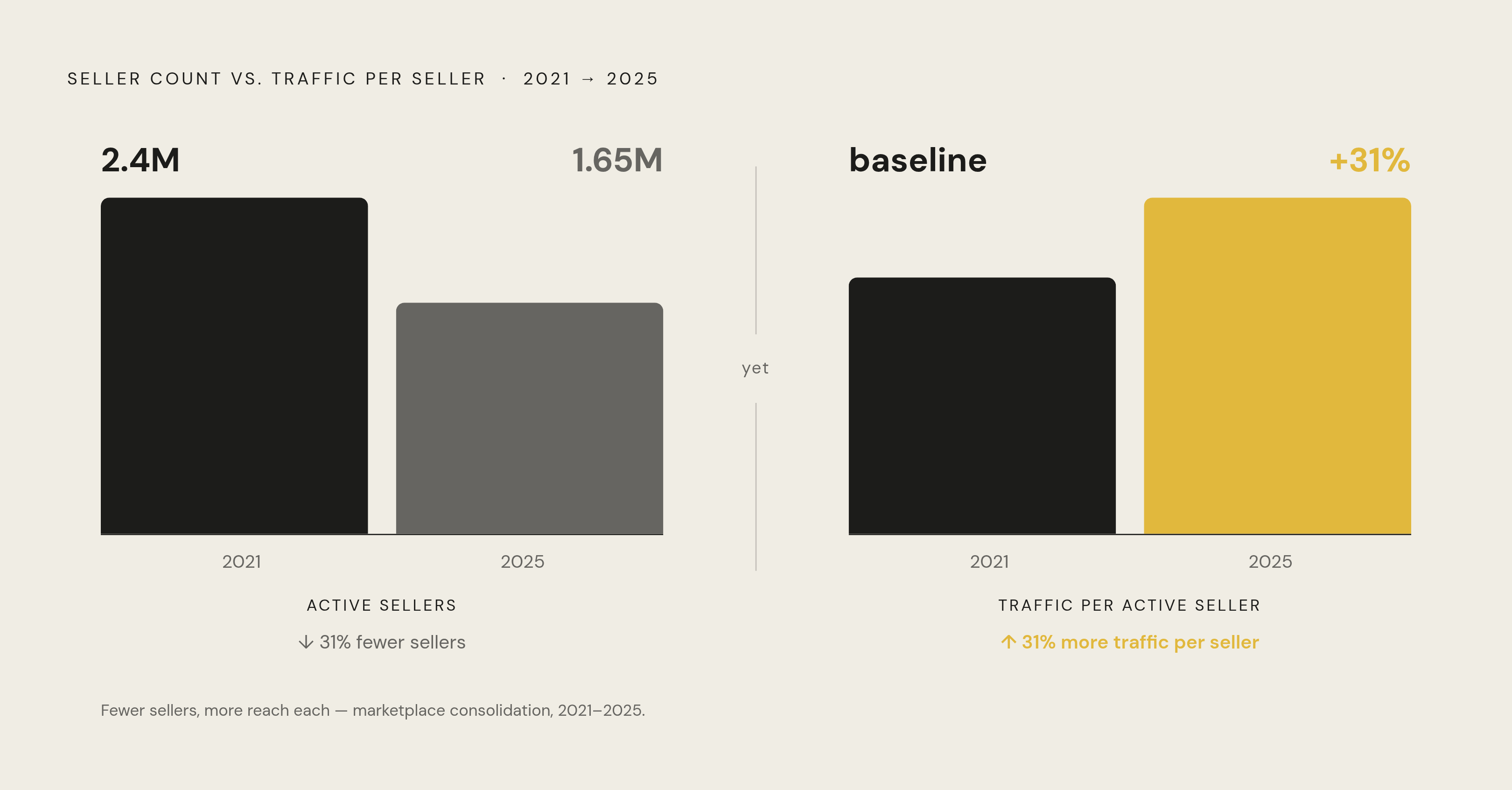
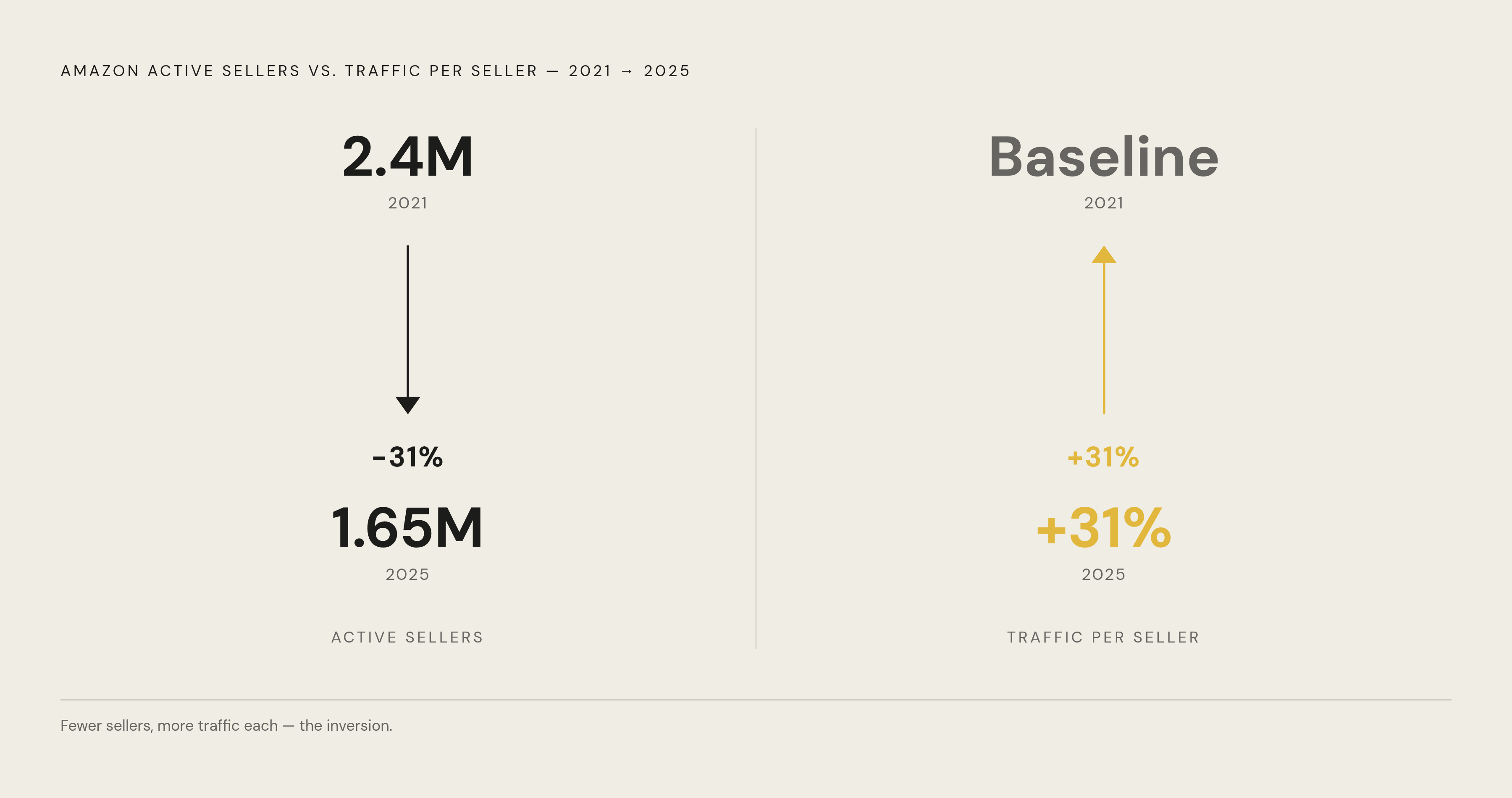
Here's a number that looks like bad news at first glance: Amazon's active seller count fell from 2.4 million in 2021 to 1.65 million by the end of 2025. Read it alone and you'd guess the marketplace is shrinking.
But traffic per active seller rose 31% over that same stretch. The sellers who remain are doing more volume each, not less. Fewer sellers paired with more traffic per seller is what a marketplace looks like once it's aged out of the land-grab phase and into consolidation, where scale and reliability start mattering more than raw seller count.
That's worth sitting with, because it flips the usual assumption on its head. A rising seller count reads as health most of the time: more supply, more competition, more choice for the buyer. Past a certain point, though, a shrinking seller count paired with rising traffic per seller says something else entirely: the platform's gotten selective, and whoever survived the cut is actually built for scale. If you're timing your next category move, that consolidation curve deserves as much attention as any demand signal on the list. A marketplace still adding sellers by the truckload probably hasn't finished digesting its last expansion yet. One where seller count is falling while traffic per seller climbs generally has the room, and the discipline, to open the next door.
Notes
- https://corporate.walmart.com/news/2024/08/27/walmart-marketplace-accelerates-growth-launches-category-expansion-multichannel-solutions-and-omnichannel-innovations-for-sellers
Provided details on Walmart's 2024 Seller Summit, including the category expansion focus and cash advances up to $5 million for qualified sellers.
- https://www.samseely.com/posts/the-amazon-flywheel-part-1
Informed the explanation of Amazon's flywheel mechanism and how it functions as a sequencing tool for category expansion.
- https://www.dioramaeduversity.com/post/decoding-amazon-s-growth-strategy-from-bookstore-roots-to-global-dominance
Supported the account of Amazon's origins in books and the rationale behind choosing that category as its first, including the 3 million titles figure.
Every new piece from marketplace crunch, as it's published.
Follow